Archiv der Kategorie: Mob

Weekend Ride Saturday February 13th

http://www.xtranormal.com/site_media/players/jwplayer.swfhttp://www.xtranormal.com/site_media/players/embedded-xnl-stats.swf

With rain the days before Saturday and perhaps snow in the mountains, I thought it might be nice to try a longer ride this Saturday in Izu Hanto.

We would get on an early Shinkansen Kodama 633 out of Shinagawa [7:04 AM] and Shin-Yokohama [7:15 AM] to arrive at Mishima shortly before 8. Then we would first ride along the North-West coast of Izu and depending on the progress and general performance level we can ride up into the mountains while heading South. There are many options that would lead us all the way to the tip of Izu and Shimoda.

Once in Shimoda we again have the choice to take the train home, or we can continue on the East coast side to go North and catch a train at a later station, for example Ito. Again, as the trainline is also mostly parallel to the coast there are many options.

We have done similar Izu rides in the past and most of them turned out to be very nice. Thre are some onsens we could visit if time allows and Teppan Curry Pasta at the Sunny Side Cafe in Shimoda is something I would look forward to as well.

7 Kommentare

Eingeordnet unter 2010, Mob

The Dawn of the Davids

Imagine you wake up one morning and the world around you has changed completely. All your neighbors have become brainless zombies and you can only defend yourself by throwing Dire Straits LPs at them. Or suddenly, everyone you know goes by the name Dave.


From left to right: David, David, David, David, David, David, David, David and Phil.


„Oh, David, good that you made it. May I introduce you to David? David, this is David, David this is David.“
„Hi David, Nice to meet you.“

„Hi, nice to meet you too, David.“

With David J. being back in England, David L. injured and David C. taking part only in short trips morning rides, one would assume that the amount of Davids that could be assembled for a ride in Bozo peninsular would be somewhat limited. Nevertheless, when Phil of TCC called for a joint winter ride in Chiba, all remaining cycling Davids and very few other guys turned up, eleven riders in total. We were quite a group: David Dachin (younger brother of James), David Denderson aka as Dominic Denderson and me, the D.O.B. were attending the tour on behalf of Dositivo Depresso.

Phil has warned us that this would become a leisurely ride, adding that we must make 30 km/hr average along the first third in order to be home on time, so we started rather fast and within no time we have also lost some riders of our group. But we always stopped and let the slower riders catch up so that we might have had a good speed average, however the overall progress was rather slow.

It is always interesting to ride in the countryside of Chiba, I believe that I can say that as an expert who has ridden there with Phil already two times. Every time and without him, I would be lost and probably still would ride clueless in Chiba looking for the exit between the vast stretches of land belonging to golf clubs. Nine years ago a Dutchman by the name of Kees Van der Werff got so much lost that he found Chibas‘ exit only after weeks (exhibit 1, at the bottom of this post).

It is also interesting to note that Chiba is not flat at all and consists of many hills, not a single one higher than 400 meters, but some of them quite steep and all in all we were able to do much more than 1.000 meter of climbing before we broke into two groups.

The riding is much different than on the West side. On the West side one picks a series of climbs with impressive elevations and connects them by dotted lines, trying to get us much of them in as possible. One knows the climbs, they are continuous and one is motivated to make an effort, go up fast and reach the top, followed by some leisure time riding downhill. It is like working as a public official in the accounting department and having a wild weekend affair. Riding in Chiba is more like the average marriage: The hills are not that high any more, but the sheer number of ups and downs adds up as well (or perhaps „adds down“ in this comparative case) and leaves its mark on the spiritual and physical condition of the participants.

One climb was particular long and nasty and Phil took photos of all of us coming in one by one except for Tim and his fixie. As there was a road branching off to the right which went down and looked much more inviting, TruffleEater constructed a nice cryptic message out of some bamboo branches which should have indicated the proper road (up) to follow. All you needed to understand it would have been basic operative training in the CIA or MI-5 and an enigma machine to decode the message. The alternatives would have been (a) to block the wrong roads with some logs that were lying on the side of the road or (b) to write a message with chalk on the (wrong) road surface at the bottom of the hill some 200 meters down:

„U-Turn here, Fixie and up the other road!“

But being nice guys we decided something simple. We never saw Tim again that day.

Then we made another stop at a nice country shop (now PE approved) somewhere in the middle of Bozo. My guess what be that our group made not only 50% of the total turnover in that shop on this day, but also 100% of the not-alcohol related turnover. I saw some locals dropping in with their typical agricultural mini cars and every single one of them left with a crate of beers. And nothing else. That should give you some idea what people in Chiba do on their weekends during winter time.

It was nice and toasty (PE rule: The word „toasty“ should be used in every post at least once between December and March.) in the shop that has provided us with a seating arrangement at least as nice as a snack bar and the only equipment missing was a Karaoke machine and some 60 year plus old bar hostesses feeding as with mizuwari from our drinking bottles, peanuts and gently touching from time to time our shaved knees.

We also took a group photo there in front of some old slot machines at the scrape yard next to the country shop.

A few kilometres later our group split, Phil leading the TCC guys back to Honda station and David, David and me riding along road 465 towards the coast to the town of Kanayamahma where we would take the ferry to Miura Hanto. Phil also suggested a smaller detour over a hill on a road (Ken 93) parallel to road 465. He suggested this climb in particular because he never did it before and wanted to know how it is.

We were cruising then at good speeds along 465 and enjoyed the tailwind as we had quite some headwind going South all day before. Unfortunately the reason why we had this nice tailwind was, that we managed to miss road 465 somewhere and we were now heading North on road 410 towards the very ugly part of Chiba, bringing as far, far away from the ferry port.

Luckily I had brought my Garmin Version (1.0, aka as a Chiba map) and we headed up to the village of Kururi where we took a turn on Ken 93 (where well hidden) and rode back to road 465. I started to bonk (no, not that) but luckily Dominic and James gave me a banana and a power bar so I felt much better than. It was the first time I ever ate a powerbar and I was surprised at the resistance it offers against being eaten. The consistency is similar to semi-liquid asphalt or dried squid and the energy required to eat it is more than the energy your body absorbs by eating it. Strange. But I felt better than.

And finally we reached the coast and some minutes later the ferry port. I have checked the departure times of the ferries between 12 and 2 PM, however we were so late because of the many stops we made and the pointless ride we included (living up to this great PE tradition) that we only managed to catch the 4 PM ferry.

This is a great ferry, designed in the Seventies and in service since then with plushy sofas, fancy chandeliers, toasty aircon and a strip show on the upper deck starting at 4.30 PM. Or we could have selected to see Tom Jones singing in the parking deck protected by a series of bulkheads.

Recently some of the ferries had sunken because the loads were not probably secured on deck. During the heavy seas which occur during the winter seasons in the bay of Tokyo, some of the vehicles have gotten loose, moved to either the starboard or backboard side and resulted in perpendicular inclination of the ferry.
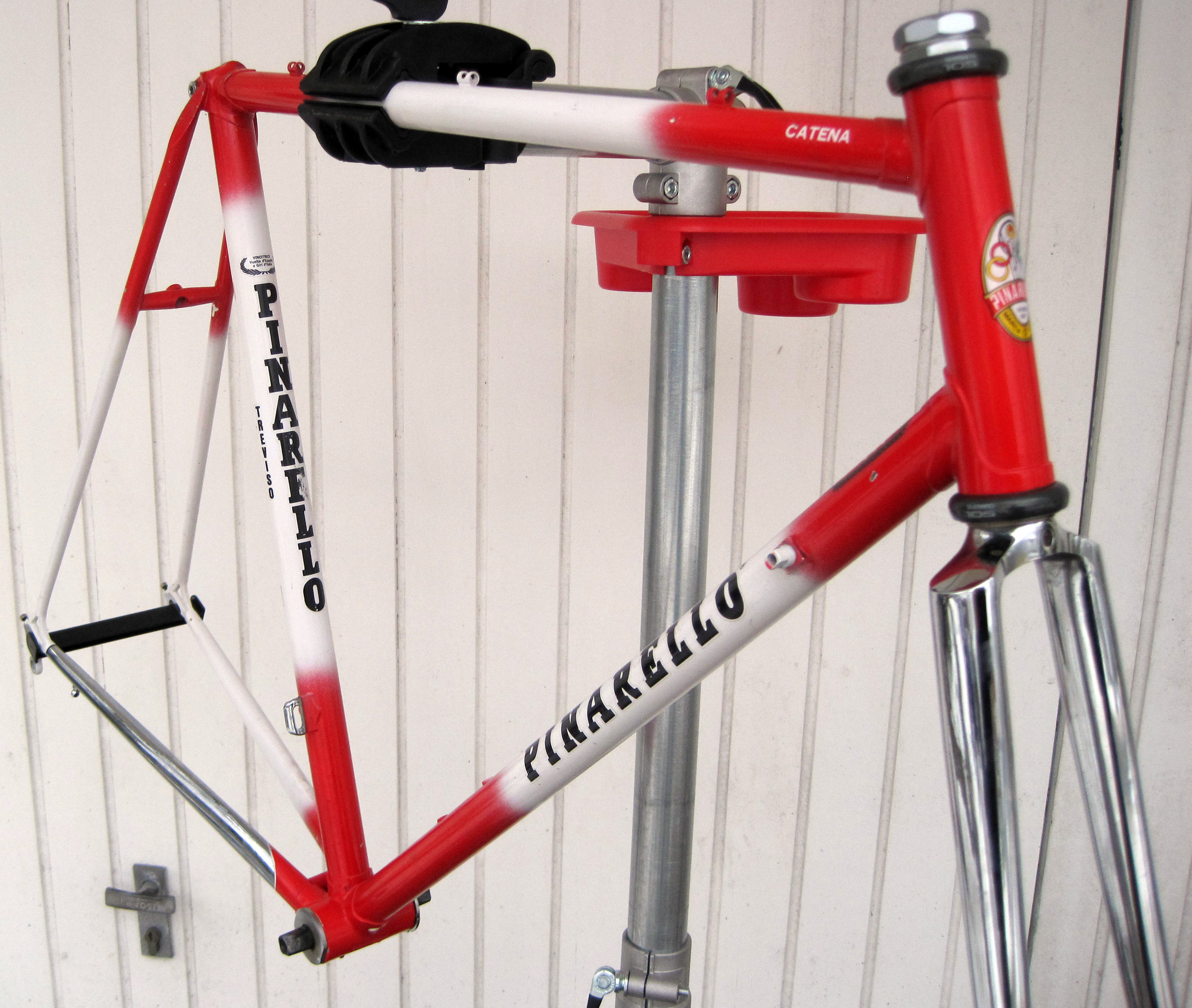
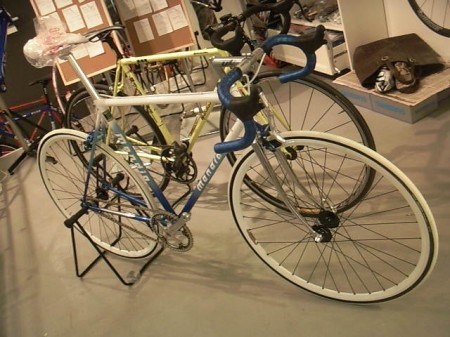
As one can see on the photo my Heavy Cervelo Soloist (8.9 kg) required therefore much tighter fixing than the relatively light Pinarellos standing next to it.

In the middle of Tokyo Bay we saw the „Tokyo Express“ container carrier by Hapag-Lloyd moving in which made my immensely proud of all the useless stuff from Germany and other European countries that is carried year by year to Japan and actually sold here. I must be the equivalent to trade beads of the 19th century and in return our ships come home loaded with Toyota Hybrids which will be immediately forwarded to Toyota dealers for recall.

In this context I would like to add that my son asked me yesterday evening if it isn’t dangerous for Toyota dealerships to intercept Toyota cars on recall as they couldn’t brake when entering the premises.

And when we arrived in Kuriyama after having enjoyed a good meal on board (thanks to the Smutje), the strip show and seeing Dean Martin after Tom Jones, it was almost dark. David choose the train home from Kuriyama while David and me took the straight road towards Kamakura. On the trip I have shared many stories about the legendary Helga, her two brothers (not named David) and the German Seacastle restaurant that they operate at Kamakura but we did not had the time to drop in despite being very fast on the last stretch. But it was already dark and we just made it to Ofuna, packed our bikes and took the train home to Yokohama.

142 km of riding and more than 1.500 meters of elevation. And, oh yes, we also met some very nice cycling Davids. Thanks to all of them for the nice trip.Exhibit One

4 Kommentare

Eingeordnet unter 2010, James, Mob, tcc

There is no shirt for the fastest sprinter

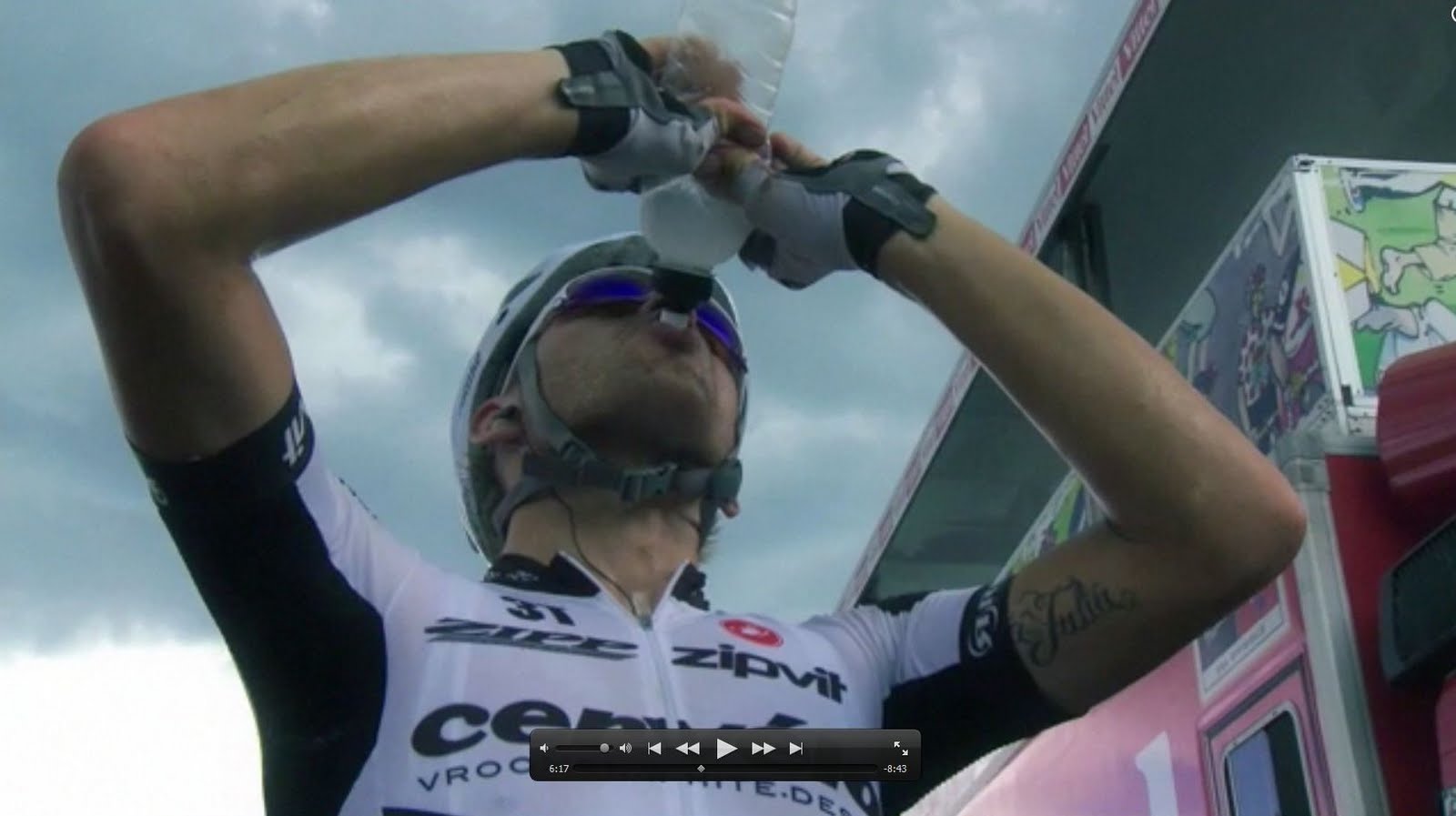
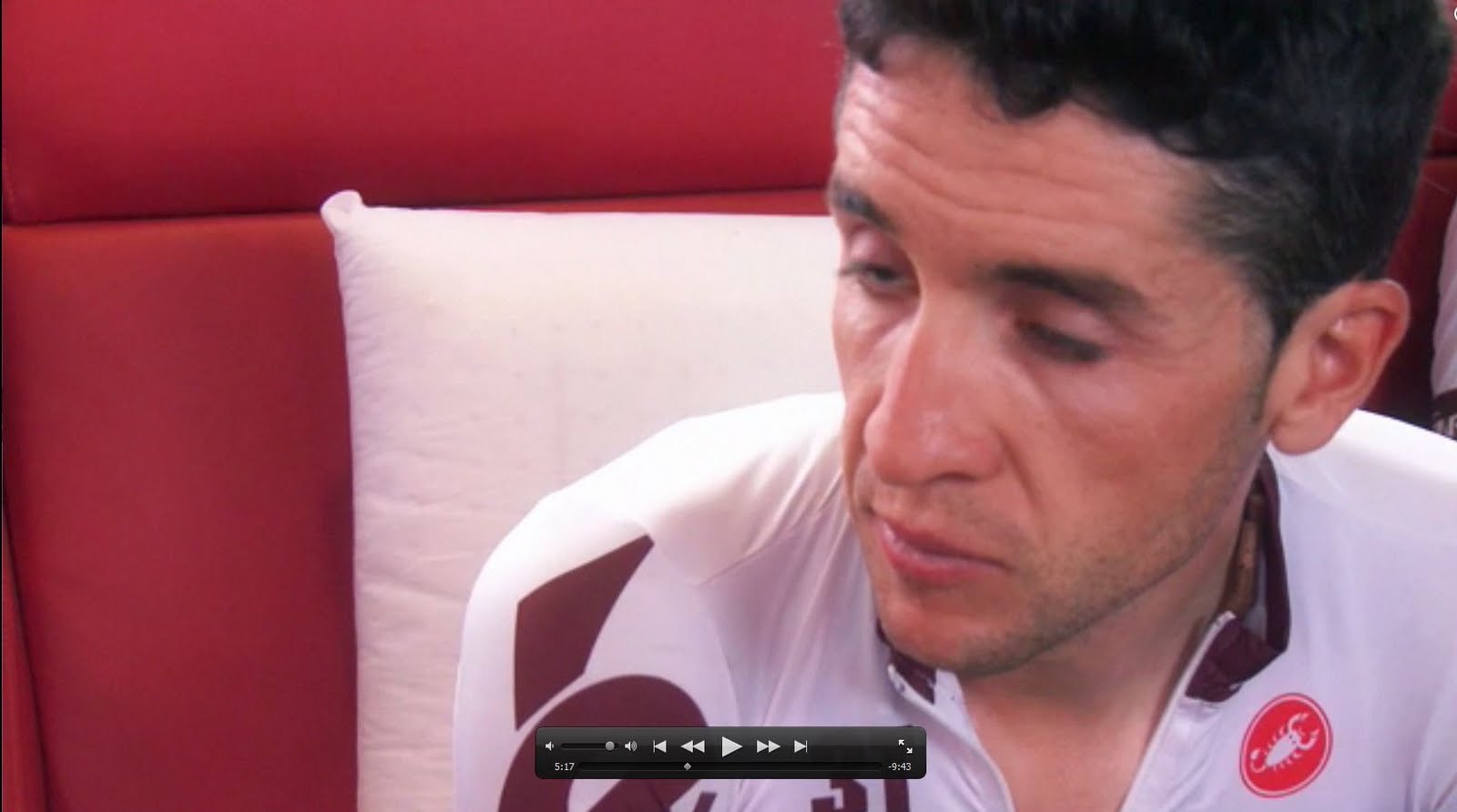
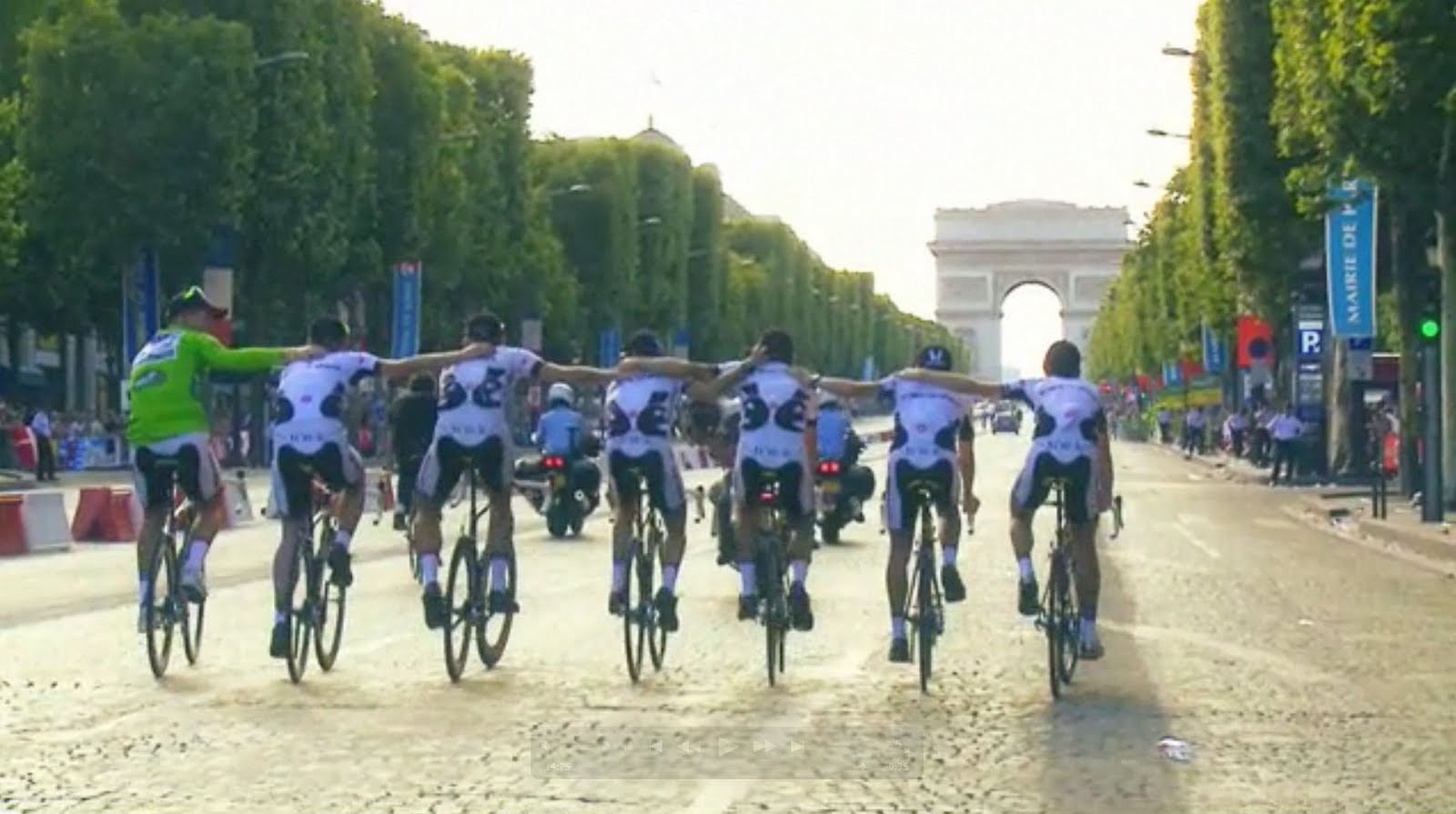
I must say I am very impressed by the series of videos about the 2009 season of the Cervelo Test Team as sponsored on bartape.net and/or as video podcast on itunes. Dominic and James have pointed this out.

I include below some screenshots from the videos I have made on my PC with Quick Screen Capture, a very handy tool which works exactly as „print screen“ should work: It takes a precise „photo“ of your PC screen in the moment you press the button, so you can for example also take pictures out of movies which you cannot with print screen. Or from Allsports.

Aesthetically, Cervelo has come a long way from their first bike shown above to the bikes they make today. I am in no position to judge, but looking at the way they design their bikes, their clothes and also now their videos, I believe that aesthetics play a big part in their brand image – and it’s a different kind of aesthetics as compared to other makers and teams. Not as loud and „sportive“, focusing more on melancholy, suffering, pain. The only other cycling-related maker than comes to my mind with a similar image is Rapha.

What I like about the videos in particular is, what is missing: They are almost bare of any direct promotion for Cervelo products (actually the first ones are, but this becomes less and less until the final Tour de France videos). And in addition they are also almost bare of any information about the results of the race the team entered. It is just about cycling and riders speaking about cycling. And combined with the Koyaanisqatsi like soundtrack, again bare of any traces of Euro-techno-beats, it appeals very much to the romantic rider in me. I would love to have seen „Road to Roubaix“ in a similar matter.

Another thing that I learned from the videos is that a cycling team consists of riders, mangers and support staff of many nationalities, Italians, Spanisch, Germans, Australians, Swiss, Norwegians …. and they communicate in English. Naturally perhaps most of them don’t enjoyed (?) higher education and at least my classmates who were brilliant in the gym were not equally gifted in learning foreign languages.

Now, in international business topics as „intercultural management“ and „crosscultural communication“ are big topics and often cited as major factors for success or failure of international business ventures. Now hearing some of them speaking English, I wonder how can they communicate effectively during the races: Some of the Germans speak with accents of German offices in US WW2 movies while the Australians/NZlanders are hard to understand even for me.

As someone who, sitting in a restaurant with his teammates, wasn’t even able to bring across the difference between „fencing“ and „fanzine“ to his English mother tongue teammates, I wonder how they manage to decide strategy on the (poor quality) team radio during a race when every second counts.

All in all it is a very motivating video, I find some traces of my own addiction to cycling included in the footage and after watching it I had the urge to ride out on my bike immediately.

Which I did.

Ein Kommentar

Eingeordnet unter 2010, Cervelo Soloist, Mob

Saturday Ride [6.2.10] : BOSO AND MIURA HANTOS

I am planning to join the TCC ride organized by Phil on Satursday. With snow in the mountains and Phil knowing every corner of Boso peninsular, I think this is a good opportunity to check out this rather unknown area.

The ride starts at 9.30 AM in front of Honda station on the Sotobo Line. With the Narita Airport Express it is possible to ride from Yokohama (7.39 AM) or Shinagawa (8.01 AM) to Chiba, the switch trains there, so the travelling time is reasonable.

My plan is to ride about 50 – 60 km with TCC, then ride along road 465 to the West coast and catch the ferry to Kurihama on Miura Hanto. I have done this last year as well, it is a nice combination of riding and cruising.

On Miura I would then go South to Jogashima and back up North on the West coast to Kamakura where I might stop at the Seacastle to have an early dinner, provided I have a) company and b) feel fearless enough to enter that joint.

Back by train then from Ofuna with a few beers already in the belly (but not 0 alcohol ones). Train also connects directly to Shinagawa within 35 minutes, so thgis is much better than taking the train home from Chiba in the evening again.

Anybody going to join me?

More TCC Info here

4 Kommentare

Eingeordnet unter 2010, Mob, tcc

Last Frontiers


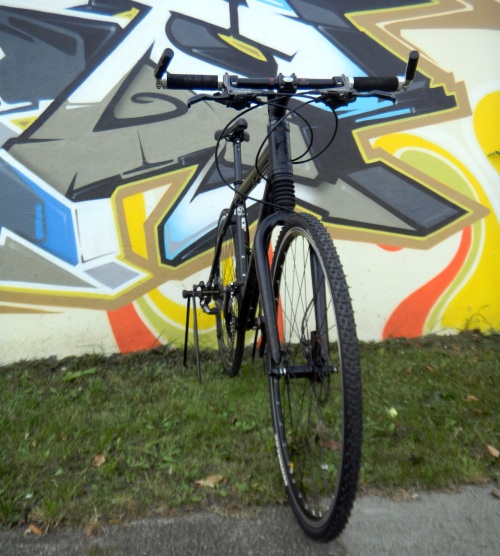
Instead of riding out on the Cervelo road bike on Sunday, I decided that it would be time to test the Bad Boy with all terrain tires out on some serious gravel trails.

I notified Tom and Ludwig about my riding plans at 11.30 PM the day before and naturally they didn’t made it to the meeting point. Perhaps this wasn’t unintentionally as I perhaps preferred to be alone on my first Bad Boy Cyclo Cross Test ride.

After having prepared the bike on the evening of the day before I left home at 7 AM only to realize that having only 700x23C spare tubes for 700x30C tires plus no patching kit with me would be probably not a good idea. Never mind. Did Napoleon leave Moscow despite the Russian winter? Did Hannibal cross the alps on elephants? Did they have spare French or spare elephants with them? No, of course not and how splendid they did nevertheless afterwards!

It took me only 48 minutes to reach the meeting point at Tamagawa which was fairly fast, given the fact that I was basically riding something more similar to a MTB than a road racer. Luckily James, Dominic, Michael and Yair kept waiting despite me being late for more than 20 seconds over the allowed PE approved waiting deadline. I was seriously reprimanded by James before we left along the Tamagawa. James had the Shimano Di-2 groupset on his Cervelo so he is the first PE rider who did upgrade. Together with the Garmin and the powerbub on the rear wheel he carried more electronic components per kilo of machine weight than a USAF stealth fighter jet.

It was really hard to keep up with Bad Boy in the flats, it almost felt like learning to cycle all over again. I had to put in at least 10 – 15% more power along the Tamagawa only to draft behind James and later in direction Takao I had to stop to get rid of my gloves. Actually I bought this padded Gore gloves for the winter season, but yesterday it was simply too hot so I continued riding without them.
This also gave me a good excuse to take it easy as I was already worn out from
riding at 160+ HRM all the time. And conversation wasn’t so much fun either. I spoke with James and even when I wasn’t in agreement with what he said I could barely stammer „ah, yeah, right“, as I was trying simultaneously to get some amount of air into my lungs.

On the positive side I had to note, that the new Selle Italia saddle with 150 mm width with quite comfortable. I probably have to realize that my behind is not made for 130 mm wide saddle due to its sheer horizontal dimensions, swallow that pill and go for something wider also on my road bike. Stephen has already let the way in this respect with his huge over sized saddle that accounts for half of the weight of his Scott bike and make it look like a chaise longue.

Our group made a stop (I rather don’t add „quick“ here) at the 7-Eleven at Takao station before we started to conquer Otarumi. Everybody was going up pretty fast and consistent, however with Bad Boy it was even worse going up than in the flat. It took me 19:30 min for the standard Toge-baka distance and perhaps I could have done it a little bit faster but not much. Pretty disappointing, and I swore that the next time I will take out Bad Boy by train and start to ride only in very close vicinity of a gravel trail. On the top I said good-bye to the group that was going back via Tsukui lake while I was continuing along route 20 to the crossing with route 76 at Fujino.

Well the nice thing with Bad Boy is, that he is really fast, stable and steady on the downhills. I overtook everybody already at the first curve and I didn’t saw anybody behind me when I reached the bottom of the hill. Braking is also very comfortable and easy to manage with two disc brakes and it was really a pleasure to ride down. It would be nice to do this again with David and check if I would be able to keep up with him as he is the actual holder of the Positivo Espresso Reverse Polka-Dot jersey, i.e. the king of the hills(down).

Road 76 was nice and empty. And before I know I arrived at Aone at the local supermarket where I purchased last supplies for the trail up to 大越 Tunnel. This is a PE-approved supermarket, however as this is the only supply point in Aone, please don’t expect too much from it. It caters to people who actually cook their meals and not to those who expect to have indication of Amino-desoxy-nuclein-ribulose-natrium-viagra-glycolyd content on their jelly packs. I asked the lady how the weather would be up at the tunnel and as usual she answers „You cannot go up there“ and as usual I said „Well, you keep telling me that, but some of my friends did before, don’t worry I can do as well.“ We did this dialog already two or three times. By now it is more like a ritual, with all words in it having lost meaning.

Outside her dog was barking as usual. He dislikes me. Or my bike.

I got lost in Aone-city trying to find the entry to road 76 leading first to 神之川 camp site. Yes, Aone is a village with perhaps 500 inhabitants but nevertheless it is not so easy to find the right road. Ludwig and me tried to find it once but once we did we had to turn back as it took too much time. TCC has gone up there one, two times but this is already two, three years ago. Lauren told me he was there a long time ago and also Tom conquered the road with his new Cyclo-cross bike recently.

So it was time for me to give it a try, as this is also one of the few roads I know about and never did before. And a good initial test for the Bad Boy as I always had this road in mind when I made my plans to upgrade the bike.

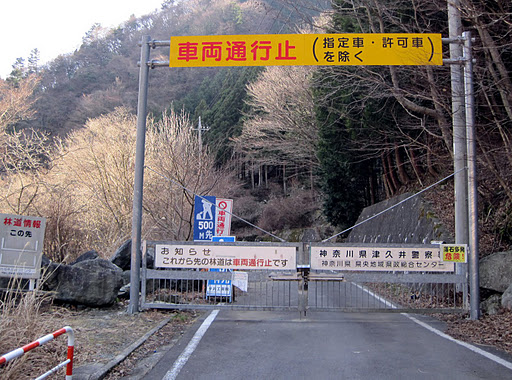
The first part up to the right-wing radical camp site isn’t particular difficult. There are some beautiful spots along the Kaminokawa river and even now there were a lot of people fishing there. Then one comes to a closed gate which is plastered with sign boards. One doesn’t need to be able to read Japanese to understand that the basic message must be:


„Come on. This is a nice road leading into beautiful mountains, devoid of any dangers and just made for cyclists like you. Fun and adventure are awaiting behind these close gates. Welcome to cycling-pleasure wonderland. Don’t hesitate to climb over the gate. By the way, these signboards are only made to look like „DO NOT ENTER“ SIGNS so that normal human beings are refraining from coming here.“

The gate is about elevation 550m and up to elevation 630m the road is in fairly good, asphalted shape. Of course there are many stones coming down from the slopes on the road. Then it starts to become a gravel road but again there are intermittent asphalted stretches. Then there is only gravel again. It is so hard and so to slow to climb this road that I had to make a break at elevation 720m to shoot some photos. The steepness of the road plus the surface made me creep up at 6 – 7 km/hr. Luckily I had my trekking shoes with the MTB-SL cleats on as otherwise I would have ruined my shoes and cleats for sure. Definitely not a road for road bikes.

Over 800m there was some ice and snow but generally it wasn’t too cold. And after a while the road became flatter and finally the last stretch up to the tunnel was asphalted again before about 30 m in front of the tunnel was a last gate.

Interesting enough some of the slopes seemed to be shotcreted recently and were in good shape while the road next to it was not. But why is there a road (and a prefectural one) in this lonely place anyway? And why is there a tunnel on the top when basically one has to climb an additional 50 to 100 meter to make it over the mountain anyway?

I was too exhausted to answer these questions and continued through the tunnel which was dark but not as scary as I thought it would be (I brought a lamp from home especially for that purpose). No comparison to the horrors that ones await at Sasago tunnel.
I stripped down on the other side and took sunbath to add some complexion to my stealth body. And then I made the downhill to Tansawa lake which was fully on asphalted road and a breeze with the disc-braking Bad Boy.

We should ride more often to Tansawa, the lake looked beautiful and there are many roads around it. After some more km I found myself on road 246 again. As I never thought I would make it that far, I didn’t think before about how to return from there and naturally I didn’t bring any maps with me. I thought about riding along 246 to the next Combini, take a look at a map and decide further. But then 246 was really ugly out there and there was no Combini at all. By the way, the landscape 246 runs through is nice indeed and also the Tomei highway over it is pretty impressing to look at. One can see parts of the old road and some older tunnels here and there but otherwise road 246 really made a cycling misery out of the place.

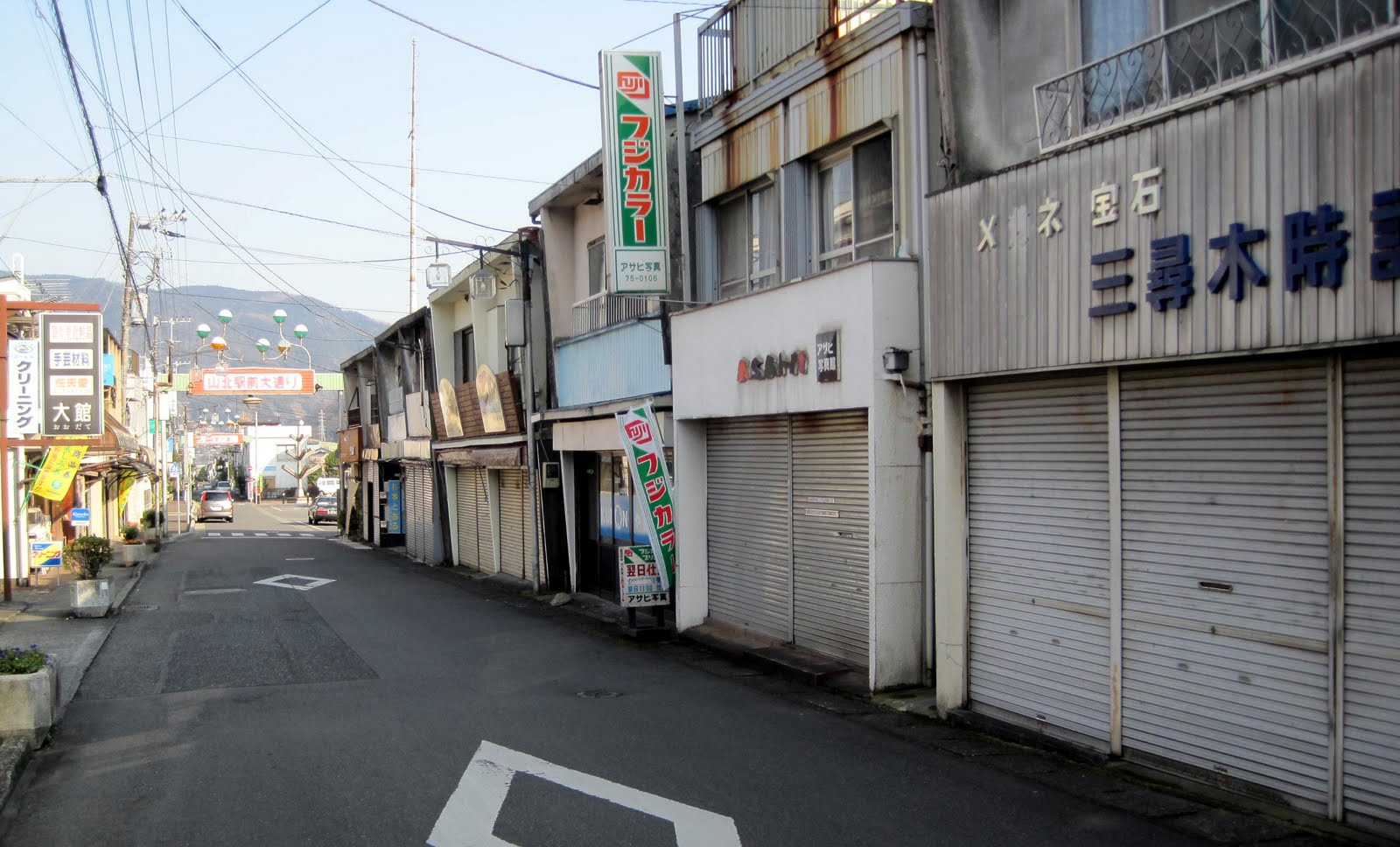
So when I saw a sign to Yamakita station I took that hint and stopped at the station there. There was a long shopping arcade with many shops in front of it so I thought I might find some noodle shop or supermarket to buy some food.
Unfortunately most of the shops went out of business in the Eighties and what is left catered to the needs of old country folk (seeds, aprons, adult diapers), so I was rather happy when I could leave the place 10 minutes later on a train. I was also happy that a train stopped at all, as it does so only once an hour.
And within no time I was in Odawara and back on the Shinkansen to Shin-Yokohama and finally home where I completely exhausted lost a game of monopoly to my 8 year old daughter and a game of Playstation2 Winning Eleven soccer with my Spanish team against Uruguay managed by my 13 year old son.

Hey, but they will never beat me up road 76.

PROLOGUE

I didn’t join any of the Saturday rides as I was out in town Friday night with my wife. Few years ago I bought a rather larger piece of art (about 3 meters long) from a promising young artist called Yamaguchi Akira. Since then we get invitations from the gallery of him to all kind of exhibitions which are mostly in Kagoshima or Akita and with artists the world has never heard about and never will. But he has become more famous by now and we were asked by the 17th Bienale in Sydney to rent out our work.

As this time our cooperation was required we got some of the better invitation cards for the G Tokyo 2010 art exhibition at Roppongi Hills plus VIP invitations for the reception hold at Maison Hermes in the Ginza. For the exhibition I can report that there was not one work related to cycling and that most of art is decorative today. Also they ran out of champagne after I drank my third glass there.

I always had some relation to Hermes-Ginza for several reasons, one being that the elevators in the building were made by my previous company and the second one being that my wife always threatens me to buy some of this stuff.

It was very pleasant and as we arrived on time we had a good time at the Sushi Bar. As we ate a lot the bar was shut-down half an hour later when we were already at the buffet and the dessert bar. It is really pretty kind of Hermes to hand out food to the unemployed, I must say.

We were shown around the building and in the sixth floor busy craftsmen were repairing handbags and leather belts at 10 PM under inhumane conditions (i.e. in full view of drunken VIP guests).

I am happy to report that I found a brand that is even more expensive than Assos or Rapha. I could convince my wife not to buy anything but to eat and drink as much as possible. Which we did and explains the headache and general unlust the next morning. Sorry. We cannot be all VIPs.

5 Kommentare

Eingeordnet unter 2010, Mob

Boystalk

Rather easy to imagine that this conversation would have happened in the same manner with a new Cervelo bike equipped with a Shimano Di-2 groupset parked in the room instead of a Plasma TV mounted to the wall.

Ein Kommentar

Eingeordnet unter 2010, Cervelo Soloist, Mob

A fateful day out

Last Sunday was quite a fateful day, for many, as it would turn out. And not only because we sighted an UFO in front of a shop after descending from Wada Toge…
James, MOB and I met at Tamagawahara bridge for a late start at 8:00am to help MOB overcome his jet lag. As we were chatting, a group of Positivo Catteni riders passed, so we hurried to catch them and show them who the A team – excuse me, the B team (according to our new rules) – was. I had them in no time, James soon after, and MOB eventually after he had recovered from his jet lag. I don’t know how Catteni recovered from this fateful shock – we never saw them again.
From Kunitachi we were sure we were invincible and slowed down to a leisurely pace to make sure the social side of our ride wouldn’t get a short thrift. Once off the Tamagawa and on the way up to Itsukaichi, I pulled up the pace – I just find it hard to take hills or mountains slowly.

We took our first pit stop at the convenience store (see PE rules for definition in case this is not yet clear to everyone) just beyond Itsukaichi. Steve from TCC was doing the same thing, and after some chatting which James found hard to end, we invited him to join us for a slightly more demanding ride than he had had in mind for himself. This had the added advantage of having a guide to the entry to Daigo Rindo – though it was really not hard to find.
Daigo Rindo was a first for the three of us. Hard to understand why we had not „discovered“ it before. I only learnt about it recently from Tom’s blog. It is a very nice rindo following a low river valley. No traffic except for the occasional hunter car. There is a stretch where the road is unpaved, but quite manageable to cross with normal racing tyres.
Unable to go slowly as usual, James and I put quite some distance between MOB and us, Steve being closer to us than MOB. As we waited somewhere for MOB, he arrived showing us proudly the below photo of a forlorn toilet in the middle of the forest, which we had missed noticing, but which served as a decent excuse for falling behind.

The rindo becomes increasingly steep, and James and I raced up the last few kilometers to the top, keen to get in some exercise.

The descent was very nice, and soon we found ourselves on the rindo approaching Wada Toge from the north. No hints of snow or ice, and all the autumn leaves gone. James and I went for our second training race. I didn’t have to wait long for him at Wada Toge, but this time Steve and MOB took quite a bit longer than the first time. The witch and her husband gave us some distraction as we were waiting.

We descended Wada and stopped at a store where we saw this UFO. Actually, many of them. So many that Steve couldn’t finish them all by himself and we had to all help. How much we were longing for a convenience store!
We continued climbing through the golf courses and then up to Kobo Tunnel. Down the other side, we waived goodbye to MOB who was clearly not yet back in form and decided to head for Itsukaichi, and after fixing a flat tyre by replacing it with another leaking tyre, for Hachioji.
The three of us attacked Kazahari Toge. I had promised Steve we would ride together on such a long climb, but found myself unable to keep my promise, longing for a heart rate of at least 155. The faster pace afforded me with a nice view on top.
The descent to Okutamako was incredibly cold. It was barely above zero and the 600m descent felt incredibly long. James claims he clocked 79.9km/h somewhere, but I find this hard to believe since no stretch is steep and long enough to reach such a speed without pedalling, on a standard crank (which he does not have).
More likely that this guy was speeding at that speed when he hit the railings of a bridge.
This was the sight that presented itself to us as we were only a kilometre away from the end of the road. The driver was sitting on the bridge a few meters away from the car, wiping off blood from his head. He was surrounded by lots of friends who had parked their cars not far from the site. Being a trained paramedic, I examined him briefly, and he seemed quite OK. An ambulance had already been called. Later we saw him walking around, examining his wrecked car while smoking a cigarette. It seemed no other vehicle was involved, and he must have lost control over his car on one of these crazy racing excursions up Kazahari.
They’ve banned motorcycles from the road (and indeed it was a lot more peaceful than before). Now it is time to ban cars too!
After the first police car arrived, we left the accident. It was 3:30pm, and the natural choice would have been to cycle to Okutama, maybe Ome, and return home by train from either place.
However, I thought I knew a faster route home. Only the other day, two women in a hamlet approaching Kosuge had confirmed the newly built tunnel below Matsuhime was open. Earlier signs near the entrance of the road had said the construction works would finish in November. So rather than climbing up all the way to Matsuhime Toge at 1,250m, we could just cycle to the tunnel entrance – just about 150m higher than Okutamako – sail through it and then descend to Otsuki, from where we could catch a fast train back. I convinced Steve this was the easiest way for him to get home. James was up for anything.
When we got to the entrance of the tunnel road, however, the road was still closed. We still went onto it, but after the first small tunnel, the road simply ended, with no signs of any construction to connect it to the longer tunnel (which we know exists because it can be seen from the other side).
It was 16:20 by now – making it impossible to get to any train station in day-light. Steve opted for Okutama – more or less all the way downhill, but also with many flat stretches and at least 30km to go. He was prepared with lights for the last bit in the dark.
I opted to climb up Matsuhime Toge with James. A rare chance to do Matsuhime in winter, and knowing we would not arrive at Otsuki much later than Steve at Okutama.
The ascent was very quiet. It was zero degrees and the air was very crisp, affording great views of the surrounding mountains in the sunset. We both still had sufficient energy for the climb, but were nonetheless nervous to make it up, knowing that any minute would count against the impending arrival of darkness.
It was 17:05 when we reached the top. The view was stunning – much nicer than usual when humidity or even clouds obscure the view. Even Mount Fuji was peaking out nicely behind a mountain range.
We put on everything we had and took the plunge of 950 vertical metres down to Sarubashi. The initial part was again freezing cold. I soon caught up with a noisy sports car making its way down. All my tailgating with flashing lights was to no avail – he would not let me pass. Beyond the tunnels where the road loses its steepness, I could no longer follow and waited for James instead.
Now already deep into the valley, it was getting really dark. I was equipped with a small flash light for the front – strong enough to be seen, but not strong enough to see anything. James didn’t even have a front light. The stretches between hamlets became guess work. Fortunately, having descended the road a couple of times, I knew quite well what to expect – even remembered where the bigger bumps were in the road. James appeared to be less confident and didn’t want to stay close to my rear light for too long, so I had to wait for him every now and then.
Eventually we made it to Sarubashi where we took a rest at the convenience store (since Otsuki has only a shop on the way to the station, no convenience store). When we got back onto our bikes, we were both shivering like mad – even the pedalling in the lower parts had not warmed us up that much and downing lots of cold drinks did not help to warm us from the inside.
We felt much better after the short climb to Otsuki, and were lucky to be able to jump onto a well warmed train quickly.
170km with almost 3,000m of climbing – not bad for a cold winter day. Fate had served James and me well. I just feel sorry for everyone else we encountered that day.

6 Kommentare

Eingeordnet unter 2010, James, Mob, tcc

Positivo Espresso Rulebook

Good point by Ludwig. And further elaborated during our club ride yesterday in the mountains of …somewhere. We definitely are in need of a Positivo Espresso Rulebook so that we know what we are talking about when we say „Convinience Store “ [defined as approved 7-Elevens, Lawsons and Family Mart] as opposed to shops [Daily Yamazaki et al.]. I suggest that we all come prepared with some good proposals to the club meeting on Thursday and combine them into a thick volume.

9 Kommentare

Eingeordnet unter 2010, Mob

***** -THE OFFICIAL EURO CYCLIST CODE OF CONDUCT- *****


1. Image and style shall be the primary concerns of the Euro Cyclist. When suffering, one must focus first on maintaining a cool, even composure and second on performance. Winning races is an added talent, and only counts if said Euro Cyclist wins with appropriate style.

2. Training shall be based solely on feel, while racing shall be guided by sensations and instinct: that is to say, “soul.” The Euro Cyclist will never accept tried or tested scientific training methods.

3. The Euro Cyclist shall NEVER, under any circumstances, wear plain black spandex bibs (shorts, regardless of colour are BANNED) or ANY team kit
containing non-prominent logos. Shorts will extend approximately 2/3rds of the way down the upper leg and will contain a compression band at the bottom (distinct in colour). In NO CONDITION shall they extend any further!

4. Legs shall be SHAVED year-round. ABSOLUTELY NO EXCEPTIONS. Certain hair removal creams are endorsed only on a case-by-case basis. One shall never show up to a race (be it large or small) with ANY amount of stubble visible on one’s legs.

5. A prominent line where one’s kit ends and where one’s deep tan begins is essential to one’s image. Artificial tanning is BANNED. The tan shall reflect the level of training commitment.

6. The socks of the Euro Cyclist shall extend to within two (2) cm. of the main bulge of the calf muscle, and shall never extend further than one (1) cm. past said primary calf muscle bulge. All socks SHALL BE WHITE in colour with prominent logo placement.

7. Cycling shoes shall contain at least 80% white!
The following exceptions apply:
i) Colour combinations such as world cup stripes or Olympic gold for which the title has been EARNED.
ii) Shoes which are custom-made for specific riders by companies endorsed by this group. These shoes shall be accessible to the particular cyclist only, and shall follow the preceding rules.

8. If white cycling shoes are not available where the Euro Cyclist resides, white booties (or “shoe covers”) with prominent logos shall ALWAYS be worn. When booties are worn, socks shall protrude approximately seven (7) cm. above the ankle, and shall always protrude at a minimum one (1) cm. from any booties worn.

9. One’s bike frame shall contain between two (2) and four (4) colours IN ADDITION TO WHITE. All colours are acceptable as long as they combine tastefully and elegantly. In addition, wheel selection must also match frame and fork.

10. One shall race only on Campagnolo Boras or Lightweights. Fulcrum Racing One, Corima Aero+ or Zipp (404 or 202) wheelsets are considered stylish enough to be used as training wheels ONLY. Irregardless, ceramic bearings shall be used at ALL TIMES on both training and race bikes.

11. ALL wheels shall be equipped with tubulars, regardless of one’s ability in gluing them.

12. Ridiculously stylish eyewear (see endorsed products list) is to be worn AT ALL TIMES without exception. Glasses are to be worn over helmet straps at all times.

13. Hair shall be kept neatly short, and matching helmet shall be worn (again with prominent logo placement). The helmet shall be predominantly white. Under NO CIRCUMSTANCES shall a clashing helmet colour be worn with one’s euro kit. Helmets are not to be worn when venturing indoors AT ANY TIME. It is, however, acceptable to wear one’s helmet while outdoors on a patio (see rule 34).

14. In certain RARE cases, it shall be deemed acceptable to have long hair. In this event, hair shall be neatly slicked back in a severely euro style, and helmet SHALL NOT be worn. It is IMPERATIVE that rule 12 is followed in these special instances.

15. When riding, sans helmet (with short hair), a team issue cycling cap (white in colour), shall be worn. The bill shall remain in the downward position at all times. The cycling cap may be worn forwards or backwards to coincide with the specifics of one’s current hairstyle. During spring training, cycling toques shall be worn at all times in place of caps.

16. Kits must always be freshly washed, and one shall ALWAYS have applied a subtle quantity of eau de toilette (or “cologne”). It is, AT ALL TIMES FORBIDDEN to ride in an unwashed kit. This is severely detrimental to one’s image.

17. Saddles shall be white in colour ONLY and shall be manufactured in Italy or France. Exceptions may be made in the following cases:
i) Saddles containing World Cup Stripes or Olympic Gold when it is EARNED
ii) Italian flag colour combo when rider is ITALIAN (born in Italy)

18. Handlebar tape is required to be cork as well as WHITE IN COLOUR. Bar tape shall be kept in pristine white condition. This state shall be achieved either through daily cleansing or through frequent replacement. These jobs must NEVER be performed by the cyclist as one must maintain one’s image.

19. All stems must be a minimum of 120mm long and of a rise no higher than -10 degrees. Stems shall be positioned no more than 0.5cm above the top of the headtube. ALL stems shall ALWAYS be oversized, made out of ALUMINUM, and airbrushed in kit/frame colours. In certain cases (Mario Cipollini) it is advised that one airbrush a buxom young woman onto the top of one’s stem.

20. The Euro Cyclist shall ALWAYS have liniment applied to his legs before appearing in public.

21. Facial hair shall be restricted to (at a maximum) a goatee, and even this is discouraged. Moustaches, beards, and any combination thereof are EXPRESSLY PROHIBITED in all instances. Stubble is, however, advisable in virtually ALL euro-situations. It is important to note that this DOES NOT apply to the legs.

22. Campagnolo shall be THE ONLY acceptable component and it is hereby deemed superior to ANY Shimano product in ALL circumstances and situations. The Euro Cyclist is expected to have nothing less than an ENTIRE campy grouppo. Crank substitutions are NOT permitted. There is, however, a case by case exception for SRAM Red.

23. One shall NEVER, under any circumstances, acknowledge the presence of a cyclist riding a bike costing less than 2000€ in ANY public place. This may be severely detrimental to one’s image. If such a situation cannot be helped, it is CRITICAL that the Euro Cyclist regard his “acquaintance” with a patrician mixture of disdain and SEVERE condescension.

24. One shall NEVER, UNDER ANY CIRCUMSTANCE, associate with triathletes. This cannot be overemphasized! It is FORBIDDEN to have any number inked onto one’s body before a race.

25. Any physical activity other than cycling is STRONGLY FROWNED UPON. This includes any form of running or swimming and their derivatives (this includes walking). The ONLY TWO other sports with a recognized degree of euro are: cross-country skiing and long track speed skating.

26. Mountain bike gloves are FORBIDDEN in all instances. Cycling gloves shall be slick, white (in accordance with kit), and have minimal padding. Padding will be beige or white in colour. Wearing NO GLOVES is entirely acceptable and encouraged. In the case of a Euro Cyclist wearing a leader’s jersey special gloves shall be made to match the colour of the jersey while simultaneously blending the colours of the team kit.

27. In a circumstance where any cyclist (or TRIATHLETE) ever displays aggression or disrespect towards a Euro Cyclist, he is required to ride up uncomfortably close to his foe and slap them in the face with his team issue gloves.

28. In the event a motorist disturbs one’s ride: one shall proceed to ride up beside the car, form a clenched fist and bang the boot of the car while doing one’s best to sound irritated in Italian. Wild arm and head gesticulations are strongly encouraged to help enhance the apparent rage. It is permitted to throw a bottle, if the perpetrator was a commissaire on a motorbike.

29. One shall NEVER rearrange one’s package while riding. Adjustments regarding seating/hanging comfort are to be done in private in order to preserve image.

30. ABSOLUTELY NO FORM of seatbag, frame pump, mud guard or mirror shall come within two (2) metres of one’s bike.

31. Gearing shall be restricted to a titanium Campy Record 11-23 cassette with a ABSOLUTE MINIMUM of 42-53 up front. One must never be seen pedaling at a cadence greater than 90 rpm in order not to detract from one’s calm/smooth factor, or “Suplesse.” The use of 25-toothed cog is acceptable for severely mountainous training situations.

32. ALL BIKES shall feature personalized nameplates next to one’s home country’s flag, located on the top-tube within ten (10) cm. of the seat-tube ON THE DRIVE SIDE ONLY.

33. Pedals MUST be either Look or Time. No other pedals are to be considered. As always, ANY form of Shimano product is STRICTLY FORBIDDEN.

34. Espresso is a NECESSITY and as such it must be consumed normale or ristretto on a patio (preferably in Italy) in full kit; All other coffee shall be brewed strong and taken BLACK. The only milk permitted may appear frothed on top (if at all). The euro cyclist shall, if possible, develop a fondness for the triple ristretto. For extra Euro, consider ordering inconvenient multiples (e.g. a triple or more). The irony of increasing the number of shots pulled while simultaneously decreasing the volume per shot will enhance the experience for all parties involved. Sugar is FROWNED UPON, and in all cases SWEETENERS ARE BANNED.

35. All podium shots (“pictures”) shall be taken while wearing one’s team kit and appropriately matching casual euro shoes (such as Pumas). Socks shall remain within the guidelines above. One is expected to display an appropriate degree of bulge while receiving kisses/trophies. The bulge may vary according to the outlandishness/impracticality of the victory prize (e.g. livestock and/or enormous cheese wheels).

36. All pre- and post-race activity SHALL be conducted under a gazebo (this includes massages, interviews, seductions, and looking fantastic) leaving one in reasonable distance of the Euro-sun to top up one’s enviable tanlines and pose for photos.

37. Post-race, one shall be tied to one’s mobile phone, receiving endless calls from:
i. One’s attractive girlfriend, or
ii. Important ad executives concerning modeling contracts. This shall be done under the protection of the post race gazebo.

38. Team bikes will be built up so that they violate the UCI weight limit in order that weights might be attached to the frame to demonstrate its superiority and lightness.

39. Motivational music during training shall consist of late 90s trance or progressive house, hereby known as ‚euro beats.‘ NO EXCEPTIONS.

40. Water Bottles shall be referred to solely as „Bidons“ and shall have a volume NOT EXCEEDING 500ml. Bidons shall always match team/kit colours. It is NOT ACCEPTABLE in ANY CIRCUMSTANCE to leave one’s bidons on the bike for more than ten (10) minutes post-ride OR while transporting bikes via bike rack.

41. Naked black ALL CARBON water bottle cages (manufactured by ELITE CAGES) shall be used on ALL BIKES. Exceptions include:
i) Special edition 24k gold cages, acceptable in certain cases such as photo shoots, prologues or where colour coordination dictates (e.g. gold cage with Olympic gold/white team kit).

42. A gold pendant on a very long, thin chain bearing some form of religious icon is STRONGLY recommended for mountain races.

43. While soloing in for a victory, one shall ensure that one’s jersey is FULLY ZIPPED and ALIGNED so that all title sponsors are clearly visible. One shall then smile and flex one’s arms while pointing sky-wards. The projection of one’s fatigue is EXPLICITLY FORBIDDEN IN ALL CIRCUMSTANCES.

44. When appearing in a photo spread for a sponsor’s products, the Euro Cyclist has the option of appearing fully nude, in team kit, or in a full Brioni three-piece suit (nothing else). Smiling is PROHIBITED in these instances.

45. When appearing in documentaries, one must be seen walking around the hotel in one’s kit at all times. It is also recommended that one constantly be eating something in front of the cameras.

46. When asked „how are you?“ while riding one must proceed with one of the following…
i. Complain about coming off a sickness
ii. Explain that one is peaking for bigger races later in the season
iii. Mention that this is a „recovery ride“
iv. Explain that one is at the tail end of one’s daily six (6) hour training ride

47. If one feels the urge to relieve oneself during a race, one shall gracefully meander to the back of the pack, seat oneself sideways on the saddle, and pee into the sunflowers. It is the DUTY of the Euro Cyclist to ensure that no camera crew catches the act, for it could be severely detrimental to one’s image. Under no circumstances shall one dismount from his bike in order to urinate.

48. When climbing anything with a gradient above twenty (20) percent OR lasting greater than four (4) kilometers, the Euro Cyclist shall fully unzip his jersey and let it flutter freely in the wind.

49. When dropping out of a race, one shall avoid the embarrassment of entering the official broomwagon and shall instead wait for the team vehicle. When asked the reason for dropping out, one shall cite mechanical problems or oncoming sickness in order to avoid any negative speculation in regards to one’s fitness.

50. If in doubt, the euro cyclist shall mention in an interview that his pollen allergies are acting up, and that he’s not sure that he’ll win the Giro this year. In this situation he must note that the sensations are otherwise good, and that he will eventually win a beautiful stage.

51. Team-building motivational camps shall be held annually in the off-season. These are to place team members in as ridiculous a setting as possible. Photos shall be widely reproduced to demonstrate team cohesion.

52. During the pre-race medical checks, star riders of each team are strongly advised to play doctor with each other while shirtless. Photos taken must strive to be as HOMO-EROTIC AS POSSIBLE.

53. In order to avoid the harsh European winter, one shall:
i. Flee to the warmer climates of Mallorca/South Africa/Canary Islands/etc.
ii. “Train the mind, body and soul” with Kreitler-brand rollers

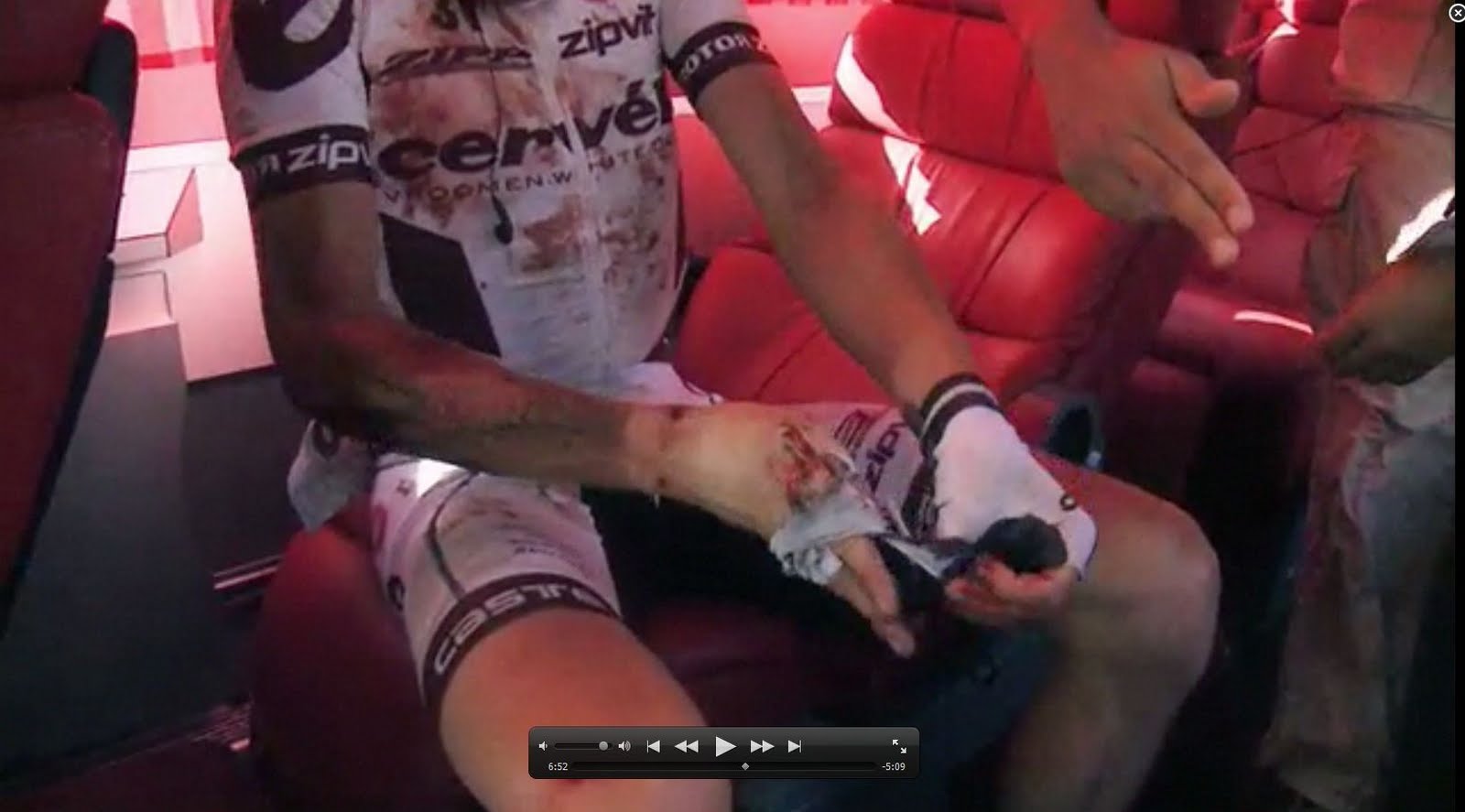
54. In the event of a crash, regardless of the gravity of an injury the Euro Cyclist shall mummify himself in fishnet gauze. The act of gauzing oneself (in order to continue racing while injured) is looked upon with respect by other Euro Cyclists as a statement of commitment and of strength of character. One shall use white gauze to bandage injuries; however, world cup striped gauze and/or national colors may be used in addition to white in select circumstances.

55. No form of large or obtrusive tattoo shall be printed onto the skin anywhere on the body. Small, discreet tattoos of the Virgin Mary or Olympic rings (assuming one has participated in Olympic games) no larger than three (3) cm. by three cm. shall be considered tasteful if AND ONLY IF located out of sight while one wears regular kit.

56. If a rider’s sponsors do not make quality parts, then the rider shall buy better parts and superimpose his sponsor’s stickers over them (e.g. Quickstep’s past rebranding of Time products as Specialized).

57. No rider shall wear any shorts with any type of hole showing skin below unless said hole and or opening was from a recent crash DURING that training session and/or race. Wearing ripped shorts is allowed ONLY while one is struggling to the finish and/or to the correct place to wait for the team car to take one out of the race.

58. When cresting the summit of a climb the Euro Cyclist will sit up, zip his jersey, and reach into his pocket for a snack while simultaneously looking back to see who will be accompanying him on the descent. Note that while coasting to allow another rider to catch up (in order to work together on the way down) is allowed, coasting in order to rest is FORBIDDEN.

59. The Euro Cyclist shall own a sizeable parrot and will ensure that he is seen walking around photo shoots with it perched either upon his casually outstretched index finger or upon his shoulder. Hair should be slicked back for maximal effect. The parrot should either be white or it should contain three (3) or more colors found within the World cup stripes. One must always smile when pictured with the parrot. The parrot should speak fluent Italian. In certain cases it is deemed advisable that the Euro Cyclist possess, in place of a parrot, SEVERAL young pumas.

60. The Euro Cyclist shall never ride deep carbon wheels with aluminum braking surfaces, with the exceptions of Mavic wheels and the Ghibli disc. Aluminum braking surfaces detract from the seamless transition of black carbon to black tire that makes the Euro cyclist look so devilish upon his race wheels. Deep carbon wheels shall have prominent decals upon them UNLESS they originate from Carbonsports in Germany.

61. When the Euro Cyclist wins a race or a grand tour he shall stylishly uncork the bottle of champagne and spray it around the podium. If the rider is ravenous, slightly overweight and German he shall place the opening of the champagne bottle close to his mouth and drink (heavily) with puffed out cheeks and a smile. If the rider is truly Euro he will take the ENTIRE bottle of champagne in his arms and parade about the finish area with it. Champagne bottles must be COMICALLY OVERSIZED. One should spray the podium girls. Especially if they are dressed in white.

62. At the finish of a Grand Tour the Euro cyclist shall celebrate by cycling around the finish area decked out in team kit and proper Euro casual footwear. If married, the Euro cyclist shall have his child in his arms. The toddler may rest upon his handlebars, or in the event that the Euro cyclist achieves a podium spot, accompany the rider onto the podium. The child should have its own victory salute that will be used in conjunction with that of his/her father. In some cases the child is permitted to wear an entirely-too-large team jersey. This rule shall be upheld by ALL riders save for Mario Cipollini, who would be unable to comply due to the sheer number of offspring he has fathered courting supermodels over the past two decades.

63. It is highly recommended that the Euro cyclist utilize any opportunity to humorously don equipment that failed during the demonstration of superior physical strength. This serves the dual purpose of mocking one’s sponsor and, in addition, providing a public display of why said rider did not finish the race on the podium. Breaking equipment due to power output is generally the best way to finish a race outside of winning it. If no spectators are present, the Euro cyclist shall prominently wear the broken equipment during all post race interviews. If the Euro cyclist suffers more then two mechanical failures of similar nature in rapid succession, throwing a petulant tantrum is strongly suggested.

2 Kommentare

Eingeordnet unter 2010, Mob

Championship memoirs

As I was climbing up to Moto-Hakone at the Ekiden ride the other day, setting a new best time and not allowing even the fastest Odawara-Hakone runner ever (yes, that was this year) to narrow the gap to me, and still not going at full power, it occurred to me once more how far I had come within just a year of cycling. Last year, I lost my power in my legs and the last third of the climb was really quite painful. I barely made it before the runners to the finish.
My own racing career started similarly miserably. In my first ever race on the Gunma track in October 2008, I couldn’t keep up with the pack on the very first hill (which is ridiculously short and flat) and was left cycling on my own for six laps before being overtaken („lapped“) by the peleton in the seventh and thus being disqualified. Half a year later on the same track, I would come in at 4th place and qualify for D-class, another few months later I would win the sprint prize on the same track. And yes, ultimately, I would win a race and become both JCRC and Tour du Japon Champion 2009.
Here is how I got there.

When we were small, my brother and I dreamt of owning expensive racing bikes and studies catalogues and bike shops. But we never bought a decent bike and I settled for riding a normal touring bike over modest distances (100km max). I mostly rode to school on nice days, and in Oxford bought a (heavy!) touring bike to get around the city (and sometimes even London). The highlight of my cycling career were rides with a like-minded friend through the countryside outside Oxford. Once in Japan, I touched the bicycle brought from England hardly at all, not wanting to cycle in crowded Tokyo and believing the countryside was far too distant.

One day in Spring 2008, MOB told me to my greatest surprise and equal delight that he was cycling regularly and trying to become road-race champion of the season. I was fascinated and it awoke old childhood dreams. I begged to be allowed to join a ride, and indeed, a few months later (July 2008), MOB invited me to a ride organized by him and David L. for beginners (two of David’s colleagues and Juliane also joined). We cycled along the Tamagawa and Asakawa to Takao, crossed Otarumi and scaled up Yabitsu, all in gruelling summer heat and humidity. I was completely exhausted afterwards (my heart kept pounding until at night) and I was too ill to go to work the next day. But I had to try again… And now I knew there were other people I could join on rides.

So I bought a rather nice road-race bicycle (Canyon Ultimate CF 8.0) on a trip to Germany and brought it to Japan. Getting bored on short trips inside Tokyo, MOB finally made some time between his busy racing schedule in October and took me on a trip to Izu. It was a hard 100km from Mishima to Shimoda, but I managed to keep up without annoying MOB too much. We started doing more rides together in the mountains west of Tokyo.

Initially I thought „let’s make the most of it before the winter sets in and more cycling won’t be possible“. But then it became clear that winter was no barrier to cycling, and as I started seeing my performance and endurance improving, I wanted to stay on the trajectory. From January, I switched to riding twice a week, almost no matter what. I think I managed to keep this rhythm perfectly until the concurrent onset of the rainy season and tons of professional work, mostly in Osaka, made regular weekday rides impossible.

My first race had been a misery. MOB invited me to a second one, around Saiko, and I did much better. It was a strenuous race and I was not able to keep up well in the uphill section. But somehow I still made it into finish just seven seconds behind the winner (in the E-class). This gave me some confidence that if I improved my performance, I could keep up in races and repeat what MOB had done that year: win the championship by mere attendance of every race and avoiding to be disqualified. Little knew I then that the rules were to be changed for 2009 and that the bar was to rise significantly. Ignorance can be the mother of opportunities.
JCRC Race No. 1 and Tour du Japon Race No. 1 – Kawagoe (15 March)
This is a point race on a short and completely flat racing track in a park (i.e. points are awarded for being among the top three in every second lap, then additional points for the overall finish). It should be relatively easy to keep up with the peleton. Ideally I would somehow manage to do so well in the sprinting that I would be among the first six and be able to move up into D-class.
JCRC awards a fixed number of points for finishing a race, and additional points for winning one of the top spots. Participation points vary by class, winning points don’t. For finishing an X-class (entry) race, one gets no points. For finishing an F-class (lowest class) race, one gets 20. For E-class, 40, for D-class, 60, and so on up to S-class (the highest). For being first, one gets 30 extra points; 25 for second, 22 for third, 20 for forth, 19 for fifth, etc.
Until 2008, finishing meant literally finishing a race, i.e. not crashing and not being lapped. From 2009, the rules were tightened and not only should one not crash and not be lapped, but one must also finish no later than 10% behind the time the tenth rider of the race made into the finish. So even in short races where the chances of being lapped are low, losing the benefit of the peleton could lead one to finish a race without any points.
When moving to a higher class, one carries forward all points awarded to date. Because those already in the higher class have had a chance to collect higher participation points for longer, the later one moves up, the smaller the chance one can actually win the class. But it is also hard to make predictions, because the best riders tend to move up themselves and thus out of one’s class, and because most people do not participate in all races.
The Kawagoe race started badly before it had started. As I was watching an earlier race, two riders crashed just after sprinting through the finish right in front of me. I decided to wear my thicker, long-sleeved jersey instead of the PE jersey. As we assembled for the warm-up lap, someone in the still ongoing race had a tyre blow-out right in front of us.
My race was no better. People had difficulty keeping the line through the long left curve followed by an immediate right curve just after the start. It was scary. Then someone crashed on one of these nasty bumpy wire covers that run in places across the track. I narrowly avoided running into the heap of riders, by breaking sufficiently hard to slow down and then navigate around the
mess, yet not hard enough to have others crashing into me. But by that time I was very scared, and became so careful that I lost contact with the peleton. I managed to catch up again driving my heart rate to unknown peaks (170 at the time). Another crash, though not right in front of

me. No chance to even think of sprinting in the even laps, with so many riders in front of me, the course being so narrow and a tight curve just before the finish.
In the final lap, just before the last
curve, I saw the left side all wide open, so zoomed through it as fast as I could, taking the final curve as narrow as possible. I sprinted in vain trying to catch up with the leading riders, but still finished a respectable 10th, which translated into 15th on the point ranking. 39.49km/h over a flat 12km (total race time of 0:18:14).
I left the place to ride home, swearing I would never ride there again.
JCRC Race No. 2 – Shuzenji (21 March)

The opposite of Kawagoe – the steepest race track in the JCRC season (except for the Shiobara hill climb). With far fewer people participating, and probably those participating being far more talented at riding bikes, and the not so good ones falling behind quickly on the climbs, this should be a safer ride. If it wasn’t for the fact that someone had died on this very tra

ck, crashing into a tree. But this was, as I realized only later, when racing into the opposite direction which has many downhill curves (JCRC Race No. 7). Nonetheless, this is even a dangerous course in anti-clockwise direction, due to the high downhill speeds, as the arrival of a doctor helicopter during the race showed.
MOB and I had visited the track a few days earlier, and I had done a full lap in a decent time, despite being on my own and on a heavily equipped bike. I felt confident I could do well, maybe even still get into the first six.

The first lap worked out well. I kept up with the leaders even though the climbs were gruelling. But in the second, I couldn’t keep up any longer on the final long climb and came in 8th, 42 seconds after the winner. But this was good enough to be now leading the E-class in points. 31.33km/h over a mountainous 10km (0:19:09).
Going to races outside Tokyo is always a good opportunity to do some nice riding in a new area afterwards. Of course this only works if one travels to races by trains and bike (sometimes including overnight accommodation), avoiding carrying anything unnecessary.
After this race, I cycled from the Shuzenji race track to Hakone and then on to Odawara. Very nice views of the Izu mountains, the Hakone mountains and Fuji-san all along (if only the weather had been better), and quite some climbing to keep working on my performance (races themselves are too short to have much impact).
JCRC Race No. 3 – Gunma (18 April)
The course of my very first race, with quite some up and down, including a slightly longer climb. But having survived Shuzenji quite well, I felt I could keep up with the peleton in this race. My goal was to come in as 4th, the idea being that this way I would get maximum points without being forcefully put into the next higher class (D-class). Having missed the opportunity to make the D-class in the two previous races and therefore being behind in total points (the higher the class, the larger the number of participation points awarded), I thought I should focus on becoming E-class champion.
All worked well – and I became 4th! 35.24km/h over a hilly 24km (0:40:52).
What a great feeling to be in the award ceremony for the first time, get a certificate and even a prize: two inner tubes. Little knew I that the rules had changed and with the 4th place I was now automatically in D-class and no longer had a right to decline, and little knew I how valuable those tubes would prove to be. And of course little knew I that ending up in D-class was for the better!

Hardly seriously exhausted from four laps on the track, I ventured to discover the mountains of Gunma. The plan was to cycle to Minakami and then all the way up to Konroku Toge at 1,600m, then return via route 120 to Numata. The Tone River valley up towards Konroku Toge proved to be stunningly beautiful, especially the higher I got. But that was partly because the higher I got, the more snow there was! Having ignored an earlier barrier, I found myself on a road with increasingly high snow on each side, soon reaching over one meter. The road itself had been cleared. Eventually I reached a point where the road continued in 1.5 high snow, so I had to turn around.

On the way down I ran through lots of little creeks of melt water running over the road, and going through one of them I hit a sharp stone that caused me my first and so far only puncture of my road-race cycling career. How glad I was I had these extra tubes just won at the race – otherwise I would have had to fiddle with patches which would have been less pleasant as it was getting again cooler.
I vowed to return after the next Gunma race and make it up Konroku Toge.
With almost two months to go before the next race, there was plenty of opportunity to discovery new territory, all over Japan. When my parents visited around Golden Week, I had them man my support vehicle which allowed me to do some great rides in stunny scenery.

Misaka Toge up from Kawaguchiko, followed by a climb up from Shosenkyo above Kofu to Tokusa Toge (1,700m) which is part of the Crystal Line. Shiretoko Toge (700m) at the north-eastern tip of Hokkaido, still mostly in snow. Via Hacchou Toge and Jukkoku Toge all the way to Sakudarai, my longest ever ride at the time. Killer climb variations of Otoge and Matsuhime Toge, or Yanagisawa Toge, Kamihikawa Toge and the old Sasago tunnel. The Itoigawa race up to the Yatsugadake hills and Suwa.
JCRC Race No. 4 and Tour du Japon Race No. 2 – Miyakejima (14 June)
This race takes place on a small island 300 kilometers off Tokyo. The island is basically one big volcano, which exploded 20 years ago and led to the evacuation of the island. The islanders are now back, but there are still frequent gas scares – though nobody has ever been harmed, by the initial explosion or since.
Access to the island is by daily ferry from Tokyo. There are also daily flights by an ANA daughter, and I wanted to be clever and use my miles to go by plane instead of suffering on an overnight ferry arriving at 5am.
What ANA or Lufthansa didn’t tell me is, that at least half of the time, the plane never takes of from Haneda because the air at the other end is deemed to be potentially too poisonous. I ended up going in vein to Haneda and thus missing the first part of the race, a short hill climb. Lufthansa and ANA still dispute that they carry any responsibility for not telling me, equating this with the extremely rare cancellation of a plane due to bad weather.
I took the ferry to Miyakejima after all, just one day late. It was a 24-hour day-trip to the second part of the race: leave home at 20:00, ferry leaving 22:00, arriving 5:00, cycling to the village on the other side of the island where the race was to be held, race from 10:00, solo ride around the island thereafter (a bit over 30km with some up and down and heavy wind in places), back at the village at 12:00, on the ferry at 14:00, back in Tokyo around 19:00 and home by 20:00.

Only 120 or so riders make it to Miyakejima, which is about a tenth of some other races. The event feels more like a family party and it is easy to make friends with other riders.

My D-class race had 11 riders of which three gave up mid-race. The pace was gruelling, and with so few riders the benefit of drafting was low. The peleton fell apart after the 5th lap, and I managed to hang on to 2-3 other riders, eventually drafting one of them through the final lap and overtaking him and another rider ahead on the sprint up a steep slope into the finish. I was 5th, and with so few riders in the race had the option to decline going to C-class which I took advantage of. I was now leading the D-class – and would continue doing so until the end of the season.
33.29km/h over a hilly 20km (0:36:03).
JCRC Race No. 5 and Tour du Japon Race No. 3 – Hitachinaka (28 June)
Another flat race, this time on a long oval car-testing track. Another blood bath. Just fortunately not in my own race, just some scary scenes – lucky once more.
Apart from sheer crash-free survival, my goal was to end up with as many points as possible without getting among top six. This is hard to manage in a race where the final sprint decides everything and it is harder to control one’s own position just before the finish line. So I decided to make it my goal to win one of the so called JCRC prizes for being among the top three in the penultimate round. Another rider who seemed to have rather too much power left broke out from the field 500m before the finish line and having just waited for something like this to happen, I was swift to follow him and draft him at amazing speed to the finish line. We were both exhausted and let the field catch up with us for the final lap.
I wanted to do the same thing again in the final lap, just make sure I wouldn’t get in similarly well placed. The same guy broke out again and I followed, but then regretted as it was the wrong tactic. I let myself fall behind and caught up by the field, but was then too exhausted to keep up with them, ending up only 26th (but just three seconds behind the winner!). 41.39km/h over a flat 30km (0:43:29).
After the race, I rode south through rural Ibaraki to the large Kasumigaura Lake, intending to ride once around it (which by itself would be over 100km). Unfortunately, the weather worsened and I ended up in heavy rain, having to abort my trip half way around the lake and taking an endless train trip home.
JCRC Race No. 6 – Gunma (19 July)

Six laps around a by now very familiar course, but this time in D-class. Would that make a big difference? Indeed the pace was slightly faster, but I felt well equipped to keep up throughout, including the longer climb.
I went for the same goal as in the previous race: get the JCRC prize. This time I managed to be first and could call three pairs of JCRC socks my own, as well as a nice photo shot with the race winners.
But just like in Hitachinaka that sprint cost me energy which I needed for the final sprint. I came in 14th, seven seconds behind the winner. 36.32km/h over a hilly 36km (0:59:28).

After another race in Gunma, this was now the chance to finally assail Konroku Toge (1,600m) and then try to make it up Konsei Toge (1,800m, up from 700m) to reach the Nikko lakes and eventually Nikko. It was again a very nice ride up the Tonegawa valley, this time without any natural barriers. By the time I had reached Katashima village at the other end, the weather had worsened significantly, and I ended up climbing the 1,100m to Konsei Toge in heavy rain, at 16 degrees. I saved myself the rain cover for the long downhill to the lakes and into Nikko, when the rain had stopped, but being soaked, I didn’t feel exactly warm… Still it was worth the trip, and the lakes worth another visit a few months later, after the Shiobara hill climb race.
JCRC Race No. 7 – Shuzenji (23 August)
I imagined this to be the toughest race of the season: six laps on this tough mountain course, at the very hottest time of the year, and now in D-class. Earlier in the year, I had barely kept up in just two laps one class lower. Outlooks were made worse by unpredictably and often rainy weather throughout the summer, making it hard to train adequately.

I left for a week of boot camp at my parents‘ home in Germany. Earlier in the year, I had bought another Canyon for use in Germany and beyond, whenever/whereever I could visit. This was the first opportunity to take real possession of the bike after a friend had collected it from the manufacturer a few months earlier. This was the cheapest road racer Canyon has on offer: Roadlite 5.0 – aluminium frame with Shimano 105 components, Mavic Aksium wheels. I immediately felt very comfortable on it. In fact, the stiffness of the frame made me feel more comfortable going downhill at over 70km/h than I do on my carbon Canyon. The 105 brakes and gears work perfectly, the Aksium wheels run just as well as my more expensive ones in Japan. If only the bike was a bit lighter (8.7 vs 6.9kg) and the crankset (Shimano R600 – the only crime on the bike) not showing so much resistance (I have since ordered FSA MegaExo as replacement).
I did 650km in a week. On the 210km ride, the extra resistance and weight showed, and I felt more exhausted than I would in Japan. However, part of it may also be due to insufficient eating and drinking, as Germany lacks the network of convenience stores and drink machines which I so much benefit from in Japan.

The training paid off. I felt fine on the climbs and was able to keep up with the fastest riders. But it was tough – my average heart rate of the full race was 169, and 13% of the time I was between 175 and 180. I had never been able to keep anything as high as this for so long.

The field fell completely apart before long, not only because of the tough climbs, but also because of the dangerously curvy down hills which made me be careful – I didn’t want to be the second person ending up on a tree and dying there (or just crashing, as happened again plentiful to others that day). I came in 11th, 1:26 behind the winner. 30.72km/h over a mountainous 30km (0:48:50).
Being in Shuzenji offered another opportunity to explore yet inknown roads and passes on the Izu peninsula, including the famous Izu Skyline.
JCRC Race No. 8 – Shiobara (4 October)
This is a one-way race on public roads through the valley of Shiobara Onsen and then up a steep hill of 459m over 6.9km. I did not know what to expect. Surely I would be able to keep up with the peleton up to the start of the steep section. How well would I do on the climb?
Unfortunately, it started to rain lightly as I was cycling up from the hotel near the JR station to the start of the race. Not a good way of getting warm! The rain stopped again and the race started on yet wet roads. Only one lane was blocked for us, and we were facing traffic on the other – amazingly dangerous when racing in such a large field!
I kept up well with the field, but shorter climbs felt more strenuous than usual. Something was wrong. The hill climb was tough, and half of the field passed me pretty much immediately. I caught up with some later on, but felt not at the full height of my energy throughout, ending 20th, 2:24 behind the winner, but still comfortably within 10% of the 10th, below which no points are awarded (new rule from 2009). 23.86km over a rising 19.2km (0:48:16).
At that point, I did not understand what caused my slightly weak performance. I had trained well in the meantime, completing a ride from home to Karuizawa, and riding from Chino through the southern Alps to Hamamatsu. And I felt sufficiently strong to add a long ride after the race, which took me through the Kawamata area over Yamao Toge (1,700m) to the Nikko lakes and eventually close to Utsunomiya.
Two days later, I left for New York on a business trip, and started feeling ill as I was about the board the plane. It seemed I was getting a flu, developing a high fever. Eventually it turned out I had developed severe, acute prostatitis. This was exactly the kind of disease which I did not want to have – no more sitting on a saddle for a while! After more travel through Germany and Portugal, I ended up back in Japan the day before the next race – jet-lagged, tired, untrained and still pumped full with antibiotics, yet at least almost symptom-free.
I couldn’t just sit back and let the race pass, and my performance deteriorate further. I undid the cancellation of my minshuku reservation and went to Gunma on the same day I had arrived at Narita.
JCRC Race No. 9 – Gunma (18 October)
This is the toughest of the three races in Gunma, because it is the longest: 12 laps of a hilly 6km in D-class, 72km in total. My sole goal was to keep up with the peleton and make it into the finish to collect my points. In the worst case somehow keep cycling for as long as possible and get some training into my body.
I ended up in between. I was still too weak and struggled to keep up on the longer climbs, and after them didn’t get the power together to do some catching up on the down hills and flats. I lost the peleton in the 6th lap, with still more than half of the race to go. This was a tough situation to be in: without the benefit of the draft and the motivation to keep up maximum speed, I would continue to fall behind, and risk being lapped eventually. Knowing too well, I powered through on my own, and made it into the 12th lap, probably just half a minute ahead of the peleton getting into finish. Now I was safe from being lapped, but I still was in danger of not coming in within 10% of the 10th (who would have been in the peleton) and thus not gaining any points. As long as I kept my speed, I was safe – the 13th so to speak of 12 laps should be shorter than 10% of those 12 laps. I kept it up and finished ahead of the cut-off, as 37th, 10 minutes behind the winner. By far my worst performance, but I had secured another 60 points, and with them I was far enough ahead to win the championship even if I crashed in one out of the two remaining races. 33.09km/h over a hilly and mostly lonely 72km (2:10:33).
No ride after this race – 72km on the track was sufficient training and I was still not sure whether I had done my prostate a favour.
JCRC Race No. 10 and Tour du Japon Race No. 4 – Yokkaichi (25 October)
Another hilly street course, far away from Tokyo. I checked out the course after registration on the previous day and completed it at a relatively leisurely pace in a decent time. I was confident I was back in form and would be able to keep up with the peleton on the long climb soon after the start and do the same once more in the second lap. In any case, all I needed was to arrive before the cut-off – with the minimum points I would be unassailable JCRC Champion 2009, even without participating in the remaining last race.
Indeed, everything worked smoothly – except for someone slipping twice right in front of me, in the tight corner just before the finish sprint. I managed to avoid them each time, and entered the final sprint in a leading position (except for two riders who had broken out some time ago). But I did not want to end up among the first six! So I slowed down during the sprint and made sure a few riders would pass me. Being unable to time this perfectly, I ended up 9th, 17 seconds behind the winner. 37.00km/h over a hilly 18km (0:29:12).
I was JCRC Champion! A dream had become true.
I left for a celebration ride, intending to make the most out of my time in Yokkaichi by crossing into adjacent Shiga-ken and from there through another mountain pass further north back into Mie-ken. This turned out to be quite an adventure. Buhei Toge was shown as a national highway on maps, but when I had climbed it half way up through a side road, further access was blocked. I asked a cyclist coming down on the forbidden side. Yes, it was possible to ride up another 3km or so, but then there was a huge landslide, impossible to pass. Normally I don’t take this for a word and know that almost any landslide or construction can be circumvented, but this time somehow I sensed this was different. I cycled up with the firm intention of turning around and returning to Tokyo early.

The landslide was indeed massive. So massive that it was clearly impossible or at least extremely dangerous to attempt to walk over it. But then I noticed a hiking path that seemed to lead around it, and indeed, having carried my bike for five minutes up a steep hill (I know why I’m using SPD pedals!), I ended up back on the road, beyond the landslide. I had a well built-out kokudo all for myself, up to the tunnel pass, and then all the way down into Shiga-ken.

After a lunch break in the first village, I crossed over north along the lower slopes of the mountain ridge I had just crossed. Quite a bit of up and down, but very scenic, and very quiet. Eventually I reached the next kokudo that would lead over Ishigure Toge back into Mie-ken. According to the maps. Somehow I found it strange that there was relatively little traffic on this national highway, despite the one further south having been closed. Soon I reached a sign saying that the road was closed further ahead, due to landslides… Oh no! If this was really true (for a change), this meant real trouble, as going even further north to the next pass would take so much time that I would never make it back to Yokkaichi (where I had left my luggage) in day-light.
I asked a shop owner and she swore the road was really closed, but when pushed said that some hikers had managed to get through, but that it had been very tough. Hmm, that didn’t sound very reassuring. But I felt I had no choice as the alternative was not appealing.
As I cycled up, a police car overtook me. I was hoping they weren’t going to check whether I was going to enter the forbidden section. I passed repeated signs that the road was closed and it was not allowed to proceed, but no actual barriers, so I went on. No police car in sight. I was all by myself, climbing through a very long construction site. „So this is where the landslide was… As so often, already totally ready to be passed…“ Back on the old road, I approached a new tunnel being drilled through the mountain. I took the old road to climb up further, despite worrying signs warning of landslides and road closure. Indeed, I came across what looked like small landslides that had been tidied up recently. And then the police car approached me, from ahead! I nodded friendly, and they didn’t stop. It felt reassuring to see the police allowing me to go that far, and apparently even further.

After lots of curves , I finally reached the pass. Well, what used to be a pass. It was blocked by concrete blocks, making it impossible for anyone but pedestrians, or a bicycle, to pass.
I went down on the other side. The road was in horrible condition. And after the first bent a big landslide covering the full breadth of the road, having torn away parts of it.
I walked over it and rolled down further. The next landslide. The same spectacle would continue, countl
ess times. But there was a hiker going downhill on the same road… I was reassured tha
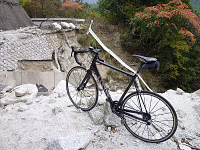
t if that person could get down, so could I, if need be on foot. An
d so I made it through landslide after landslide, none too scary not to pass over them.
Eventually, I got to the other side of the newly built tunnel, and from there it was a fast autobahn run down into the valley, and another 35km back to Yokkaichi.
JCRC Race No. 11 and Tour du Japon Race No. 5 – Saiko (8 November)

As I was already JCRC champion for 2009, I could have skipped this very last race of the season. However, it offered the chance to go for an outright race win, something I had to avoid before not to be upgraded into the C-class and possibly not have sufficient points any longer to become champion (though in retrospect it turned out I had more points than both the C-class and B-class champions). Also, there was still the Tour du Japon rating where I was only a distant second and with the last race offering double points, a very strong showing by myself and a mediocre one by the leading contender could still make me Tour du Japon Champion.
So the dream was to win the race and cash in not only a first prize for a race, but also two championships. But dreams become rarely true – in so many races I

had started thinking I could do well and ended up not quite where I wanted. In this race, it was all down to saving energy for the first 19km and then having the right tactic for the final sprint, on an uphill section. My tactic was simple: never go first, always draft behind others, and switch always behind the fastest riders pulling ahead. All of this on an uphill section where hopefully not all riders could keep up with the pace (or as it turned out would crash!) so the field would become thinner, making it easier to find space to switch places.
Somehow it worked out exactly as planned. All I had to do is to pull together all my energy without going into overdrive and running out of steam too early, and then sprinting away over the last 200m. I could not believe it! Another dream, and this time a really unexpected one, had become true! And how nice to hear my name being announced over the loudspeakers – „a foreigner had won, what a surprise!“ 41.19km/h over an almost flat 20km (0:29:08).
I was showered with medals, award certificates, winner jerseys and other presents for the bike in the subsequent ceremonies. What a nice feeling when one has never ever won anything in sports before. My results at school were always embarrassingly bad; I was never a star on the football or basketball pitch.

But now is the time to bow out of racing. Not only is it quite demanding to make sure one doesn’t miss attendance of these eleven races all over Japan, racing is also quite dangerous. I have seen many people crash, and at best nice bikes being ruined, at worst ambulances take away riders. Flat races in particular were orgies of blood, because they attract many riders who are too unskilled or inexperienced to ever be in a race. There are fewer of them in hilly races, and the remaining ones mostly fall behind the peleton and thus pose less of a risk to others. I was both sufficiently lucky and skilled to avoid any crashes (sometimes escaping sliding riders by a few centimeters), but I do not want to count on my luck for longer.
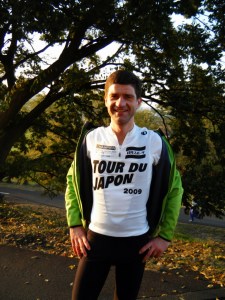
Instead I shall focus on riding purely for pleasure, and discovering new mountain passes and areas of Japan. It is becoming increasingly difficult to discover anything new in the vicinity of Tokyo, where I must by now know almost every mountain road up to 150-200km away from Tokyo. Most of my rides take me that far and thanks to the very efficient public transport system, I can easily return home by train, having packed up my bike in a small bag that I always carry with me (it’s like a parachut, letting me bail out whereever I want, as long as there is a train station).

In the 15 months since starting, I have ridden 14,000km in total – which compares to something like 16,000km which I have ridden in my previous 39 years (I’ve kept records!). I do want to fall back to the pace of my first 39 years, but I’m also unlikely to keep up this year’s pace. As long as I get sufficient exercise, discover new passes and have good company (not all necessarily always at the same time!), I shall be happy.

With my greatest thanks to MOB, without whom this would have never happened (starting it, buying the right gear, using it the right way, cycling the right roads, learning the right racing strategy, getting prepared for races, etc. etc.) and the larger PE and even TCC community,
Ludwig
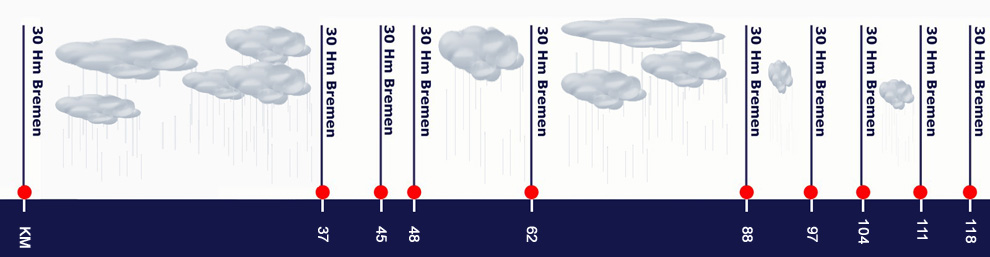
2 Kommentare

Eingeordnet unter 2009, Mob