Archiv der Kategorie: Autoren

Gute Menschen, die auf diesem Blog schreiben.

IZU CLUB RIDE MAY 5TH

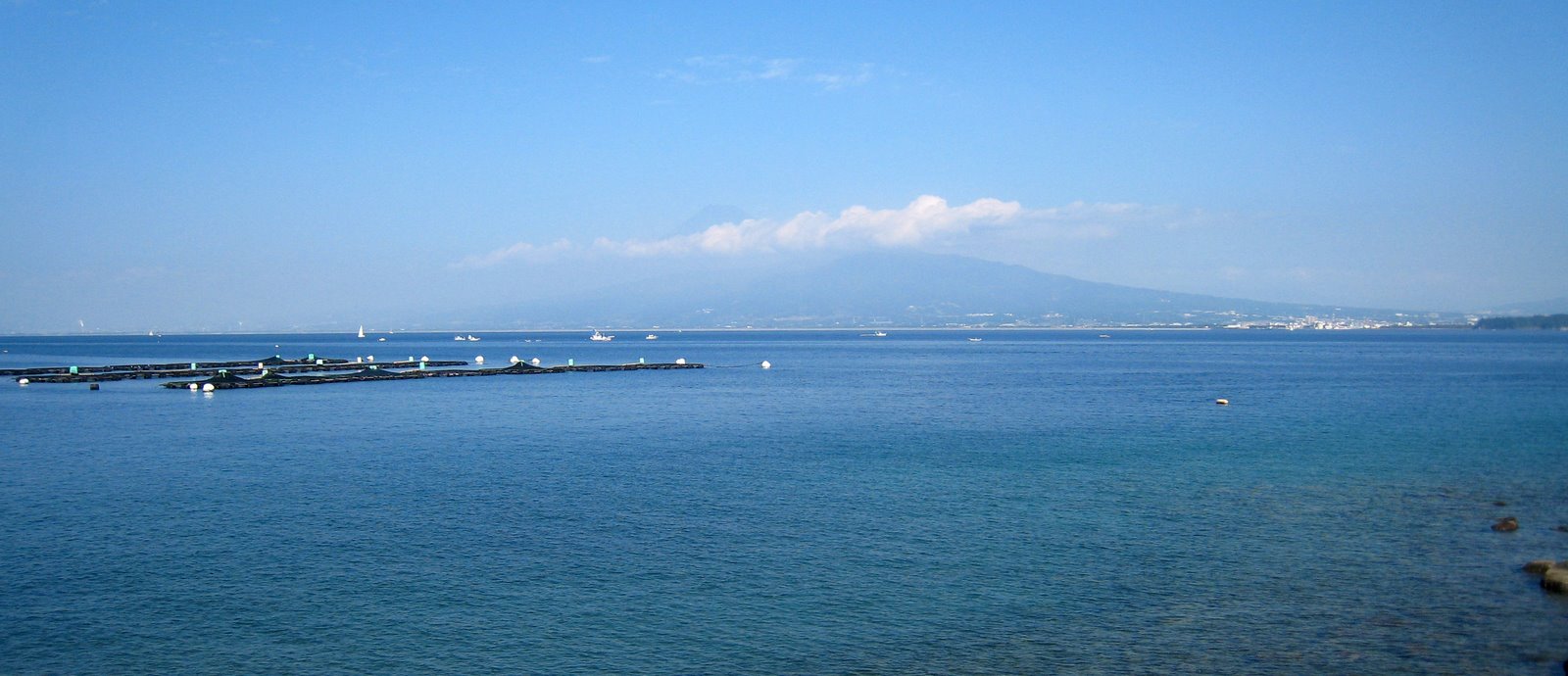
Mount Fuji as seen from the road on Western Izu autumn 2008

We are scheduling a club ride down South on Izu Hanto during the Golden Week. Here is the plan:

07.15 Meet at Shinagawa Station, Shinkansen Entrance

07.34 Departure Kodama 635

08.20 Arrival Mishima Station
08.45 Start riding in direction Shimoda along West Izu coast [proposed route]
12.30 Lunch break somewhere, somehow
13.30 Crossing the famous Jaishi Toge

Going up Jaishi Toge can be very hard with a bowl of ramen in your stomach


16.00 Arrival Shimoda
, Visit Kanaya hot spring :
20.37 Last train leaves Rendaiji (station next to Kanaya) for Shinagawa
23.09 Arrival Shinagawa

Alternative 1
: Return the same day home. Perhaps we can squeeze in a dinner at Sunny Side as well.

Alternative 2 : Have dinner at Sunny Side Cafe at Shimoda Beach, stay the night at James’s house (if OK with James, so this is still open, also depending on feedback)

Some more cycling the next day, to be decided on the spot. Return by train to Tokyo then in the afternoon.

What you would need :

– Bicycle bag, repair stuff, tube, pomp, wind breaker, you know, the usual stuff.
– Definitely lots of CO2 cartridges – Izu is a jinxed place

WHO IS JOINING SO FAR ?

The West Izu Team in 2006


Yes, for sure : michael (1 day), Michael (open)
I think so : David (1 day), James, Ben

If anybody else is interested, please post in the comments section. In case we have the chance to do a two day trip we need to do some preparations :

– Luggage per takyubin to Shimoda
– Grill reservation with Sunny Side
Shinkansen tickets (anyway it is GW)

Hurry up, there is not much time left.

5 Kommentare

Eingeordnet unter 2009, Mob

Tour of Japan : Tokyo Race

The 13th Tour of Japan, a professional race will take off next month, and also this year it will be linked with a „amateur race“ in Tokyo. It is time to register and seize the opportunity to crash right in front of your house door.

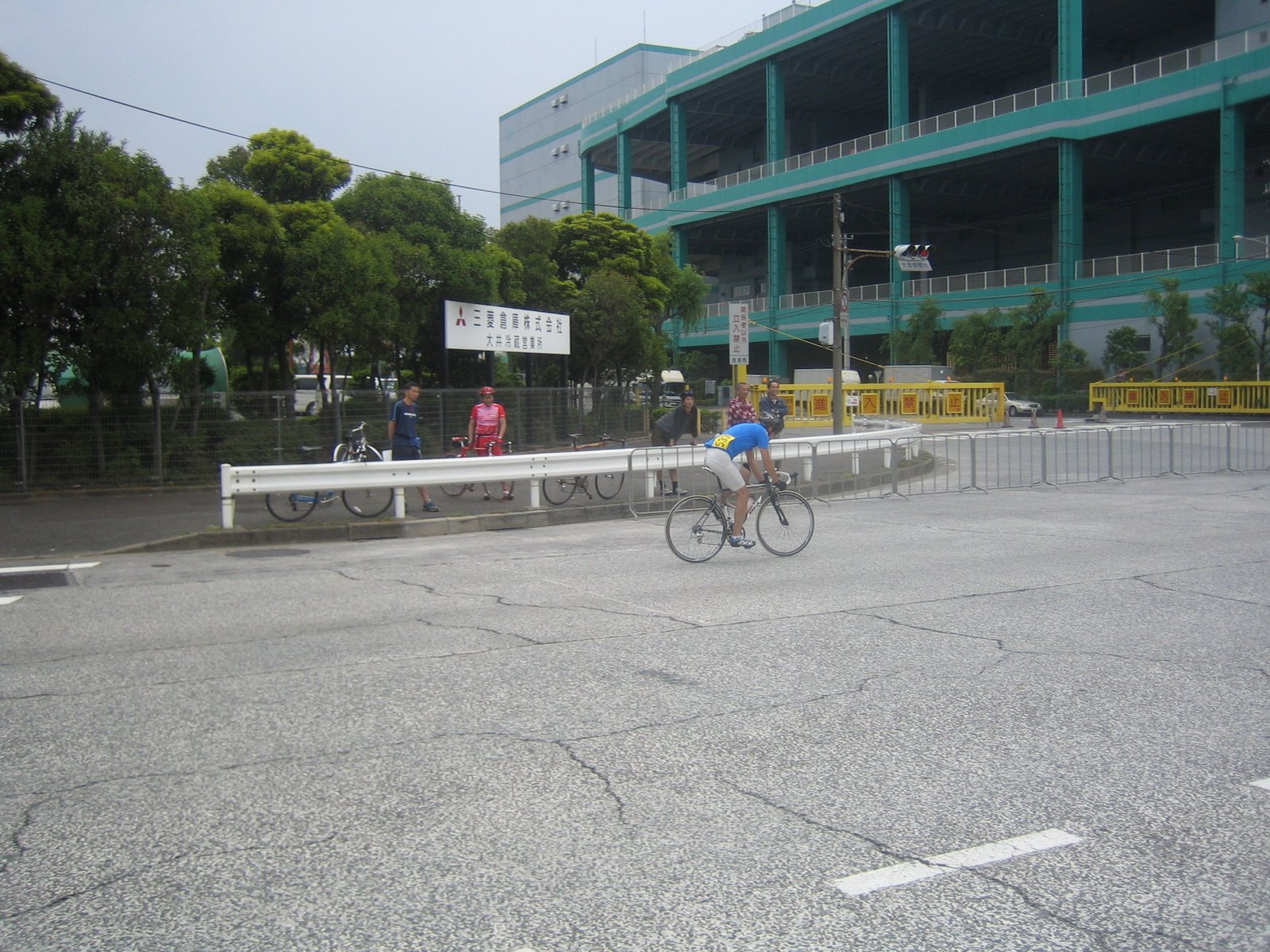
Yes. After a look at the course map (if there is any), you may think „Hey this race is dead flat and looks quite easy – even I could win that.“ That is what we all think. And not even us, but also about 12 Million other Japanese citizens as well who might think that they should try their luck at a first cycle race. And why not? It is hold in Oi-Futo, the port of Tokyo where riders flock on the weekend to show-off their new carbon bikes and race against others on the wide streets normally crowded by container trailers.

Well, everybody can win this race, provided he is of average strength with the field AND he arrives at the finish in one complete piece, bones, organs, flesh and muscles all orderly lined up in the right order as they should be.

Because this particular race has, and I can say this from the experience of attending it the last two years, some major risks :

  • A lot of idiots are attending and serving crazy over the course like there is no tomorrow. Never, ever think about racing in the beginners field.
  • The track does not only have some sharp turns, but also probably more drains, manhole covers, uneven asphalt surfaces, metal sheets and corrugated steel covers per kilometer than there are cobblestones plastered between Paris and Roubaix.
  • And, if in addition the race is hold in pouring rain, like last year, the risk that you slide in a twisted amalgamation of riders right into some guide rails is multiplied by the factor ten.

But after making this rather factual statements, let’s come back and dwell a little bit more on the details: As every year the race is organized by Nikkan Sports, the popular sports newspaper which publish these fantastic articles about baseball, horse racing and groping techniques on the Saikyo line. Nikkan Sports has a huge distribution and attracts a lot of its readers to attend the race. so be no surprise if the guy racing next to you thinks about baseball, horse racing or other things while riding straight and at high speed into the hairpin curve.

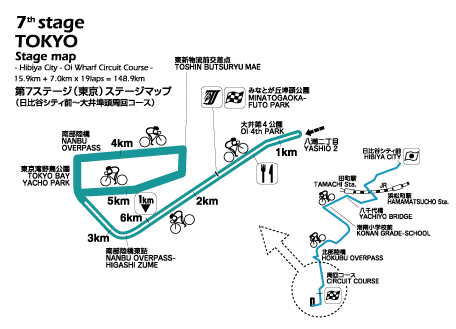
The track is 7 km long and has to be passed three times, making the total race distance to 21 km, which is about the common flat type race in Japan. One nasty U-turn, three other technical turns but at least the finishing straight is very wide and almost free of obstacles.The right track is the one in question. The left track is the one used by the pros before they spin some laps at the end of the race on the right track.

One can attend in four classes (plus women and seniors) which are „High grade“, corresponding to S and A grade JCRC riders, „General 1“ (B,C), „General 2“ (D,E) and „Beginners“ (scum). For some reason which remained already last year a mystery to me, the most popular category is „General 2“, which is therefore divided into three groups (2A, 2B, 2C, so far, so clear) and you must submit your registration for one of them (2A, 2B or 2C, but they are anyway all the same). Of course it makes sense, for example if you have problems to get out of the bed early in the morning, to join the 2C group, as this one starts at 9:19 AM, as opposed to the earlier 9:17 AM start time of the 2A field.

In each General 2 field there are 70 places and you might want to register fast with Nikkan Sports. Registration has started on April 11th and tend to be completed very fast. A Japanese post offer transfer from can be downloaded here and after filing some basic information and paying 6.000 Yen the formalities are dealt with. If anyone would like to race against me – please opt for 2A. I am an early bird by the name of Kraehe.

By the way, the race is on Sunday May 24th and it might be a good idea to go there and spin some laps before the actual event to get accustomed to the place. The crowd is one of the biggest in any event (except of course for the famous Positivo Espresso New Year Ekiden Training Session) as they come to see the pros and not you.

If it does not rain one can also be tempted to watch the pro race afterwards.

A more detailed report about last year’s race is published at this blog, however I must warn you that I wrote this post under the influence of a book „English as a second language“ and you may not want to look at it on your office screen.

So I would be happy to meet many at you on the day in the port, if possible still in one piece.

Hinterlasse einen Kommentar

Eingeordnet unter 2009, Mob

COLOR

It is difficult to find a good book about a subject in which one is not interest at all. At least at first. One good example is „Playing the game“ by Ian Buruma which is even about two topics I am not interested at all (cricket and India) and is nevertheless a very good book, another one is „Flaubert’s parrot“ by Julian Barnes (the life of Gustave Flaubert) . Next in line would be „Color“ by Victoria Finlay, which is even a more fantastic book about a topic seemingly so uninteresting that one takes it for granted: colors and how one makes them to paint, dye and do other things with them.
Every year, when spring comes to Japan, I start to see some new colors of flowers and trees when riding out on my bike. Plum and cherry blossoms for sure, then later camelia (tsubaki), the arrival of Ajisai equals the arrival of the raining season, later than Higanbana and my favorite Kosumosu in autumn, meaning that the nice cycling days will be over any time soon. How could it possibly happen that I developed a feeling for that, being a true engineer by heart. Should I not adhere rather to the different shades of grey, defined by the volume of added fly ash and portland cement in bare concrete surfaces of slope protections?

Anyway, on Monday, when riding out colors in Japan were at it’s best. I started at the Kan One from Tamagawa, where on the left side of the road there is this building which looks like it is experiencing severe kidney’s disorders. Every time I pass by I want to take a photo, every time I don’t want to stop and pull out my camera … is there some way to make good photos while riding without stopping, any hints?
The tank road then was covered by a blanket of fallen cherry blossoms. Then, as usual I lost the way when I try to find the small road to the North of Tsukui lake and instead and by chance I ended up climbing to Shiroyama lake, David has posted about. This is indeed a nice climb and can be easily added to our Sunday routine as following :

MY MAP FOR 20 BEAUTIFUL KILOMETER THROUGH HASHIMOTO

I then found the entrance to the Tsukui lake road and continued along to Doshi Michi and Miyagase lake. After a short lunch at one of the better soba shops there, I started the climb up Yabitsu. The weather was beautiful, the roads were empty but there was a nasty head wind.
I desperately wanted to do a fast time up, which I did, but the best part was that apart from two stretches when the real climb starts, I could feel that I could hold the climbing tension. Especially the last part, from the tea house at the river to the top of Yabitsu was very good and I was exhausted but happy when I reached the top.

Without break I continued the descent to Hadano, then further boring 30 km to road #1 at Ninomiya, through Odawara and then further on to Hakone where I took the second break of the day. It was already 4 PM and I wondered if I should really climb up to Moto Hakone at lake Ashino or if I should give up. But hey, I have given up the idea to combine Yabitsu with road „#20 from Hakone to Atami so many times, that I really wanted to do it this time. Yabitsu and road #2, being the most beautiful cycling roads I know, and the combination of both surely must have been something similar to total cyclorgasm.
Alas, it turned out to be more of a combination of two favorite dishes from my childhood (cherry jam and pickled cucumbers). I was going up slow to Hakone, this took me more than an hour as my legs were heavy after having spend seven hours on the bike already. The weather stopped to be nice. No more blue skies, temperature dropped to 10 degrees and I had my wind breaker even on the climbs. Finally reaching the highest point of road #1, the surroundings were covered in mist. And it is different to climb alone than to have a huge support from the Ekiden crowd like in January.

No time for a break in Hakone, up to Hakone pass where the headwind was even more nasty. Instead of going 40 – 50 km/hr down road 20 to Jukoku pass, I crawled at 20 – 30 km/hr because of the blloody cold wind. Then down from Atami Toge to Atami. Seriously, every time I am going down and I start to have cramps in my hands from constant braking, I wonder how I could ever went up here. This is the OWI 2.0 killer hill, for sure.
I had dreams of arriving during sunset in Atami, but the weather was not like that. Hoped the Shinkansen home, which took, including baging the bike, less than an hour.

A colorful trip with many facets in the end.

3 Kommentare

Eingeordnet unter 2009, Mob

A 1.0 on the open Wada Scale

Yesterday, when I was climbing up Yabitsu and I was going steady and fast despite some headwind, enjoyed the ride and crossed bridges named „Hell swamps“ I wondered: Why are some climbs so easy and some are so different to complete? And the suffering has nothing to do with the distance, the elevation difference and the average gradient.

So I came up with the idea to setup a new unit , which gives a better idea of climbing pain. THE OPEN WADA INDEX [OWI]. An Open Wada Index of 1.0 describes the pain inflicted on oneself while arriving on top of Wada Toge after making a decent effort to chase one’s personal best time. This is of course a highly individual index, but I guess it serves well to compare other climbs to one’s own experience of Wada Toge. Which after climbing many mountains in Tokyo, Kanagawa, Chichibu, Yamanashi and Shizuoka, is still one of the more challenging climbs the Kanto area has to offer.

The index is open, because all climbs that are harder than Wada can be rated with a number higher than 1.0 and there is no upper limit for this. A typical Saturday ride by Tom, including more than 250 km of distance, more than 10.000 meter of climbing and passing through various strictly forbidden tunnels, roads and forest fires would perhaps score as high as 30 on my OWI scale, if I ever would be so foolish to undertake such madness.

Here is my OWI rating for some of the more common mountains and hills on our weekend rides:

  • OTARUMI TOGE : 0.80 Not a difficult climb but one has to be faster than 15 minutes and the rest of the pack. Every time. [Takao approach]
  • JEROME’S HILL : 0.82 Even faster. Full power from the start to the end not giving up. I am even more exhausted on top then for every other climb. [Itsukaichi approach]
  • TOMIN NO MORI : 1.10 A very long climb with a very frustrating straight stretch close to the end. [Itsukaichi approach]
  • YABITSU : 0.50 This is not a climb. This is like a weekend spend on a river. {Miyagase approach]
  • MATSUHIME : 0.95 Long, but not unreasonable from Okutama. The approach from the other side would be more in the range of 1.2
  • ATAMI TOGE : 2.00 Rode down yesterday and wondered how I could ever went up this one. An ongoing nightmare in 2005 with Juliane and David.
  • KOBU TUNNEL 1.10 The last climb is OK, but going through the golf club hills is doubling the inflicted pain [Uenohara approach].
  • YANAGISAWA 1.45 Long, long, long through the deserted landscape of Okutama. Not sure why, but not so attractive to me [Okutama approach].
  • SHOMARU 0.85 The first two kilometers are always killing me but once I have found my rhythm this goes quite well. The end is also always more far than one thinks. [Hano approach]
  • HAKONE 1.60 Still and after all the years, one of the most difficult climbs I know, also due to the traffic congestion and the gradient [Odawara approach].

As one get better, faster, develops more stamina, the OWI does not change if the roads are regulary experienced. If not the memory is playing tricks: One of the hardest climbs I regularly did was a small hill on the coast of lake Hamanakako close to Hamamatsu, where I rode my 60 km laps in 1998/99. This must have been a climb of perhaps 30 meter elevation gain, otherwise the lap was more or less dead flat. But still, this hill was killing me, so thinking back about this time, I would easily award it with an OWI of 1.0 or more.

But last year I was riding in Hamamatsu just for fun and I didn’t even notice the hill.

So, what are the Toge of Kanto with your lowest and highest OWI?
MOB experiencing an OWI of 3.0 in front of an enthusiastic crowd at one of his first solo races ever in Ashigara [dead flat course].

2 Kommentare

Eingeordnet unter 2009, Mob

The two pensinsulars

Some ideas stick in one’s head forever before they are realized or finally abandoned. I wanted to travel to Chichijima for eight or nine years before I finally did it. I wanted to ride in Chiba for eight or nine days – then I called Phil and we did it.I have to admit that I have many prejudices about Chiba. It is the prefecture which is all industry and social housing complexes in the North, followed by petrochemical plants on the coast (funny enough, the Japanese word for large petrochemical complexes is コンビナート, which comes from the (East-)German word „Kombinat„, only being used in the GDR for large state-owner industrial complexes in general), followed by an endless supply of golf courses in the backyard.

One of the biggest foreign affairs blunders of the Japanese government ever, was the decision to move the Tokyo international airport from Haneda to Narita in the Seventies. Sure enough, the developing fight of left-radicals and farmers against the construction of the airport produced many beautiful photos and videos (some can be seen at the police museum in Ginza) of beautiful aesthetics.

And in case you don’t know, for the first 9 month in 2008 the number of passengers passed through Haneda airport was close to 56 million, making it by far the busiest airport in Asia, while Narita was trailing in 7th place with roughly half the pax.

So, when the average normal traveller, full of Japan and it’s romantic image of Japan (Geisha, Bonsai, Samurai, Maid Cafes, Visual Kei and Anime) arrives in the morning after a long international flight in bad mood, what is he subjected to? Another endless bus or train ride into town, passing emulations of crammed, boring „mansions“ and apartment blocks, warehouses in dull grey with corrugated steel roofs, production plants of unknown purpose and worse of all, Funabashi, commuter’s hell.

This is the first impression one gets leaving the relatively international grounds of Narita airport and I believe that this has done more damage to the image of Japan then anything else. It’s a kind of ongoing Pearl Habour publicity disaster.

So far, concerning Chiba.

But hey, one has to be open minded and I just loved the idea to ride in Chiba first, then take the ferry from Southern Boso to Miura Hanto and continue the ride on the other side of Tokyo bay. Phil from TCC, also member of the failed Tsukuba team, also member of the soon to be very successful Hitachi Naka team has kindly offered to guide me through the labyrinth of Chiba back roads.

We met at 9 at Honda station, me after a 2 hour long rain ride from Yokohama. Off we are to Lake Takataki and continue to go South on smaller roads. All the roads we ride are small and consist of a constant up and down. Riding in Chiba is definitely different from riding in the Western mountains of Tokyo. There is less climbing, the longest one is perhaps 100 to 150 m of elevation difference. So one goes anaerobic by trying to do the climbs fast and rests while doing the fast descents. It is like some kind of interval training. Phil knows the area very well with a lot of shortcuts and scenic views. Sometimes we talk while riding, but he is also a fast guy and a fast decenter so I need to concentrate to keep up with him. We concentrate of riding fast and I don’t have the time to take photos.

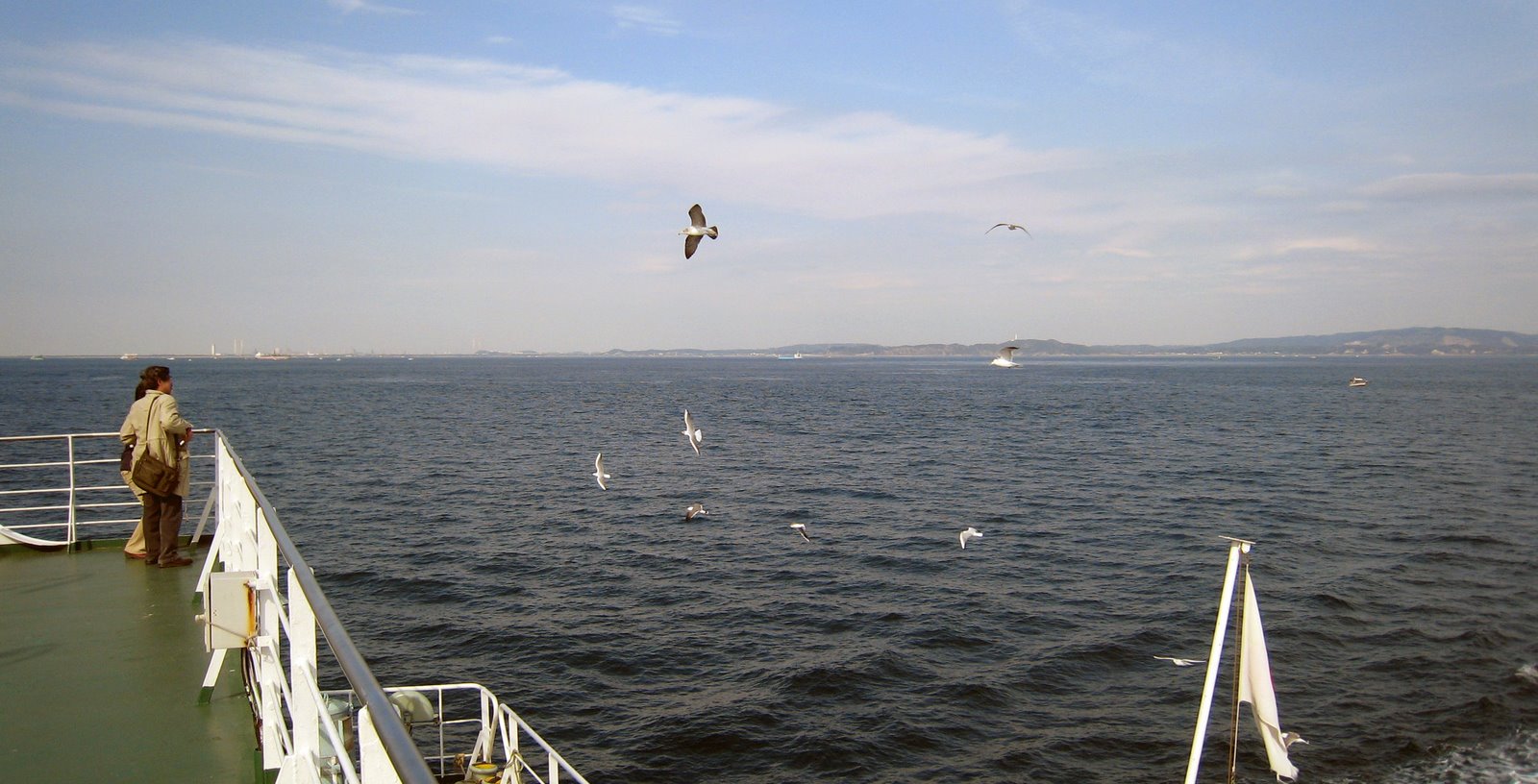
Then suddenly the landscape opens and we have reached the cost in Southern Boso. Phil is heading back to the North and I continue along the coast road which is clogged with cars. But soon I turn to road #89 and another splendid ride through rice paddies and hills open up. I reach the coast at the end of the road and check my watch: Only 30 minutes left to reach the 14:35 ferry to Kurihama on Miura and more than 12 km to go – I need to hurry up. Luckily this coast road is not that crowded and I make good speed. The ferry is in the port and waiting for me. My bike is fixed by pros against the effects of heavy seas.It’s now time to say good-bye to Chiba.As I had no time to east so far, I visit the ferry’s kiosk and check for some food. Hm, here they have all kind of good food on sticks: dark brown croquettes on a stick, light brown eat balls on a stick, an older mobile phone on a stick – I ask if they can warm it up for me.
After 40 minutes the ferry arrives at Kurihama. I line up in the car deck and wait for the front gate to be opened.And I continue my ride in Miura, first going South along the coast, then cutting over to the West coast and heading in direction Kamakura. The pace is good, but the traffic is just terrible.For a moment I think about having coffee at the restaurant German Seacastle, but when I come close to the place I reconsider. I am just too afraid to enter the place alone. This is a restaurant as no other in Japan, a typical German restaurant where one is served unfriendly and rude and an atmosphere of fear and terror let all guest stare at their plates, silently east their meal and try to avoid to attract any attention.

So I continue to Ofuna where I pack my bike again and take the train home to Shinyokohama as I really hate riding the last 20 km or so through Yokohama city.

Home the day turned out to be a mid distance ride with surprisingly lots of climbing meters. It was a good training for the forthcoming endurance events and I would like to thank Phil for his good companionship.

4 Kommentare

Eingeordnet unter 2009, Mob

To the edge of Chichibu

Ludwig and me started to explore the trail of Chichibu in autumn last year. Although Chichibu is a massive landmass, second in size and roughness only to Wales, we already felt that we have explored almost all trails in Chichibu by now. So this time we ventured out further to the edge of Chichibu.

As some of you may know, the edge of Chichibu is called Gunma and sometimes Nagano and is basically identical with the end of the world. A guy called Tanaka had built in the seventies a town behind the edge of the world which is called Niigata. This is even behind Itoigawa.

And as it can be very far to the end of the world, Ludwig and me decided to meet (relatively) early and head out directly to Chichibu city, without trying any „shortcuts“ or adding any numbers of interesting climbs.

Of course we could not pass through Ome without stopping at the Aurore bakery; a Pavlovian Reflex for every Positivo Espresso rider by now, just as the 7-eleven in Takao. I guess that if someone of us is called on the phone and the other party says: „I am standing in front of the 7-eleven …“, then before even listening further one would assume that the person is standing in front of the 7-eleven in Takao. Even if we know that the call is from Mozambique.

And of course we could not ride up Yamabushi Toge without starting a competitive time trial which Ludwig won easily. The last time I saw him on the slope was when he was pedaling with his hands and whistled „Yankee Doodle Dandy“ while sitting upside down on his bike. Yankee Doddle Do or Die.

After a fast ride into Chichibu and a short break we rode further along road #140, the same one we had taken with our sherpa David in autumn, when we dared the climb to Mistumine Toge. But shortly before we went ride on road #210 in direction Otaki dam.
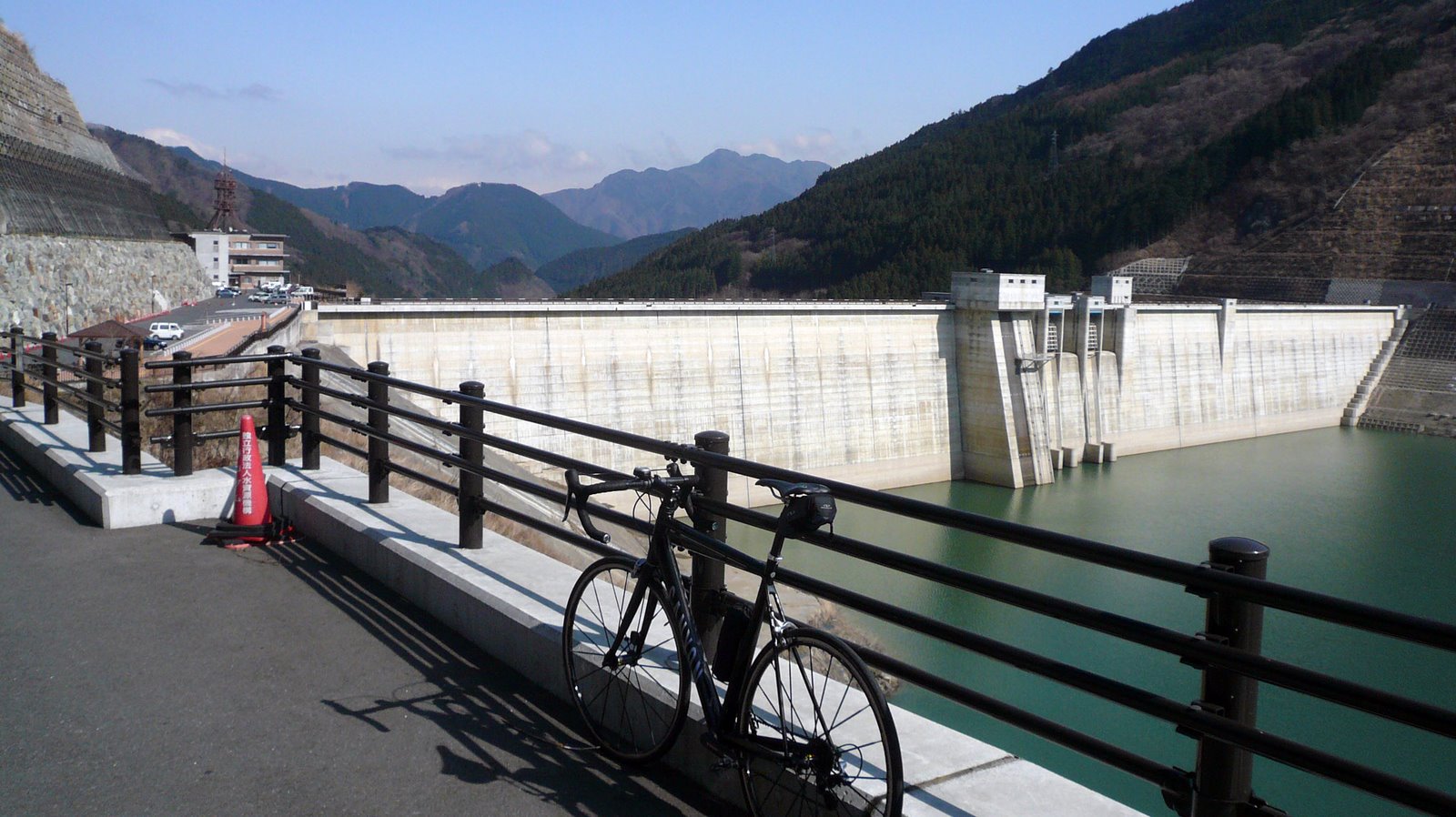
Now, here it starts to get impressive. Shortly before the dam, there is another loop which I assume would be a nightmare for Laurent.Wow. If this is not impressive, I don’t know what is [I don’t mean the shitty plastic bike with integrated ashtray in the foreground, but the magnificent engineered dream in the back]. Still I have the feeling that there might have been a less costly solution feasible for this road construction. In particular considering that this road is mainly connecting the industrial centers of Chichibu and Ensan.
Here we can see a very impressive Cervelo bike, mainly in orange. Further we went, riding along the lake towards the edge of Chichibu. It now became also a little bit colder. After coming home I found out that the Ciclo has recorded a max. temperature of 27 and a minimum of 4 degree on this ride. How to you dress for this?Then the road forks off, one direction Ensan, the other one up to the edge of Chichibu and road #299. Here the roads there are not in too good a shape, so that’s why there are many construction sites along them. I somehow have the suspicion that the roads are in bad shape BECAUSE they are misused by heavy construction equipments to transport concrete, gravel etc. to these construction sites. This is in contrast to three brand new (2003) concrete lined tunnels, all in impeccable shape.

Of course all this road construction is absolute necessary for the benefit of Japan and its population for the following compelling reasons:

  • Ludwig and me can ride these rodes and brag about them later (most important)
  • There is one village with about 42 inhabitants (probably all 72 years old or more) which needs to be stably connected to the outside world for the next one hundred years
  • There is substantial industrial development in the area (I will come to that later)
  • The road is essential to the vital nationwide activity of „Indian summer leaves watching“
  • It connects a not important road to another one AND
  • One can easily hide Patriot missile launchers there to shoot down North Korean ballistic missiles (I can only hope that North Korea as some ISO9001 certification for their missile program)

Well then the serious climb starts and one gets to a nice example of industrial decline in Japan, which is so well documented in Deathopia. Thirty years or so ago, this must have been a quite big Nicchitsu mining operations, perhaps for iron, zinc or other ore, perhaps for Sauerkraut [actually the biggest mining operations in Germany, conducted by dwarfs with red jelly bag caps in the region of the Sauerland]. I wish that Meinolf will read this one.
old wooden workers d
Beautiful dilapidated architecture on both sides of the roads, dormitories, a small post office, but still there seems to be some kind of activities ongoing, probably gravel or concrete for the road construction.
Another long push and we find a branch of the road leading to another Mikuni Toge, possibly in direction of Nagano prefecture. We need to check this one out in May or June when the climate is more accommodating. Another push. The road drags on forever, finally at almost 1.300 m height we arrive at Haccho tunnel (not only bloody long with more than 800 meters but also useless).
We are pretty much done. After a short rest and the obligatory memorial photo (otherwise nobody will believe us), we ride through the tunnel which seems to go on forever. There is not much light inside, then we arrive finally at the other side,almost in Gunma. It is cold and there is still snow next to the road. But what a view:This time not obstructed by any plastic. Absolute fantastic – this must be the edge.

We then continued our ride back to road 299 and made a fast run for Chichibu station. Quite a long ride with 187 km plus and we are glad that we can hop on the train home which will anyway take hours. I phone home to say that I am late and exaggerate the situation to my son, telling him that I am in Gunma. He completely misunderstands me and tells my wife later that „I have immigrated to Gunma and will not come back.“ Perhaps forever.

http://www.mapmyride.com/route/jp/kanto/660123790261187997

Ein Kommentar

Eingeordnet unter 2009, Mob

Izu Hanto Training Ride

Ludwig and me decided that it was finally time to ride out to Izu.

So we one morning we took the Shinkansen out to Atami – living now close to Shinyokohama makes these types of adventures quite easy for me. We started to ride along the coast instead of riding up the killer Atami Toge straight out of the Shinkansen. Then we climbed up at Usami which was much nicer and with better views and headed straight for the CSC Shuzenji.Ludwig had his 2nd 2009 JCRC E class race scheduled there the next weekend, so we made some training laps on the tracks and discussed possible race strategies. From there on I remembered that I had once taken a small road to the South, but I could not remember where that was. We searched for quite a while but got lost or on gravel roads and in the end we decided to take route #80. Which was nice, small and leading to the South. And just might have been the road we were looking for.

From there on we followed the main inner Izu road #349 and #414 in direction Shimoda. One escape attempt to find a smaller roads through the woods led to some significant climbing before we ended up in front of a gravel road again. Back again to the main road.The wild boar sanctuary closed down due to the economic depression it seems.

Then we reached Amagi Tunnel, the highest point on this road and we decided not to take the boring, modern road tunnel but climb even higher to the old Amagi tunnel which was constructed in the 19th century (Meiji). Of course another half gravel / rotten asphalt road but I didn’t minded any longer.For every civil engineer a wonderful tunnel, just straight out of forgotten engineering wonderland. An older couple asked Ludwig to take some photos and I complimented them on their good choice of the photo motive: Meiji tunnel plus Meiji car in front (plus almost Meiji couple in front of the Meiji but I refrained from saying that).Of course the tunnel has not only an entry in the „spooky place of Japan“ list, but it was also the scene of some love adventures described in the book „Izu no Odoriko“ by Kawabata, later made into a movie, even later made into a major express train.

Then the descent including the famous 414 loop. Due to our main attempts to shortcut we lost a lot of time and when we finally reached the coast it was already pretty late. So we started the after-burner and rode fast along the East coast. Traffic was not great but OK and after a further detour, we finally reached Ito station where we had to wait quite long before we could finally catch a train home.

A very enjoyable trip with a lot of climbing but also some fast runs. I hope that there will be more opportunities to ride in Izu this year – there is still so much more waiting to be found down there.
http://www.mapmyride.com/route/jp/izu/191123738286321953

3 Kommentare

Eingeordnet unter 2009, Mob

Multiple Mental Challenges

# 1 : Jerome’s Hill

An interesting day today. I started to ride out early in the morning as I had to be back home by noon. With only 4 – 5 hours riding time available, I thought it would be nice to revisit Jerome Hill. I haven’t been there for a while, felt strong and thought that I might finally top Tom’s 2007 record.

The pace along the Tamagawa was fast, constantly in the 34 – 36 km/hr range. Another rider tried to stay in my draft for quite a long while but in the end I was able to get rid of him. It is rare indeed that somebody even tries. I think I know now very corner along the Tamagawa. Before coming to Mutsumibashi I crossed the river and rode along Charles country road, a very short shortcut but still somehow one of my favourite shortcuts. I don’t know why, but every time I ride there I hear the sound of helicopters crusing above my ahead. I feel paranoid.

After Itsukaichi I proceeded slowly, trying to preserve all power for Jerome’s hill. Then the explosion, start, accelerating at the first flat part to 40 km/hr plus. At least for the first two minutes I could stay above the 30 km/hr threshold. Another two minutes above 25 km/hr and still below 170 bpm heartrate. The slope continues to become steeper, I went down in speed. Then as usual the point is reach where I have no sprinting power left and I want to give up. I try to stay in a slower, steady pace for 30 seconds than accelerate again. Now I see that I am already at the last bend. I look at the watch, it looks OK, I can still make it, so I give everything, my heartrate goes up to a maximum of 177 and just before running completely out of steam I reach the top: 7:59 min, an excellent time for me, in particular this early in the season. One year ago I was hovering in the ten minutes range.

I spend three minutes on the top trying to get my breathing rhythm in order and my pulse down. Within two minutes my pulse is at 110, I can breath again and I start the decent. I feel good, the road is dry and in good shape and I reach 69.7 km/hr speed. Wow, that’s fun. But despite all this wonderful fast runs I still run the risk of coming home late. So I ride home very, very fast, there is no better motivation than remorse. In particular if I promised something to my son or daughter. On the Tamagawa a rider in an old Lampre fit overtakes me with 40 km/hr plus. I hang on but cannot for long, than I notice that his speed is dropping as well. So I overtake him, he overtakes me, than I overtake him again for the last time. He is giving up.

Through the hills of Yokohama and back home after 117km in 4:27hr with 26.0 km/hr average speed, inclusive all breaks. Nice fast one.

# 2 Figure Skating Exhibition

I guess that figure skating is a sport about which you will not find too many entries on this blog.
However, for my family it is the most important sport, even more important than cycling (me), soccer (my son) and table tennis (my son and me). This is because my daughter goes to figure skate training every single day in order to fulfil the lifelong wish of her mother, that one day she will represent Japan at the Olympics or World championships. In case Japan doesn’t work out and with double citizenship in the backhand, we can still give it another shot in Germany. Which is way easier.
My daughter spends more hours per day on ice than I do on my bike.

On Saturday there was an exhibition show at her club’s skate rink in Shin-Yokohama [Prince] and training was intensified in the days before. Our house was pure panic the last days before. My son and me got somehow neglected, we had to manage food, clothing, tidy-up all by ourselves.

Then on Saturday, after riding out to Jerome’s hill we took the subway to the skate rink and watched the exhibition. Figure skating and cycling have some things in common I noticed :

1. Spandex: but at least cyclist wear black, whereas female skaters wear this flesh-colored things that look like compression bandages in home for the elderly.

2. Otherwise generally terrible clothes. Really, there is not much difference in designs. At least in figure skating there are no brands patched all over the jerseys.

3. Absence of good looking females. Yes, a sad but true fact in both sports. You can see better looking mothers in front of the child care center of IKEA Kohoku.

I think that I am pretty versed in figure skating by now; a result of watching countless events with my wife in 16 years of marriage on TV (I mean the events were on TV, not 16 years of marriage). My favourite figure skater is still Oksana Baiul who had a wonderful, eccentric expression just like a princess from czarist Russia and was obviously one step over the edge. I am not thinking too highly of the Japanese skaters (Asada Mao, Miki Ando, Shizuka Arakawa etc.), but I prefer the Russians. From a technical point of view they might not be able to do all the fourtimes jumps, but they have a better, stylish, more polished performance and simply more aura. US skaters are technically very well but do not have to offer much else. With the exception of Tonya Harding for other reasons albeit.

Nevertheless watching hundreds of skaters in solo and group performances in about three hours is a challenge on its own. After having seen so may top athletes it is quite interesting to see so many different levels in performance, from top-notch (Nakano Yukari) to beginners. One begins to appreciate more and more the finer details and starts to understand that not every figure is easy to perform and always perfect. There are two major differences between pros and beginners: One is of course speed, moving from one figure to another, preparing for jumps. The other one is body tension. Yukari Nagano was like a tensioned bow, or a catapult. Amazing. The third one is style and rhythm.

Nevertheless it is a real mental challenge for me to watch for three hours.

# 3 Writing a German Essay with my son

His German teacher chose „An eerie meeting in the woods“ and my son had started his essay already in school with the description of a group of giant ants, breaking free from the ground and sucking in a group of hunters with their vacuum cleaner like giant beaks. I had the unthankful task to help my son writing the end to this essay in a form somehow acceptable for his German teacher. As the story was already going very much in a direction of more and more violence and I didn’t felt that I could change that without being immediately discovered as my sons secret helper, I tried to polish his writing style and grammar as good as I could. As a result a lot of blood has been sprayed in the forest. But at least in style.

A very special challenge.

Hinterlasse einen Kommentar

Eingeordnet unter 2009, Jerome, Mob

Powerclimbing with TCC

Last week I arranged secretly a Positivo club ride with the TCC. I didn’t know that all of this would end up in another chapter of the „元気じゃない物語“, the modern sequel to a famous book from the Japanese Heian past.

All of this required quite some work behind the scenes, including a reconnaissance trip two days before the actual ride to check out the road conditions on one of the long climbs to conquer. Quite cumbersome, the next time I lease some drones.
David, Jerome and me met at Tamagawahara bridge at 8 and we planned to meet the TCC group, including Tom, assembling at Itsukiachi, on the top of Wada Toge. This would spare us the embarrassment to let everybody wait on the top for us.

We got a very interesting combination of „dressed to cycle in spring“ together: I was packed in long bib shorts, three layers of jerseys plus additional windbreaker in the saddle bag plus overshoes. This was in view of my information gathering two days before. Jerome on the contrary wore short bibshorts, short sleeve jersey and below his famous and beloved fugu fishing net. David was somewhere in between.From the first minute on, we felt this immense pressure to arrive on top of Wada before the TCC and we zoomed along the Tamagawa at breakneck speeds. We were way ahead of schedule at the entrance to Wada and went up slowly as we had to preserve our strength for a) some of the longer climbs to come and b) to show off when riding with TCC. Definitely we were in competition mood.
The gates of Wada were open and the road all clear, this was different to the last time I went there earlier this month. So when we arrived at the top of Wada I immediately called Tom and wanted to tell him that we are already waiting for hours, but I couldn’t reach him. We waited for some time but nobody arrived so it would have gotten boring if not for some entertainment provided by the mountain witch (山姥) running the tea shop at Wada toge.

One middle-age couple in a car, obviously new to the area, was parking in the tea-house paid parking lot where you have to pay rates which you would normally expect at Roppongi Hills and similar locations. The car was already parked when she dashed out of her Lebkuchen house and advised the driver in he usually crow-like, persistent voice that he should move more to the back. That was not really necessary, but as she was the witch and he only the tourist, he obliged and moved the car back by app. 12 centimeters when she started to panic and shout „Stop, Stop, not that much!“. What a great welcome.

Would anybody support me if a write a petition to the Monbusho to nominate her as living national treasure [category: witches, magicians, demons, cursed and supernatural]?

Now as TCC was not showing up, we were even more afraid, that we would be overtaken on the slopes of the golf course hill leading to Kobu Tunnel. This is really frustrating because as per Japan Cycling Road Racing Climbing Association / Committee of Definitions and Abbreviations / Subcommittee of Hill Climb Locations Definitions, the climb through the golf hills is NOT recognised as an official climb but only as „a leisurely ride through the hills of what is left of bubble era Japan“.

That’s why we decided to move on. As usually David, who is the fastest downhiller I know, led the way through Fujino, the descent was really fast and beautiful this time with new fear to meet spots of ice on the road and a fantastic view on Mount Fuji.
From the bottom of my heart I can say that I really hate Uenohara and I hate the climb in the golf hills in particular. One is riding up and finally when a rhythm is found and some elevation gained, one is going down again. On the left and the right people are playing golf instead of earning a living or doing something meaningful with their life, for example: cycling. Sorry, I couldn’t come up with a better example but I think the readers of this blog will understand this example most easily.

Finally we reached the entry to the Kobu tunnel. Jerome, who will attend a marathon within short time, had sticked to his training concept, which can most easily described as: No training. Doesn’t have impact anyway. So he was quite exhausted when he reached the tunnel and throw his bike against the steel barrier on the side of the rode. One can clearly seen the bended steel bars in the photo below, while there is no damage to his bike visible at all. This clearly proofs the superior material properties of carbon fiber compared to steel. As there is also clearly damage visible to the body of Jerome, one can further assume that he is not as strong as carbon fiber or steel.
Still no TCC group in sight. So we thought that it would be OK to get overtaken on the approach to Kazahari Toge and started another wonderful descent with David in the front. Again he won the „reverse polka dot“ jersey as fastest descender and I had trouble to stay on his wheel.

Well and then the long climb to Kazahari or Tomin no Mori started. I was still feeling good and moved away from David and Jerome already at the start of the climb. As usual I got overtaken by a few lightweight, young Japanese riders but I was going steady thanks to the change to a compact crank on my bike. So I passed Sengenzaka without feeling the urge to jump into the hot water there and looking out from the pool on the road watching other cyclists struggling.
I like the climb very much, but there is one part, after the deserted toll booth with is long and straight and seems to take forever. Long and straight roads are demotivating me. I like small and bended roads where one cannot have any idea where they are leading and how much longer they will wind up.

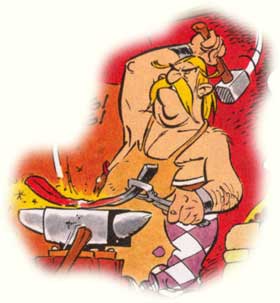
All in all I was pretty exhausted when I arrived at Tomin no Mori. It was also quite warm and I finally decided to get rid of my undershirt. I also shed some extra weight at the toilet there which I assume had some negative impact on my performance going up. I hope they can re-use the place by now. To show how fast I was, I ran to the shop and ordered a bowl of Soba which I wanted to have finished and placed in front of me when David and Jerome arrive. But first it the shopkeeper, who always reminds me of the village smith in Asterix took forever to prepare it and then much to my surprise Tom showed up. He told me that he was on he heels of the TCC group which has passed Tomin no Mori and then he rode away again.

David and Jerome arrived some time later. They had taken a break at Katsunuma. Jerome was in even worth shape than at Kobu Tunnel which is always a good sign that he will became much, much better later during the ride.
Finally on the top of Kazahari (without snow, so yet another misinformation from me) we met the TCC group , but again we decided to speed ahead after a short break and started the most wonderful descent on the back of Kazahari. Normally, when climbing up on one side and going down then on the other, I only have one thought and that is „How lucky that I went up the other side“, as the road I am going down always seems so much steeper than the one I went up (good example: Nennogon in Chichibu). But this is not the case for the road now leading down from Kazahari to Okutama. For years I thought that the climb from Okutama would be much steeper and longer than from Itsukaichi. Not true. And now, after all the construction the roads are in fabulous shape and one can go down really, really fast.

The roads at Kazahari are frequently used by bike and car racing types and the sound of ambulance cars coming to the rescue is not infrequent. By providing an even better playground for racing at Kazahari I am sure that in the years to come even more racers will flock there, enjoy an accident and a longer stay at a hospital or graveyard. Which is probably part of a brilliant strategy to keep the rest of streets in Tokyo safe.

At the Okutama lake I finally met up with the TCC group and continued to ride with them. There were some guys I have met early (Alan, Naomi, David) and some I didn’t (Steve, Phil and some others) and just by chance our complete failed Tsukuba Endurance Team was presented. We continued at a surprising leisurely pace towards Ome and I was drafting first behind Tom and then behind Phil. Drafting behind Phil is much better, because drafting behind Tom is like trying to hide behind a baseball. I will use this example to illustrate my class at the ICU the difference between „riding effectively“ and „riding efficiently“.

We made one more stop at a convenience store close to Okutama station (the Western most conbini of Tokyo as it proudly announces his superior service quality, but it was still better than the one we dropped in at the TCC run in January). Here two memorable things happened:

First David A went through a door in the convenience store on which was written in very big and clear Japanese letters „THIS IS NOT A TOILET“. And then he stayed behind that door forever. I am not sure what he did there and I hope that he did the right thing in the right place.

Then without noticing, a lonely group of two Bosozoku (暴走族) riders had parked their scooter next to the store, but there not seemed to be of the dangerous type. However, when they started the engine again, almost immediately the sound system (I guess that 90% of the horsepower is used to provide electricity for the sound system) was engaged and the sound of the most dangerous music on earth wailed through the former peaceful valley: ENKA ALARM! 

Well Enka is basically one song with infinite variations and performed by the most beautiful women on earth like this, this and this.

We barely survived this heinous attack but still today thinking back to the day I hear

アンコ椿は恋の花

ringing endlessly in my ears. Especially after Alan and Naomi told me that they went to Izu-Oshima, an island famous for this flower.

So we made a wise decision to leave and continue to do the last climb of the day which I described to all TCC riders who were unsure about it as „a piece of cake“. In fact it is again another climb of 400 meters up and while Tom, his Vlaams teammate and David A rode ahead as nothing has happened earlier in the days of climbing, Steve and me battled it out in a constant fight up the slopes at approximately 8.2 km/hr. He completely misunderstood me when my answer to his question „How much is it still?“ was „About 280 meters“ which of course is the official style of answering sanctioned by the Japan Cycling Road Racing Climbing Association / Committe of Definitions and Abbreviations / Subcommittee of Hill Climb Quick Shout Definitions and ALWAYS means „280 meters up in elevation“ and NEVER „280 meters forward“.

As Steve thought that the top of the hill was near he gave everything for the next three kilometers or so, probably thinking that this was natural distance-guessing tolerance. We arrived on top almost at the same time, where I could barely stammer „see, piece of cake“ before being subdued by the forces of gravity and falling to the ground.

One after another also the other riders arrived and I have to say that I was particular impressed by Andy who seems to have made the full ride on his heavy steel frame MTB/hybrid type bike complete with back tray, fenders and all other kind of stuff that we normally don’t consider worthwhile to mount on our bikes. Well, as Lance Armstrong said „It’s not about the bike„, but by no means I would like to imply that Andy is perhaps using EPO. Steve also has a nice KLEIN bike which has a particular good paintjob and is changing colors depending on the angle looking at it.

We then took the much better road down on the other side and immediately Alan had a flat tire. This is the second time I ride out with Alan and he experiences a flat. So I was talking with Tom about the problems of international marriage and even before I could finish the account of all the troubles with my wife (a very short list indeed), Alan hat changed the tire and we could ride on. Incredible. Or impossible. So I still assume to this very day that either he had a spare wheel hidden in the jersey behind his back or that he simply exchanged front and rear tire and just pretended that everything was fine.

The road was getting much wider and better now and as the hard part was over, Phil, Tom, Vlaams and me started to go really, really fast and overtake each other. That was fun.

The rest was eventless, we split at Itsukaichi station, some of the guys went home by train, some by car and I had still to climb up to Tomin no Mori where I have parked my rental car. Sorry the part before Tomin no Mori was made up, I admit that.

All in all a very enjoyable ride, 171 kilometers and 2.800 meters of climbing. It would be nice to repeat this from time to time with the TCC guys.

Later David wrote me that Jerome and him moved along the road further to Ome and then home along the Tamagawa. As suspected, Jerome pulled him all the way home. Which is what he usually does after fooling everybody for 90% of the ride that he is in bad shape.
5 Kommentare

Eingeordnet unter 2009, David, Jerome, Mob, tcc, Tom

Where have I been ?

I made a longer trip yesterday in beautiful weather. Can you guess where I have been? I went up to this place and waited for the monster slope I have heard about. The approach was steep but not monsterwise. So I thought all reports so far were exaggerated. Until I went down the other side – I had to pull the brake levers all the way to the handle bar and I was virtually sitting on the rear wheel while sneaking down at 10 km/hr. This is not a road. This is a wall. I also tried this new climb – no cars just silence, quietness and peace 300 meters up. Glad I made it.

3 Kommentare

Eingeordnet unter 2009, Mob