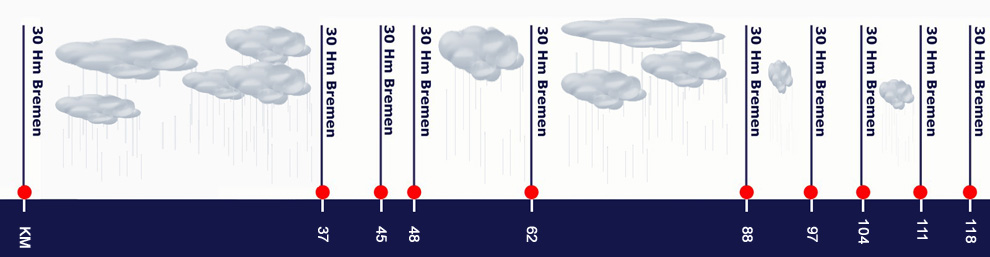
as taught by Theo Bos at the Tour of Turkey:
Archiv der Kategorie: 2009
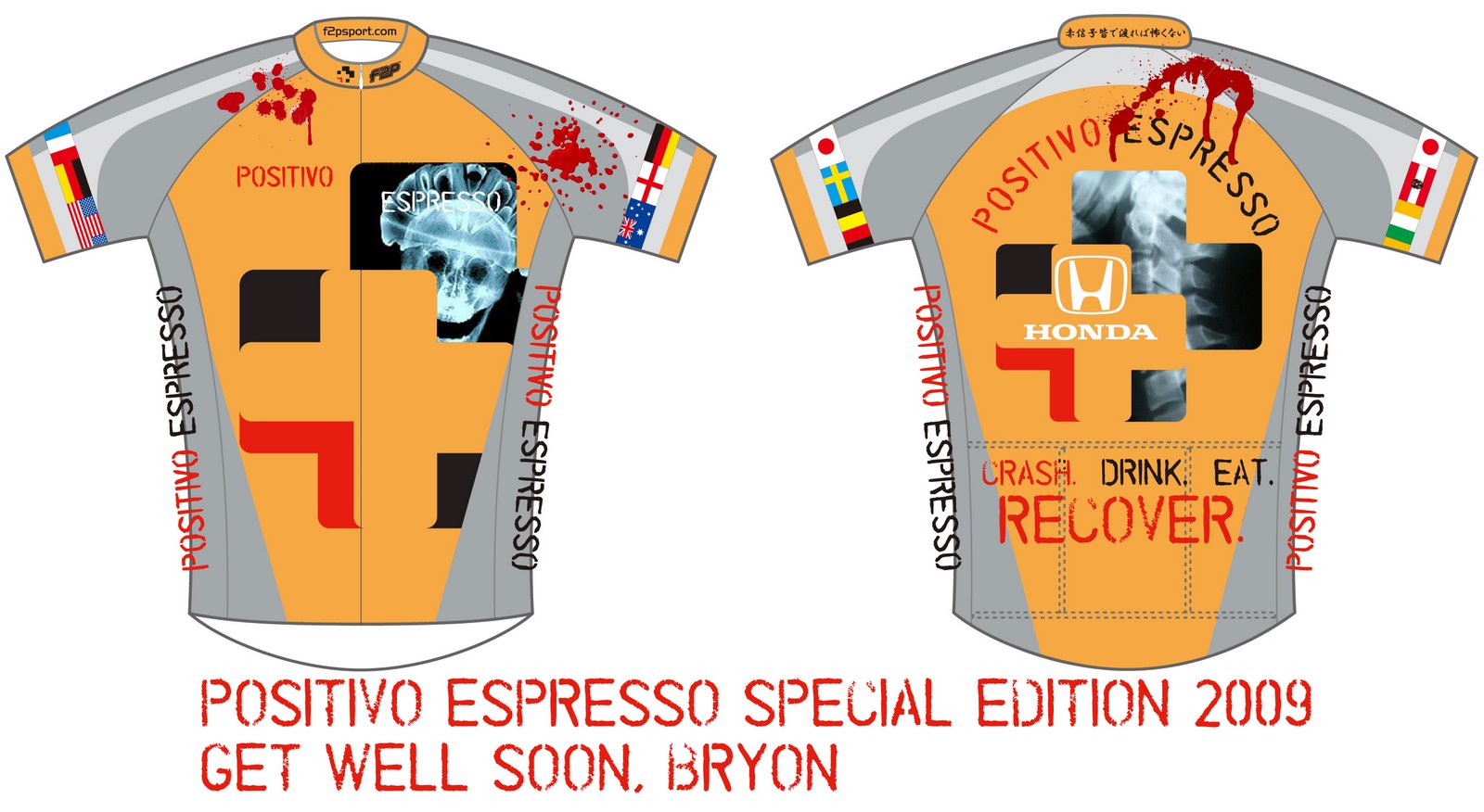
Get well soon, Bryon
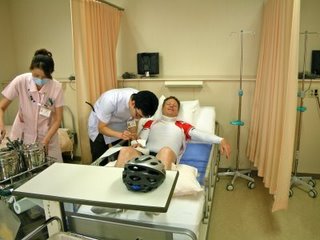 Still shocked about the crash of Bryon last weekend. Yesterday I read by chance about it on the blog of James.
GET WELL SOON. [Excuse my girlish sentiments]
赤信号や
白いホンダが曲がって
落車の音
白いホンダが曲がって
落車の音

Eingeordnet unter 2009
Tour of Japan : Tokyo Race
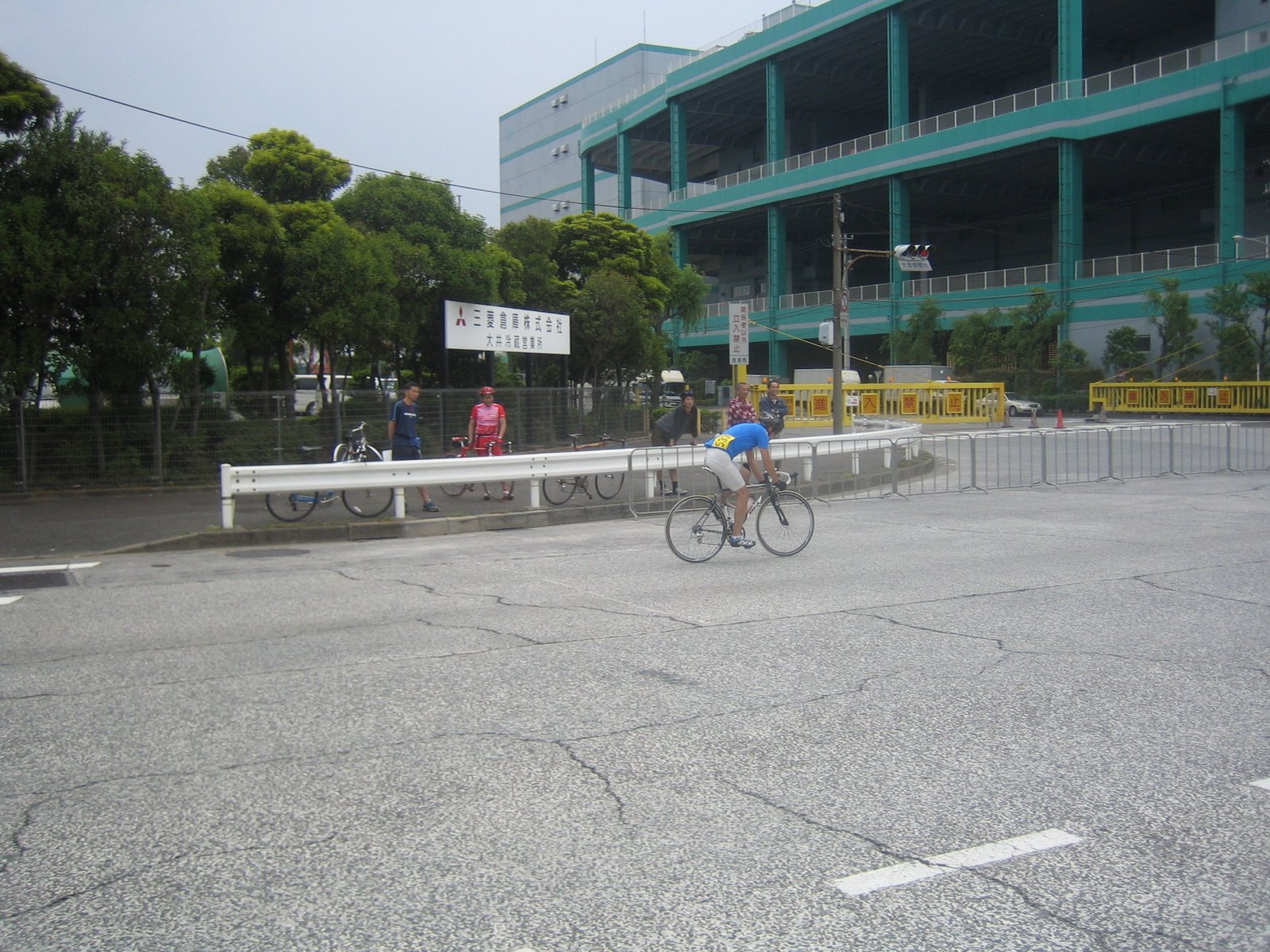 The 13th Tour of Japan, a professional race will take off next month, and also this year it will be linked with a „amateur race“ in Tokyo. It is time to register and seize the opportunity to crash right in front of your house door.
Yes. After a look at the course map (if there is any), you may think „Hey this race is dead flat and looks quite easy – even I could win that.“ That is what we all think. And not even us, but also about 12 Million other Japanese citizens as well who might think that they should try their luck at a first cycle race. And why not? It is hold in Oi-Futo, the port of Tokyo where riders flock on the weekend to show-off their new carbon bikes and race against others on the wide streets normally crowded by container trailers.
Well, everybody can win this race, provided he is of average strength with the field AND he arrives at the finish in one complete piece, bones, organs, flesh and muscles all orderly lined up in the right order as they should be.
Because this particular race has, and I can say this from the experience of attending it the last two years, some major risks :
- A lot of idiots are attending and serving crazy over the course like there is no tomorrow. Never, ever think about racing in the beginners field.
- The track does not only have some sharp turns, but also probably more drains, manhole covers, uneven asphalt surfaces, metal sheets and corrugated steel covers per kilometer than there are cobblestones plastered between Paris and Roubaix.
- And, if in addition the race is hold in pouring rain, like last year, the risk that you slide in a twisted amalgamation of riders right into some guide rails is multiplied by the factor ten.
But after making this rather factual statements, let’s come back and dwell a little bit more on the details: As every year the race is organized by Nikkan Sports, the popular sports newspaper which publish these fantastic articles about baseball, horse racing and groping techniques on the Saikyo line. Nikkan Sports has a huge distribution and attracts a lot of its readers to attend the race. so be no surprise if the guy racing next to you thinks about baseball, horse racing or other things while riding straight and at high speed into the hairpin curve.
The track is 7 km long and has to be passed three times, making the total race distance to 21 km, which is about the common flat type race in Japan. One nasty U-turn, three other technical turns but at least the finishing straight is very wide and almost free of obstacles.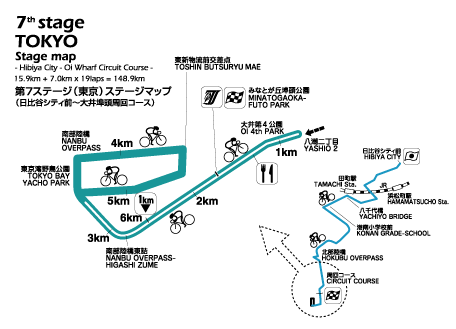 The right track is the one in question. The left track is the one used by the pros before they spin some laps at the end of the race on the right track.
One can attend in four classes (plus women and seniors) which are „High grade“, corresponding to S and A grade JCRC riders, „General 1“ (B,C), „General 2“ (D,E) and „Beginners“ (scum). For some reason which remained already last year a mystery to me, the most popular category is „General 2“, which is therefore divided into three groups (2A, 2B, 2C, so far, so clear) and you must submit your registration for one of them (2A, 2B or 2C, but they are anyway all the same). Of course it makes sense, for example if you have problems to get out of the bed early in the morning, to join the 2C group, as this one starts at 9:19 AM, as opposed to the earlier 9:17 AM start time of the 2A field.
In each General 2 field there are 70 places and you might want to register fast with Nikkan Sports. Registration has started on April 11th and tend to be completed very fast. A Japanese post offer transfer from can be downloaded here and after filing some basic information and paying 6.000 Yen the formalities are dealt with. If anyone would like to race against me – please opt for 2A. I am an early bird by the name of Kraehe.
By the way, the race is on Sunday May 24th and it might be a good idea to go there and spin some laps before the actual event to get accustomed to the place. The crowd is one of the biggest in any event (except of course for the famous Positivo Espresso New Year Ekiden Training Session) as they come to see the pros and not you.
If it does not rain one can also be tempted to watch the pro race afterwards.
A more detailed report about last year’s race is published at this blog, however I must warn you that I wrote this post under the influence of a book „English as a second language“ and you may not want to look at it on your office screen.
So I would be happy to meet many at you on the day in the port, if possible still in one piece.

COLOR
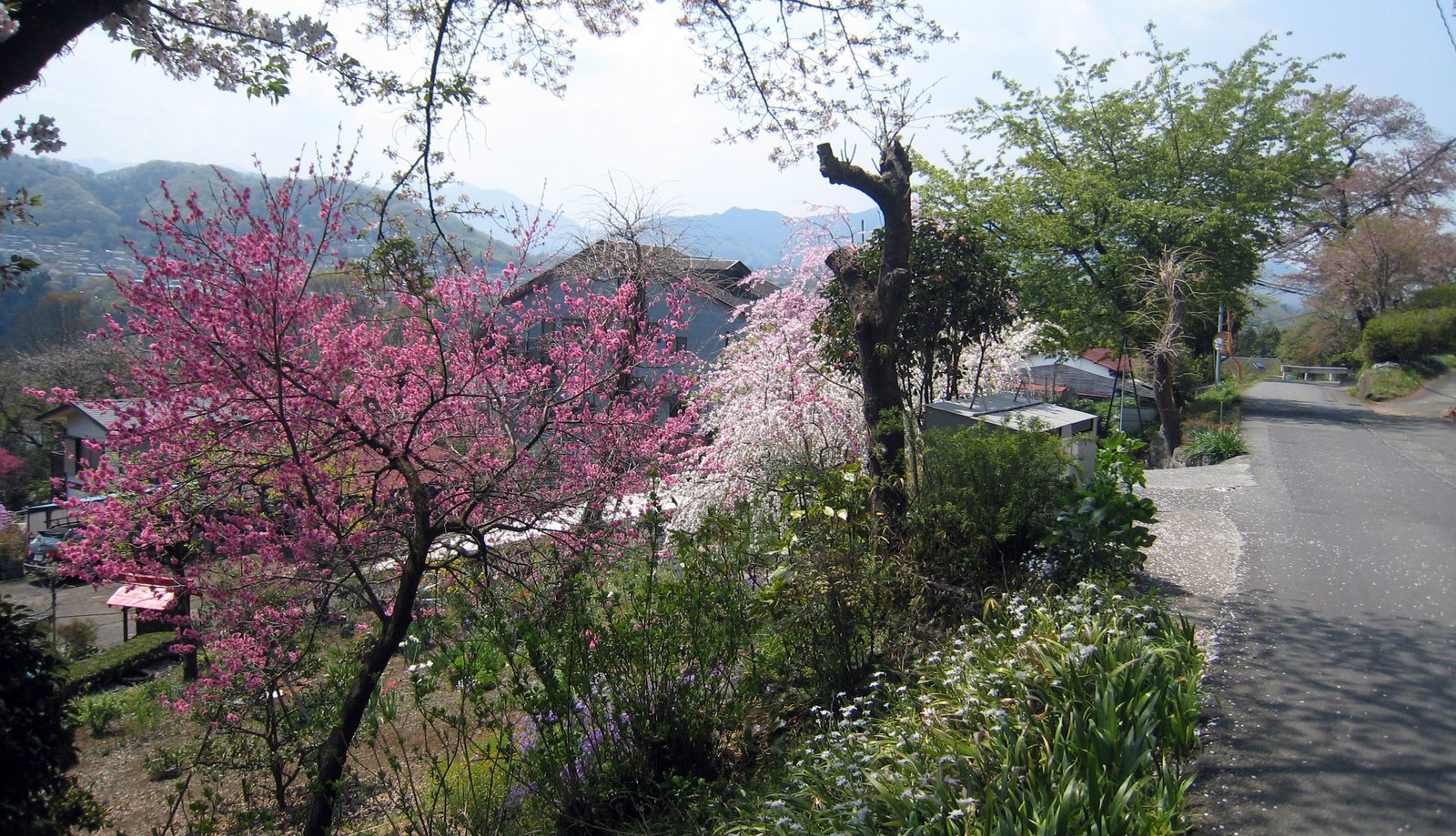 It is difficult to find a good book about a subject in which one is not interest at all. At least at first. One good example is „Playing the game“ by Ian Buruma which is even about two topics I am not interested at all (cricket and India) and is nevertheless a very good book, another one is „Flaubert’s parrot“ by Julian Barnes (the life of Gustave Flaubert) . Next in line would be „Color“ by Victoria Finlay, which is even a more fantastic book about a topic seemingly so uninteresting that one takes it for granted: colors and how one makes them to paint, dye and do other things with them.
 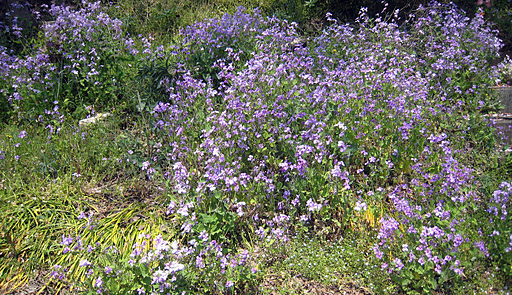 Every year, when spring comes to Japan, I start to see some new colors of flowers and trees when riding out on my bike. Plum and cherry blossoms for sure, then later camelia (tsubaki), the arrival of Ajisai equals the arrival of the raining season, later than Higanbana and my favorite Kosumosu in autumn, meaning that the nice cycling days will be over any time soon. How could it possibly happen that I developed a feeling for that, being a true engineer by heart. Should I not adhere rather to the different shades of grey, defined by the volume of added fly ash and portland cement in bare concrete surfaces of slope protections?
Anyway, on Monday, when riding out colors in Japan were at it’s best. I started at the Kan One from Tamagawa, where on the left side of the road there is this building which looks like it is experiencing severe kidney’s disorders. Every time I pass by I want to take a photo, every time I don’t want to stop and pull out my camera … is there some way to make good photos while riding without stopping, any hints?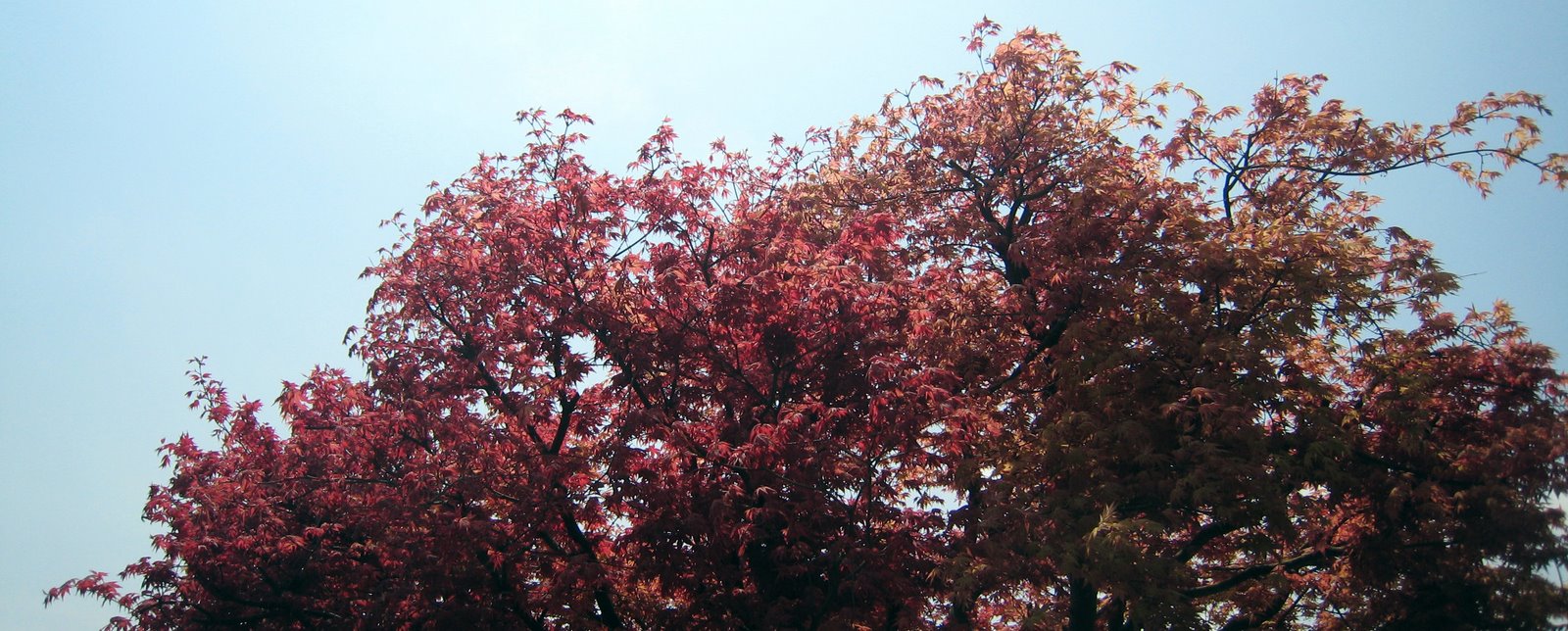 The tank road then was covered by a blanket of fallen cherry blossoms. Then, as usual I lost the way when I try to find the small road to the North of Tsukui lake and instead and by chance I ended up climbing to Shiroyama lake, David has posted about. This is indeed a nice climb and can be easily added to our Sunday routine as following :
MY MAP FOR 20 BEAUTIFUL KILOMETER THROUGH HASHIMOTO
I then found the entrance to the Tsukui lake road and continued along to Doshi Michi and Miyagase lake. After a short lunch at one of the better soba shops there, I started the climb up Yabitsu. The weather was beautiful, the roads were empty but there was a nasty head wind.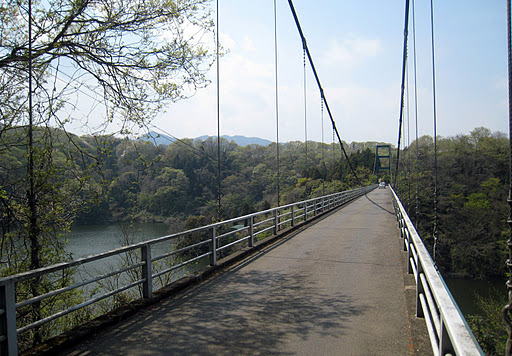 I desperately wanted to do a fast time up, which I did, but the best part was that apart from two stretches when the real climb starts, I could feel that I could hold the climbing tension. Especially the last part, from the tea house at the river to the top of Yabitsu was very good and I was exhausted but happy when I reached the top.
Without break I continued the descent to Hadano, then further boring 30 km to road #1 at Ninomiya, through Odawara and then further on to Hakone where I took the second break of the day. It was already 4 PM and I wondered if I should really climb up to Moto Hakone at lake Ashino or if I should give up. But hey, I have given up the idea to combine Yabitsu with road „#20 from Hakone to Atami so many times, that I really wanted to do it this time. Yabitsu and road #2, being the most beautiful cycling roads I know, and the combination of both surely must have been something similar to total cyclorgasm.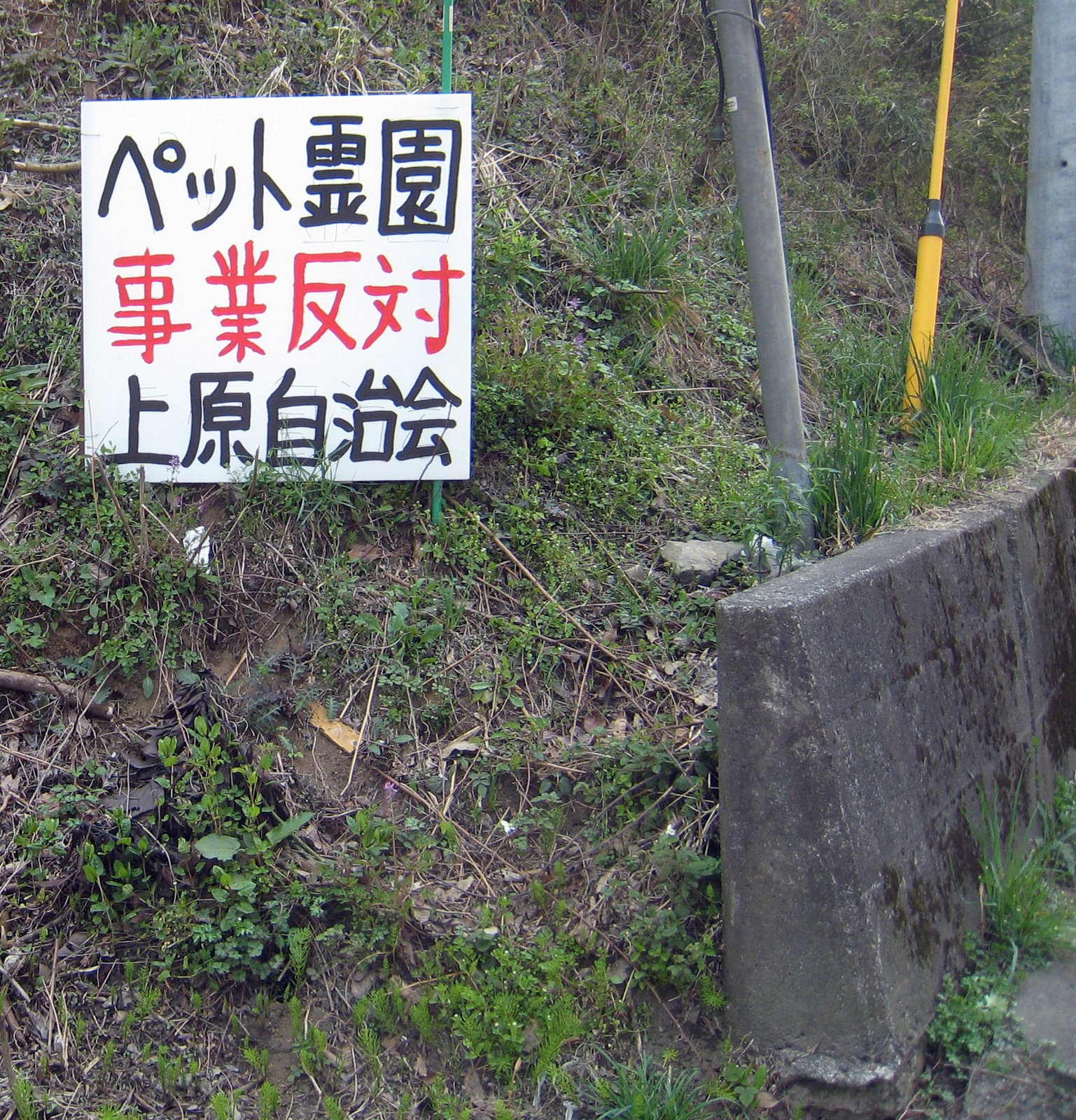 Alas, it turned out to be more of a combination of two favorite dishes from my childhood (cherry jam and pickled cucumbers). I was going up slow to Hakone, this took me more than an hour as my legs were heavy after having spend seven hours on the bike already. The weather stopped to be nice. No more blue skies, temperature dropped to 10 degrees and I had my wind breaker even on the climbs. Finally reaching the highest point of road #1, the surroundings were covered in mist. And it is different to climb alone than to have a huge support from the Ekiden crowd like in January.
No time for a break in Hakone, up to Hakone pass where the headwind was even more nasty. Instead of going 40 – 50 km/hr down road 20 to Jukoku pass, I crawled at 20 – 30 km/hr because of the blloody cold wind. Then down from Atami Toge to Atami. Seriously, every time I am going down and I start to have cramps in my hands from constant braking, I wonder how I could ever went up here. This is the OWI 2.0 killer hill, for sure.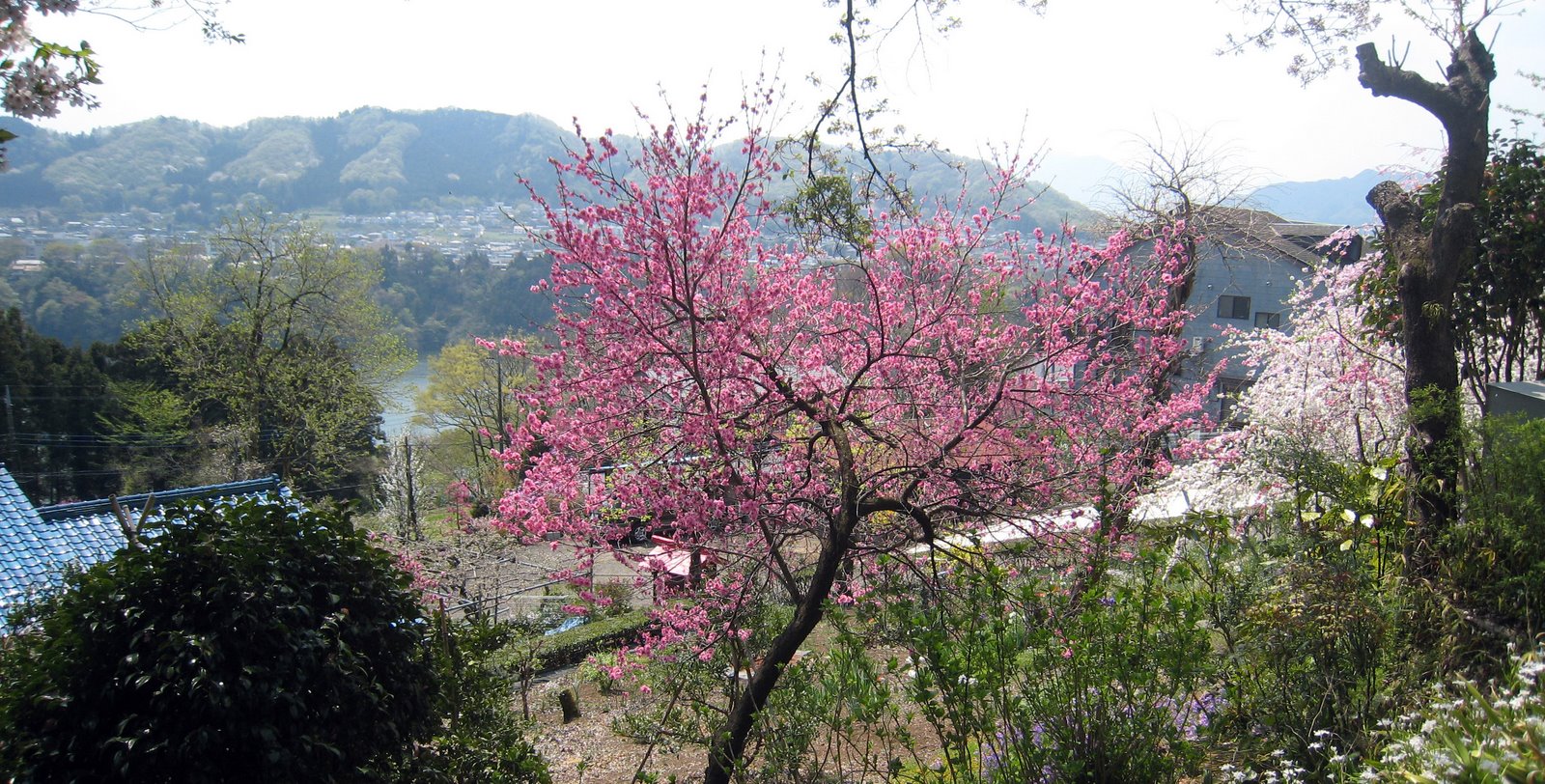 I had dreams of arriving during sunset in Atami, but the weather was not like that. Hoped the Shinkansen home, which took, including baging the bike, less than an hour.
A colorful trip with many facets in the end.
A 1.0 on the open Wada Scale
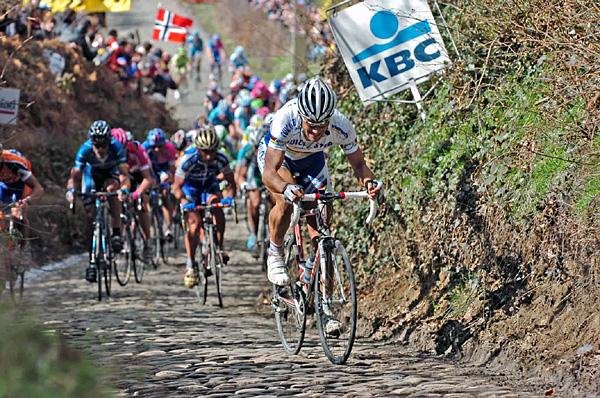 Yesterday, when I was climbing up Yabitsu and I was going steady and fast despite some headwind, enjoyed the ride and crossed bridges named „Hell swamps“ I wondered: Why are some climbs so easy and some are so different to complete? And the suffering has nothing to do with the distance, the elevation difference and the average gradient.
So I came up with the idea to setup a new unit , which gives a better idea of climbing pain. THE OPEN WADA INDEX [OWI]. An Open Wada Index of 1.0 describes the pain inflicted on oneself while arriving on top of Wada Toge after making a decent effort to chase one’s personal best time. This is of course a highly individual index, but I guess it serves well to compare other climbs to one’s own experience of Wada Toge. Which after climbing many mountains in Tokyo, Kanagawa, Chichibu, Yamanashi and Shizuoka, is still one of the more challenging climbs the Kanto area has to offer.
The index is open, because all climbs that are harder than Wada can be rated with a number higher than 1.0 and there is no upper limit for this. A typical Saturday ride by Tom, including more than 250 km of distance, more than 10.000 meter of climbing and passing through various strictly forbidden tunnels, roads and forest fires would perhaps score as high as 30 on my OWI scale, if I ever would be so foolish to undertake such madness.
Here is my OWI rating for some of the more common mountains and hills on our weekend rides:
- OTARUMI TOGE : 0.80 Not a difficult climb but one has to be faster than 15 minutes and the rest of the pack. Every time. [Takao approach]
- JEROME’S HILL : 0.82 Even faster. Full power from the start to the end not giving up. I am even more exhausted on top then for every other climb. [Itsukaichi approach]
- TOMIN NO MORI : 1.10 A very long climb with a very frustrating straight stretch close to the end. [Itsukaichi approach]
- YABITSU : 0.50 This is not a climb. This is like a weekend spend on a river. {Miyagase approach]
- MATSUHIME : 0.95 Long, but not unreasonable from Okutama. The approach from the other side would be more in the range of 1.2
- ATAMI TOGE : 2.00 Rode down yesterday and wondered how I could ever went up this one. An ongoing nightmare in 2005 with Juliane and David.
- KOBU TUNNEL 1.10 The last climb is OK, but going through the golf club hills is doubling the inflicted pain [Uenohara approach].
- YANAGISAWA 1.45 Long, long, long through the deserted landscape of Okutama. Not sure why, but not so attractive to me [Okutama approach].
- SHOMARU 0.85 The first two kilometers are always killing me but once I have found my rhythm this goes quite well. The end is also always more far than one thinks. [Hano approach]
- HAKONE 1.60 Still and after all the years, one of the most difficult climbs I know, also due to the traffic congestion and the gradient [Odawara approach].
As one get better, faster, develops more stamina, the OWI does not change if the roads are regulary experienced. If not the memory is playing tricks: One of the hardest climbs I regularly did was a small hill on the coast of lake Hamanakako close to Hamamatsu, where I rode my 60 km laps in 1998/99. This must have been a climb of perhaps 30 meter elevation gain, otherwise the lap was more or less dead flat. But still, this hill was killing me, so thinking back about this time, I would easily award it with an OWI of 1.0 or more.
But last year I was riding in Hamamatsu just for fun and I didn’t even notice the hill.
So, what are the Toge of Kanto with your lowest and highest OWI?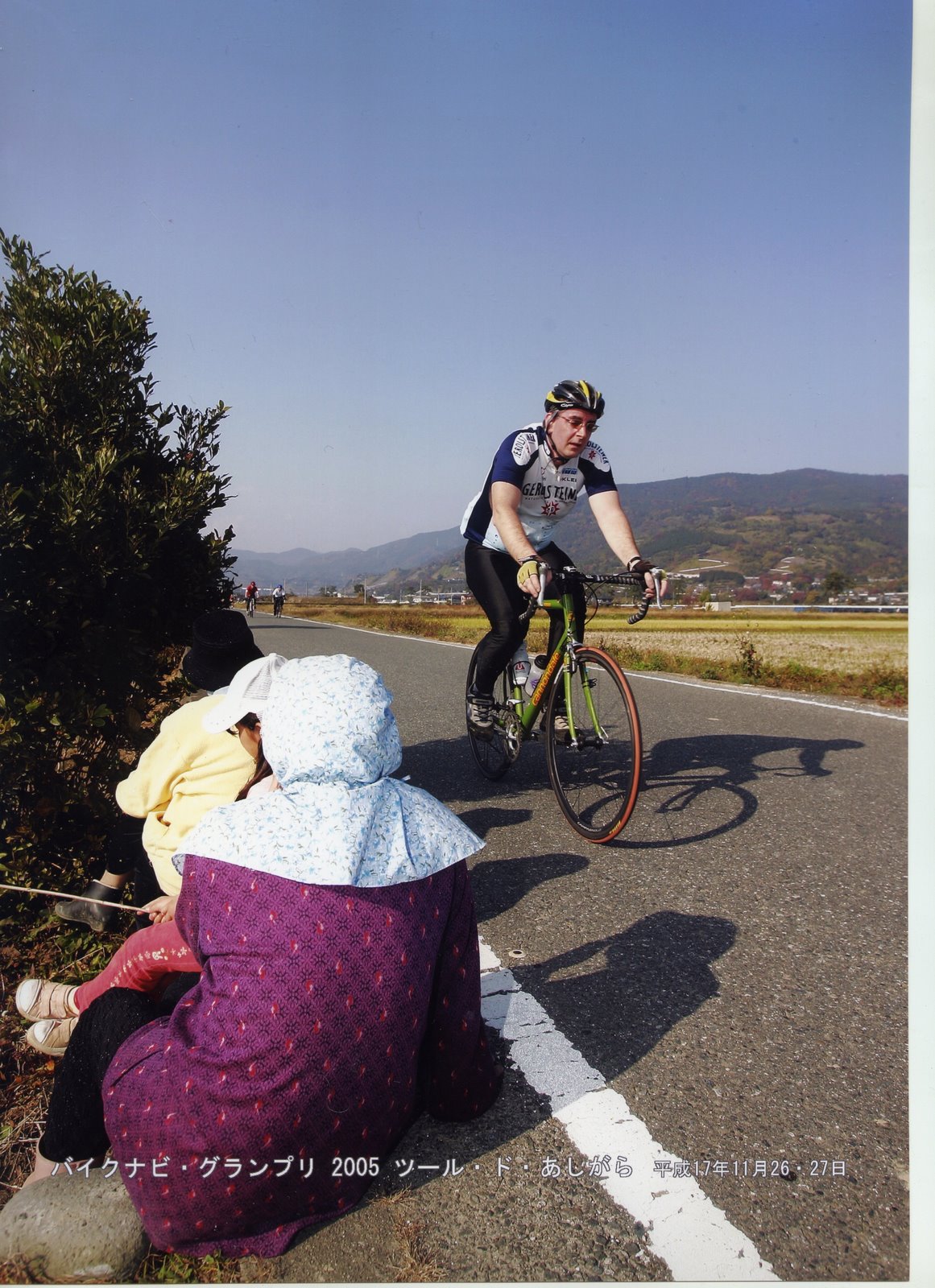 MOB experiencing an OWI of 3.0 in front of an enthusiastic crowd at one of his first solo races ever in Ashigara [dead flat course].
C A R E
 Laurent has started a charity project for the benefit of CARE and asked me for our support and to spread the word:
"I am trying to raise as much money as possible for specific projects run by CARE International. CARE is a humanitarian organization fighting global poverty through education and training to encourage self-help, social inclusion and economic opportunity. CARE also delivers relief in emergencies.
Some of you receiving this mail know that Societe Generale is partnering with CARE on 3 concrete projects in Peru, Mali and Bangladesh.

I have decided to actively raise funds for these projects by entering a fund-raising bike ride from Paris to London organized by SG in June (NB: We'll get on a boat to cross the Channel between France and the UK. I'm not planning to cycle under water, and the guy who used to part the seas isn't around anymore!). I think I will be the only participant from Asia and I am counting on a lot of support from friends in the region and elsewhere.I would also like to start an SG Asia team for future years!

You can help me by contributing financially either directly to me, or via my website  http://www.aiderdonner.com/laurentdepus You can also help by promoting this around yourself, to your friends, colleagues and family. Please help me reach as many people as possible.

It takes only a few minutes and every contribution counts.The integrality of your donation will be delivered to CARE. I and SG will cover all the expenses of the event itself.

I started yesterday with a 1000 EUR target but from the wonderful and immediate response of many people, I will be able to increase this target very soon. The sky's the limit.

Thank you in advance for your support!"

Eingeordnet unter 2009
POSITIVO ESPRESSO 2009 SEASON TEAM OUTFIT
After a longer break and some communication with F2P I finally found the time (and the renewed pleasure) to work on the Positivo Espresso Team Outfits for the 2009 season. F2P pointed out some inconsistencies in the designs which I corrected. I tried to address as much as possible the comments from the riders that have been forwarded.
So here is the latest design for the short sleeve jersey.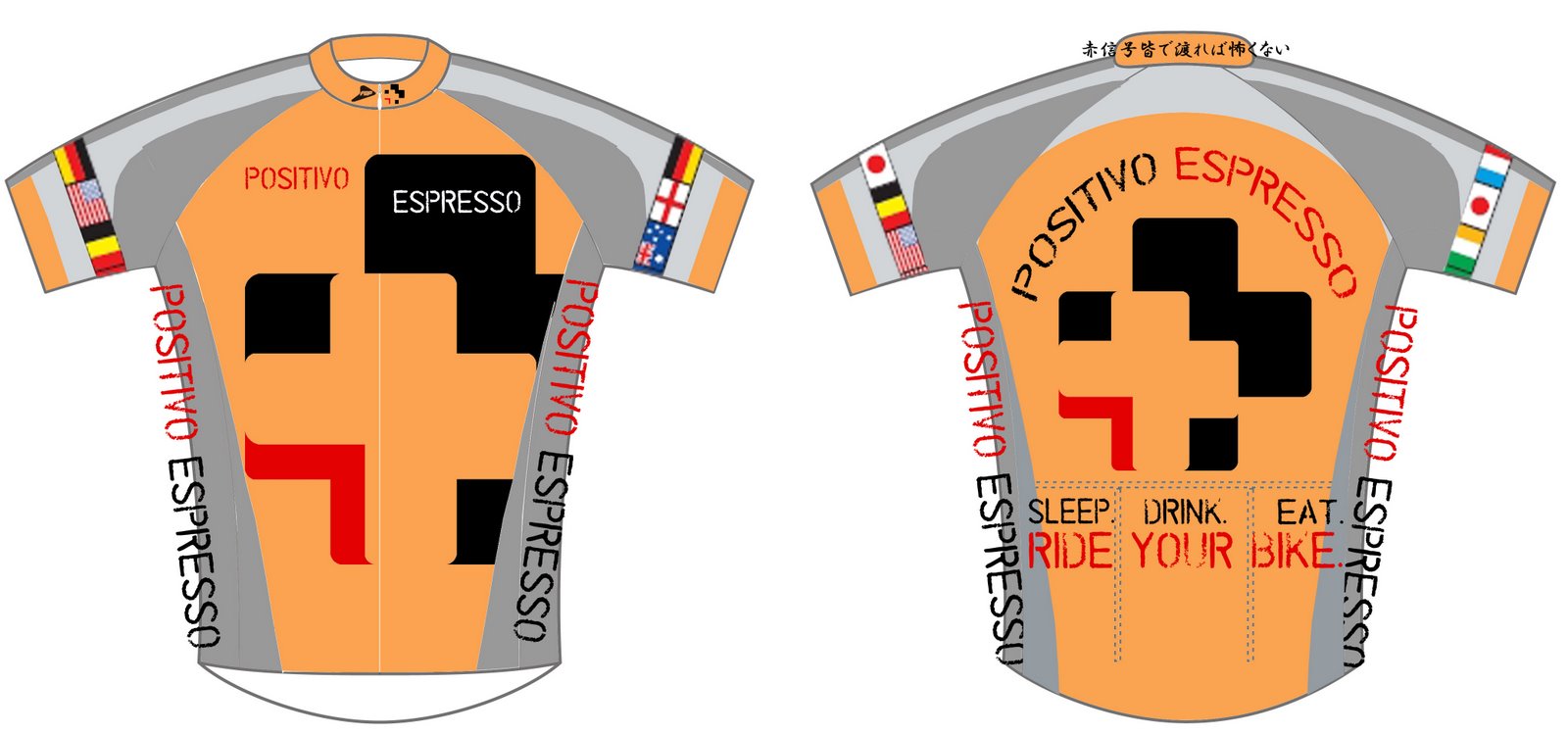 There was much more interest for the short sleeve jerseys than for the bib shorts, so I am intending to make this the main item for 2009. F2P also agreed to reduce the required minimum lot size, therefore we can finally start the production if everybody is OK with this design. I would like to add some comments
- The main colors (orange, light grey and dark grey are the same as for the 2008 design)
- These colors are also matching with the colors of the bib shorts, so 2008 jerseys can be worn with 2009 bib shorts.
- There has been a long discussion about the slogans on the back. In the end I concurred with some of the opinions expressed, that SLEEP. DRINK. EAT. RIDE YOUR BIKE. is somehow the established vision of Positivo Espresso and should be included on the back.
- I still like the Japanese[The light is red – but / if we all cross together / it won’t be scary] but I can also understand that there are strong feelings against it. I left it on the jersey, but minimized the size and put it on the collar. This has also the advantage that you can not read it in it’s entirety – which makes it some kind of secret message.
- We will have a full length zipper on the front.
- The general cut will be not PRO CUT but FUN CUT which seems to be more suitable for the majority of the riders that would like to have a new jersey.
And here is the latest design for the bib shorts.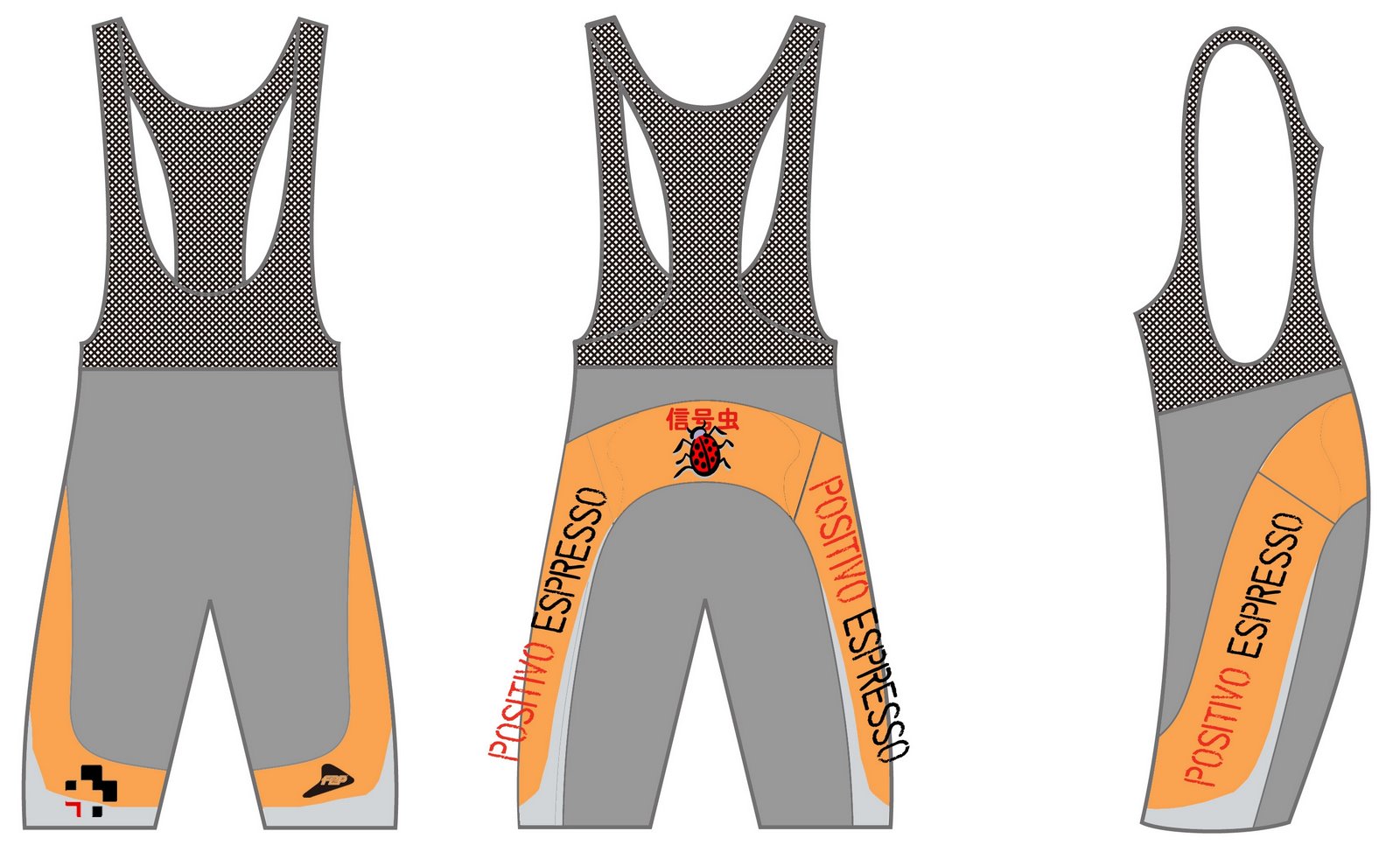 Please note that only the orange part can be printed. The design is more or less as the first one. However, I have removed all Positivo Espresso logos except the one on the lower right leg, as we have more than enough logos on the jersey.
I liked the comment about the ladybug very much and included one on the back. This one is then called „Shingomushi“ in Japanese, meaning „Traffic Light Insect“, or, if written with different characters „Ignoring Traffic Lights“.
I will send an e-mail to all riders who expressed their interest with some more details. In case you are interested, but you didn’t got a mail, please let me know. You can also order a jersey if you are not a member of Positivo Espresso. We will also discuss the jerseys must likely at the „Davis Touring Planing Meeting“ on April 14th. That is, if I am allowed to speak up.
If there is something you would like to comment on the design, please let me know.
Eingeordnet unter 2009
The two pensinsulars
 Some ideas stick in one’s head forever before they are realized or finally abandoned. I wanted to travel to Chichijima for eight or nine years before I finally did it. I wanted to ride in Chiba for eight or nine days – then I called Phil and we did it.
 I have to admit that I have many prejudices about Chiba. It is the prefecture which is all industry and social housing complexes in the North, followed by petrochemical plants on the coast (funny enough, the Japanese word for large petrochemical complexes is コンビナート, which comes from the (East-)German word „Kombinat„, only being used in the GDR for large state-owner industrial complexes in general), followed by an endless supply of golf courses in the backyard.
One of the biggest foreign affairs blunders of the Japanese government ever, was the decision to move the Tokyo international airport from Haneda to Narita in the Seventies. Sure enough, the developing fight of left-radicals and farmers against the construction of the airport produced many beautiful photos and videos (some can be seen at the police museum in Ginza) of beautiful aesthetics.
And in case you don’t know, for the first 9 month in 2008 the number of passengers passed through Haneda airport was close to 56 million, making it by far the busiest airport in Asia, while Narita was trailing in 7th place with roughly half the pax.
So, when the average normal traveller, full of Japan and it’s romantic image of Japan (Geisha, Bonsai, Samurai, Maid Cafes, Visual Kei and Anime) arrives in the morning after a long international flight in bad mood, what is he subjected to? Another endless bus or train ride into town, passing emulations of crammed, boring „mansions“ and apartment blocks, warehouses in dull grey with corrugated steel roofs, production plants of unknown purpose and worse of all, Funabashi, commuter’s hell.
This is the first impression one gets leaving the relatively international grounds of Narita airport and I believe that this has done more damage to the image of Japan then anything else. It’s a kind of ongoing Pearl Habour publicity disaster.
So far, concerning Chiba.
But hey, one has to be open minded and I just loved the idea to ride in Chiba first, then take the ferry from Southern Boso to Miura Hanto and continue the ride on the other side of Tokyo bay. Phil from TCC, also member of the failed Tsukuba team, also member of the soon to be very successful Hitachi Naka team has kindly offered to guide me through the labyrinth of Chiba back roads.
We met at 9 at Honda station, me after a 2 hour long rain ride from Yokohama. Off we are to Lake Takataki and continue to go South on smaller roads. All the roads we ride are small and consist of a constant up and down. Riding in Chiba is definitely different from riding in the Western mountains of Tokyo. There is less climbing, the longest one is perhaps 100 to 150 m of elevation difference. So one goes anaerobic by trying to do the climbs fast and rests while doing the fast descents. It is like some kind of interval training. Phil knows the area very well with a lot of shortcuts and scenic views. Sometimes we talk while riding, but he is also a fast guy and a fast decenter so I need to concentrate to keep up with him. We concentrate of riding fast and I don’t have the time to take photos.
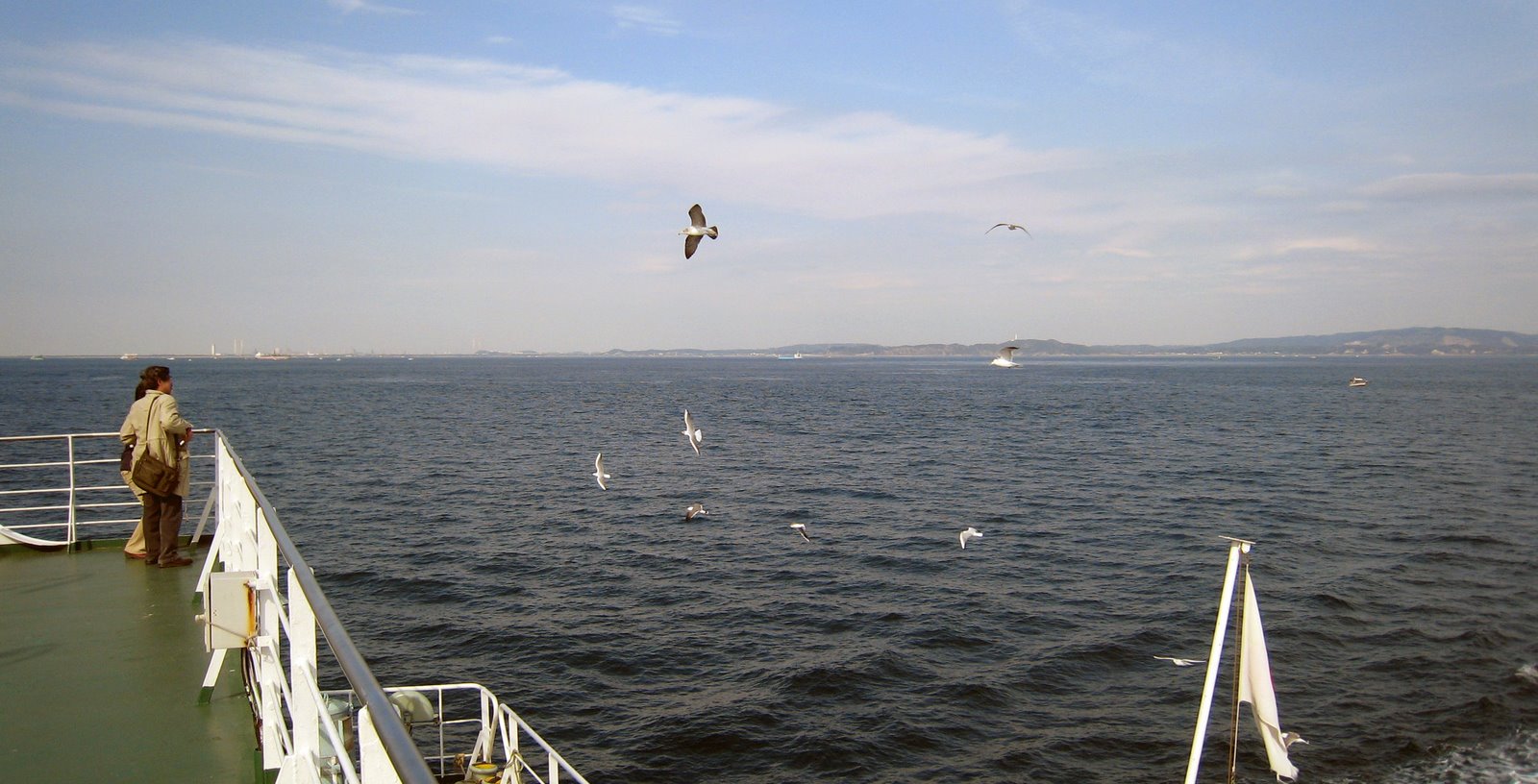
Then suddenly the landscape opens and we have reached the cost in Southern Boso. Phil is heading back to the North and I continue along the coast road which is clogged with cars. But soon I turn to road #89 and another splendid ride through rice paddies and hills open up. I reach the coast at the end of the road and check my watch: Only 30 minutes left to reach the 14:35 ferry to Kurihama on Miura and more than 12 km to go – I need to hurry up. Luckily this coast road is not that crowded and I make good speed. The ferry is in the port and waiting for me. My bike is fixed by pros against the effects of heavy seas. It’s now time to say good-bye to Chiba.
 As I had no time to east so far, I visit the ferry’s kiosk and check for some food. Hm, here they have all kind of good food on sticks: dark brown croquettes on a stick, light brown eat balls on a stick, an older mobile phone on a stick – I ask if they can warm it up for me.
 After 40 minutes the ferry arrives at Kurihama. I line up in the car deck and wait for the front gate to be opened.
 And I continue my ride in Miura, first going South along the coast, then cutting over to the West coast and heading in direction Kamakura. The pace is good, but the traffic is just terrible.
 For a moment I think about having coffee at the restaurant German Seacastle, but when I come close to the place I reconsider. I am just too afraid to enter the place alone. This is a restaurant as no other in Japan, a typical German restaurant where one is served unfriendly and rude and an atmosphere of fear and terror let all guest stare at their plates, silently east their meal and try to avoid to attract any attention.
So I continue to Ofuna where I pack my bike again and take the train home to Shinyokohama as I really hate riding the last 20 km or so through Yokohama city.
Home the day turned out to be a mid distance ride with surprisingly lots of climbing meters. It was a good training for the forthcoming endurance events and I would like to thank Phil for his good companionship.

Abandoning Mikkuni Toge
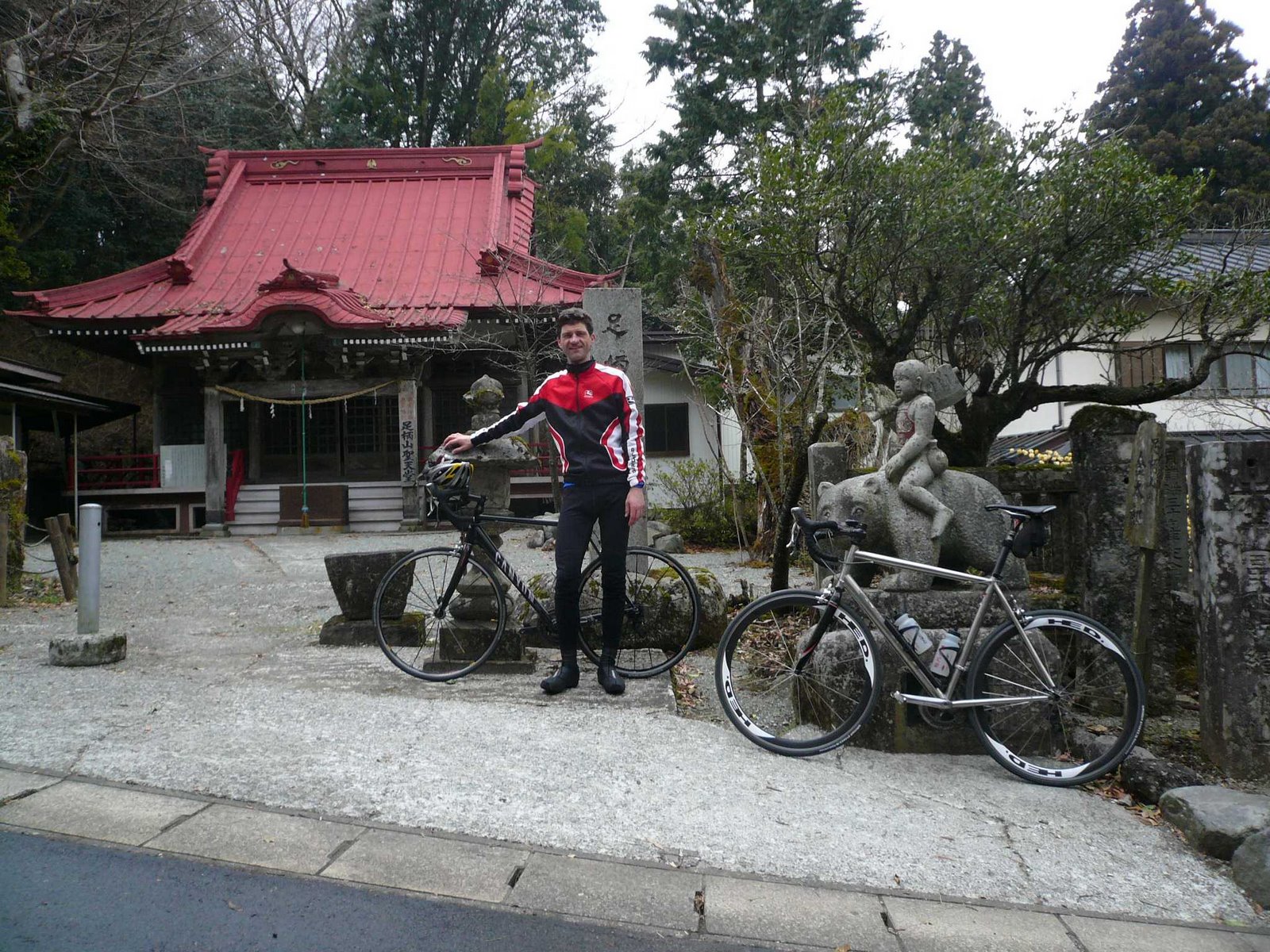
T
homas from TCC and I attempted the Mikkuni tour organized by the TCC a day ahead of everyone else. I thought I was clever going for Saturday with the supposedly better weather, but ended up regretting the choice exactly for the weather. We had to give up on climbing Mikkuni as we were facing increasingly heavy snow. We bumped into Steve from TCC, who was just coming down again after going up a further 200 meters and confirmed it would not get better.
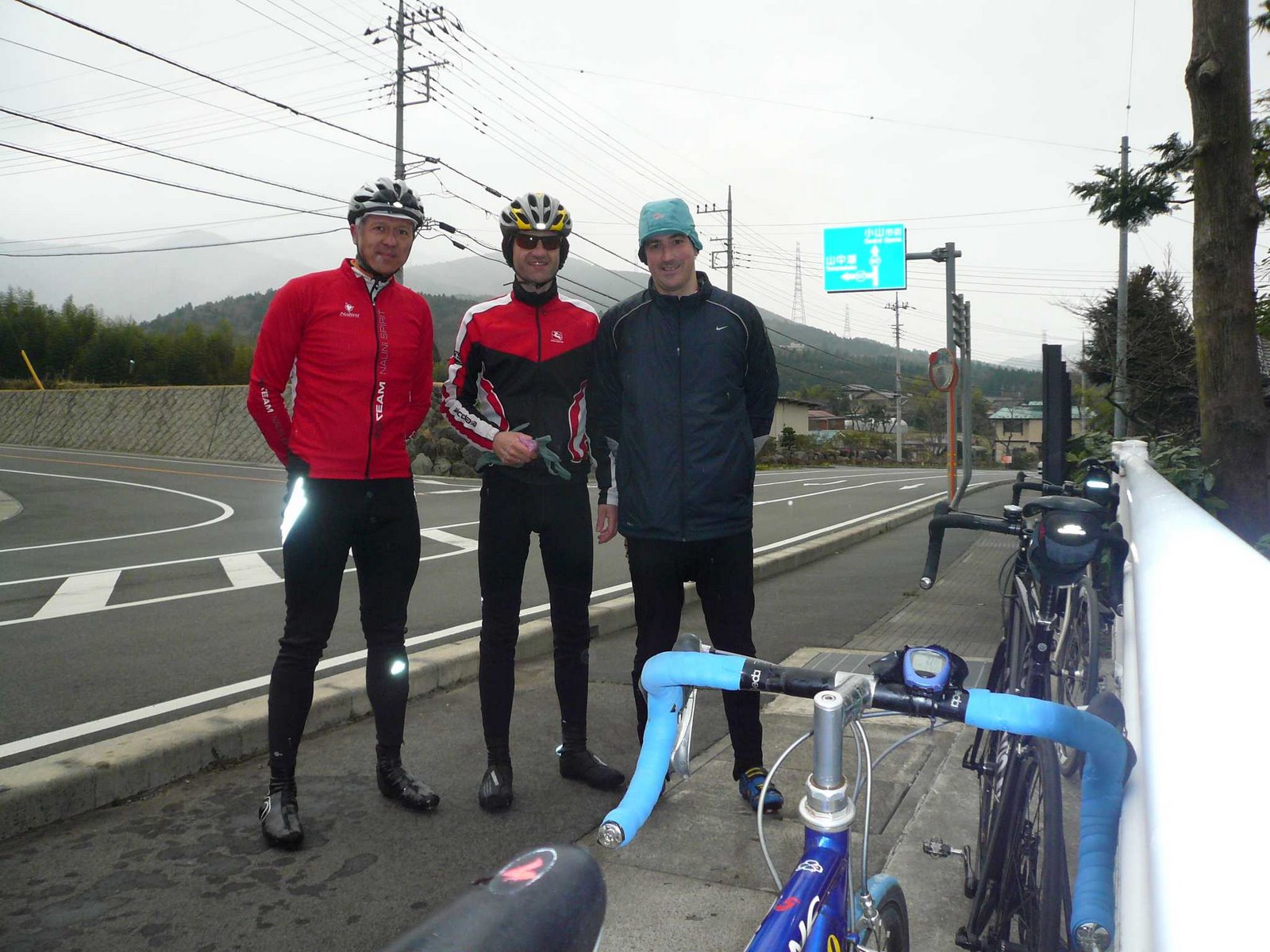
So instead of going up Mikkuni, we cut through to Gotemba and climbed Nagao Toge from where we had a wonderful view of Lake Ashi and even some rays of sun emerging. We returned to Shin-Matsuda via Kintoki Toge and the valley behind it which was very scenic indeed.


It was my shortest ride so far – just 85km. But at least the two passes provided for a good work-out, with 750m and 400m climbing, respectively. Altogether, we did 1,600m of climbing – not bad for such a short ride.













 bikesnob28hb
 fixiefanboyhb
 sudi1662













 there is no "I" in cyclyng
