Archiv der Kategorie: 2010

Taking it to a Higher Level of …

achievement.

planning.

pain and suffering.

spectacular scenery.

camaraderie.
I was surprised on Saturday morning to see 80-90 cyclists assembled at a park along the river North of Ichinomiya, on the outskirts of the Nagoya area, for the Chubu Audax-sponsored 600 km BRM501.  I had expected maybe 30.  The crowd was bigger than all the people on the streets of central Ichinomiya when I arrived at the station from Tokyo early Friday evening, buildings shuttered for Golden Week, or for good?

We started out by riding 4-5 km along a narrow „cycling road“ through the park, disturbing at least 2-3 elderly people per kilometer on their morning walks.  Finally we came up onto a wide path on top of a levy, and a tail wind helped me stretch my legs a bit … talking it up to 38 kph for a few minutes while keeping the heart rate down, so I could move forward into the front 20-25 or so riders.

My cardio conditioning is WAY better than 6-8 weeks back.  Rewards of hard work — proven by my threshold power test at Bryon’s studio on Friday, where I moved up from a terrible to a mediocre test number, but was able to gradually accelerate over the length of the 10km test, keeping my pulse down, and finished wishing I had pushed a bit harder.  Then again, on Saturday morning my legs felt stiff, not at all fresh.  … maybe also a result of the prior day’s power testing (remind me not to try something like this again the day before a big event).  Anyway, the muscles would stretch out and get loose as the ride continued, and continued, and continued.

We finally exited the park and were on heavily traveled roads for awhile, before reaching light traffic.  A quick move up onto a deserted sidewalk before a long guardrail and a narrow lane allowed me (and a few others) to pass about 30 cars and another 10 or more cyclists who had been penned in by cars, waiting for a light to change, and when a few riders came together with me at another traffic light, 5-10 minutes later, I found myself in one of the front groups.
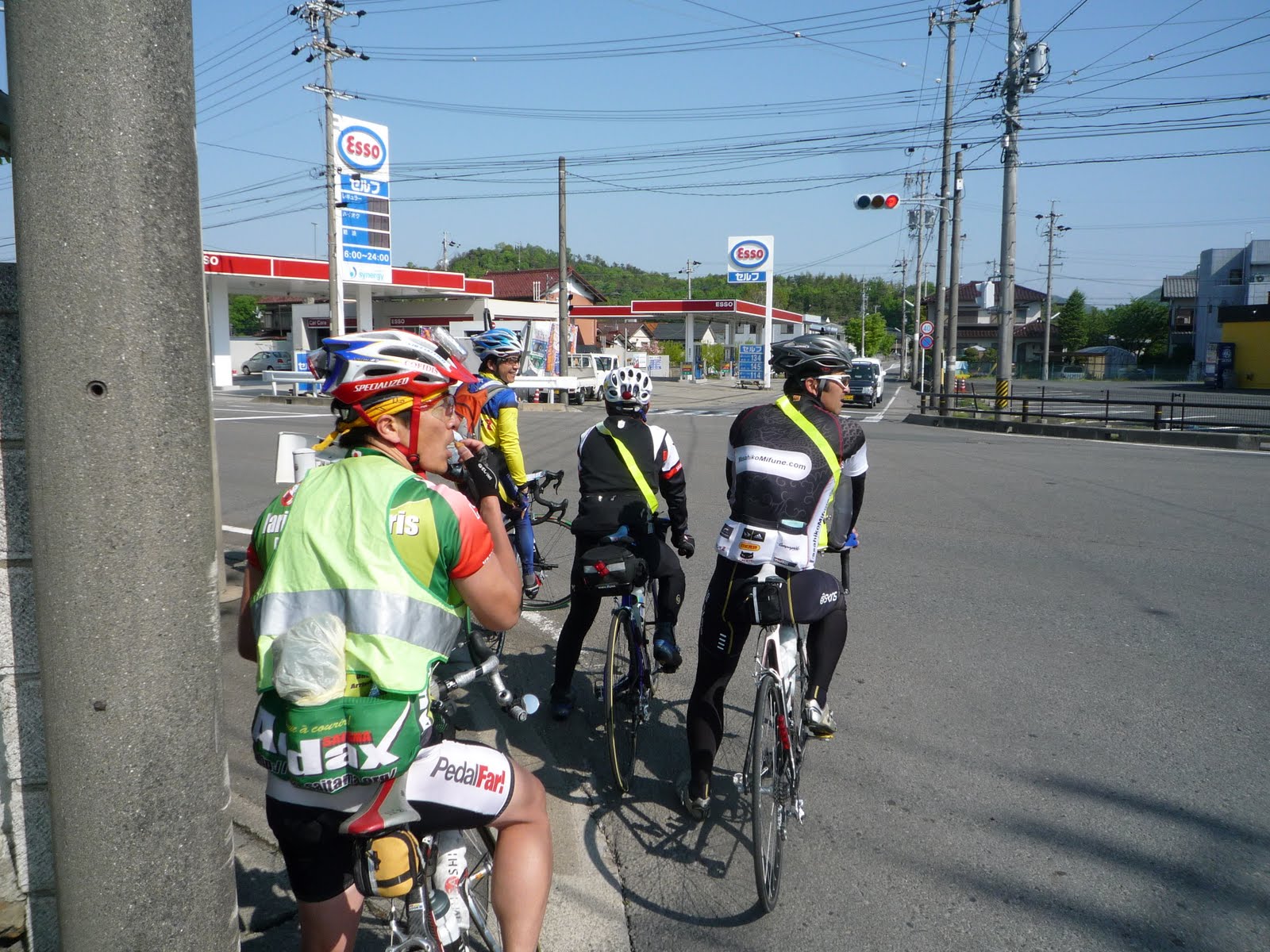
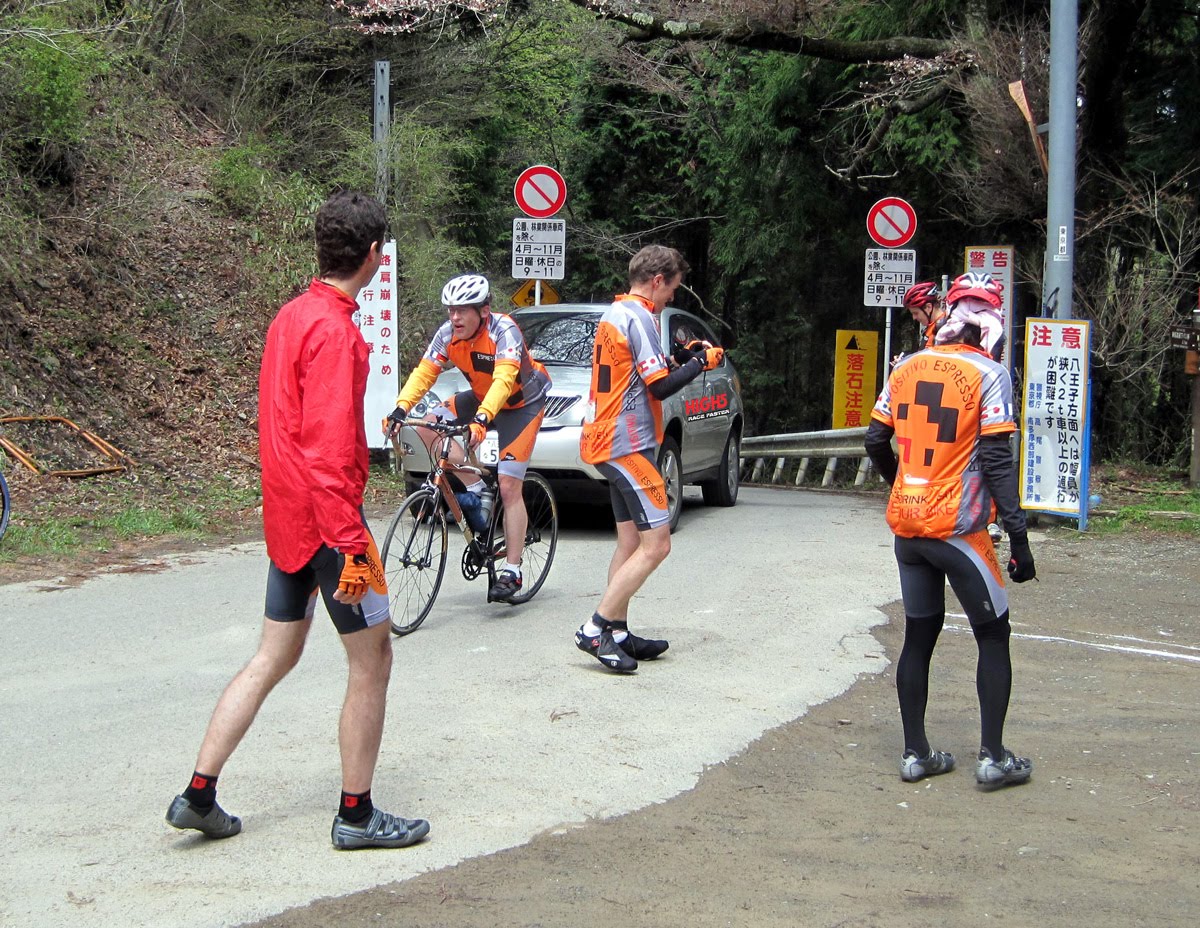
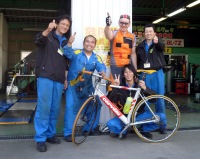
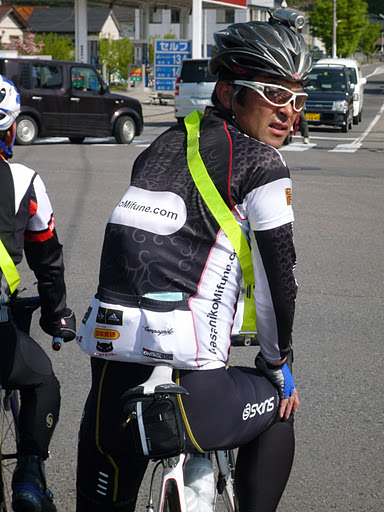
These guys looked really strong.  One (in front, in blue and yellow — photo above), who had chatted with me at the start, had not an ounce of body fat, and a rucksack that looked outsized on his small climber’s body frame.  Another had calf muscles (back of lower leg) that bulged.  He wore „pedal fast“ shorts and a Saitama Audax 2007 PBP jersey (see photo above).  I rode much of the last 2 legs with other people in these and similar 2007 PBP commemorative articles of clothing — vests and jerseys — notching up their 2010 mileage to get their 2011 spots).  Mr. Pedal Fast was riding alone, while the other 3 were clearly working as a group.  Another rider pulled up behind me and pointed to one of the three.  „That’s Mifune-san.  He was a pro for 8 years in Europe, rode with Landbouwkrediet-Colnago.“  (actually, he said „Rabobank Colnago“ … but who wouldn’t, given the extra vowels in „Landbouwkrediet“).  Sure enough, Mifune-san had a bit of the look of a Euro pro … and turned around just as I was about to photograph the personal url on his jersey to preserve for a visit to his website later.  His jersey’s „dragon scale“ decoration was interesting — almost as if a yakuza tattoo had instead been placed onto a cycling jersey, subtly and without color.
Anyway, I rode with them almost to the first checkpoint (at only 36km) … or maybe I should say that the last 10 km I rode behind them, catching up at lights and on short descents that followed a few short climbs.  I was having fun — and why not, as long as I could keep the effort within limits, my heart rate not high.  I lost them on one of the longer, open stretches, a few kilometers before the checkpoint, but arrived as they were still buying their food.

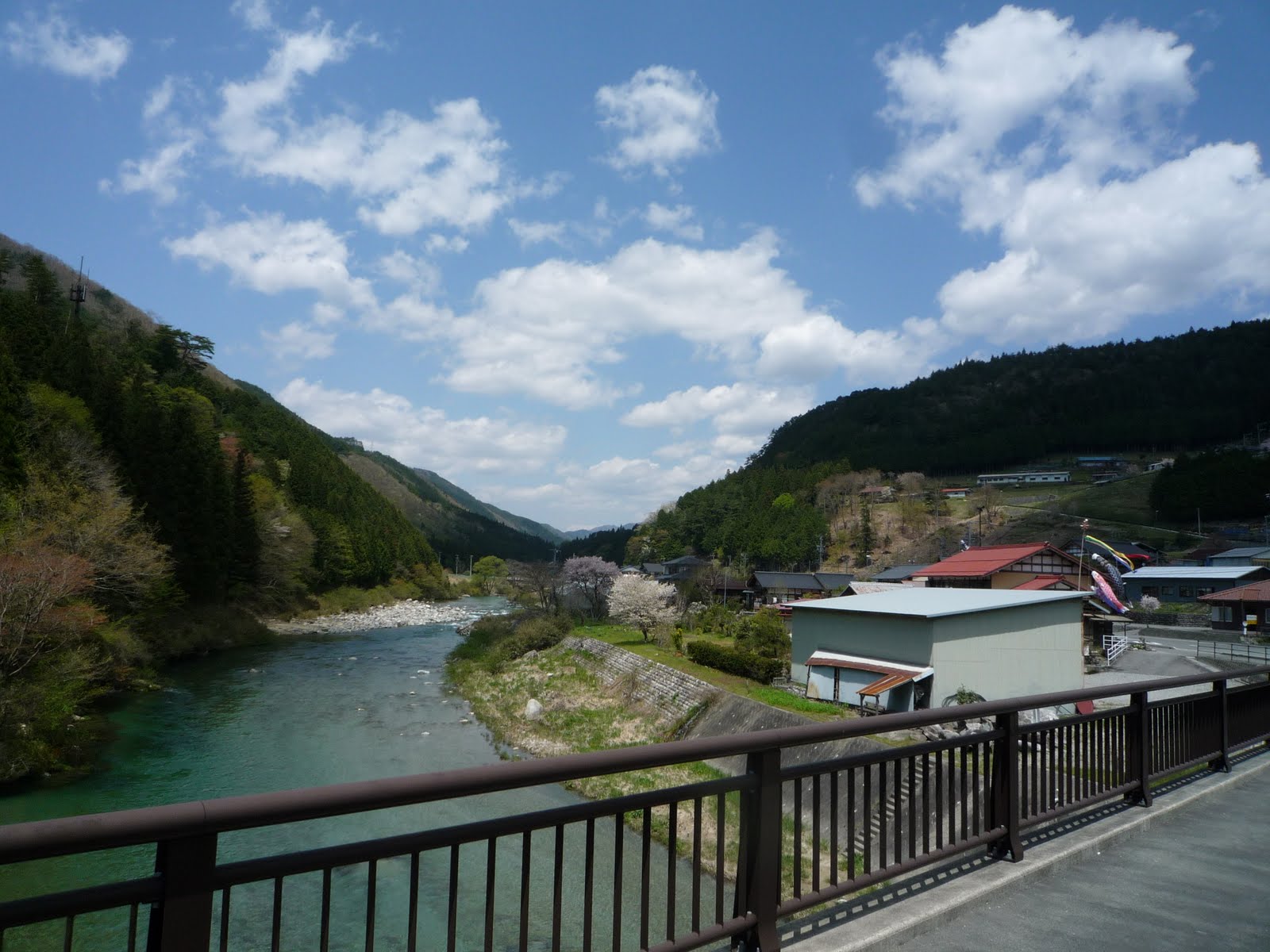
Now the real ride began.  Many beautiful valleys, even the dams and reservoirs were nice, on a smaller scale than Okutama-ko or the massive one we sometimes pass in Gunma when heading toward Honjo Waseda.

This segment involved a number of smaller climbs of 150-250 meters net elevation, the first on Rte 85 over a pass, then one up to a reservoir, then further up to another reservoir, then finally up a hillside to a tunnel entrance, and through the tunnel and down a real descent, into Gero and then Hida-Hagiwara, for a quick stop at PC2.  105 km done, 500 to go.  The third segment started with another 21 km ride up crowded Rte 41 along the Hida-gawa, and just a few kilometers before Takayama turned East with Rte 361 and toward the day’s major climb.  There were flowering trees and quaint villages everywhere, but my main impression of the second and third segments is of the sound running water.  Almost everywhere, we are riding alongside rivers, streams, or just water burbling through the drainage systems alongside the road.

I rode with 2 other riders for awhile, one of whom had cut very short his first rest-stop visit, and had a mostly-uneaten submarine sandwich in his rear center jersey pocket.  … very tempting.
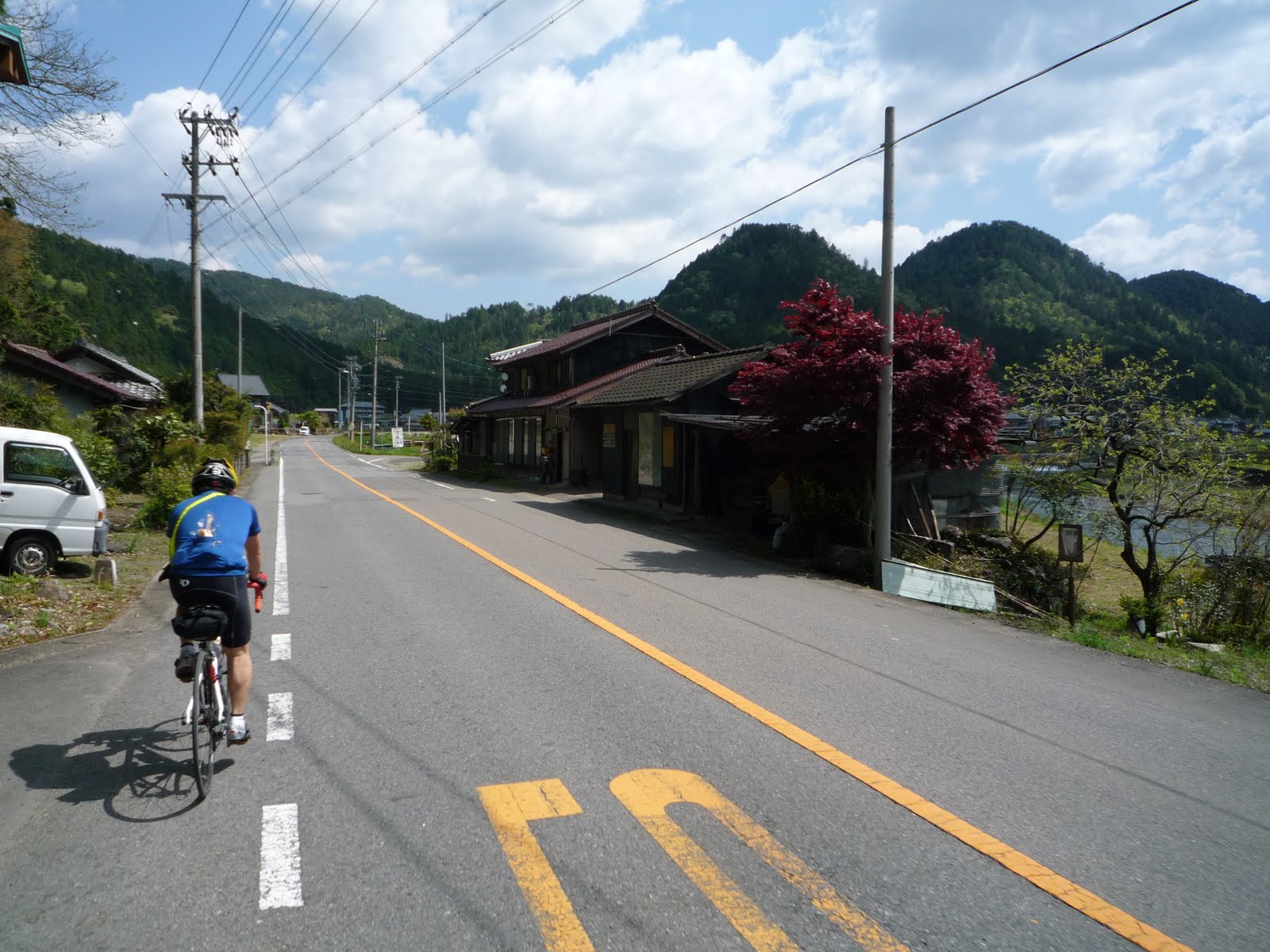
Another rider with strong legs and plenty of gear in his rucksack, was my companion for part of segments 2 and 3, before he went ahead (I saw him one last time briefly at the top of Nomugi Pass, as I rolled in and he finished his rest stop):
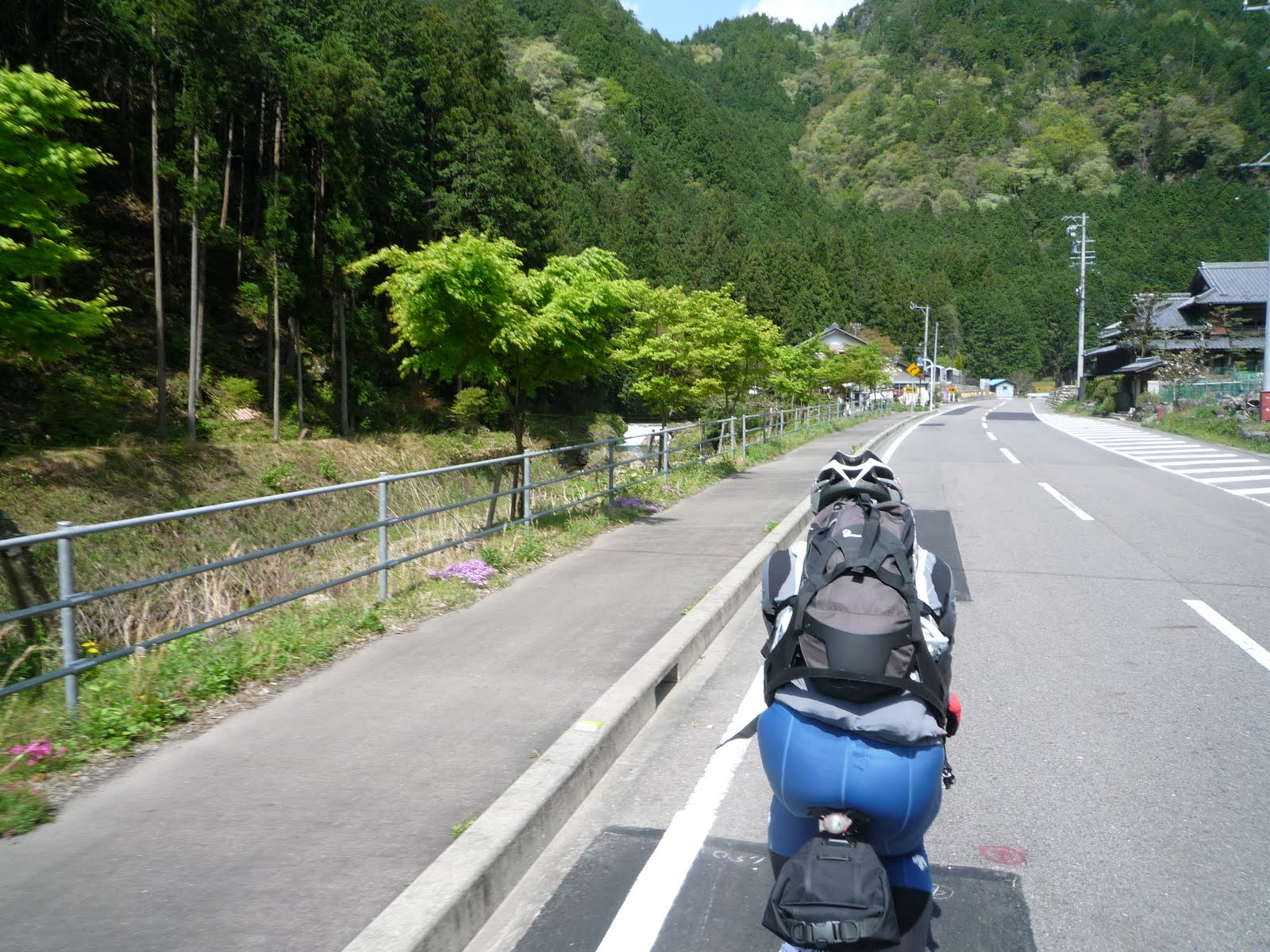
More rivers, hillsides, trees:
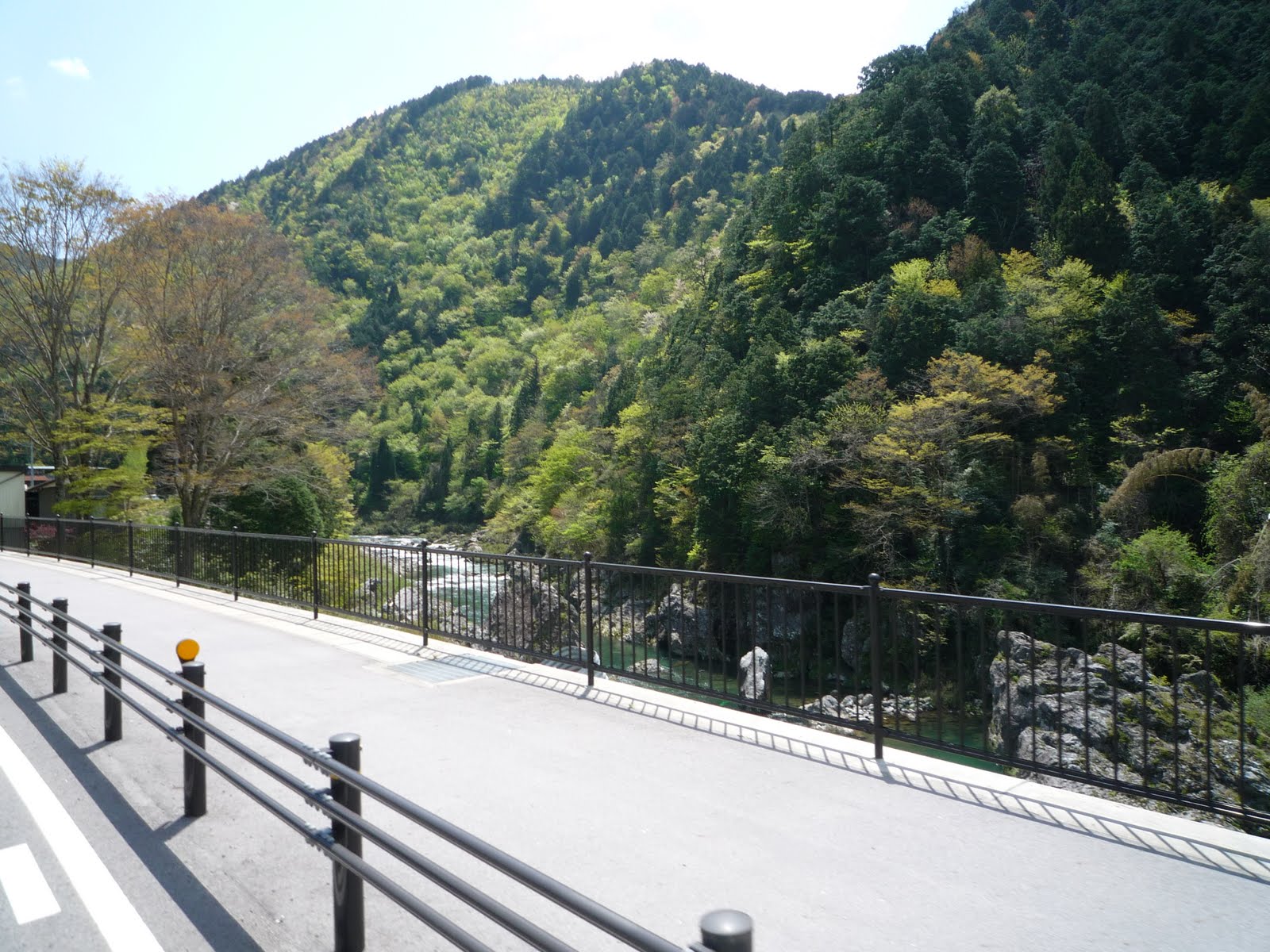
Even the reservoirs looked pretty:
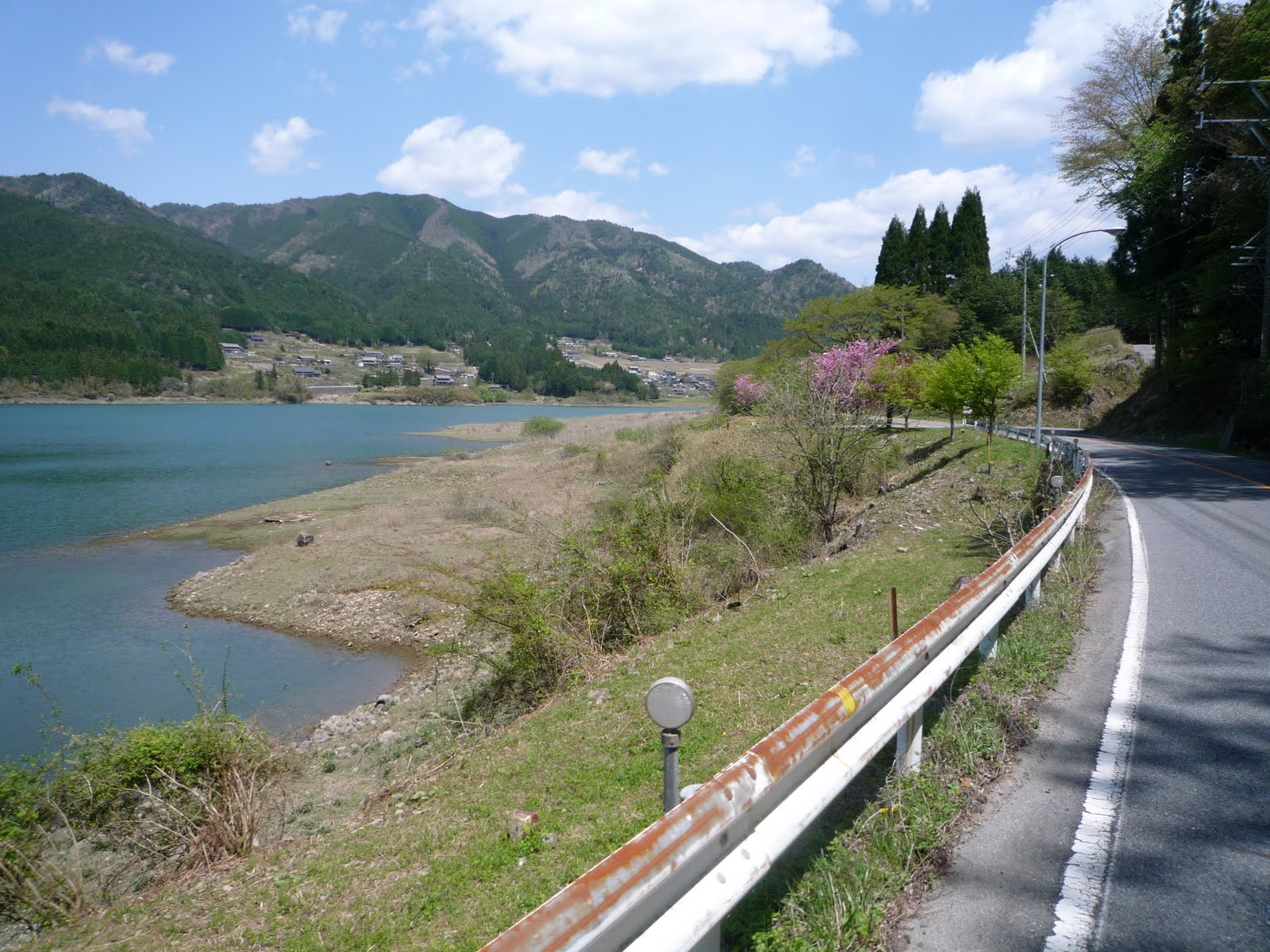
Plenty of work this Golden Week for the rice farmers in Gifu:
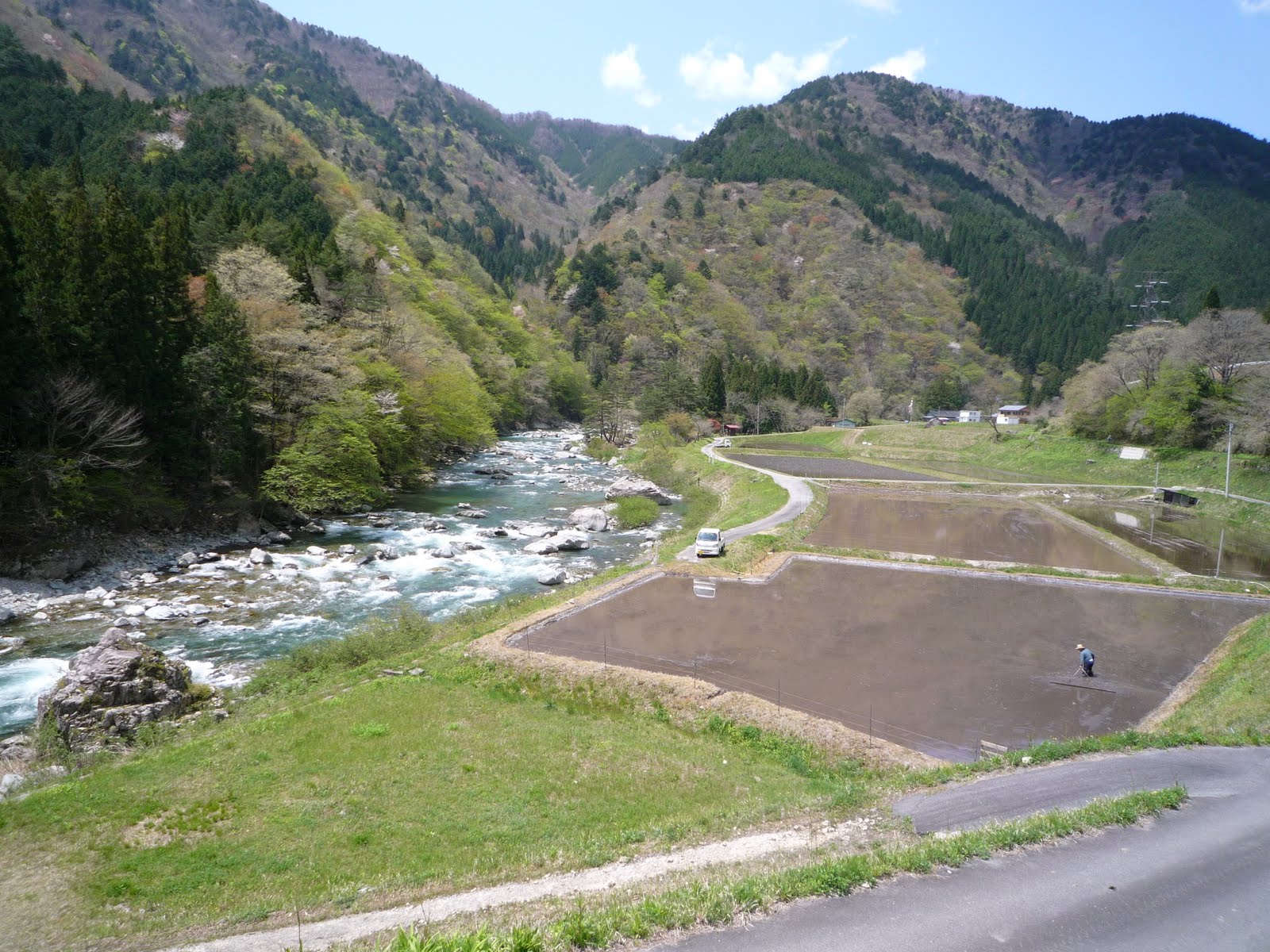
Are those mountains in the distance?
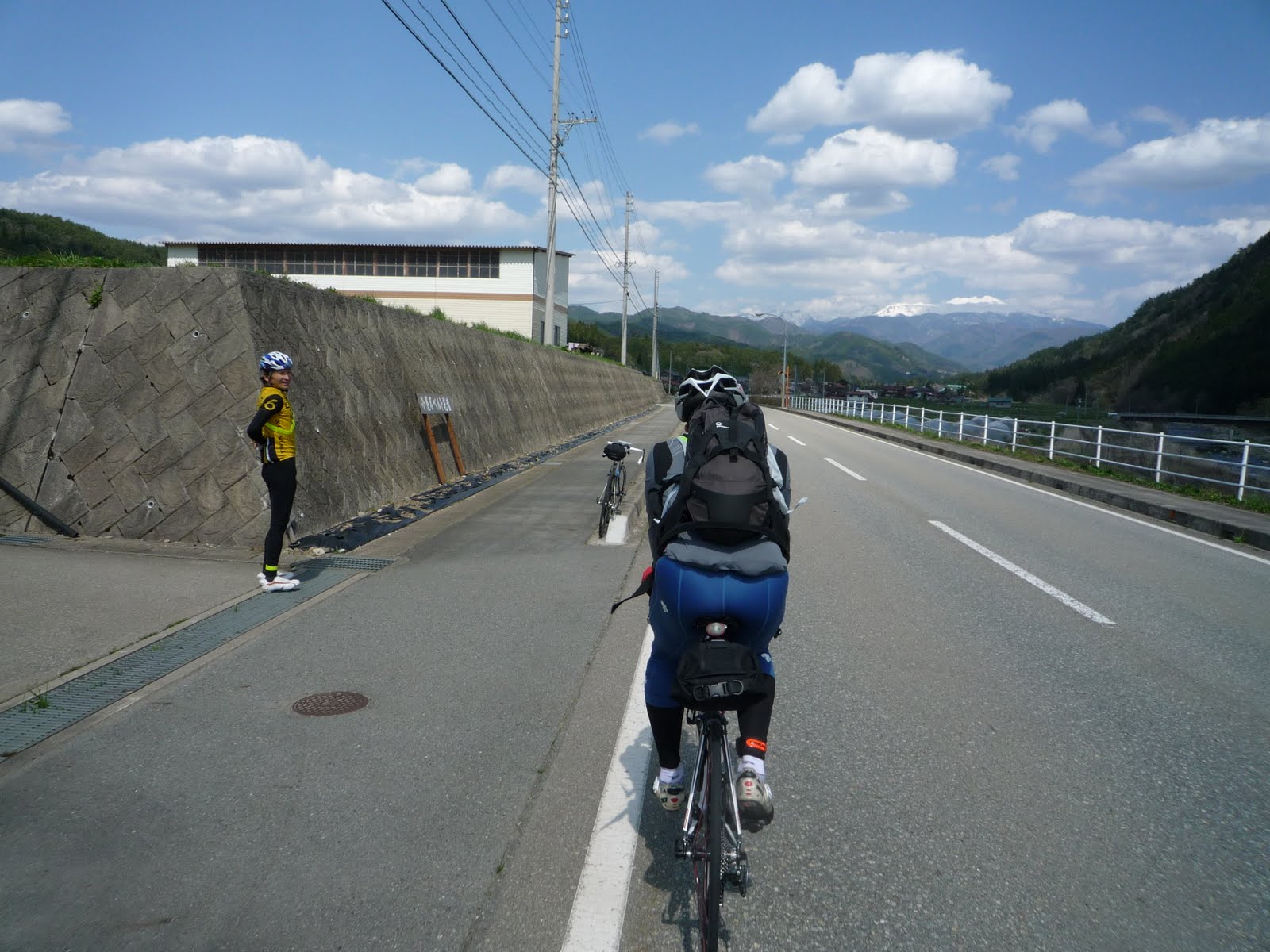
Checkpoint 3 was at a small rest stop (Michi-no-eki) on highway 361.  One of the organizers was waiting there, logging us in, and checking off our convenience store receipts from the first two unmanned checkpoints.  Only about 10 riders had arrived before us.

Up Rte 361, through tunnels, around reservoirs, a bit harsher, higher territory, and finally, the turnoff for Nomugi Pass — onto Rte 29 for the long climb. Again, I found myself alone — below is a photo of the lower middle of the climb and Norikura Mtn (before the first „false“ pass at 1375 meters, the descent back down to 1225, and the „real“ climb up to pass at 1670).  (Today I see that this same stretch of road is photographed in Cycling Sports‘ Nomugi Pass write-up in the June 2009 special on the top 20 mountain passes of Nagano — the road pictured is probably a 9% grade, visibly turning up to 11% or so):
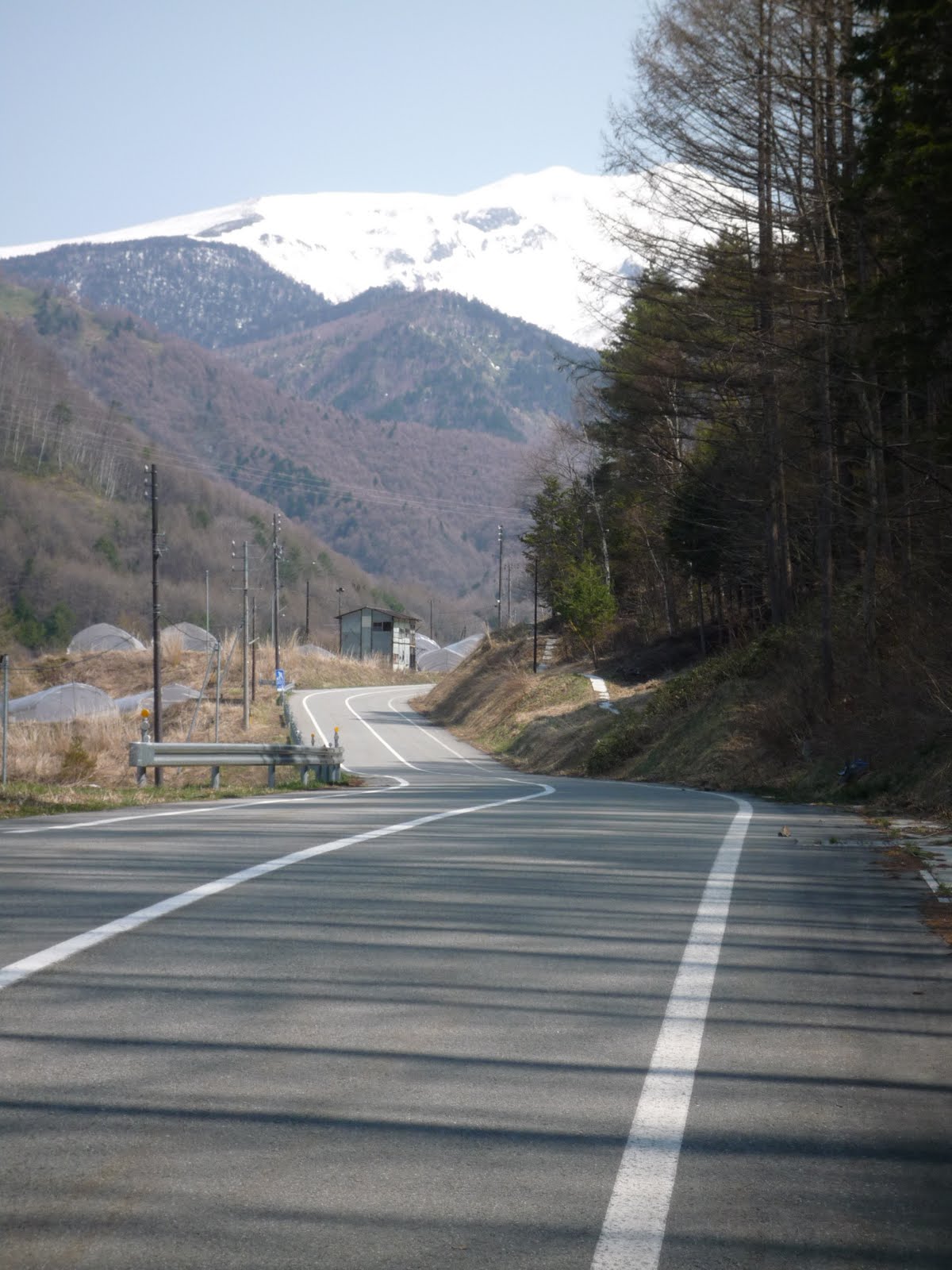
When I made it to the top, I saw the rider from earlier in the day leaving the visitor center to start his descent.  Have you seen anyone else?  „No.  Nobody.“

There were probably 10-15 fast riders ahead, and the rest … are far enough back so they did not even catch ME on the long climb … maybe I started out too fast, again?  It is somehow reassuring to see another rider come up to the Pass just as I am remounting.

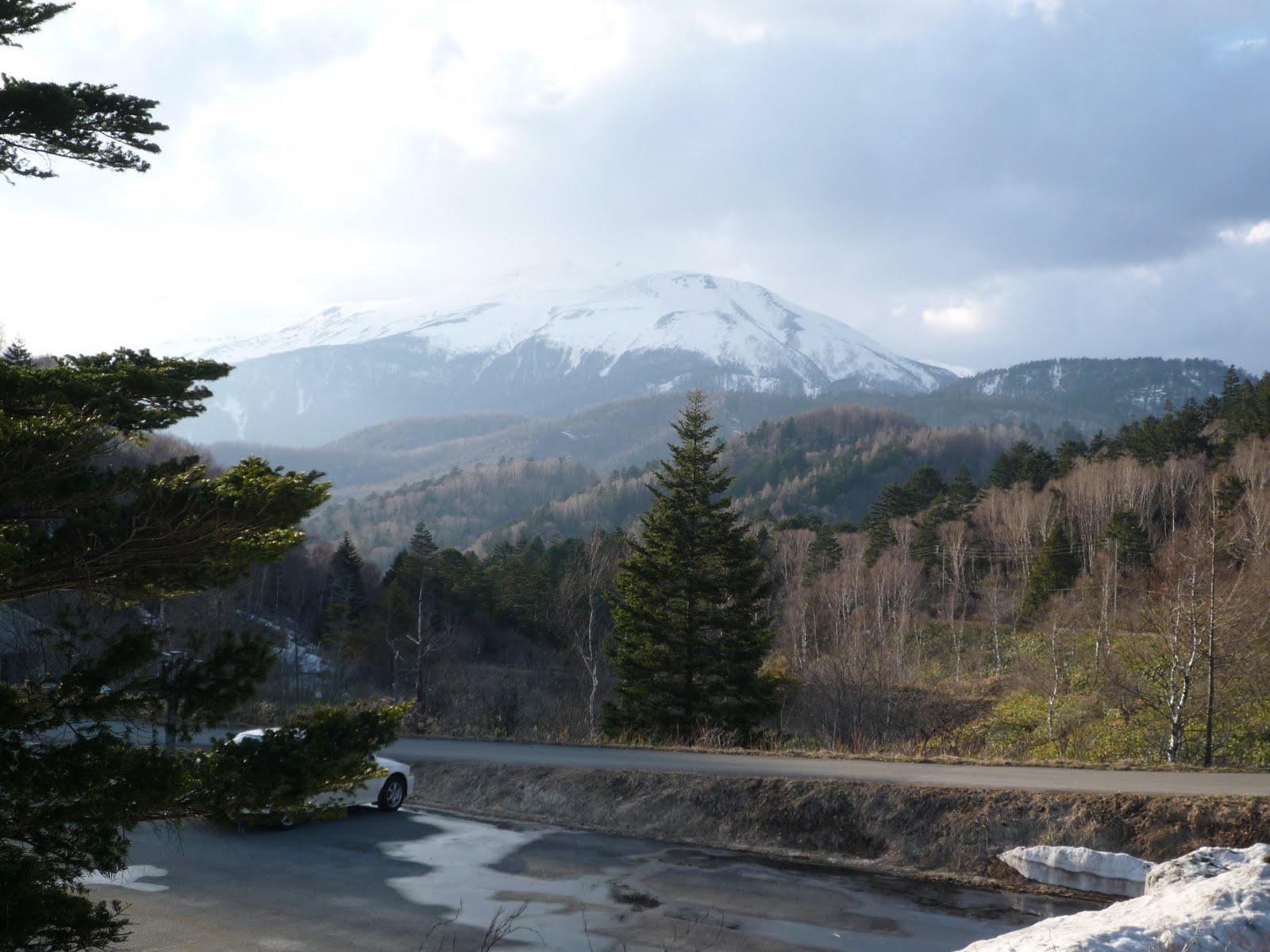
Norikura Mtn, looking back from the top of Nomugi Pass, as the sun gets lower in the sky:

Zoomed in:
I was with another rider on the dark country roads between Akashina and Tokura Onsen … I had ridden with him after PC4, as we lost the route, took an alternate, and ended up rejoining it on Rte 147 and then Rte 19 to the North.  I pulled him much of the way for 10 km+ down Rte 19 — flat or a 1% downgrade, light traffic, and even a slight tail wind allowing me to make great time and put the hammer down a bit.  We then headed into the cold and the hills, the first of several climbs on the next stretch.  Eventually, I bid farewell and pulled off at a rare convenience store that appeared out of nowhere in the countryside, as the Nagano Expressway loomed overhead in the dark just before the turn from Rte 403 to Rte 12.  Fatigue, exhaustion, a desire for sleep — nothing a Rainier Double Espresso with plenty of caffeine and sugar wouldn’t hold at bay, at least temporarily.  As I continued, a few other riders passed me, including Mr. „My Pace“ from two weeks back in Nishi Izu — who was riding strong and reported that this time, he was well-rested and going all the way, as he no doubt did. 

There was one more climb on Rte. 55 before the last flat section to the turn-around.  On the map it was labeled „forty eight turn pass“ or   四十八曲がり峠, though I could remember that there was a tunnel before the top (looming above in the dark), saving us from the actual pass.  I started the climb and could see some lights of other riders behind me in the night.  Two passed me, and I passed someone who was lagging.  3 of us were relatively close when we came upon a sign that was like someone’s idea of a cruel joke — „warning 13% uphill grade ahead.“  A few meters later the road entered a shed, designed to shield it from snow in the winter — way too steep for plowing or for cars to travel if covered with snow or ice.  Fortunately, after a few minutes and couple hundred meters of barely turning the crank, the road started to level a bit, the shed ended, and we could approach the tunnel.  The forty eight turns seemed to be on the OTHER side of the pass, as the road down twisted and turned many times. I finally made it down Rte 55, to Togura Onsen.

One young rider struggled with me to navigate the recommended route through Togura, that would lead across the bridge, onto the next main road (Rte 18).  There were plenty of people out and about strolling after enjoying the hot water.  We ended up choosing alternate routes — he made the better choice, since I passed him again 10 minutes later as I hit my pace again on the flats of Rte 18.  As I approached Kawanakajima and the war memorial park, I kept thinking I must have overshot, checking my map repeatedly … but then I saw some of the faster Brevet riders heading the other way on their return, so knew I was still on track.

Eventually I found the park/memorial — pitch dark, nothing visible there, not even the statute of Uesugi and Takeda.  The Daily Yamazaki down the street … was dark, boarded up, with a „tenant wanted“ sign.  Where was the turn-around?  I pulled out the cue sheet and finally figured out my mistake.  There was another Daily Yamazaki that did not show up on Google Maps, and I needed to go back to Rte 18 and head back 500 meters.  I must have passed this store going in the other direction, across the wide (6 lane, with divider) highway and not noticed it.  … my concentration was fading.  I reached for my maps in my jersey pocket … NO MAPS.  They must be on lying somewhere back on Rte 18 within the past 3-4 km.  Well, even with no map, if I could just get Rte 70 out of this area, that would take me all the way to Rte 19, then I just needed to retrace my steps, with one required (and easily identified) side trip after Nomugi Pass, and I could finish even without a map, and assuming that my GPS battery would not last much longer.  No map, no problem.  And I was halfway done in just under 15 hours, with a 40 hour cut-off, and an informal goal of 36 hours (8PM finish giving me plenty of time to wrap up and find my way to Nagoya for the last shinkansen to Tokyo (leaving 10:10PM Sunday).

I studied a map off the magazine rack at the turnaround checkpoint’s Daily Yamazakistore, and headed out after eating, chatting with the organizers and trying to rest … somehow 50 minutes had passed but I did not even get a chance to lie down, and I certainly did not feel rested.  I found the turn-off toward Rte 70, went ahead as it twisted and turned, remembering the map in my head, despite lack of any signage and another rider (who DID have a map) pulling off at several points, finally stopping at intersection to check the route … and not following, no light even visible behind me when I looked back 500 meters later.  Someone else did catch me as we approached the climb, a younger rider from Mie Prefecture, and first he, then a sign ahead, confirmed that this was Rte 70.  He seemed like a nice guy, and wanted to talk.  He clearly had extra energy left.  I told him to please go ahead.  He said no, that he found riding alone at night could be boring.  He would zip up a section of the climb, then slow down and wait for me to come lumbering up.  He asked a lot of questions.  :How long have you been in Japan?  When did you start doing Brevets?  Have you done one in the U.S.? I’ve heard they have some in the U.S. without hills, is that true, and where is the fun in that?“  I suggested to him again, REALLY, he should go ahead.  He did not take the clue.  My answers to his questions got shorter and shorter, as did my breath.  On a different route at a different time, I would have been delighted to chat and returned the questions and then some, but not at 12:30AM on a climb.  Finally, another rider came up and joined us, and I could see more lights down the hill one or two switchbacks behind us.  I seized the opportunity, „please go ahead without me, I need a bathroom break, I lied.“  That finally did it and they left me in peace.

The next couple of hours, after midnight, were very tough.  My pace slowed, there was no good place to rest, and it was way too cold (3 degrees?) for me to contemplate the idea of resting outside.  A few minutes and my sweat would cool, with teeth chattering effects.  I slogged ahead, saying to others that I would look for a family restaurant in/near Matsumoto, for a meal and 45 minutes of sleep.  I saw a few more riders on Rte 70 — most passing me, fewer being passed — but I saw almost no one the whole time I was on Rte 19 all the way back to Akashina and then on toward Matsumoto.  Only the occasional truck racing through the night.  In Akashina, one more quick unofficial 7-11 stop, … where I noticed that my sunglasses were missing.  They had been hanging around my neck, but must have fallen when I zipped up my jersey, or jacket.

I had one major crisis on the ride.  Still on Rte 19, I started to lift out of the seat to „dance“ on the pedals and stretch my back, and just as my weight transferred toward the front wheel I heard a loud „ping“ sound coming from the vicinity of my front wheel.  A spoke had broken cleanly into two even pieces — the first spoke to break on my Fulcrum wheels in 14 months since I bought them, though I’ve had plenty of other minor difficulties and a few false alarms where the spoke just came loose and I thought it must have broken.  Fortunately, I had brought the Fulcrum spoke wrench, in case I needed to true the wheels.  I was panicked.  It was near 3AM.  No one around.  If I could not get the wheel into „rideable“ shape, relatively „true“, I would need to drop out.  No spare wheels and no support here.

15 minutes later, I had adjusted the spokes to the point where the wheel only rubbed slightly — a slight thwamp, thwamp, thwamp, when I leaned on the handlebars.  If I sat back, there was no rubbing at all.  I’ve ridden home with a broken spoke before … maybe even 50 or 75 km at most.  But 260 km?  The odds of completion had just fallen dramatically.  I gave up all hope of rest, or finding a family restaurant for a warm meal, and decided to push ahead straight to checkpoint 6.  I would try to take it easy a bit while continuing to ride, no sudden shocks to the wheels on the descents.  In my continued panic over the wheel crisis, I misread a sign – I want to turn right at Rte 147, taking it over to Rte 48.  Instead, I turned right at a sign that leads „to“ Rte 147 and Azumino City.  I must still have been 10 km North of the turn I wanted.  I finally realized the error when I got to Rte 147, several kilometers away — out of the way.  It was very cold.  When I checked the weather Friday, Azumino was colder than Matsumoto, Nagano, Chino, Suwa, or any of the other cities in Nagano that I could find … I just did not realize it because I could not read the kanji for Azumino — 安曇野 — but at 3AM Sunday morning I figured it out [CORRECTION — actually the cold temperatures on Weather News website were for Azumi (安曇) Middle School weather station — which is on Rte 158 just past PC6.  Azumino City is just in the same sloping plain as Matsumoto and is not any colder].  So I turned left onto Rte 147, heading SSE, knowing that eventually I would get to the SW turnoff I was supposed to approach from the other direction … just not sure how far, and no map to help.  I tried a few false starts, but each time returned to Rte 147.  (It was incidents like this that put my total mileage for the 600 km ride at 625 km.  Add in 11 km from the hotel to the start. .. to get 636 km, or just shy of 400 miles — a quadruple century).

It was getting light by the time I arrive at checkpoint 6.  Two riders were trying to rest outside, in front of the store, clothes pulled over their legs in an attempt to keep warm.  I stayed inside, eating my instant soup and other food.  They did not kick me out (the „foreigner’s privilege“?), even though the store was surprisingly crowded for 4:45AM Sunday morning.  I decide to push ahead slowly — no place to sleep or rest until over the big mountain, but at least I could hope to get off Rte 158 (the most crowded, narrow shouldered stretch of road on our entire route), before the traffic, and the big buses.

Not.  Only a few kilometers into the climb up Rte 158, I start being passed by massive empty tourist buses, heading up to start their days.   And lots of other traffic as well — others who decided to beat the traffic.  Finally I made the turn South onto Rte 26, losing 80-90% of the vehicles who continue up Rte 158.  I passed some covered bus stops … little sheds with a bench inside.  Each had a bicycle propped up against one side and a rider trying to stretch out and sleep inside.  At least it offered a flat surface and shelter from the wind, but not the cold.  I could not imagine stopping in that cold — still in the 2-3 degree celsius range.  Looking at the bright side, I was climbing so slowly that the sun would be up and temperatures warmer before I reached Nomugi Pass again — the top of the climb.  Until then, my activity would keep me very warm.

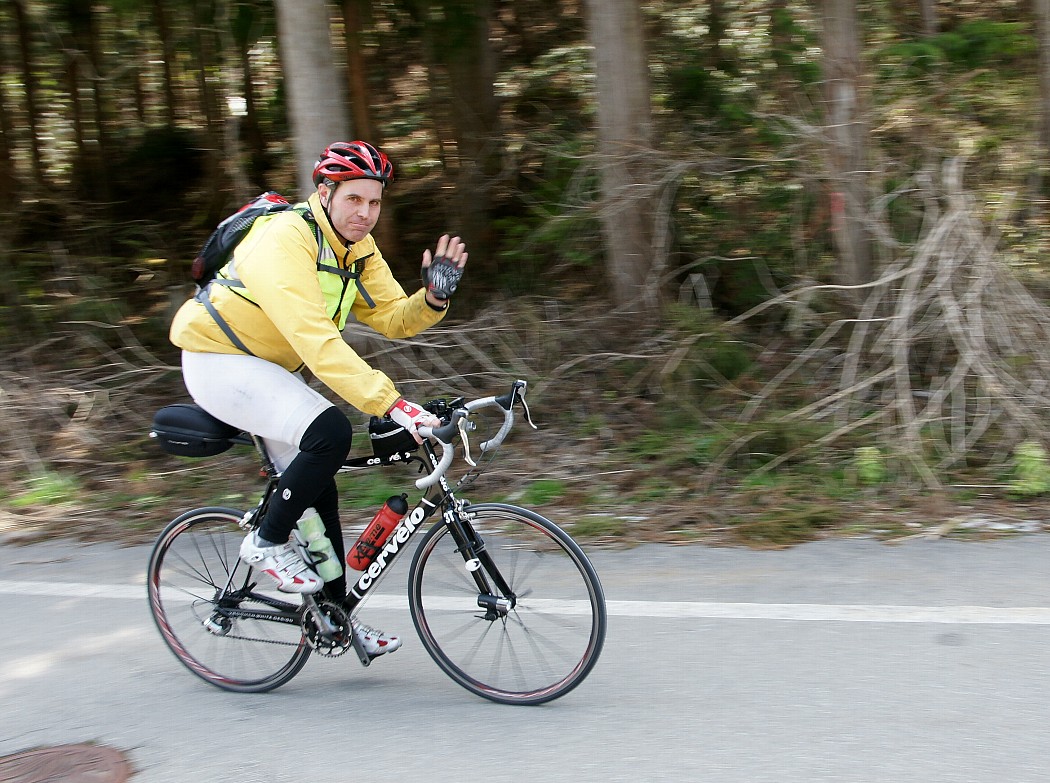
One of the Chubu Audax members manages a small onsen (hot spring) along the 秋神川 (Aki-Kami-gawa?) on Rte 435, a mere 7 km detour off of Rte 361 along a reservoir and then up a river valley.  PC 7 was at this onsen, where we could relax in a day-house, take a quick shower and soak to freshen up, and even sleep (in my case, for 45 minutes — I arrived around 11AM, and wanted to make a 1PM departure to stay on track).  This was an incredibly nice feature of this Brevet — even a chance to sit in a room with some of the other riders, eat cup noodles and mikan, and hear some stories of this and other events.  Thank you, Chubu Audax!

The organizer who managed the onsen had a high end digital camera and was snapping pictures as riders headed out, one of which I’ve copied and pasted from the Chubu Audax BBS:
My front wheel held all the way to the goal.  The „thwamp“ grew a little worse, so that by the time I was coming down Rte 41 along the Hida-gawa on Sunday afternoon, I heard the noise whether or not I leaned on the bars in order to brake.  I stopped using the rear brake to slow the descents.  I started to go full speed ahead, clearly 60 kph at times and throwing caution to the wind.  I stayed generally close to the same 4-5 riders on the last 2 legs, until we got into town and were completely separated.

I had saved some battery juice in my Garmin GPS for the last part of the ride, to navigate the many twists and turns after dark (what a feeling — two sunsets on one ride).  But it died just as I got into town.  I outpaced on 2007 PBP jersey-wearing rider on the last descent (his front derailleur had malfunctioned, leaving him with only the smaller chainring).  I stayed behind another rider who looked as if he knew exactly where he wanted to go … until he missed an obvious right turn.  I yelled out at him „Right!“, „MIGI-Desu“, „MIGI-Desu“, following him through the intersection, then stopping.  He looked around, but then went on … down a dark road that I was pretty sure would have him hunting for an „alternate“ route where no good one existed, and I did not see him again at the finish.  I did fine until the entrance to the final park.  It was pitch black, and the map would do not good.  I decided to try to ride along the southern edge of the park — a road along a levy – instead of through the park, at least until I got closer to the finish.  I ended up fumbling my way through dead ends and another darkened park (where I stumbled upon a large group of youth hanging out in the dark, up to who knows what … but this being Japan, they did not rob or attack me and I actually found a way out the other side, over a second levy and entered the maze-like main park.  Finally, I found a mapboard, which, to my disappointment, showed only a tiny portion of the park, and did not highlight or identify the „cycling road“.  A light approached and a rider passed me by, he apparently knew where he was going, and I hopped in behind to be guided the last 5 km.  It was almost 8:30PM by the time we fumbled into the finish. 

1.  Planning/logistics.  This ride offered some great challenges.  In addition to the distance, the climbing, and the time limit, there was the temperature variation — a low near zero Celsius (which would have been several degrees at least colder for someone who made it back to Nomugi Pass in the dark) and a high near 20 degrees C — and the long distance between rest stops/food options over the main pass.  Everyone had studied the route carefully and most seemed to have a strategy for how to get through.

The organizers offered to take a „drop bag“ to the 300 km turn around spot/PC5, and a second „drop bag“ to the hot spring/PC7.  I made the mistake of putting my brightest, heaviest headlight in the PC5 drop bag … when it turned out that the darkest roads were earlier than PC5 (especially, the fast and partially blind descent from forty-eight turn pass), whereas the moon was large and high in the sky after I left PC5, and Rte 19 back to Akashina was lit much of the way.  But the drop bags generally this worked great.  I put a warm, long-sleeved inner layer in the PC5 drop bag, but carried enough warmer gear to get to PC5 without difficulty, and before the really cold hours.  I put some of the „High5“ goods into the PC5 bag as well — refilling my saddle bag and pockets just as they hit empty.  My PC7 bag … included a small towel, disposable razor and toothbrush/toothpaste — luxuries that would have been foolhardy to try and carry the first 450 km, but were nice to have.  Now I just need to get the USB charger to work for my Garmin 705 …

2.  Chubu Audax is a really impressive group —  Otsuka-san, Ichikawa-san, Ikawa-san, and many others I met, but whose names I did not learn.  They offered encouragement at stops 3, 5, 6 and 7, organized the really nice Kurumi hot spring rest stop, and pulled off a very complicated logistical effort (to get the drop bags transferred around seamlessly.  It boggles the mind that the entry fee for this event was only 2500 yen, half of which went to pay for insurance (as a non-Audax member).  This required an incredible volunteer effort, probably 4-5 times the effort of a 300 km ride given the logistical challenges.  I got a little extra help that I suspect was offered to me as the only foreigner to attend — a 10 kilometer lift in Ikawa-san’s SUV from the finish to the Owari Ichinomiya train station that allowed me to get the last shinkansen back to Tokyo Sunday night.  I am deeply grateful to the organizers. They are sponsoring a 1000 km ride in October (that also starts in the same park N. of Ichinomiya, and includes the entire route of the „Tour de Noto“ along the way).  I definitely want to join it — and will try as much as I can to keep my schedule clear.

And as I have sensed before, the longer the ride, the more friendly other riders become (well, except when you are feeling cranky and someone keeps peppering you with questions at 1AM).  Every rider is a potential savior if you get in trouble, and the common endeavor breaks down any barrier that might otherwise exist to communication with these folks.

3.  Pain and Suffering.  Even the slightest physical problem gets magnified over this kind of distance.  Everything worked perfectly on my last 300 km ride, so I had confidence in my gear set-up, and was happy to get a larger „Dyna Pak“ Topeak under-saddle bag and thereby avoid a rucksack at least until PC5.  On this ride, I was pain free and enjoying the ride most of the time.  I had only very minor physical problems — nothing that would usually be of any note … except that I did notice, over this distance.

My left ankle somehow got a mild sprain during the ride.  I barely noticed it until the finish, and could walk fine until Monday morning.  It made a bit of a „tick“ sound sometimes as I used it Monday, of some concern.  Tuesday AM it was still very tender — definitely a mild sprain and difficult to walk on or go up/down stairs — but after one day wearing an ankle brace it seems 90%+ healed today.

My cleat placement ended up „off“, the cleats farther forward than the balls of my feet.  I only realized it from shooting pain in the bottom of my feet late in the ride that told me something was wrong.  The new style of Look Keo cleats with grips on the bottom were a disaster.  The grip part came loose on the right cleat, and prevented me from clipping in properly numerous times, until I finally had a „near miss“ from slipping out of the pedal while remounting and about to gain speed going down a hill after 10PM at night (maybe this caused the ankle sprain?).  I managed to pull off the partially separated grip pad by hand, and I could clip-in and unclip okay the rest of the ride.  I suspect that putting my feet down in the „near miss“ is when I hurt my ankle and when the cleat placement shifted.

On Monday, I was as stiff as I have ever been.  The tips of my outer two fingers were a bit numb and tingly on both hands.  The palms of my hands started to get tender and red 25% of the way through the ride — combination of the Shimano 7800 brake hood shape, too much pressure too long, and moisture inside my gloves.  I guess this tenderness was not caused by the FSA wing carbon bars, as I had thought.  (Otherwise, the new Ritchey carbon bars are great for me).

Even the Assos bib shorts were not perfect this time — my butt ached, a result of moisture and chafing I think, since it seemed to be solved by application of some Assos magic chamois cream at the hot spring rest stop.  But the aching butt and need to stretch my back at times meant extra „dancing“ (stomping?) out of the saddle, which probably triggered the broken spoke.  A problem with chafing shorts eventually triggers a broken spoke?  A problem with cleat grips ends up causing a sprained ankle and aching feet?

I had no issues with nutrition.  For me, the High 5 4:1 carbs/protein drink is good, the electrolyte tablets for water are good.  I filled up 1 liter of water (w/ electrolytes) at every stop, and mixed a 667 ml bottle of the 4:1 sports drink nearly as often, and I don’t get sick of them.  Spaghetti with meat sauce is still edible after 500 km., as are yogurt and yogurt drinks.  Cup noodles and soups are good.  I avoided anything fried or unusual, and anything sickly sweet (no Aquarius or Pocari Sweat).  The 7-11 burritos (ham and cheese version) that I usually like at a first rest stop on one of our rides out of Tokyo … are much more difficult to consume 18 hours into a ride.  If possible, always best to avoid any non „ride tested“ foods — once you start to have stomach issues on a long ride, it is very hard to recover.

Here is the GPS recording of the route through the first 360 kms, when I switched off the Garmin battery to try to save a little juice for emergency navigation later:
http://connect.garmin.com:80/activity/embed/32052833

BRM501 Statistical Review …  As long as the Garmin battery lasted:
Split Moving Time Distance Elev Gain Corrected Elev Avg Mvng Spd Avg HR Max HR Calories
Start to PC1 1:17:29 36.6 247 310 28.3 131 152 1,786
PC1 to PC2 (valleys of Gifu) 2:48:37 70.22 910 1,473 25 135 159 4,056
PC2 to PC3 (Rte41) 1:18:48 32.31 403 430 24.6 137 151 1,828
PC3 to Nomugi Pass 2:25:58 39.4 1,176 1,551 16.2 135 150 3,036
Nomugi Pass to PC4 1:05:35 37.31 196 255 34.1 119 145 1,306
PC4 to PC5 (turn around) 3:33:10 88.2 719 733 24.8 121 142 4,008
PC5 to … Garmin off 2:02:24 38.88 567 485 19.1 116 134 1,894
 Summary  Totals/Averages 14:32:01 342.92 4,218 5,237 23.6

17,914

The „corrected“ elevation gain suggests that we went over at least one mountain that had a tunnel — and is shown merely for amusement. Actual elevation gain is around 3600 meters for the outbound trip and maybe 3200 on the return?

Another very memorable ride.  I hope to see other P.E. members on these at some point … This format seems designed for Tom S., and I’m sure others would like it, though not for everyone.

9 Kommentare

Eingeordnet unter 2010, David

Impressions from my Sayonara Ride

It is very strange to write in detail about one’s own Sayonara ride while one is still in Japan. So I would like to make a few comments here and there only, post some pics and thank everybody who came along and send me off to the far shores of Germany. Still it is hard to write something which hasn’t been written already a thousand times before. But you have given very much to me and I am very thankful for that.
So, we had a good time.

It started as a nice day in spring with the carp streamers high up in the sky. I met some of the PE guys at the Tamagawahara bridge and we rode off to Takao. On the way we passed a cyclist with an exchange frame on the back. Perhaps, I thought, we should re-start the TCC-thread about the proper content of a saddle bag and include „Exchange carbon frame“ I thought before we realized that the bicycle free flea market was hold at Sekidobashi along the way. Just like cycling, the flea market has come a long way, from a hardly noticeable event to more than 100 people attending last Saturday – not bad at all.
We said goodbye to Dominic who was asked to attend a ballet recital of his daughter before she will be send to Borneo where she will live in the jungle with the Aborigines for two years; hence the need for ballet education which will come handy.
And by chance I also saw Zenbiker along the way at the Asakawa. Or perhaps I understood something wrongly. My English is not very good, sometimes I mix up easy words such as „fencing“ and „fanzine“.

The ride was not really leisurely so far, but we took the peaks out most of the time. Suddenly I was alone with Fumiki and (Ko)shu, but we all arrived more or less arrived at the Takao 7-Eleven. Can you see where this picture was „photoshopped“ to get rid of some unpleasant detail?


A huge crowd has arrived already and I was very much impressed by the turnout. Doing my round of shopping at the 7-Eleven, I noticed a small detail at the Weider Jelly Stand.
It seems that nobody so far was interested in Vitamins, Proteins or Beauty, but everybody was preparing himself for a „leisurely“ ride. More energy was much in demand.

We then rode on through Takao, the Showa cemetery (where I once almost met the emperor with the zipper of my trousers open) and along the Jimbakaido to the bus stop at the base of Wada Toge where we assembled the group for the first ever organized time trial of TCC and PE. There was some reluctance first and some riders choose to disappear before we could get started, but overall we manged this quite well and we had a lot of competitive results. James time was very impressive and so were those of James and Tim on their fixies.

Here are some photos which I took at the start of each rider and which documents the various pro starting techniques which are acceptable in Japan as per Japanese Cycling Rulebook paragraph 248 b):

The „Handle is piping hot“ style. It is not allowed to touch the handle before the command to start and Tim also never did afterwards until reaching the top.The „Ground is piping hot „style: It is not allowed to touch the ground ever unless a flat tyre needs to be repaired. Which happens every 20 km.
Zen-like concentration paired with minimum wind resistance in standing position. Headtowel soaks up sweat from extreme concentration.The „I am gone already, cannot possibly wait for your finger to push the shutter“ style executed by Yair.
The Scottish copy of the previously described Hiroshi-Zen starting style. The rucksack is filled with real look stone made out of polyester to increase the awe-factor. Note: More efficient when rucksack is open.
The „When speed is more important than direction“ style.
This style is appropriate for rides from Tokyo to Nagoya or further as proven by Travis.
This is Kim starting – easy to mix up with Fumiki as both belong to the blue men group.
The bike starts to move at 40 km/hr immediately after releasing the brakes. The „American dragster race“ style.
Sorry to say, Steve, but this style is not yet described in the rulebook.
Please note that as usual Mike lines up behind Sergey at the start so that his motivation to overtake him is amplified by a factor similar to the amount of Japanese government debts.
…. as we can see here.

Sorry, there are no photos of Thomas, Graham, Tom, James, Kim and me. Our huge group was then assembled at Wada pass when I finally made it up and much to my surprise everybody was sitting in front of the witch’s tea house. The witch was nowhere to be seen. Really, I never have seen such a sight in my life at Wada. We then continued with a fast downhill and the cumbersome climb through the golf hills of Uenohara. Tom had selected this course to execute his final punishment on me and also in memory of Paul Jason who rode this precise course once.

Nobody was really in the mood to start another time trial up to Kobu Tunnel (OK, I was not in a mood to do so) but nevertheless once David gave the „Go!Go!Go!“ sign everybody started to move up quickly. I was staying with Yair almost all of the time. Already a bunch of guys were waiting at the top when I arrived and the others came in one by one. Steve almost crashed while trying to raise his arms in victory salute. He barely could stay on the road and in order to calm down he went for a pee with fellow Englishman Michael. Which lasted for only a few seconds as the warning shout „Naomi is coming up!“. Steve managed to zip-up and to play the innocent bystander while Michael couldn’t manage to stop.Naomi nevertheless didn’t noticed anything and showed Steve how to cross the finish line not only in style but also straight and paralell to the road. Also I would like to mention that she was also so kind to finish behind me, I guess some form of Sayonara-present. She overtook me once when riding up to Tomin-no-mori and that was when I set my personal best time. Amazingly after a while also the Fixies were arriving. They had the huge respect of everybody that they could do that extensive climbing on their bikes. Still I guess that everybody else thought that theyr were happy to posses 20 speed geared bikes. I like this photo of James with enchanced colors. The bike itself is rather not enhanced. Cool helmet color, by the way.

And then we went superfast down to Itsukiachi in nice duells giving no rest to the wicked. This also continued on the Mutsumibashi road to the Tamagawa, where Ludwig, James, Travis, Yair and me speeded along at 40 km/hr plus. And what did I get for all of this effort? One lousy T-shirt from Israel!No, I was joking, I think it was the perfect present for the day, Thanks Yair.
As this was my Sayonara ride I rode out the next day with Ludwig to Chichibu, but this is another story to be told another time.

L’hitraot.

3 Kommentare

Eingeordnet unter 2010, David, Hiroshi, Mob, tcc

Suspicious SUV sighted at Wada


OK, in the photo we can see Ludwig, David and Hiroshi taking little interest in the suffering of Graham on the last meters up to Wada Toge. Not very interesting indeed. But who knows something about the silver-grey SUV trailing behind Graham? I don’t know why, but something make me suspicious … James?

Hinterlasse einen Kommentar

Eingeordnet unter 2010, Mob, tcc

Official Results of the 1. Omote Wada Time Trial


I will blog later about the wonderful ride yesterday, but I guess everybody is very curious about the time trial results. So I will post them first.

Place / Name / Time / Comment

1. ME 24.12 seconds
2. James 16:06 min
3. Mike 16:29 min
4. Alan 16:48 min
5. Fumiki 16:55 min
6. Sergey 17:10 min
Ludwig 17:10 min
7. Tom 17:36 min
8. Kim 17:47 min
9. Hiroshi 18:48 min
10. Keren 18:55 min
11. Travis 19:04 min
12. Thomas 19:35 min
13. MOB 20:55 min
14. Steve 21:17 min
15. Yair 21:32 min
16. James 23:22 min (Fixie!)
17. Graham 25:02 min
18. Tim 25:59 min (Fixie!)
19. Philipp 129 days 17 hrs 12:34 min (of no riding)

It was fun and one wonders why we haven’t come up with the idea earlier. Also the results were quite impressive – we are a very competitive bunch. To bring them into perspective, please check with the PE blog Togebaka (to the right, #2, the TCC Hall of Fame [Wada Toge East] and the all time cyber cycling list. James winning time of 16:06 min would have placed him in 43rd position out of 457 entries.

I also found a nice uasage for the jewish M size jersey that was presented to me yesterday. I promptly dreamt last night about cycling in Palestine.

2 Kommentare

Eingeordnet unter 2010, Hiroshi, Mob, tcc, Tom

Hiei Hill

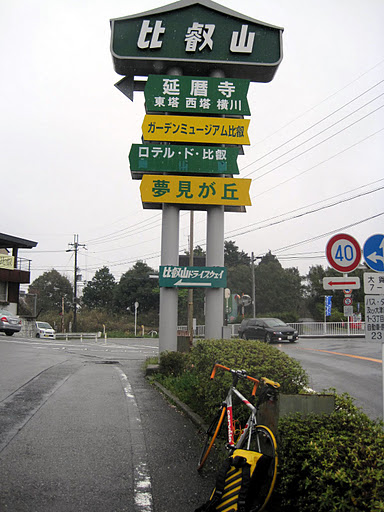
On my first ever visit to Japan in 1985 I spend some days in a small village called Sakamoto at the shores of lake Biwa just outside of Kyoto. For a long time I have been fantasizing about about riding my bike from Kyoto to Sakamoto and with time running out quickly I graped the chance to do so on Tuesday.The weather looked real miserable when I left the house at 5.30 hr in order to catch the first Shinkansen of the day from Shin-Yokohama to Kyoto station. Riding in the train and looking out of the window the weather situation seemed to deteriorate even more while going West. This was going to be a miserable day, without doubt. So it was no surprise, when it drizzled already when I finished to assemble my bike and started to ride out Kyoto station on the beloved Avanti/Fismy side. How many times have I been there to buy some junk, not appropriate for my age group regardless of which age I entered?
I was so eager to ride out of town, that I rode much to far to the North. When I changed into rain gear and checked the maps at a 7-Eleven, I found out that I hat to ride back quite a distance and make a turn to ride on Ken-30 in direction Hie-San. This is a magical mountain with some remarkable temples on the top, most notably Enryakuji. It is where the warrior monks (Yamabushi, but no Yamabushi Toge in sight) used to live and descend to Kyoto to terrorize the local population. I have ridden up by car a few times long ago and I expected an awful long and steep climb, but it wasn’t that bad. Mount Hie is actually more a hill in the scale of Otarumi or Yamabushi Toge (Chichibu, that one).Nevertheless with a lot of luggage on the back it took me quite a while to reach the top. There was an entrance to a toll road (Hie Driveway) which was closed for bicycles. These war-mongering monks still find ways to extract money from innocent travellers, now by levering tolls on highways. So I rode down the other side towards lake Biwa and the town of Otsu.
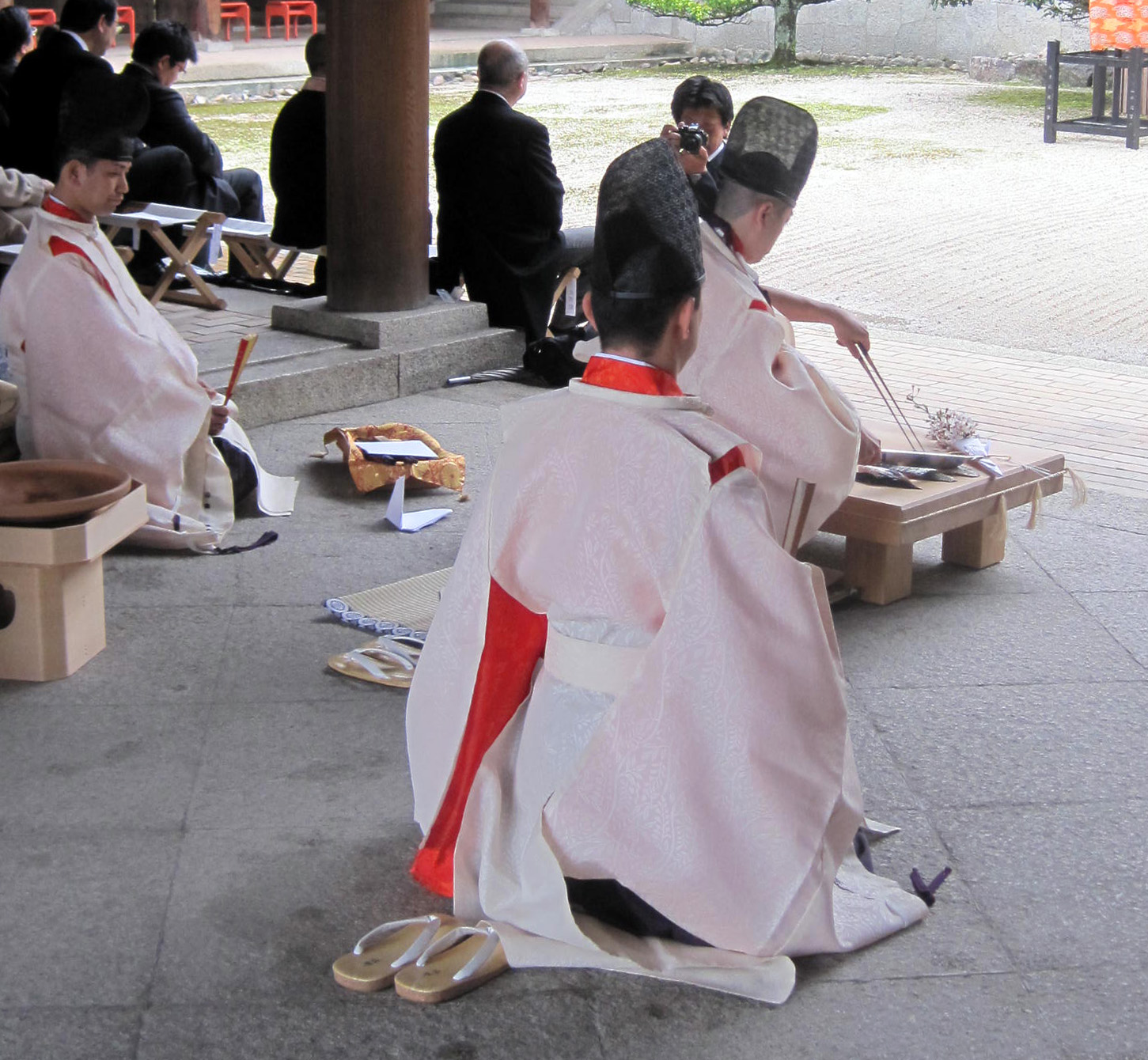
I had no particular goal to reach, no route planned and no minimum distance or elevation to be covered. So I just rode along in the rain, looking for things of interest on the left and on the right. A very much enjoyable type of rising like I used to do many years ago when I started to explore Tokyo by bicycle. Very non-competitive. Lake Biwa with it’s long history is also a very fertile ground for this kind of riding and before long I found the entrance to a bigger shrine (Omi Jinja) where I thought I could buy some Ema for my collection.When I approached the main hall, I heard some typical Shinto music and I saw a larger congregation of rather old people gathering under the roof. Curiously I climbed up the stairs and just in front of me a ritual take place where three fully dressed Shinto priests dissected some fresh fish with a huge knife and extraordinary long chopsticks. The scene was almost surreal: here I came through the rain on my 21st century (not carbon!) bike dressed in high performance rain gear and suddenly I was in a location and watching a ritual that could have been conducted in the same manner at least 100 years ago.I reminded me very much of a scene from the movie Lost in Translation, where the female lead finds by chance a temple in the middle of Tokyo when lost in the city and marvels about the strange things experienced.
http://www.youtube.com/get_player
This is not one of my favourite movies. Actually there is only one movie I really, really like and I have seen a hundred times or more: „L’homme qui aimait les femmes“ by Francois Truffaut (1977) and this one has nothing to do with cycling. Are there any scenes of cycling in Truffaut’s movies? Perhaps in Jules et Jim, but I am not completely sure. Anyway, despite the title and the fact that the movie is starring Brigitte Fossey, in 1977 the most beautiful woman on planet Earth (my generation knows her mainly from La Boum) I do not like the movie so much because it is about love. No, it is a movie about writing and this is what I do when I don’t cycle (or have to earn a living or keep my family happy).I deviated. Slightly. So coming back to „Lost in Translation“, I nevertheless like this movie not because of the movie itself but because what happened when I went watching it with my wife. Much of the movie is located in the PARK HYATT HOTEL in Shinjuku, a very expensive but nevertheless stylish place where I choose to stay in 1998 for one night out of a sudden and foolish impulse. The next morning I felt terrible for spending uselessly so much money so I tried to compensate myself for this by stealing the hotel’s Yukata from my room. Hey, for 50.000 Yen one can expect that piece to be included, can one? Of course I never told that my wife as she hates when I steal things from time to time out of bad habit. I have a nice collection of good looking ashtrays from hotels around the world and a massive amounts of coat hangers from the Excelsior Hotel in Hong Kong where I was forced to stay many times to attend many boring meetings at Schindler’s Asian headquarters.

Now, when my wife and me watched the movie, suddenly the main character, Bill Murray, appears on the screen wearing the very same hotel Yukata (at app. 1:46 min in the trailer). Of course my wife noticed this immediately and gave me a hard time to explain why I had precisely the same type. So eventually all bad habits get punished, some earlier, some later. Or like we say in German: „Kleine Suenden bestraft der liebe Gott sofort, grosse dauern etwas laenger.“

All of this went through my head as I was standing there watching fish get chopped, sliced and diced in old fashioned form just in front of me. Discretely as I came, I went, trying not to disturb too much the tranquility and peace of the place and the people attending.

Back on the shore road to lake Biwa I found myself sandwiched between speeding trucks on one side and the barracks of a Japanese Self Defense Force Base on the other. A group of soldiers in full gear tried to cross the street led by a guy with the famous Japanese red light swords, commonly used at public road work sites. Funny.By now I have grown accustomed to the rain and I was pretty wet. My shoes had reached the point of no return as well. Do you know this sensation when riding through the rain? The feet are getting more and more wet and then suddenly they are soaked with water and becoming cold. Do you know this feeling of helplessness that nothing can prevent this from happening? That you will ride the rest of the day, even if the sky turns blue and the temperature rises to 50 degrees in the shade, with wet socks in wet shoes? This must be destiny.

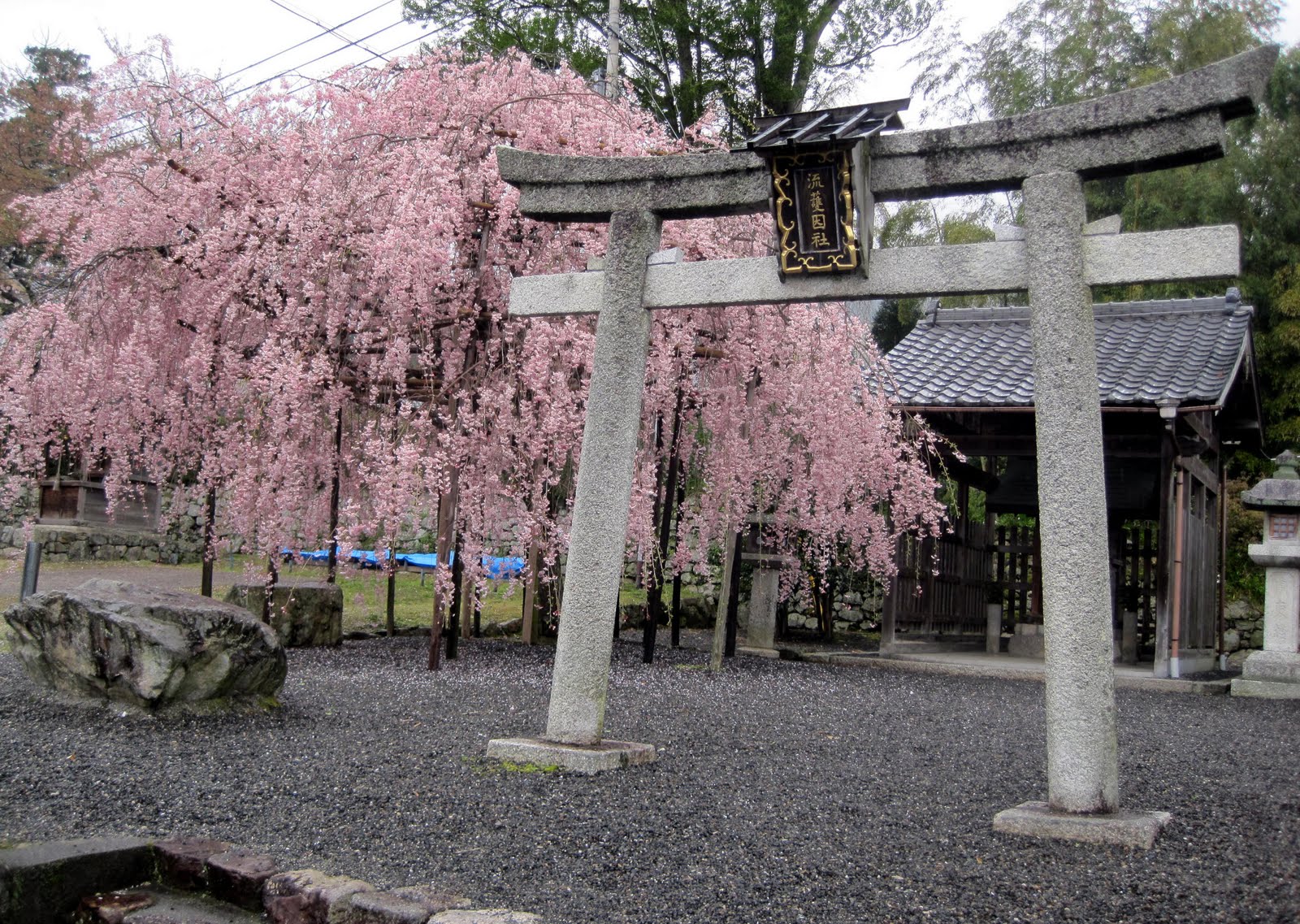
I then entered the village of Sakamoto which is really beautiful with a lot of old buildings and temples and continued on Ken-47 towards the North. The area is beautiful, still some Shidare-Sakura in full bloom and history lurks out behind every gate and wall. So I continued to the town of Ogoto and and tried another road up to Enryakuji, the Oku Hie Driveway. But also this one was closed to bikes – there is no way to ride up to the temple by bike (and to spend money).So I decided to do the most sensible thing and look for a nice Onsen on the coast and relax after this long, hard ride of 70 (!) km. I found one modern Onsen but it was OK as they had all kind of stuff which one needs to stay there. Even towels, razors and tooth brushes. First I was a little bit irritated that there was no tooth paste, but when I cleaned my teeth with it nevertheless, I noticed that the tooth paste is already integrated in the brush. Clever idea. Or perhaps it was the residuals of the guy who used it before me, again not 100% sure.

And this Onsen also hat three tatamis on a podium in the middle of the bathing area where one could lay down, completely naked and sleep. A most splendid idea.

After having a nice nap, I mounted my bike again and rode to Sakamoto where I met a friend from my first visit in 1985 and we had an excellent time together. The last Shinkansen at 9 PM brought me back to Tokyo later. Not such a cycling focused day but more than one can reasonably expect from a rainy day in Japan.

Ein Kommentar

Eingeordnet unter 2010, Cervelo Soloist, Mob

Ludwig, the Last

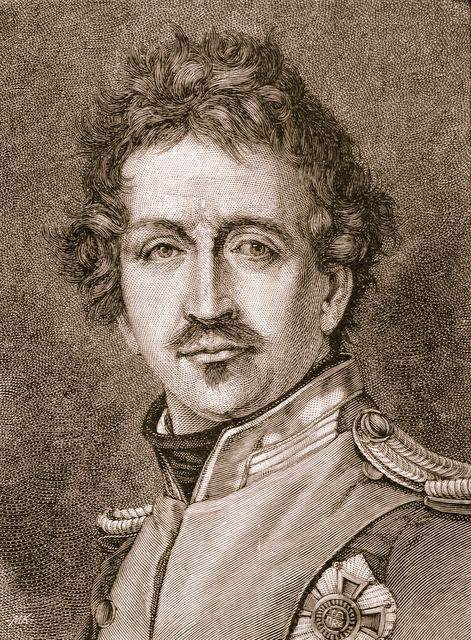
Ludwig I. was king of Bavaria in the 19th century and contributed greatly to the city planning of Munich. His wedding is said to be the start of the „Oktoberfest“ tradition. His grandson Ludwig II., much better known as the „mad king“ squandered money unscrupulously and built many castles which now greatly contribute to the touristic value of the state. His tradition is continued by Japanese public works. Ludwig the Last is not related to any of the above (although one may argue that he posses a similar level of obsessions as his famous predecessors), but is the unofficial name of the perhaps last ride Ludwig (Manfred) and me did together last Sunday.

It was awful cold when I left the house at 5:20hr in the morning and arriving at the Tamagawa I found the view obscured by ground fog and frost. Almost a scene from autumn days. Ludwig was cyclo-crossing while I opted for the bare Cervelo without bottles, bags, lights but with new Shimano Ultegra rear wheel and 11/28 cassette. As I needed to be back home by 12:30 hr, we headed out fast along the Tamagawa and later Asagawa in direction Takao through an increasingly thick fog. Until I realised that my glasses had fogged up and the weather was not as bad as it seemed to be. Then, we made a turn on Jimbakaido and headed out for Wada; when we made one more turn suddenly the sky was blue and the temperature very pleasant – great. So we speeded up for the entry of Wada where we wanted to time-trial up.

I had prepared myself well for this; firstly I thought that Ludwig would pull me up, secondly I had a 34/28 gear to bring me through the hard times and thirdly I spend 30 minutes at the very nice toilet hut with heated toilet seat at the bus stop before the start of the climb to get rid of any excess weight which was still lingering in my bowels.

Off we went and Ludwig speeded ahead, but at least I could still see him some 20 – 30 meters ahead so I thought that I would be doing good. But somehow I was out of shape, the road was also slippery from the rain and snow and perhaps a 34/28 gear is just too easy – in any case I arrived only a minute later than Ludwig on the top but still did only a time between 20 and 21 minutes. Which is OK, but not really great after investing 40.000 Yen for a new wheel.

Perhaps next time a will try an enema to further reduce weight.

On the top we met Steve from TCC who rode up from the other side and was scheduled for hanami at Shinjuku Gyoen in the afternoon. I think it is a very good idea to go there after the cherry blossom season is over, as it will not be that crowded any longer.

We went down on the other side and continued back along route 20 where we made a stop at the Seven-Eleven before Sagamiko Station. Here we met some Japanese riders, two out of three on Cervelos and we asked them if they would know a road between route 20 and Tsukui lake after having crossed Otarumi in direction Takao. One of them was introduced as „quite kuwashii“ but he had no other suggestions but to go on 412/413 (..yawn..) which is anyway before Otarumi from this side, or to go up Otarumi (if we desperately wanted to do so) and ride down again the same side and then take 412/413 (..yawn..). Sorry guys, but in order to qualify as „kuwashii“ in our opinion, you must do better than this.

So we time-trialed up Otarumi from the Sagmiko side and again Ludwig went ahead but I was able to draft for about 2/3 of the time before we saw James and Yair riding down in the opposite direction. Again, I did a 17:34 min time which is OK but not great.

Going down the other side, we saw at least 30 – 40 riders going up: two larger Narushima groups, one group of Aqua guys in blue and some more individual riders. Clearly the good weather and the cycling boom in Japan has enticed everyone to leave the winter pillows behind and try some hills.

Ludwig and me, following our tradition to explore at least one new stretch of roads every ride out, wanted now to cross over to Tsukui lake riding some uncharted rindos and trails we have found on Google map the day before. So 2/3 of the way down we took a right turn and rode up a small road until we came to a charming hidden love hotel consisting of many small bungalows. Some meters up the road we met an equally charming hiking group of old ladies who we asked what the best way to Tsukui lake would be. They were definitely „kuwashii“ and advised us against going up this rode but to turn back and take the next road branching off from route 20.Which we did and that brought us to one of the famous Ukai restaurants, Toriyama which we hesitated to approve for PE as it seems to be rather expensive and does not stock Weider jelly packs. Some hundred meters further up the asphalted road stopped and became a rather nice dirt trail which then became a not so nice dirt trail and continued to become a rugged, slippery and poorly drained, dirty dirt trail, hardly fit for road bikes. Ludwig slipped and crashed just in front of me and then I went in front and crashed as well, so we decided to walk up part of the way. Actually, almost all of the way. On the top we had a nice view on Shiroyama lake and then we came to a small temple where we had an even better view of the Tsukui lake from a very new angle.Finally we rode down another dirt track to the main road at Tsukui, where I went ahead to Hashimoto and jumped the train home and Ludwig did some more riding as recorded in his own account:

After MOB had left for Hashimoto station, I cycled up to the Shiroyama reservoir lake. At the power generation plant, I saw a map that indicated one could walk all around the lake, and much of it looked like it was a paved road. I was delighted - I knew the lake from hiking by it at the opposite side, and had hitherto thought there was no access road around it. Actually MOB thought so too, and had noted that it was an exception to my observation that in Japan dam lakes always have access roads all around them.
I rolled down to the dam and crossed it on a widely paved road, frequented by hikers and a sports club of youngsters running around the lake in pairs. So far so good.

But as soon as I had crossed the dam, I found myself on a hiking trail which forced me to push or carry the bike. Can't be that long I thought. Well, it turned out to go on like this basically around the entire lake, climbing up probably 150m above the lake. I had to climb up and down many long stairs, and even where there were no stairs, it was mostly impossible to cycle.

There were plenty of hikers, and of course I drew their full attention - a biker on a hiking trail, how crazy... Yes, and that's a bit how I felt too.

Eventually I got close to Misawa Toge which MOB and I had crossed only a few hours ago. I found a gravel road that led down towards the lake and from there on was able to sit on my bike again continuously. I arrived back where I had started 45 minutes earlier. This had been much harder than I thought - and carrying a bike for most of the time made it harder than normal hiking.

Back down at the first conbini, I was debating whether to seek out other mountains, but with all the hiking, I had lost my rhythm and didn't really feel like doing another excursion.

I headed home instead, taking the Tank Road (with a small detour through the park) and its full extension (which I find more interesting than the Tank Road itself), and then the roads through Tsurukawa, Noborito on to Setagaya Dori.

Early on I passed a slower rider in full gear on a road racer. He felt slighted being overtaken by a crossbike and tried to pursue me, sitting in my draft. I shook him off pretty quickly. But now I was in racing mood, so kept cycling the full bit home at high speed and relatively high heart rate. That compensated for the early finish.

144km with 1900m BBiT climbing (this time possibly close to the true climbing due all the hiking which my Ciclo doesn't capture well).

http://www.mapmyride.com/route/jp/kanto/880127158506963196


Hinterlasse einen Kommentar

Eingeordnet unter 2010, Cervelo Soloist, Mob

Sci Fi Movie

Sunday offered near perfect temperatures for riding.  As planned, Jerome and I headed out a little after 6:30AM and met Tom at Koremasa-bashi.  Tom, having done another monster ride on Saturday, over 250 km and some big passes, still managed to pull us at about 35 kph along the first stretch.  With Tom („the Cylon“) in front, Jerome second, and me in the back, I could still see reasonably well, but had an almost perfect wind block.

Just before Tamagawahara-bashi we passed a group of 25 or more cyclists in team kit assembling for a morning ride.  We later passed a group of about 12 Catteni Positivo riders in a line on the Tamagawa path.  They have new uniforms, looked younger and fitter than last year’s Catteni group and were moving at a good pace … but were still easy to pass with Tom pulling at 35 kph. The Catteni leader looked like a real racer/climber type.  We also passed a group of Ovest riders from Fuchu, heading at warm-up pace to a rendezvous at the end of the path … with another huge group of riders, waiting around, mostly in Ovest kit.  Tom uses the Ovest shop and swears by it, and we have seen some very fast Ovest riders flying before — putting in top-five times on the Tokyo-Itoigawa ride, at least.

We rode out via Itsukaichi (where we passed another large team in „Hotstaff“ jerseys — I could not have passed them but for a lucky traffic light at a minor intersection where they stopped and I continued), and then Umegaya Pass (aka „Jerome Hill“) and up Yoshino Kaido, parting ways with Tom at the 7-11 at Kori, where Yoshino-Kaido ends and we turn left onto Rte 411 (Ome Kaido) to climb up to Okutama-ko.    We took as second quick rest at the end of Okutama-ko in front of the recommended cafeteria (still too early for a meal).  

These teams — yesterday Catteni, Ovest and Hotstaff, plus the first group we saw, are a big change from the days when the only group of more than 10 cyclists one would ever see was Nalshima.  And while these groups may not be riding as far as we do, they seem to be more serious than in the past.  This is only a good thing, as far as I am concerned.  Drivers will watch out for road cyclists.  And it is almost never these cyclists who do the stupid tricks on the Tamagawa path that risk injury to us.

On the Tamagawa there were flowering sakura (cherry trees).  On Jerome hill there were a wide range of flowering trees, including one in a spectacular purple.  At Okutama-ko (540m elev), there were more sakura and ume (plum trees), and we could see them on many wild hillsides later in the day. We headed up Rte 139 toward Kosuge, cut over to the base of Tsuru Pass and then to the base of Matsuhime.

The 500m elevation main climb up Matsuhime (from 750m to 1250m elev) was not bad, and at least made me feel that I am starting to get back in shape as a result of the past month’s rides.  Then again, I had put on the compact (50/34) crankset, so it was only expected that I was able to spin up the hills better than in previous weeks.  There was only one other cyclist at the top — far away from the morning crowds.

We descended quickly from Matsuhime (1250m elev) to the South, stopping at the park at Fukashiro Dam (650m elev).  We filled our water bottles at a (temporary) stream close to the top of Matsuhime.  A few people had stopped at the Fukashiro dam rest area.  These were the last humans we saw for the next several hours.

And this is where our science fiction movie started.  We crossed under/over the gate and through the tunnel for the long climb up the road to O-Toge (Big Pass -around 1550 meters elevation).  After what seemed like a few hundred meters, there was a loud „bang“, a „hiss“ and it was as if we were transported in time or space.  I thought I saw a blue flash.  Jerome’s sidewall tire had clipped one of many rocks on the road surface, pinching his tube.  He was able to patch the tube quickly and we were back on our way.

The road surface was terrible, as last year, but there were only two spots (above 1100 meters) where there was so much debris as to require a dismount.

Complete solitude greeted us on this climb and the following descent — two hours at least, from 650m to 1550m and down to around 1000 meters, not a single person.  What had happened?

Had we gone forward in time, with one of those devices the Terminators use to come back and kill John Connor … to a day (say, the year 2075) when there are no more Japanese people left, except for old people in nursing homes?

Or was this „I am Legend.“  Had all the people been wiped out by a terrible (unintentional) genetically engineered plague, leaving behind only zombies who would come to get us if we could not make it to safety by dark?

We got our answer soon.  There were some kind of animal droppings at various places along the climb.  Then we saw it — a monkey came down noisily from the brush above and onto the road ahead.  It detected us and took off running down the road away from us, rounded the corner and plunged into the wooded slope below.  This must be Planet of the Apes.

We picked up the pace, in case a group of armed gorillas should be sent out to look for us.  This is a beautiful climb, spectacular vistas, varying grade, and the road gets better once you pass 1250m elevation.  The descent on the South side, with no traffic (closed road still above 1000 meters), and not too cold to enjoy it, was spectacular, memorable — to anyone asking the question, THIS is why we ride.

As we did last week, we hopped the train from Otsuki and were home for dinner.
http://connect.garmin.com:80/activity/embed/29756956

3 Kommentare

Eingeordnet unter 2010, David, Jerome, Tom

Rindo Exploration in Chichibu

The forth weekend in succession on which I explored rindos with my new cyclocross bike. This time, I headed for Chichibu.

Despite a particularly early start, leaving home at 5:45am, the Tamagawa was already crowded with people. And not because of the cherry blossom in many places – actually these were the most deserted parts.
I noticed quickly that I was still not fully back in form, having been down for two days with a virus mid-week. I had difficulty pushing my heart rate above 150 – or rather, I didn’t even feel like trying. But cycling at moderate speed (not made better by significant head wind) was still fun, so I kept going.
I explored a new route onto the Green Line (see GPS trail below), going from Ome to just before Hanno, then turning up the Irumakawa valley, turning into the valley leading towards Nennogongen, but taking the first rindo turning off to the right and over a 300m pass down to Higashi-Agano (on route 299). Route 299 was full of nasty truck traffic as usual, but I only had to cycle 200m upward on the pavement before turning off to the right into a nice valley and then rindo leading up to Kouburi Toge (500m), the start of the Green Line. From there the rindo continues as everybody knows over various „passes“ reaching up to 900m.

It was nice climbing with little traffic. The sun had finally come out, and I found myself overdressed in what was still basically winter gear.
At Ono Toge, instead of turning right as we always do towards Shiraishi Toge and Sadamine Toge, I left the Green Line to the left, heading towards Kenminnomori. Saitama needs its forest just as Tokyo needs their own (Tominnomori). This rindo was also well paved, and easily accessible by road bike. In fact, I saw a group of riders who must have made it up from Chichibu city.
Instead of turning down towards the city, I kept going, passing by a camp side protected by a friendly guard man, direction of Nagatoro. Beyond the camp side, the rindo falls down steeply, first unpaved (but in decent condition so manageable even on a road bike), then paved. My hands became quite tired from all the breaking, so steep and long was the descent. At one point, I got off to check the heat of the wheel rims, and almost burnt my hands. I felt the rubber melting and losing grip. The paved surface was rather uneven, so I couldn’t go faster than 30km. What a waste of mass! I prefer to spend accumulated altitude on a fast downhill!

At the foot of Sadamine Toge, I turned north, passing the Nagatoro gorge on its right. People were enjoying the by now really beautiful spring weather going through the gorge in boats.
Lots of nice photo opportunities, of landscape and also a lot more cherry trees. Every stop made me realise that I was really not in great shape – I felt the exhaustion even though I had not really pushed myself that hard. At a 7-11 stop in Nogami, I decided it was best to take the shortest route to Honjo-Waseda and spend the rest of the afternoon resting at home, perhaps getting in shape to head out with the PE crew the next day. I had rewarded myself with an onigiri and Black Thunder, when I was approached by an older woman offering me another rice ball that she and her husband had left over. I took it gladly, and it was delicious, a lot more so than the usual 7-11 variety. It looked home-made.
The guilt of the extra calories convinced me to keep going – for another round into the mountains. My plan was to head over to the Shimokubo dam lake and take the rindo leading from there to Shiozawa Toge, then run down to Tomioka.
All worked well until I missed a turn into a rindo that was meant to take me down to the dam, and instead kept going upwards on a rindo that was running parallel to the lake on its south side. I realised the mistake only 50 altitude meters or so after the turn, but decided this one was also worth exploration. The rindo keeps rising ultimately up to 980m, and then leads on in various ups and downs around the ridge of the mountain range to Tsuchizaka Toge at 700m, one of the many passes from Chichibu into Gunma which I have taken before.
Down in Gunma, I was tempted to climb up to that other rindo and cycled up to the entrance of the road, but then decided to be reasonable for a change and not attempt another 650m climb in my condition. Better take the road straight to Honjo, or so I thought. Least did I know that I still had quite some climbing ahead of me. As it turns out, (according to mapmyride) I would have had only another 200m to climb and no difference in distance at all, had I gone up that mountain…
I took route 462 along the valley towards the lake. Traffic was moderate, but rather too many noisy motor bike groups for my taste. So I left 462 to take what is essentially a badly maintained rindo, running on the other (south) side of the lake. Unlike the kokudo though, it runs deeply into some of the valleys running into the lake, and has several climbs of up to 150m each.
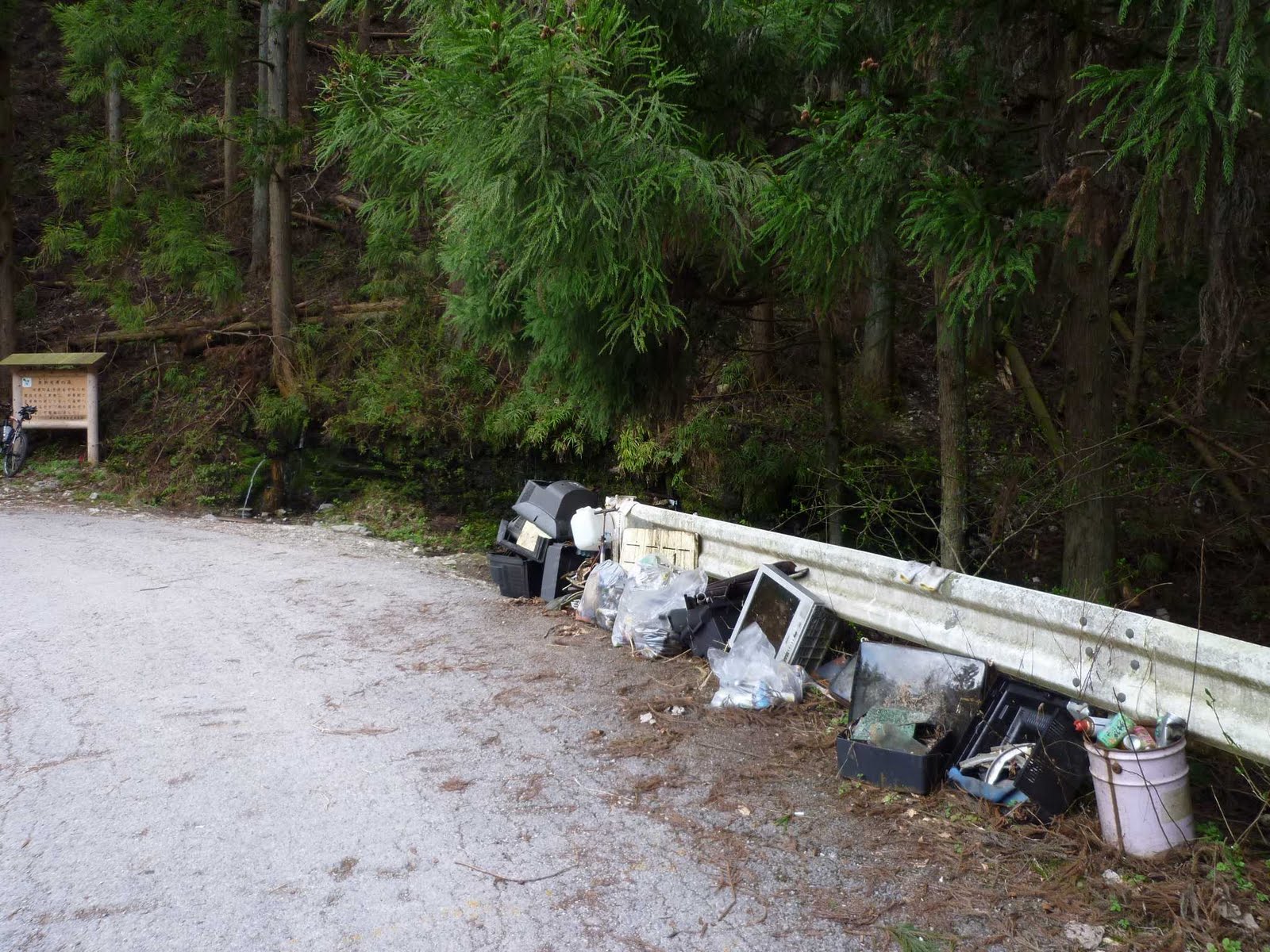
I passed by a nice natural fountain and replenished my water supply. Less nice about it was the fact that somebody had dumped their sodaigomi in front of it. Unfortunately, the rindos in this area were full of such sights/sites. Unbelievable that people ship their trash out into the mountains instead of paying a few hundred yen to have it collected.
Such sorrow sights were compensated by plenty of stunning views of the lake and its small islets.
The dam wall looks like the fortress walls of a Japanese castle.
Beyond the dam, I thought it was all just a straight downhill into the village at the bottom of the valley and then a fast run to the station. None of it – more up and downs! And a landslide that blocked the entire road – an invitation to the cyclocrosser to walk over it!
Then another building site – road blocked to traffic! Well, when has that ever been an obstacle? This time, however, there was a huge gap in the road, with a five meter cliff straight down. Building workers busy with their work, and not noticing the sole cyclist towering over them.
I thought it was pointless calling their attention as this would just risk them telling me to get lost from where I had come. Instead, I worked myself up a steep hill, through grass and bushes, and then down again, right into the building site, to the utter surprise of one of the workers, who was so speechless, he couldn’t say anything. Which was just as well, so I could get on speedily.
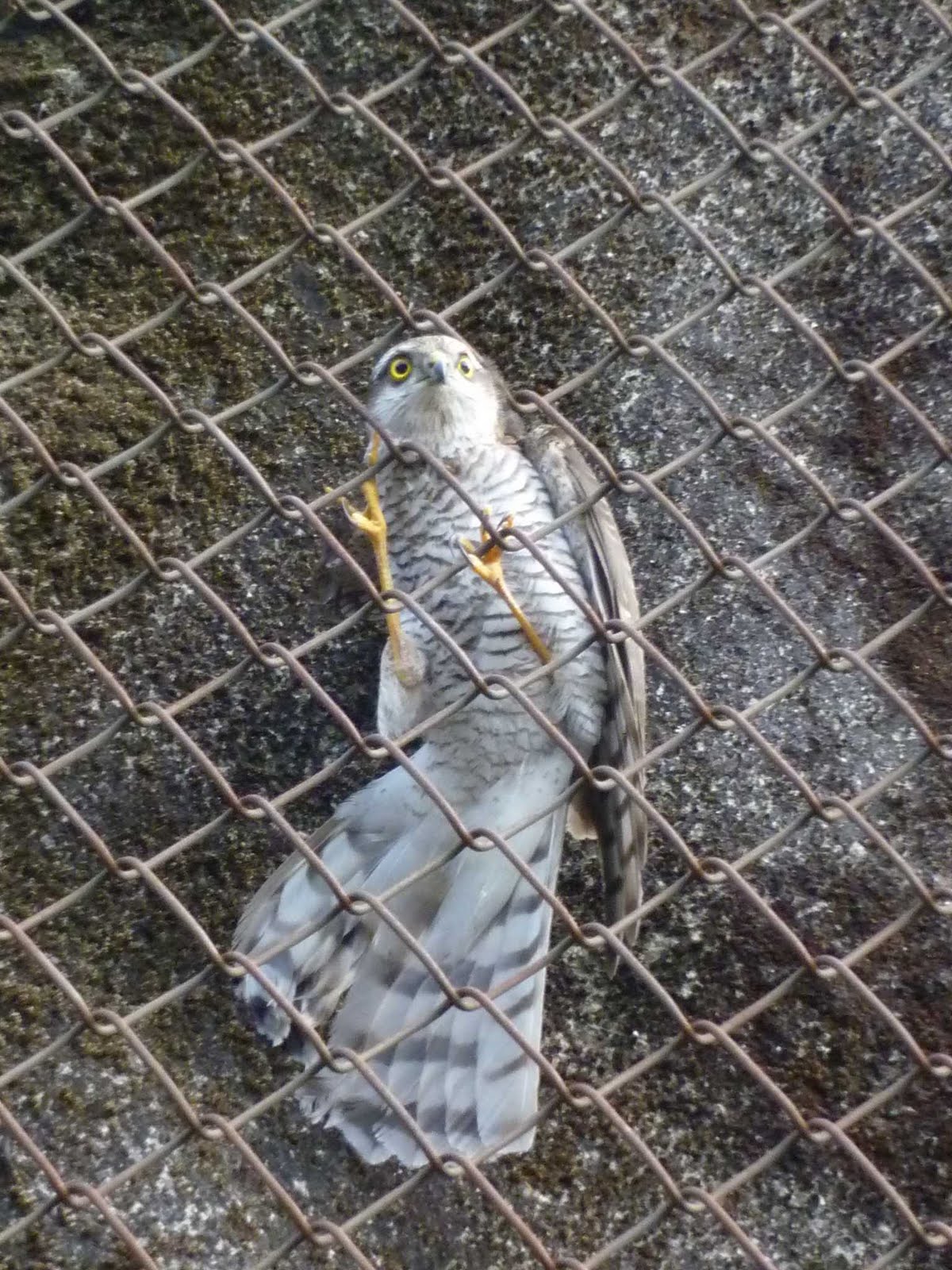
The remaining barrier of the day was one for a bird rather than myself. A young prey bird had got trapped behind the fence securing a wall of rocks along the rindo.
I managed to secure a larger whole at the bottom of the fence by inserting between fence and rock a PET bottle from another one of those trash dumps right opposite. The bird had fled my help attempts to the upper parts of the fence, and I can only hope it eventually found its way out.
I myself found my way to the station rather easily, this time avoiding route 462 altogether, and going to Honjo rather than Honjo-Waseda. A Takasaki-Hiratsuka direct train took me to Shinjuku in just one go (and 1.5 hours).
185km with 2,800m BBiT in altitude gain. 11.5 hours on the road, of which 8.5 on the bike – i.e. I had taken it rather easy.

2 Kommentare

Eingeordnet unter 2010

Sunday Ride — Route TBD

Jerome and I will be leaving my house (let’s call it the corner of Komazawa Dori and Kanpachi Dori) at 6:30AM.  We will pick up anyone who wants to join at Tamagawahara-bashi at 7:00AM.

The route thereafter is open to debate and depends somewhat on who joins, on the weather forecast (rain Sunday night … or starting before our return time in the afternoon?) and any individual time limitations.  But make no mistake, it is prime training season and we are hoping for a classic Positivo Espresso ride.

My vote is for Matsuhime (1250 elev) from the North side, then the gated-off Northern approach to O-Toge (1500 meters) and quick drop down to Otsuki … but I could be persuaded to do just about anything other than Yanagisawa Pass, which we just did last weekend.  I could probably be persuaded to do even Yanagisawa again — they’ve got two newly opened sky bridges so the descent to Enzan is even faster than before.

Please show up and get ready to make a persuasive case for your favorite* ride!

*Must be within day-trip distance of Tokyo.

9 Kommentare

Eingeordnet unter 2010, David, Jerome

Beyond the Peloton : Milan – San Remo 2010

A new video from the Cervelo series. Perhaps not as good as the 2009 videos, but still better than almost everything else about cycling on the web.

I liked the picture of the Cervelo rider in the typical flat lands of Belgium; so similar to my home town. And so much closer as well.

Hinterlasse einen Kommentar

Eingeordnet unter 2010, Cervelo Soloist, Mob