Archiv der Kategorie: 2010

The Wild Sheep Hunt

Yesterday, Tom rode the giant Yanagizawa Loop, consisting of the climbs to Yanagizawa, Kamihikawa, Sasago, Suzugane, Hinazuru und some other minor ones. Today, David, Jerome and me did the same loop. Almost.

Well, at least that was the plan, when the three remaining Positivo Espresso founding members gathered at Tamagawahara-Bashi at 7:30 AM. The (former) Tamagawa bicycle path, now a major walking path for the hanami-crazy, was full of people so we decided after a while to ride the normal road up to Ome.

Which brings me to the discussion about the Tamagawa path and the recently added obstacles (see for example here). Honestly, I don’t care. I don’t even want to put the argument forward that riding along the Tamagawa is boring and not very challenging and that I have been there a hundred times. Yes, all true but not of general interest. The point is, in my opinion, that the sum of total obstacles doesn’t increase too much, if some fixed obstacles are added to the enormous number of moving ones.

There were simply not that many people when I started to ride along the Tamagawa about ten years ago: people, people with dogs and bicycle riders on the path. It was a fast and simple way to get out of metropolitan Tokyo. But by now, this has changed dramatically: too many moving obstacles. Even if the speed bumbs will be removed, that wouldn’t change too much.

So, riding the (normal) road to Ome was comparatively much more pleasant and we were speeding towards our target like a fusillade of human bullets shot from an AK-47. Or perhaps more like a set of RPGs, given the shape of our bodies.

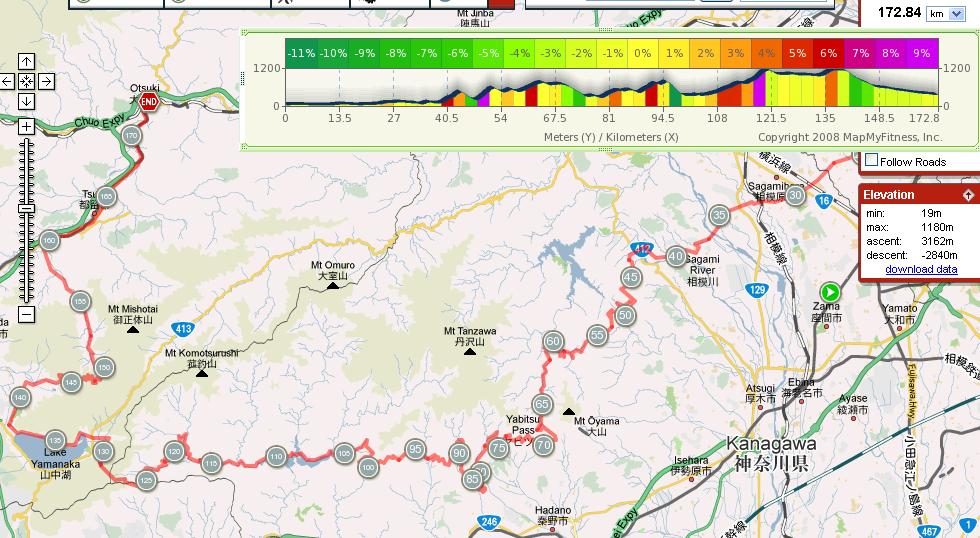
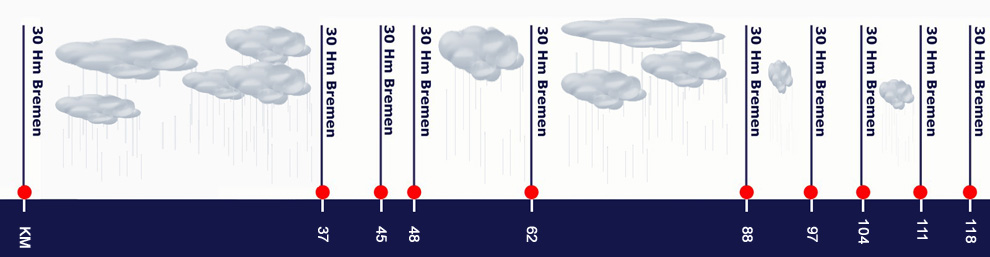
And so we arrived in Ome in 2 hours and 5 minutes – from my home in Yokohama that is. It cannot be done faster (today). And after a short break at Aurore bakery, we continued our fast ride towards Okutama and further up to the Okutama lake, without any longer breaks. This was the first time that I did the stretch between Ome and Yanagizawa in one go and as you can see on the right side this has now become the CHO TOGEBAKA (cho, in the double meaning of 長い and 超える), given the distance and elevation conquered. This is the mother of all Toge Baka (so far).

Now, when we made the turn at Okutama lake, Jerome was shouting from the top in front of me. Actually he told me, that we should wait for David who was further behind. But I didn’t understand that properly, plus I didn’t saw Jerome waiting, so I was assuming that he would be still riding in front of me. Now, as I don’t wanted to be beaten up Yanagizawa, I accelerated and went quickly around the lake, supported by a nice tailwind. No sign of Jerome. „Jesus“, I thought „He must be in really good shape.“ So I tried harder and exhausted myself completely on the climb. No Jerome came into sight. I had this vision that I was so slow, that David would overtake me with double my speed from behind.

So I run up Yanagizawa at full speed; until 200 elevation meters before the pass when I finally was convinced that Jerome must have been behind me. And I had run out of power. The climbing started to become really, really hard after being in the saddle for almost three hours. All the houses up there are deserted and all the curves looked alike and finally, well, there was the final one and I arrived at the restaurant on the pass which was also luckily opened. Jerome wasn’t there.

I had a bowl of Soba, when Jerome arrived about 10 minutes later. We waited for David, who joined us after further 30 minutes, looking pretty wet and exhausted. In the moment he entered the restaurant, Jerome and me got up from our chairs in good, old Positivo Espresso tradition and said „OK then, let’s go!“.

But the truth was, that I was also pretty much done and I wasn’t fully hydrated and recovered after some days of sickness last week.

So I made the following proposal: „We can do now Kamihikawa, Sasago, Susugane and Hinazuru, so about 34.786 meters (BBiT) of climbing plus an estimated 6.732 km (BBiM *) of distance, or we ride down to Ensan (now Koshu, by the way) and jump into an Onsen.“ Surprisingly enough, all of us opted for the Onsen visit, so we mounted our bikes and made the fast run down to Ensan. There it was pretty hot. The sky was blue, the thermometer showed 17 degrees and after all the cold weather before, we suddenly didn’t felt in the mood any longer to linger in hot water.

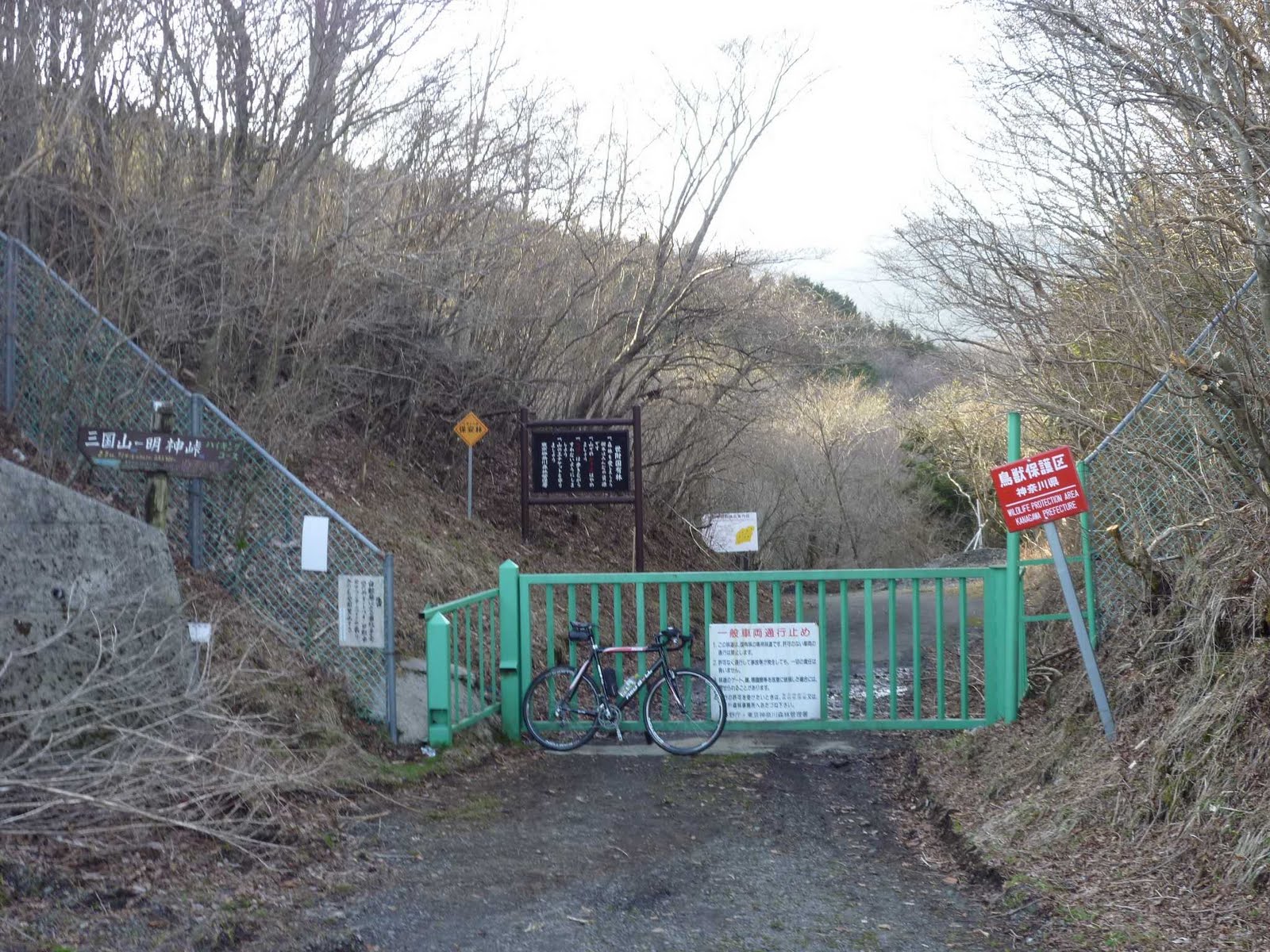
So we rode the Fruit Line to Route 20, climbed up again and then took a right turn up to the haunted Sasago tunnel. We took it really easy, at least David and me, while Jerome was frolicking around in faster speed-hemispheres.

Shortly before the gate we met a woman who asked us, if there would be an old hotel further up the road. No, only a haunted tunnel with transparent octopuses living in the vaults. Later David said, that we should have taken a photo of the women in order to check if her body and face would show-up on the print, then perhaps she was only an epiphany of a Fox deity.

The old Sasago Tunnel was filled to the ceiling with maximum horror as usual.

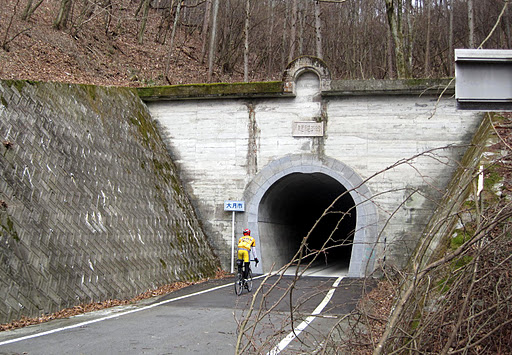
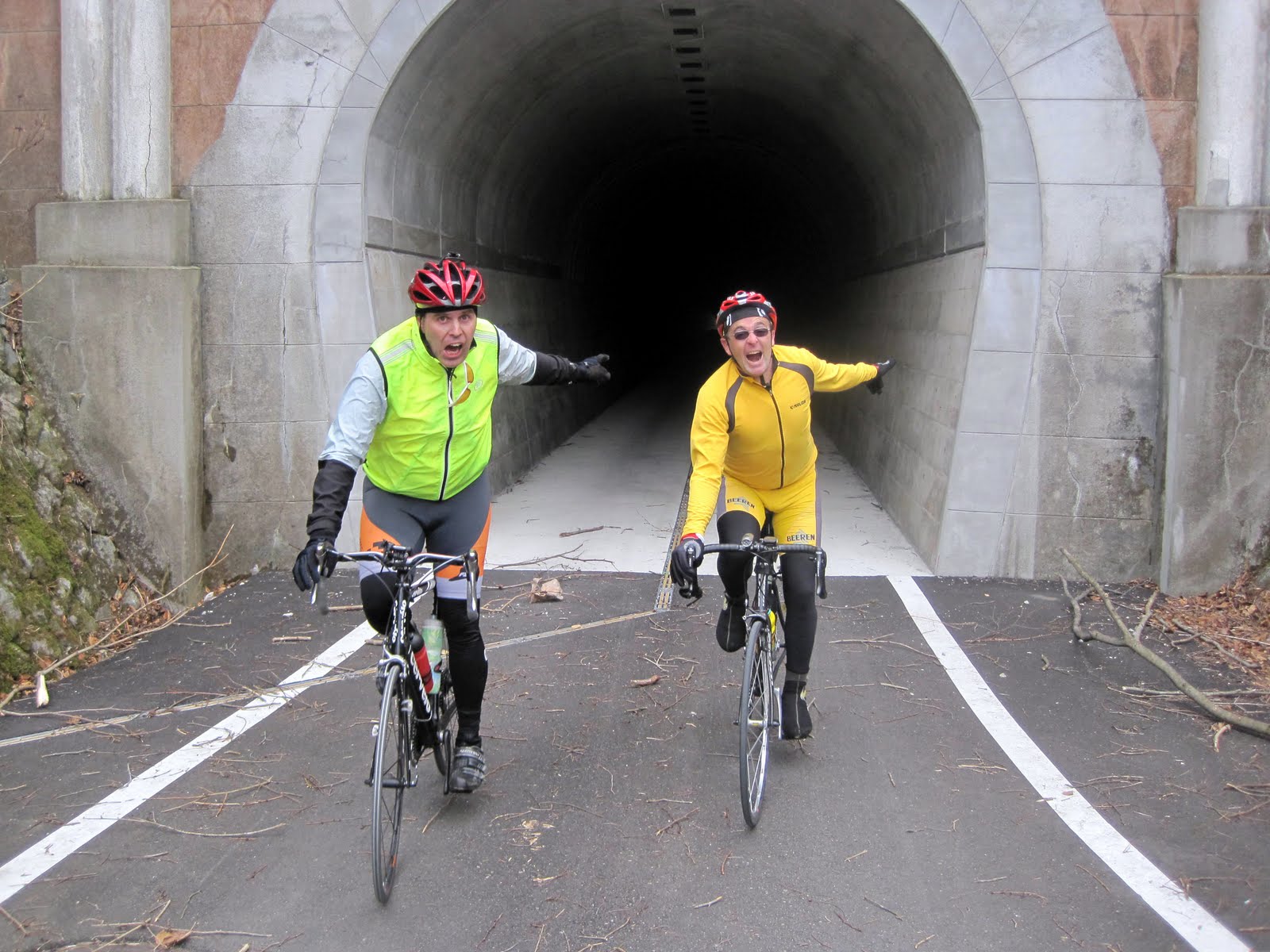
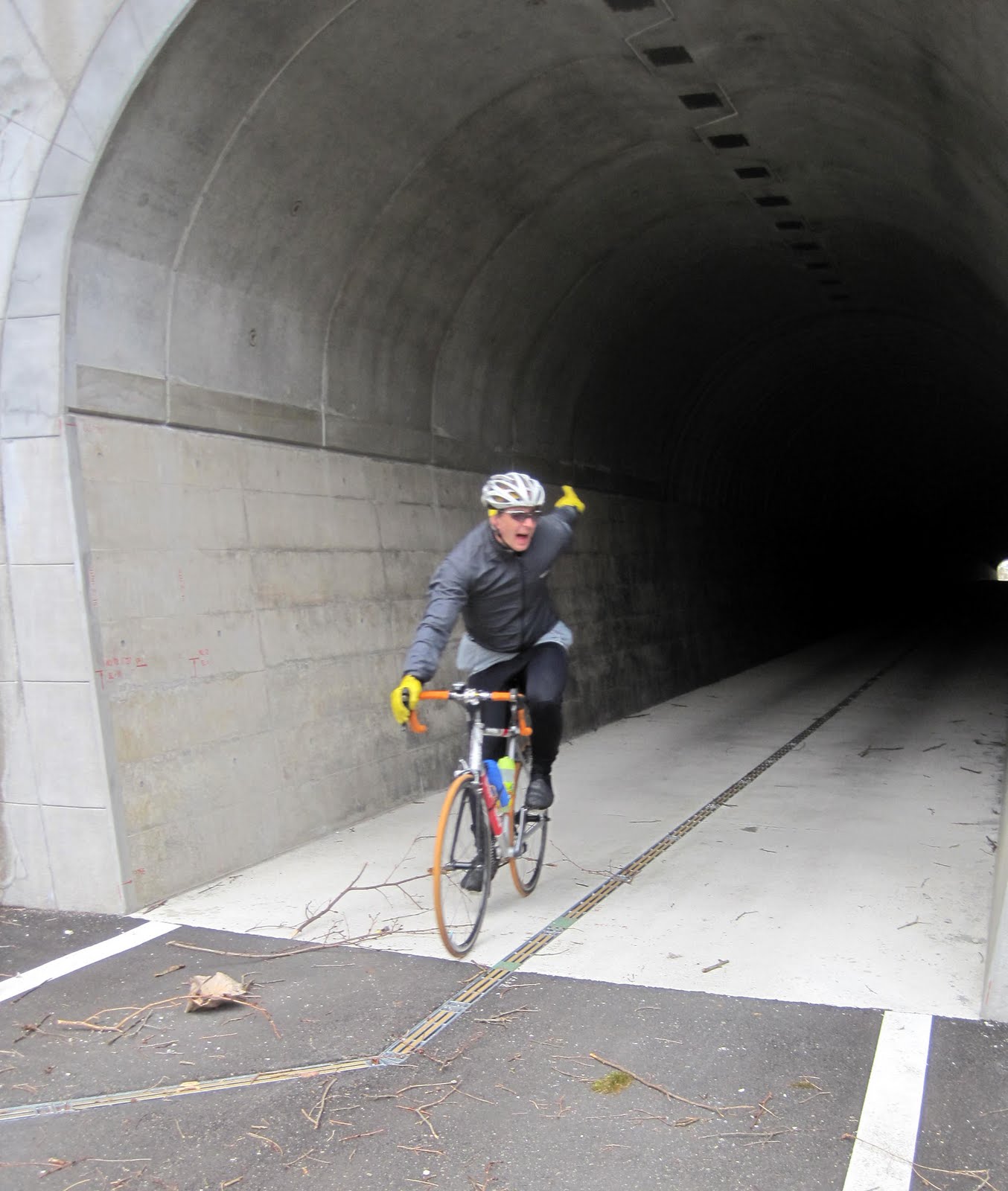
Here we can see David and Jerome, still not suspecting anything, while entering the tunnel from the Ensan side. And here we see David and Jerome and me coming out on the other side, after we have experienced pure terror in it’s most terrifying form in the darkness inside.On top of that there was also a strong wind and it was extremely cold inside the tunnel. And the weather on the Otsuki side of the tunnel was about 10 degrees colder than on the Ensan side.
So we made a fast run down to route 20 and almost froze to death. Then we made another superfast run down to Otsuki station on route 20 which was even more fun. And then we had a superfast express train from Otsuki home; all in all it took me less than 2 hours from arriving at Otsuki station to the door of my house.

A very nice trip with 167 km distance and more than 2.500 meter climbing (mapmyride checked). Could have been warmer, though. The last two rides (Chibchibu and this one) were some of the coldest rides ever. I enjoyed reading about the other rides on the weekend by Ludwig, Tom and the large PE group as well. It is good to know that so many activities are going on and there are so many groups to join.

Notes: I wrote this post yerstday after the ride, but didn’t had the time to edit it and include the photos. So, please take this as an addition to David’s post on the same subject.

(*) BBiM : Blind Believers in Me
Hinterlasse einen Kommentar

Eingeordnet unter 2010, Cervelo Soloist, David, Jerome, Mob

W.B. "Bill" Hurlow: The bicycle builder who sculpted his lugs and frames

Good to see a bicycle builder getting so much press, albeit only upon his death. Yesterday’s FT carried a long article on him, almost as long as the article on the Pope, filling the rest of the page on top.

Sound bites:

London-born Bill Hurlow was one of the world’s best-renowned and respected builders of lightweight racing bicycle frames, not just for racers but for bicycle fanatics, weekend riders and collectors across the globe who still treasure his creations. Described by many of his peers as „the Picasso of bicycle builders“, not just for his artistry but for the speed with which he plied his craft, Hurlow worked for most of Britain’s leading bike manufacturers after the second world war, when Britain was at the vanguard of bicycle making and set the standard for the rest of the world.

[…]

Among the customers for his bespoke models were rock star bike enthusiasts Mick Jagger and Eric Clapton, as well as actor Peter Sellers, who insisted his model be finished in Ferrari red to match his car.

[…]

Hurlow was an amateur racer himself, winning numerous time trial awards for two of the great cycling clubs of his day, Galena and Marlboro, including in the great Bath Road 100 (mile) time trial, in which he won the Lascelles Cup three times – in 1949, 1951 and 1952. He was still racing into his seventies, often beating competitors 30 years younger, and still covered 30-40 miles a day for pleasure into his mid-80s.

[…]

Hurlow’s designs influenced bicycle makers worldwide, particularly in the US, where frame builders took up his mantle and one described him as „the builder’s builder, a tailor of tubes“ for his ability to design and build a bike to individual measurements and needs – height, weight, build, and even, like a tailor, the vital inner leg measurement – to angle and balance the frame to suit the customer. „His bikes were the equivalent of Savile Row suits,“ said his friend and fellow biker John Hunt of Canterbury, Kent.

[…]

For many years, the Hurlow workshop in the mews of the White Horse pub in Herne Bay, Kent, was a mecca for would-be frame-builders, collectors or simply fans of his work from all over the world. One such visitor, American builder A.D. „Art“ Stump, who came to Britain to have Hurlow build a bike for him, said of his work: „I liken a well-designed lug frame to a good, engraved English shotgun. It doesn’t shoot any better than a plain shotgun, but it is pretty and shows the builder’s care in making it.“ Such was Hurlow’s reputation in the US that, after word of his death spread, bikers across the country hit the saddle for memorial rides in his honour.

Ein Kommentar

Eingeordnet unter 2010

Rindo Easter

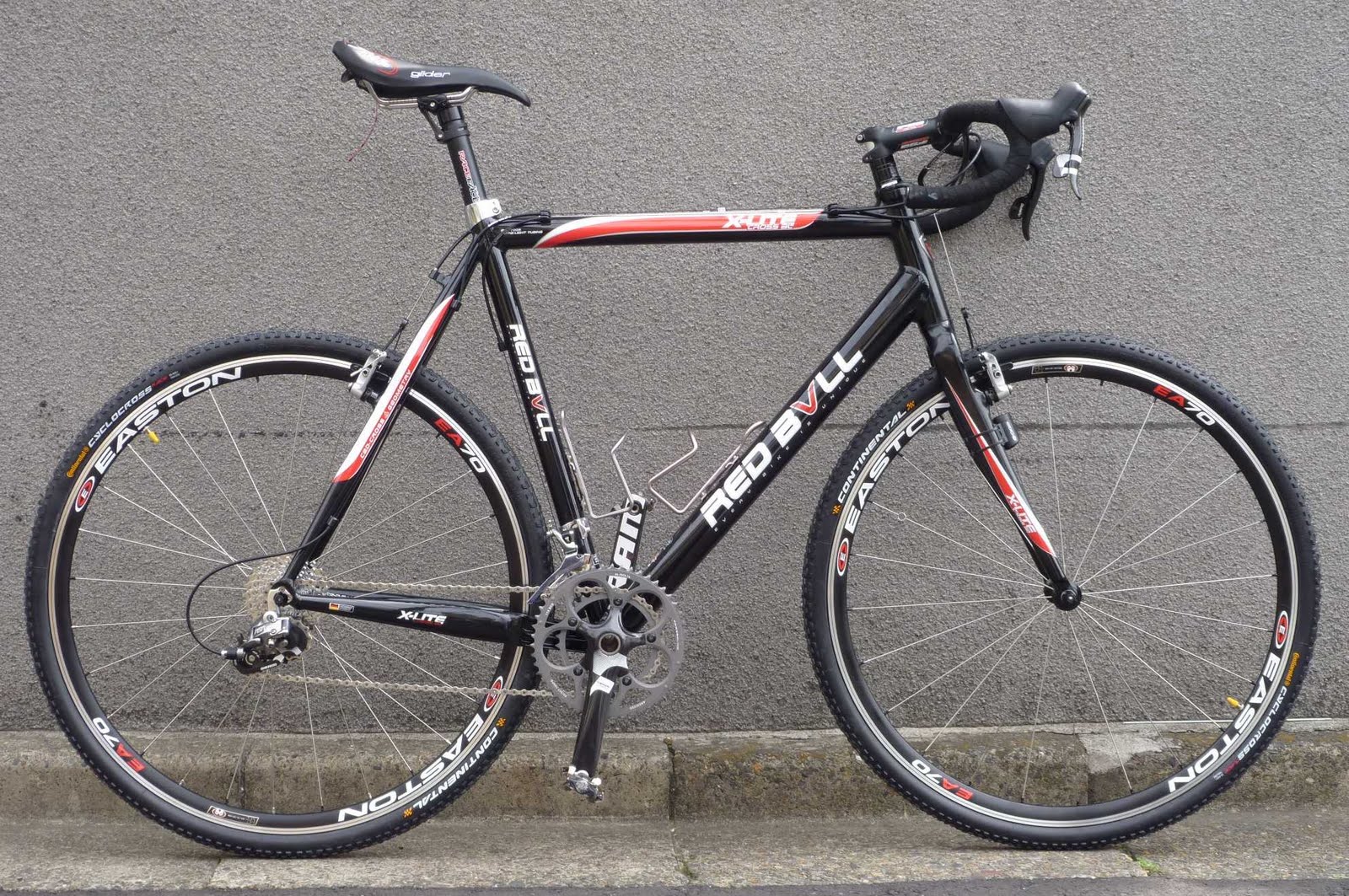
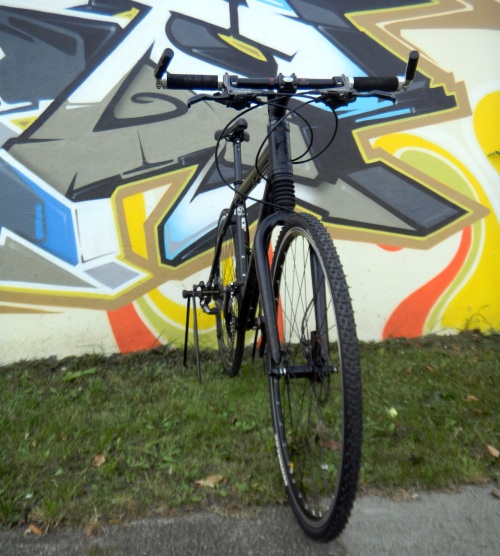
After the virgin ride with MOB and another one with Tom (which both have blogged about), it was time to do my first solo ride with my new cyclocross bike, at my own pace.

I left home at 6am on Easter Saturday, taking Setagaya Dori and its extension all the way to Aikawa, situated at the foot of Miyagase Lake. Instead of surrounding the lake, I took a rindo leading up to my first pass of the day, Hanbara Goe at 500m. From there down into the next valley (250m) and up through a completely closed off entrance to the next rindo, Monomi Rindo, which presented nice views of the Ebina plain and Enoshima visible in the distance (unfortunately not sufficiently clear to be seen on a photo). Monomi Tunnel was at 600m, and from there it went down again on a rindo full of tree branches and stones to about 400m. After another 100m climb to another tunnel, I was finally on the descent to the exit onto the road leading up to Yabitsu.

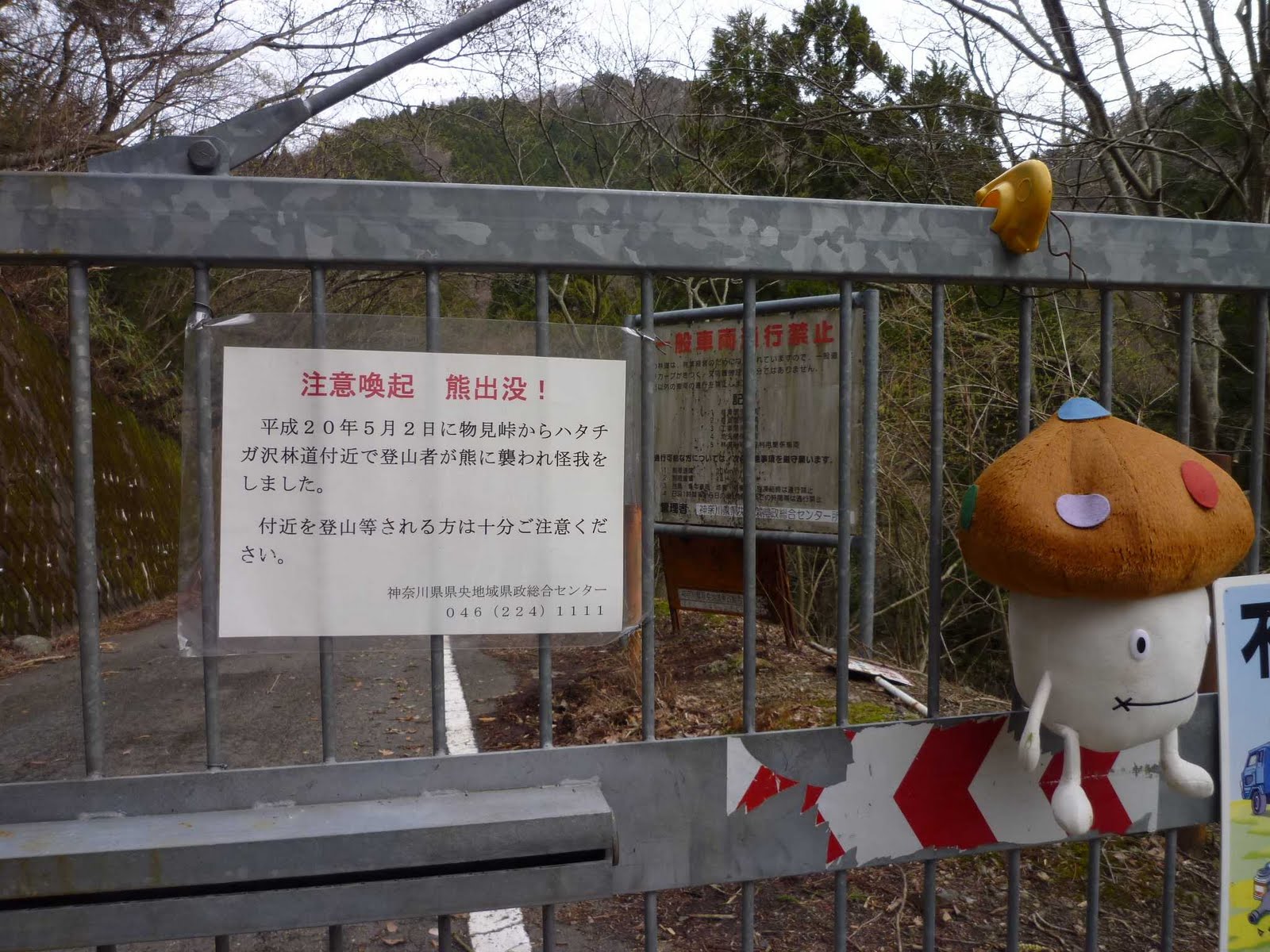
There I learnt that the rindo I had just taken was obviously so deserted that even bears were in the area!

As I reached Yabitsu Toge (761m), lots of riders were arriving in succession from the other side, in what looked like an informal group race. I descended about 100m to the entrance of a rindo, which I had often passed before, but never entered. This rindo, too, was sewn with tree branches and stones, but by no means unpassable for a normal road bike.

I enjoyed great views of Hadano below and the rindo meandering ahead at relatively even level in the mountains. I passed a group of hikers who greeted me with shouts of „sugoi!“. Well, so far not so sugoi. The sugoi part was still to come.
I avoid a paved rindos leading down to the left twice and stayed on the main rindo, which eventually started to descend. At about 500m, it ended and led onto a relatively steep gravel road, which I descended another 200m. Soon after this turned into a paved road I reached Hadano Togawa Koen, a large park area along a small river.
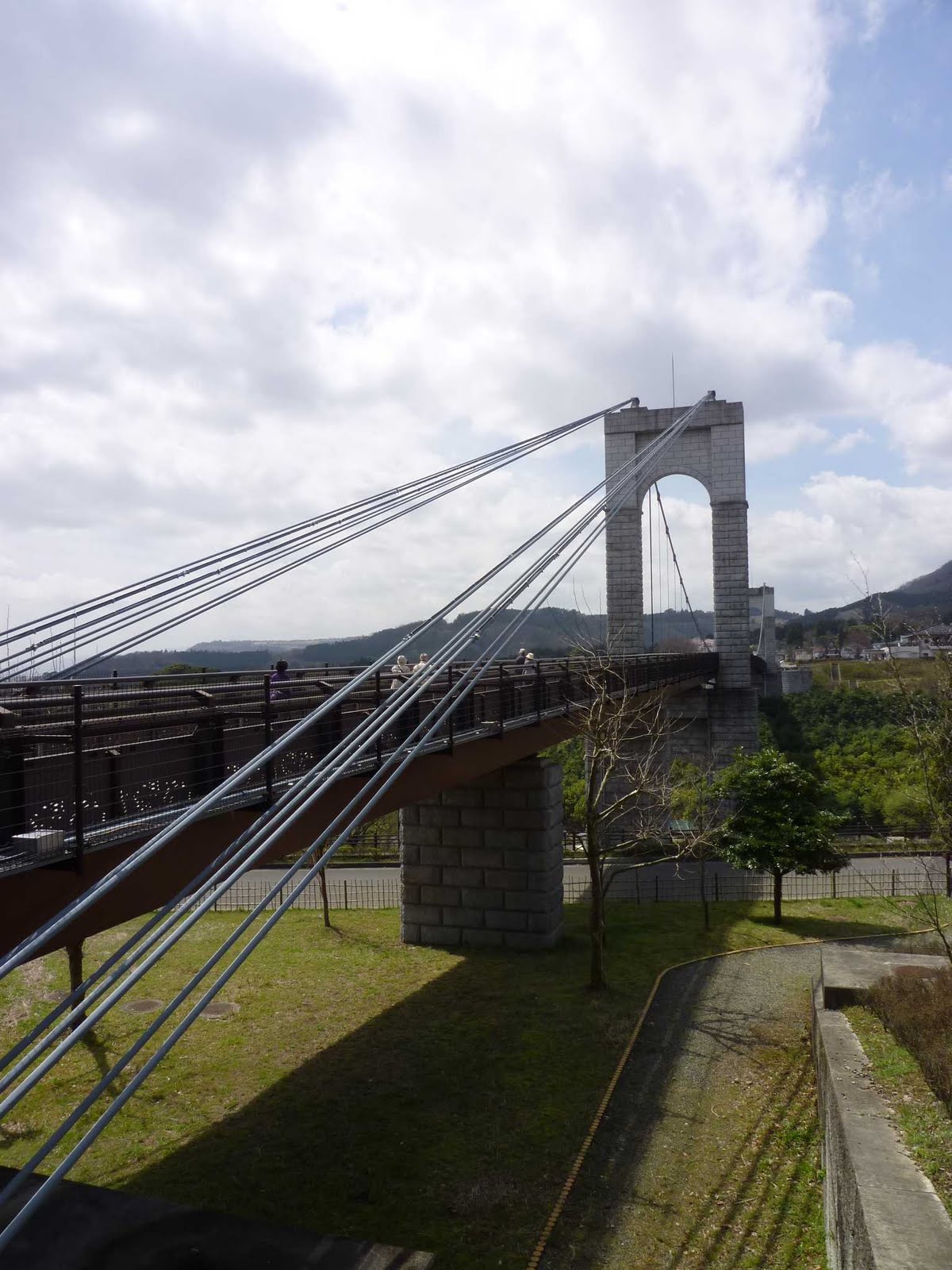
The dimensions of the valley and river hardly justified the monstrous pedestrian bridge, which I crossed by bike.
After a quick soba lunch in the park’s restaurant, I wanted to find the short-cut rindos all the way through to the ascent to Hadano Toge, which I had passed on the virgin ride with MOB. However, this was easier thought than done. I got lost on a small foot path up a small valley, leading to nowhere. I had to turn back and descend quite a bit, before crossing over into the next valley. The rindo running well above a river to the right quickly turned into a gravel road, running up the valley for rather too long for my taste (maybe 4km, but that’s painful on a gravel road). Eventually I reached the end of the valley and the point to return on the other side of it.
Soon I was presented with the choice of descending further or turning up another rindo that looked like it would lead me to the right place. I encountered a hiker and he advised me it would end in a dead end… Back I turned, descending further on gravel, until finally reaching a paved road, and then the entrance to the paved rindo that finally looked like it would lead me over to Nakatsugawa valley, from where I wanted to climb up to Hadano Toge.
Indeed, this is where I ended up, and after a chat with a couple that were completely surprised a cyclist would dare to enter a road closed to traffic, I was on my way up to 750m. After not feeling too strong in the morning (no surprise after a work of heavy work and little sleep), I was finally able to push ahead at a brisk pace, despite the temperature now being close to 20 degrees.
Once again I had a rindo all to myself. Hadano Toge is not actually the highest point of the rindo. There follows a descent of 100m, followed by another 130m climb, and then it is a fast descent with stunning views down to Tanzawa Lake – the same rindo MOB and I had laboured up just two weeks ago.
I took a rest again at the same shop on the shores of the lake. This time, the cat was preoccupied with cleaning itself and took no interest in me.
I had been debating all along what to do next. My ambitious plan for the day had been to go on a long gravel climb towards Mikkuni Toge, and make it eventually to Otsuki. But that felt risky. It was already 14:30, that gravel rindo was actually explicitly closed to bicycles and I knew from a reconnaissance ride a year ago that there were aggressive people at the entrance turning away cyclists, and probably for good reason as this would be easily 15km on gravel climbing from 350m to 900m in the middle of nowhere.
Another choice was to do route 76 from the south. This would mean climbing to 940m, but all on paved roads, then descending mostly on gravel down into the Doshi valley. From there to Uenohara, Fujino, Takao or Hashimoto. Or of course I could just go down to route 246 and take the old roads to Shin-Matsuda – the easiest way home.
But why take it easy? I was out here to explore and have fun. So on I sent to the forbidden valley.
As predicted, I was hassled by an old man living just nearby as I went through the gate to the rindo. He was alarming guys sitting in a container just a few meters down the rindo, apparently on guard to hold of cyclists and maybe provide information to hikers. But I was too fast and had passed them before they could come out of the container… For a while, I was wondering whether they would follow me by motorbike or car…
I passed a beautiful waterfall and took the opportunity to open up my layers of clothing, as it was still quite warm and riding on gravel was heating me up even more.
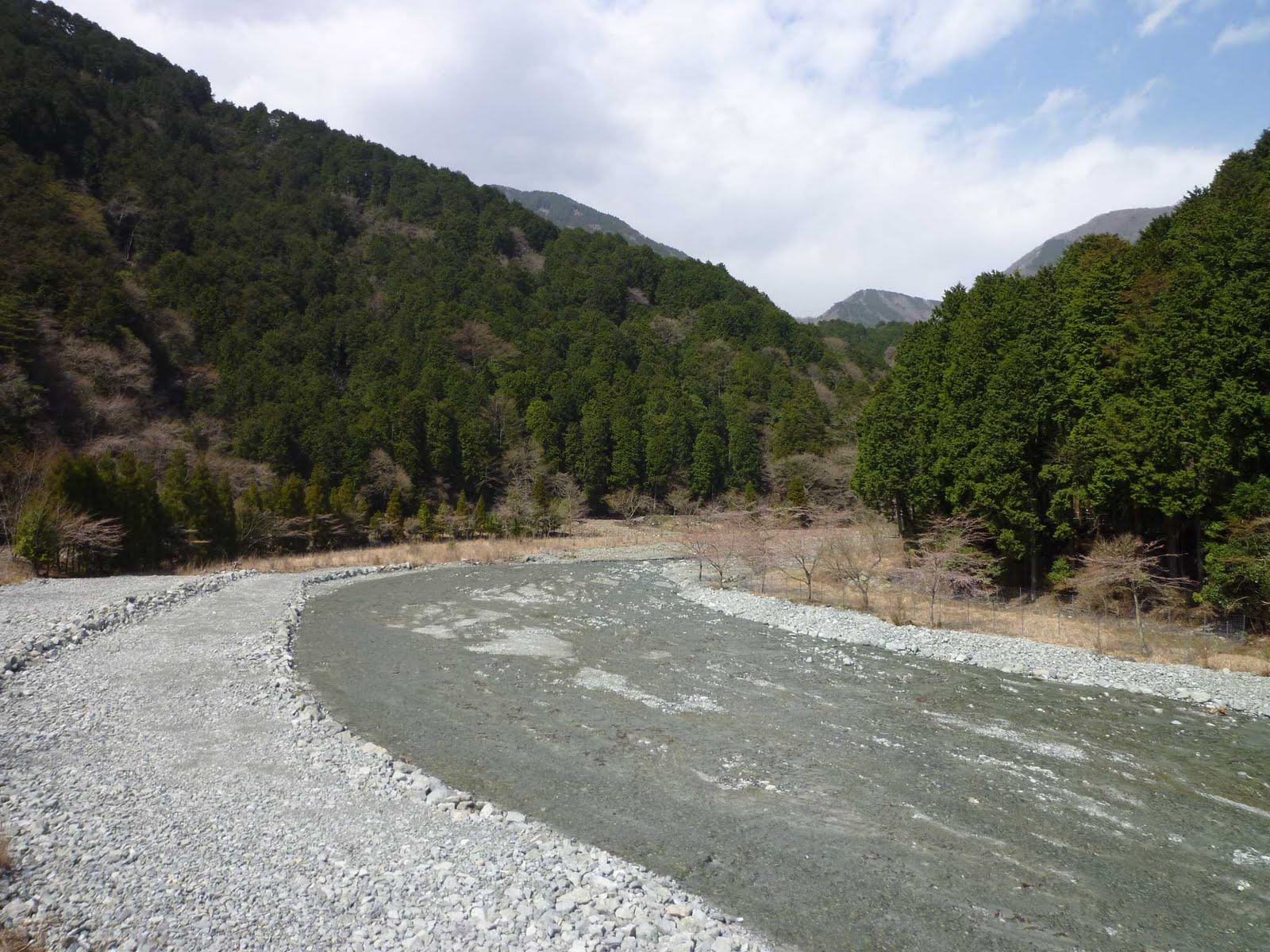
Sefugawa was a very beautiful river, quite large and noisy. Nobody was following me, but I passed a few hikers here and there, and wood workers. There was life out here! I still did not feel entirely safe. OK, I was well prepared: there was plenty of water everywhere, I still had some energy bars, I had spare tube and tools. Still, what if I had a problem with my dérailleur or chain, and would have to walk all the way back?
I eventually reached a turn-off with a choice between Inukiri Toge which had been sign-posted all along and no directions at all… I was about to continue on the sign-posted rindo when I thought I’d better check against my map. No Inukiri Toge anywhere – instead I wanted to go to Myojin Toge, which is the rindo that comes out onto the main road half-way up to Mikkuni Toge. Turning right and not following the sign-posted rindo felt right, so that’s what I did. Soon I reached another Y section, this time not sign-posted at all. Again, turning left felt right if I was to trust my Kanagawa-ken map. On I went.
After the first turn-off, the gravel road had started to become steeper, as it was no longer following a river. Fortunately, the steepest parts had a concrete surface, but nonetheless even the more modest inclines felt quite exhausting on gravel. I faced the choice of going out of the saddle and slipping on stones, or putting my weight onto the back wheel and stressing my back. I chose to do both in turns. I had to descend twice for about 100m each, as the rindo was reaching a new side river. How annoying to lose hard gained altitude!
Eventually, signs started to appear that marked the forest property and mentioned Myojin Toge somewhere in the distance. I seemed to be on the right track. The gravel rindo became increasingly steep, and it was another 100m altitude meters to Myojin Toge. Some stretched of paved road appeared where it was particularly steep.
Eventually, I made it, to the familiar looking entrance of the rindo from the climb to Mikkuni Toge. I continued up towards Mikkuni Toge. I thought after this ascent, anything would feel easy, but Mikkuni is just very steep! It was only 5-6 degrees, but I was still sweating badly.
The view back into the valley from which I had climbed up was breath-taking. I had made it through this endless sea of forest.
After a quick stop at the 7-Eleven in Hirano on the shores of Yamanakako, frequented by hordes of evening shoppers, I continued along the northern shore, then turning north towards Otsuki.
I had once again been debating how to go to Otsuki. Wouldn’t it be nice to climb up to Nijumagari Toge – only another 200m up – and then have a long descent on a deserted rindo to Higashi-Katsura, and from there a fast downhill drafting cars on route 139 to Otsuki? The only problem was time – it was 17:30, the sun was about to set and I was not sure I would make that rindo in daylight. Heading straight for route 139 felt much safer. But then I just had to do Nijumagari Toge…
Just as I arrived at the pass, the sun was setting – exactly at 18:00. A group of photographers were enjoying the view. So was I, as was getting ready for a descent in fading daylight.
Or so I thought. Just after entering the closed off rindo, I encountered problem no. 1: fallen trees and lots of small landslides… They were all manageable, but if they continued would slow me down considerably. Fortunately, they became rarer the further I went. But the further I went, the more ups and downs there were… I had remembered only the downhills, but it was a while until the rindo really turned downwards…
By that time it was pretty dark, and I was navigating the stones strewn over the rindo. I had removed my cycling glasses for maximum visibility, but was promptly rewarded by a big insect hitting my head.
Eventually, I reached the gravel stretch. Good, just a bit more, and I am back in civilization, I thought. But I had not remembered this gravel stretch to seemingly go on for ever, or so it felt, navigating bigger stones in almost complete darkness.
Everything comes to an end, and so did this gravel. Soon there was traffic, and when there were cars behind me, I enjoyed their lights helping me see the surface of the road.
I had hardly turned onto route 139, when a young woman driver almost wiped me off the road, turning left just mili-seconds after putting on the indicator. Fortunately I was prepared for exactly this to happen and was able to stop and turn with her on time. I told her off – she was completely surprised, i.e. had not even thought about looking into her back mirror.
The rest of the ride was uneventful. I arrived at Otsuki station at 18:15, a bit over 13 hours after I had left home, of which I spent 9h15 in the saddle. 194km with just over 4,000m of climbing on the BBiT scale*.
The new bike has been serving me well so far. It is very comfortable to ride, in fact, more comfortable than my road racer. The wheels absorb shocks better, yet the frame is extremely stiff. Downhills are fantastically stable. I haven’t had the chance to go over 60km/h, but even at that speed it feels just so safe and stable.
The tyres take away a bit of energy, but not an enormous amount. At the same time, no problem going over debries and tree branches on the road, and without slipping as easily over them as on the road racer. No matter how bad the road, no descent has been dicey so far.
Riding on gravel is no problem either. Which does not mean it is easy: a lot of braking going downhill to avoid going over 20km/h, quite a bit more power needed to go straight or uphill. I wouldn’t want to do 200km purely on gravel…
With this bike, I seem to be prepared just for any conditions. And as I like solitary rindos, and there still seems so much out there to discover, I might end up using the cyclocross much more than anticipated when I decided to buy it.
* BBiT = Blind Believers in Technology, i.e. as measured by barometric devices like Garmin, Ciclo etc. For this ride, this translates into a bit over 3,000m of true climbing, some of which was made particularly hard by gravel.

5 Kommentare

Eingeordnet unter 2010

Sunday Ride?

This weekend finds me with no Brevet and no work/family conflicts on Sunday (in contrast to Saturday, today, which has both work and family conflicts),  … so I very much hope to ride tomorrow.  I want to get in one of the traditional routes I have not yet done this year — one or more of Kazahari, Tawa/Tsuru, Matsuhime/O-toge and/or Yanagisawa passes, and in typical P.E. fashion the plan may be more ambitious than the actual trip.  It looks like it will be cold in Okutama, but sunny, so dress warmly and in layers.  I’ll leave my home at 7AM and plan to be at Tamagawahara-bashi at 7:30AM.  Any interest?

6 Kommentare

Eingeordnet unter 2010, David

Into the Heart of Coldness

„I raised my head. The offing was barred by a black bank of clouds, and the tranquil waterway leading to the uttermost ends of the earth flowed somber under an overcast sky–seemed to lead into the heart of an immense darkness.“ (1)

And so our trip to Chichibu began on that fateful day of March 31st in the year of the Lord 2010 as we assembled along the shores of the river Tamagawa. The air was humid and cold and despite several layers of clothes wrapped around our moribund bodies we froze as if we had entered eternal purgatory.

Considering the conditions of the roads, we made good speed along the Tamagawa until we reached this hotbed of modern decadence, the sixties Saigon of Yamanashi-Ken, the city called Ome on the fringes of metropolitan Tokyo, this last outpost of civilisation before time comes to a final, sudden and grinding stop.

Luckily our friends and loved-ones did not catch us red-handed as we engaged in an orgy of absolute evil at Aurore bakery. Shamelessly we indulged in the indifferent consumption of „Royal Milk Bread“; the only king we are loyal to being the master of pain in the upper calves, waiting for us behind the passes into foreign Chichibuian land. But we needed to fill our stomachs thoroughly, as we would enter civilisation again only after a long journey through the impervious jungles and hills of the land to the North of us.We mounted our trusted gear the next morning and after a while we reached the holy fountain, a place where mysterious powers would emasculate the prejudiced riders.  A group of young riders from a minor educational institution (Waseda Univ., that is) came back from a trip surveying the edge of the known world and greeted us heartily.  Never will they know the horrors of life, until after graduation.

The first test of manliness awaited us at Yamabushi Pass. A German expedition led by Colonel Manfred von Holstein has conquered this hill some time ago and their unbelievable deeds have been engraved in the cornerstone of cycling forever (in plain language: see Togebaka # 12 to the right). Jerome, our svelte French cook, Dominic, the ruthless colonel of the aborigine regiment, David, the American maverick of unequivocal lineage and myself, all (seven) of us charged ahead with full speed:

„Half a league half a league,
Half a league onward,

All in the valley of Death

Rode the six hundred:
‚Forward, the Light Brigade!
Charge for the guns‘ he said:
Into the valley of Death
Rode the six hundred.
“ (2)

Even after I had climbed up for what seemed to me an endless amount of time (15 minutes, to be precise), I could still feel the warm breath of Jerome blowing in rapid convulsions against my neck. I gave all I could and conquering the last bends of the road I was finally on my own and arrived at the lofty heights of Yamabushi in respectable time. So did Jerome, Dominic and David as well, as they are brave and respectable fellows indeed.

But in the cold no break could be made: the sweat we produced so plentiful during the climbs became solid slabs of ice on our bodies within no time. There was no choice but to continue to the next hill of Shomaru Toge. A strange place where coffee is served (but no tea) to the travelers who bode no ill. Where water is a priceless commodity, photos celebrate the visit of Prince Takamatsu and Princess Chichibu in 1953, and people hover over bare holes in the grounds to get finally rid of the remains of Royal Milk Bread and other lustful offenses of the past.

Again, down into the valley of the death (route 299) we charged while the cold got almost unbearable. And up again we clambered towards the heights of Karibazaka, a place talked about in whispers on stormy nights when the one-legged and the crazies gather around the fireplace to tell the lore of times long past (in plain language: see Togebaka No. 17 to the right).

A yellowed photo taken on the pass may give the curious reader an impression of the hardness the men endured.Along the ridge we proceeded until we came to the hedonic temple of Takayama Fudo and again made a charge into the valley of the death (Route 299). As the strain of the journey mounted, the men were beginning to show their nerves: „It is the 10th birthday of my daughter today – I must go home!“ cried one of them in an uncontrollable rage, before jumping through the bushes into the wild never to be seen again. Or perhaps he made it indeed, but as the distance to home was long, he surely did not make it before the 11th birthday of his little princess.

What remained of the men, now reduced in strength by illness and desertion to about 3/4 of their former and full force, continued along the road and then made a fateful left turn towards the center of hedonic worship: The temple of Nennogongen, guarded not only by two fierce deities but also by steep slopes with ridiculous gradients.

„Surely the way straight is shorter and will lead back to civilisation. I must go there!“ uttered one brave man when finally faith abandoned him. With all earthly powers spent and not one grain left to keep him away from his foolish deeds, he disappeared in front of our eyes up the road toward doom. Our once glorious platoon had by now lost 50% of its men, and the thin French cook and I readied ourselves for a last, long and dangerous climb up to the temple awaiting in the mist ahead.

After a while the Frenchman showed his nerves as well; aimlessly he was wandering from the right to the left and barely could he keep his gear under control. I did all I could to keep him away from fate, telling him stories about the beloved left behind. How surely wonderful the places must be that we were certain to reach at any minute. Waiting for us behind that last curve. That turned out to be the second last curve. No the third-last. Not even this. And with the last drop of power almost spent, we arrived at the parade ground in front of the temple and rode up the last few hundred meters. Everything that was told about the place is true. The curious reader may wish to find out for himself.Now riding down in small numbers the bends of the unbelievably steep slopes, we headed for the last and ultimate goal of our journey: The temple of Takedera, where according to our secret assignment, Mr. Kurtz was supposed to hide.

What seemed to be quite an enjoyable ride along a stream turned out to be a hellish ascent for the last 500 meters. Who would have thought that this would prove to become the most difficult part of our journey? While we Christians are punished for our earthly deeds after death when we are judged by our lord, the pagans are punished already on the way to their places of worship.

Arriving finally at this wonderful place we were informed that we were too late: Representatives of the colonial powers of Singapore and Australia have already come and taken samples of the place. Surely it was a most beautiful place and the climb up to the Honden provided us with some compensation for the things we have been through. But nothing was left but to return to our world after we have seen:

„The Horror! The Horror!“


So brought to senses by the foolishness of the things we were chasing after in vain, we made the run for home. Just like speeding human bullets, faster than ever before did we rode along the roads that would surely bring us back to civilisation. There, finally a light along the road. No, this time it wasn’t a fee fire but the illumination of this wonderful place called Tamajiman where only too soon more social events will take place.

And there, to our great joy, David greeted us, holding out for the last few days he had even managed not to touch the remaining two slices of pizza lying so temptingly in front of him, and bearing the names „Jerome“ and „Michael“.

Yes, we all made it back into the lap of civilisation, with its warm toilet seats and glass washing basins, and I am here to tell you the story of our adventures. The rest is shortly told: In the darkness we rode back along the shores of the river Tamagawa and all of us arrived between 7 and 8pm that evening at home. Great was the joy there when we could re-unite with our loved ones (unfortunately 2/3 of my loved ones were at the ice skating rink and the remaining 1/3 experienced a sudden and powerful attack of puberty- one may think about reinstating proven, good traditions).

More than 200 km of riding and far more than than 2.000 meters of climbing (excluding barometric tolerances).

PS By the way, in many ways this was also a very classical Positivo Espresso ride. We started very fast, slowed down considerably and were equally fast in the end as in the beginning. The only non-classical element was, that 50% of us stuck with the original riding plan.

(1) from „Heart of Darkness“ by Joseph Conrad, 1902
(2) from „Charge of the Light Brigade“ by Alfred, Lord Tennyson, 1854

Hinterlasse einen Kommentar

Eingeordnet unter 2010, David, Jerome, Mob

A Tale of Two Towers

When I arrived in Japan in 1998, I worked the first two years in Hamamatsu/Shizuoka in the factory of a now famous Swiss elevator company. I was transferred to Tokyo in 2000 and since I am returning to Germany in a few weeks, I thought it might be a nice idea to ride from Tokyo to Hamamatsu on my bike as a conclusion of my stay in Japan. As the distance between the two cities is about 270 km which is hard to ride within one day, I decided to split the trip into two legs. On Saturday evening I rode from Tokyo to Yokohama and on Sunday I did the remaining stretch.

Note: This post is dedicated to the Yellow Giant aka Travis who rode from Tokyo to Nagoya on road 246 and 1 in January this year. He has my full respect as he had stayed on the man roads for more than 400km. As the end point of his journey was the house of his parents in law, I still suspect that the main purpose of his ride was to have an convenient excuse to do absolute nothing there but to lie around, watch TV and eat good food. Also, when asked next year if he will come again, he might answer: „Again? I cannot ride there every year!“.

Well, actually I enjoyed the last squash match of my life at the TAC with a friend and rode home on my bike afterwards. The next morning I woke up at 5 AM in fabulous shape, ready to roll.

The weather was not really good, cloudy, but at least no rain forecasted until 3 PM. I was blessed with a very strong tailwind, so I made good progress along the Nakahara Kaido and later on road 1 towards Odawara. I tried to control my heart rate and not to overdo it, even when I had a chance to go faster. This early on a weekend day, the traffic was rather light and I arrived at 8 AM at the 7-Eleven on the start of the old Tokaido up to Hakone. One signboard said something about only 100 km left to Shizuoka – cool. I almost made it.

The mountains ahead were completely covered in mist and I was afraid of snow and rain up there. Typical 三寒四温 weather. I started the climb up to Moto-Hakone and again I tried to pace myself in the 140 – 150 HRM range, so that I would not exhaust myself too much. Nevertheless it took me only 54 minutes to reach the top, which is almost as fast as the second time when I went up there with Ludwig and Jerome. It was cold up there, only 1 degree plus, a little bit foggy but no snow and no rain. So I continued to Ashinoko and Hakone pass before taking the very fast downhill road 1 to Mishima without stopping.

First stop after Mishima (this town always reminds me of China) at a 7-Eleven and checking the maps: It looked much better to continue on road 380 along the coast; this is a road we have previously used to ride out of Mishima in direction Western Izu peninsular. Done. This road was also fast and the traffic was acceptable and again in no time I was in Shin-Fuji where I promptly got lost. Looking now at the map, I notice that I made a detour on road 396 but as this is the only other road to cross the Fujikawa river except the road 1 bypass (not allowed to be used by bikes) I had no other choice anyway.

This should happen quite a number of times: While it is no problem to ride on road 1 all the way between Tokyo and Mishima (nevertheless it wouldn’t be my suggestion to do so), large stretches of the same road are barring cyclists from usage. Warning signs not to enter are all over the place and even if I love to take forest roads which are not allowed for public traffic, I hate to ride on these fast roads leading through flyovers, bypasses, bland correct underpasses and the like. How Travis did this – I don’t know. I would have been scared to death out there.
Strangely, the distance to Shizuoka did not decrease during the last three hours of riding as much as it was supposed to decrease. Was this some Kafkanian castle trick from the Japan Highway authorities? And furthermore I have reached the point where the mountains were rising so steeply directly from the sea, that there was hardly any land left between there flanks and the water. And the few land remaining was used for the most important purpose of the country; to accommodate the Tomei highway, the national road 1 and the railroad line.

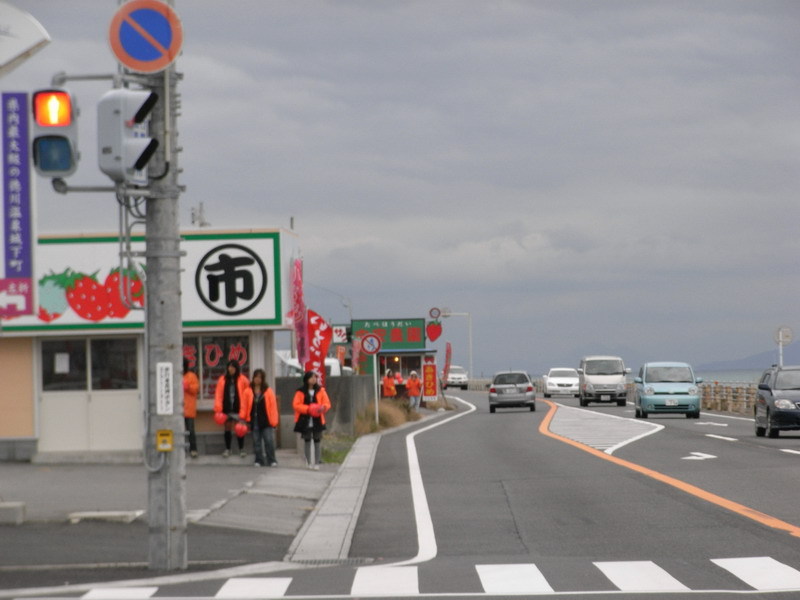
At the end of road 396 I couldn’t possibly ride on road 1 which was hardly distinguishable from the parallel highway; that much were the number of lanes, the amount of traffic and the speeding of cars and trucks. But luckily there was a signboard showing the way to Satta Toge (薩埵峠) which sounded interesting enough to give it a try. We would not mention these types of passes in our weekly ride report, shallow hills with not much of climbing. But this one had a partly very steep approach of more than 20% slope and after a lot of hours in the saddle every climb becomes (more or less) a respectable challenge. The weather was good on top and to look through the Mikan orchards down on the roads and the sea was quite nice. That is how and why Satta Toge became Positivo Espresso approved.Now, after riding down on the other side, I came into the (rather boring) port city of Shimizu, where after some maneuvering I found road 150 leading along the coast. Another time, road 1 could be avoided. This stretch of road 150 is also known as „Strawberry Line“: On the left side is the beach, even some stretches of sand not covered by giant tetraeder concrete blocks and on the right side are greenhouse after greenhouse filled to the brim with mature strawberries that are screaming: „Sell me! Sell me!“. And this is the precise reason why in intervals of perhaps 20 meters poorly paid students are dressed up as giant strawberries and red pandas. They carry strawberry lampoons on strings which they are twirling through the air to indicate to passing cars that one can buy here, well, strawberries. To be honest, this offers the same degree of excitement as speaking with my wife about recent trends in figure skate dressing.

But finally I have made it into Shizuoka city and crossed the Abeguchi river still staying on road 150. However, when I wanted to continue along the road I came to another long tunnel and there was no way I could pass through. Road 150. Tomei highway and the Shinkansen line where all swallowed by mountains and
road 1 had disappeared in the North quite a while ago. After trying some small roads at the tunnel portal to no avail, I rode back to the city and managed my way through thanks to the help of some locals. Road 416 was beautiful and gently swinging along the sexy curves of the coastline. The locals have warned me that I would be moving „up into the mountains“, but what they mean by mountains is something we would refer to as „Yamanote“ perhaps. Also, I asked if there would be any tunnels and the answer was „NO“, spoken in a way like one would say: „Of course, not!“. I came through three of them.

Which was actually good, because by now the weather had very much deteriorated and it began to fizzle. I was getting wet fast so in one semi-tunnel (one side was almost open to the sea with some nice window cut-outs), I decided to a) take a piss looking like a roman statue in an alcove and b) put on my rain jacket. It was high time, outside of the tunnel it had started to rain even harder and I could barely made a few more kilometers before I had to stop at a (yes, I admit it) Family Mart in the town of Yaizu.

Now, again I checked the maps, had some yaki-soba, tried to stay inside as long as possible. As I was looking outside I noticed that it had started to hail. Small white hard balls of something between snow and ice were falling from the dark grey skies and made a tremendous noise when colliding with the sheet metal parts of cars.I was ready to give up. There were at least 80 km left to Hamamatsu, it was already close to 3 PM and the weather didn’t look like becoming better any moment. I thought, OK, let’s give it one more try and I continued to ride. Within minutes I had that typical sensation of wet feet. One knows, that now the socks and shoes are soaked and that this will remain so for the rest of the ride. I was so desperate that I started to hum Rick Astley songs.And suddenly the rain stopped. Just like in Woodstock, 1969. No rain, no rain. Also the surface pf the road was dry and the sky ahead had the color of eye-pleasing grey. But when I looked behind me, the sky had the color of sock-soaking dark grey – so everything I endured must have been true. The wetness of my socks and the last notes of a Risk Astley song reminded me of this truth.

OK, so now I could move on, crossing the Oikawa and riding along road 79 to one of the biggest incidents of ruthless and senseless wasting of tax payers money in the shape of the new Fuji Shizuoka Airport opened in June 2009. I checked the website to make sure that this airport is offering the staggering amount of 20 national and 6 international flights per hour! No, I was joking, this is the number of flights per day. I guess during rush hour there are more trains leaving the station closest to my house per hour than flights the whole day there. JAL has a high share of this flights which is their fate: As a quasi national carrier they have to serve all this micro airports and mini routes in Japan. More flights are done by the home airline, Fuji Dream Airlines (FDA, owned by Suzuyo). I don’t know what you think which you hear the abbreviation FDA, but apart from „Feine Deutsche Art“, a German Punk Band from Duesseldorf in the Eighties, FOOD AND DRUG ADMINISTRATION is probably close to what most people would come up with. I had to laugh which I checked the Japanese website of the FDA (the airline, that is) and they introduce their (three plus one) travel destinations by displaying pictures of typical food of the region. Food after all?Now, how do you come to this airport, if not on the bike from Yokohama? Well, the next train station is 6 km away. Funny enough, the next train line is precisely under the airport, being the Tokaido Shinkansen line, but no train stops there and neitehr are there any plans to built a station. Luckily. And to Shizuoka City it is about an hour by bus. I would dare to say that from many places in Shizuoka, one is equally fast at Haneda airport in Tokyo or at Chubu Airport in Nagoya.

It never stops amazing me, how these dinosaurs of poor infrastructure planing appear suddenly in the middle of nowhere-Japan. It is the same with Fuji Speedway: You ride there by bike or by car, there are no big roads, no signboards, nothing. Suddenly, they pop up in front of you.

OK, I had to stop to get angry with myself and eventually get cancer as a consequence and start doing something for my health, i.e. to continue to ride. Road 79 was quite pleasant with a lot of ups and downs and before long I was in familiar territory in Kikugawa and Kakegawa where I joined again road 1 for a short stretch. Now that I was sure that I would make it and almost in daylight, I decided to pay a short visit to my old factory in Fukuroi.The factory got ISO 9001 approval on Christmas Day, 1997 but even 12 years later it was still lacking Positivo Espresso approval so I changed this quickly. Also the test tower for a budget elevator (Smart) was still standing on the factory ground. As this is one of the few meaningless things I helped to become reality in my working life, I PE-approved the elevator as well before I wanted to leave silently. But, oh God, someone was coming out of the building, he had seen me and there was no way I was going to get away unnoticed. This looked for trouble! But, the guy just got into his car without caring about me and drove home (actually it was precisely 5 PM, so he didn’t even made one minute of service overtime work at the office there). Then I remembered that this was precisely the work attitude of many of my colleges I have worked with at Schindler: If something doesn’t fit into the precise frame of one’s work assignment, it can be ignored safely. I always had my problems with this attitude and I am sad to note that this hasn’t changed ten years later.

From there on I rode on road 413 and 1 through Iwate and finally crossed Tenryu river into Hamamatsu. I could now see the second tower, that is the bubble-area Act City skyscraper close to the main station.

An hour later I checked into a small business hotel with bike storage, was sitting in a yakitori bar and drinking beer and munched on some very delicious pieces of something on wooden sticks.The circle was closed, I was back where I started 12 years ago.

8 Kommentare

Eingeordnet unter 2010, Mob

Mid Week Ride Announcement : 31. March (Wed) Chichibu Hills and Sights

For tomorrow, we have scheduled a nice criss-cross ride through some well known areas of Chichibu, including medium climbs and some temples and shrines along the way:

http://www.mapmyride.com/route/jp/chichibu/234126991531058203

Meeting Points are at 7 AM on the Komazawa Dori / Kanpachi Intersection and at 7.30 AM at Tamagawahara Bridge, Tokyo side (km 0).

From there on we will proceed along the Tamagawa towards Ome and have a second breakfast at Aurore bakery (km 32) where we need to pack enough food supplies for the climbs to come.

We will then follow the road to the holy foundation and start the first hill climb time trial up to Yamabushi Toge (participation optional). This will be followed by the short climb to Shomaru Toge and a fast downhill to road 299. From where we will start the second time trial to Karibazaka (again, optional). Eventually this will lead us to Takayama Temple and back to road 299, where we will turn North again and start to climb up to the famous Nennogon Temple (from the non-steep side).

A quick, pointless ride will lead some of us for the first time to Takedera. After everything hard is done, we will make a second rest stop (km 112) and continue back to the Tamagawa and ultimately home.

About 156 km of riding, covering app. 1.900 meter of elevation starting Tamagawahara Bashi.
So far Jerome, David, Dominic (tbc) and me have signed up. If anybody else is interested, please let us know, we can arrange further meeting points if convenient.

7 Kommentare

Eingeordnet unter 2010, David, Jerome, Mob

The Great Yanagisawa etc. Attack

James, Jerome an me planned to do a 250 km „weekend tour preparation ride“ on Friday which led us to some surprising places.

As it can be read on the ride announcement post, we were planning to attack Yanagisawa Toge (about 100 km away, over 1.400 m high) followed by Kamihikawa Toge and some other minor peaks. So we met very early in the morning at the Tamagawa and made good progress in direction Ome along the main road. We passed the brand-new Fussa town hall, followed by the Ome town hall under construction. What a waste of money (at least they could spend the money for road repairs). Fussa has a populationof about 60.000.

Until James rear wheel got a flat from a glass shard that penetrated his tyre. Believe it or not, it took the three of us more than 45 minutes to get his bike running again; wasting another tube along the way, ripping apart one of his tyre levers and fiddling around with three bike pumps before we got the thing inflated finally.

So we were late already. And by now it had started to fizzle as well. The general environmental feeling was rather unpleasant, so we had a long breakfast & coffee break at Ome Station shopping at the 7-Eleven, Aurore bakery and McDonalds where we had six cups of coffee for the price of three. James complained to the girl behind the counter that was speaking in a frequency band barely audible by bats, about the quality of the coffee, so we all got one for free.

Later, when we mounted our bikes, the weather has become even worse despite all nice looking weather forecasts. It was miserable. In the best tradition of Positivo Espresso we decided to give up our ambitious plans and ride to Umenoki, hoping that the weather would be better closer to the coast.

It was the first time for James and Jerome to climb up Umenoki and we were all having fun [of different degrees and magnitudes]. James was zooming ahead but suddenly I saw him waiting some meters in front: Because of the recent storms, some trees were lying on the road ahead. But not only that, the trees have fallen in a way that they have ripped off the cables of the nearby power line so we needed to be double careful when crossing all the obstacles to avoid sudden and instant electro-execution.

I made it up to the top in 23:48 min and included that time in a new Togebaka TT (No.21 see right below, James and Jerome might want to add). On the top it was cold (3 deg. Celsius), raining and we met a friendly MTB rider who told us that the weather would be more or less the same down the other side in Itsukaichi.

So we made the only possible and logical decision and headed 4 km to Tsuru Tsuru Onsen, where we bought a towel (110 Yen), stepped into the outside hot water basin and relaxed and talked for almost two hours. We were still hoping that the weather might get better, but it didn’t. Finally we mounted our bikes and rode on. It was hard, because after the Onsen my body was in a mental state of „OK, well done for the day, let’s relax.“

James wife wants to loose some weight to be even more competitive in the next JCRC race so she planned to visit the hairdresser in the afternoon. Which in turn implied that James had to come home early. We parted in front of Itsukaichi Station and Jerome and me continued to climb up to Kobu tunnel. Where the weather was still miserable.

And then we rode down on the other side to road 20 and Uenohara where we stopped to have lunch for another very relaxed hour.

Finally we rode along road 76, taking a turn to include Magino pass (read correctly: Makime pass) in our ride. Makime-toge has a very steep last part with a donut-patterned concrete road but suddenly I felt super-strong again and sprinted up the final approach to the top.

And then we made our way along Doshi-Michi back to Hashimoto where I could convince Jerome that it would make sense to jump on the train home. Most of the riding and climbing was done after the Onsen visit but even by riding until 5 PM, we only managed to go 140 km in almost 12 hours.

In Shin-Yokohama I assembled my (dirty) bike and rode home, passing the skating rink where my wife and daughter have spend the last 5 years almost every day and night. And for the first time I actually met them there outside. So we agreed on a race, who would be home sooner: them with the car, or me on the bike. I won hands down. I even had time to undress and jump into the shower before they came.

Now I guess I should also clean my bike to be in good shape for whatever my bike and me have to endure on Sunday.

2 Kommentare

Eingeordnet unter 2010, Cervelo Soloist, Jerome, Mob

The Human "omes"

From WIRED magazine. Found that sometime ago on a flight, wanted to post it forever.

Hinterlasse einen Kommentar

Eingeordnet unter 2010, Jerome, Mob

Taipeh Cycle Show : Future Bicycle Design

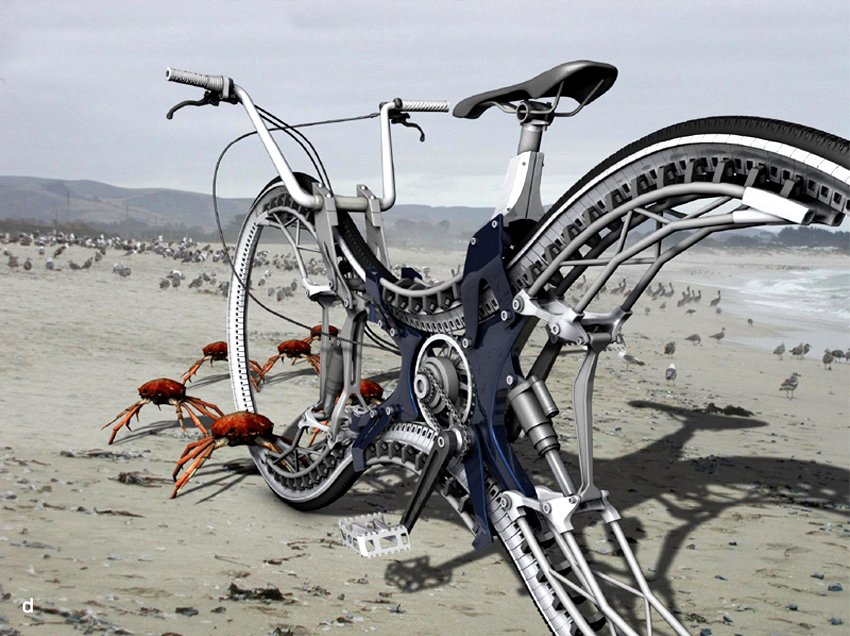
Spiegel-Online published an article [in German only] today about bicycle designs that were awarded prizes at the Taipeh Cycle Show.

This is only about design,basically done on CAD basis with additional rendering, none of these bikes exist. Having experienced a lot of flat tires again recently, I like the design of the bike with a continuous rubber belt along the rear and front wheel position.As a very simple idea, I also like the bike with the huge shopping net in the front, this could be a nice diversification of mama-charis in Japan.

Otherwise: Not too innovative, rather done by professional designers than people from the bike industry, as there is too much emphasis on appearance and less on function. Designers try to make things out of bikes that they aren’t. Like toasters with USB ports. Added functionality is not always a plus, in case of bicycles it makes them heavy and, ultimately, useless.

Hinterlasse einen Kommentar

Eingeordnet unter 2010, Mob