achievement.
planning.
pain and suffering.
spectacular scenery.
camaraderie.
I was surprised on Saturday morning to see 80-90 cyclists assembled at a park along the river North of Ichinomiya, on the outskirts of the Nagoya area, for the Chubu Audax-sponsored 600 km BRM501. I had expected maybe 30. The crowd was bigger than all the people on the streets of central Ichinomiya when I arrived at the station from Tokyo early Friday evening, buildings shuttered for Golden Week, or for good?
We started out by riding 4-5 km along a narrow „cycling road“ through the park, disturbing at least 2-3 elderly people per kilometer on their morning walks. Finally we came up onto a wide path on top of a levy, and a tail wind helped me stretch my legs a bit … talking it up to 38 kph for a few minutes while keeping the heart rate down, so I could move forward into the front 20-25 or so riders.
My cardio conditioning is WAY better than 6-8 weeks back. Rewards of hard work — proven by my threshold power test at Bryon’s studio on Friday, where I moved up from a terrible to a mediocre test number, but was able to gradually accelerate over the length of the 10km test, keeping my pulse down, and finished wishing I had pushed a bit harder. Then again, on Saturday morning my legs felt stiff, not at all fresh. … maybe also a result of the prior day’s power testing (remind me not to try something like this again the day before a big event). Anyway, the muscles would stretch out and get loose as the ride continued, and continued, and continued.
We finally exited the park and were on heavily traveled roads for awhile, before reaching light traffic. A quick move up onto a deserted sidewalk before a long guardrail and a narrow lane allowed me (and a few others) to pass about 30 cars and another 10 or more cyclists who had been penned in by cars, waiting for a light to change, and when a few riders came together with me at another traffic light, 5-10 minutes later, I found myself in one of the front groups.
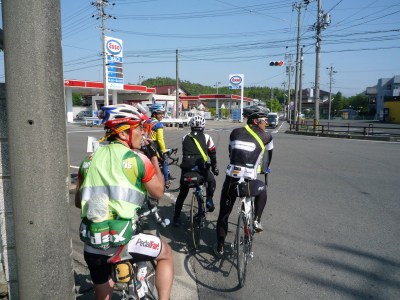
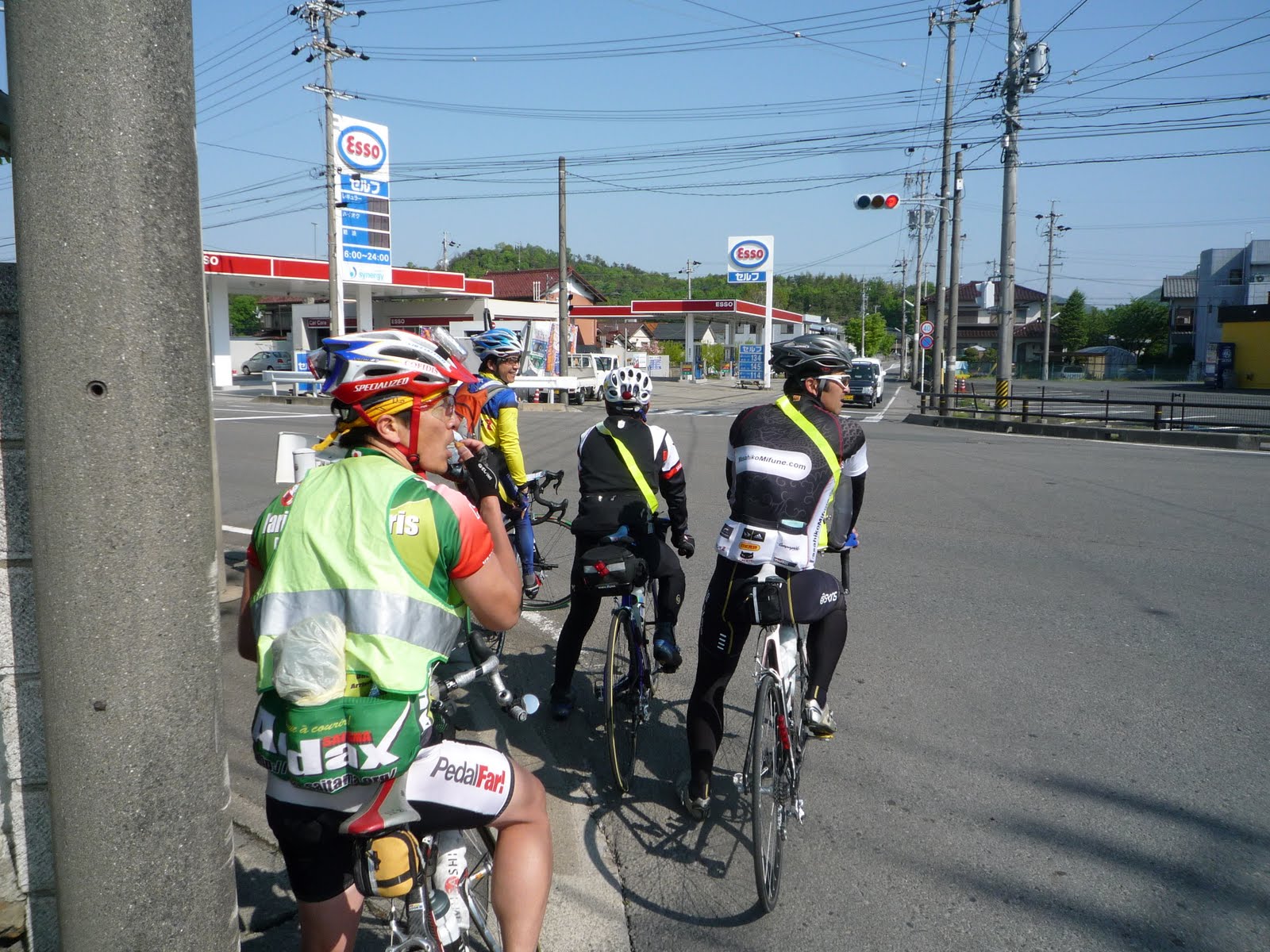
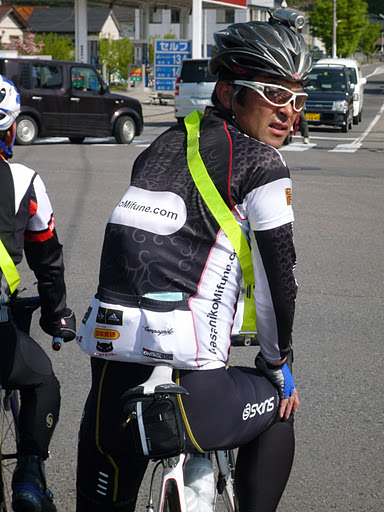
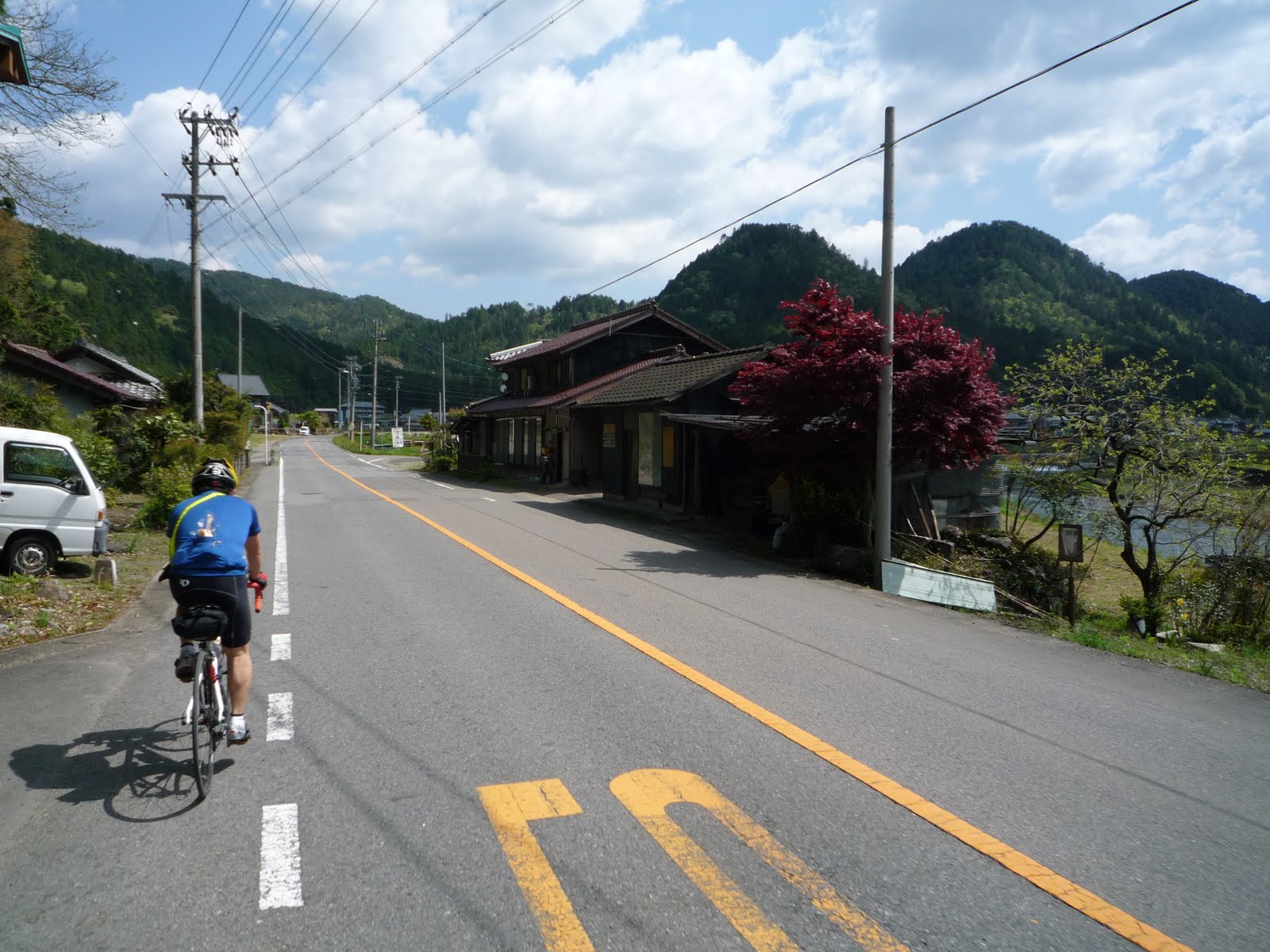
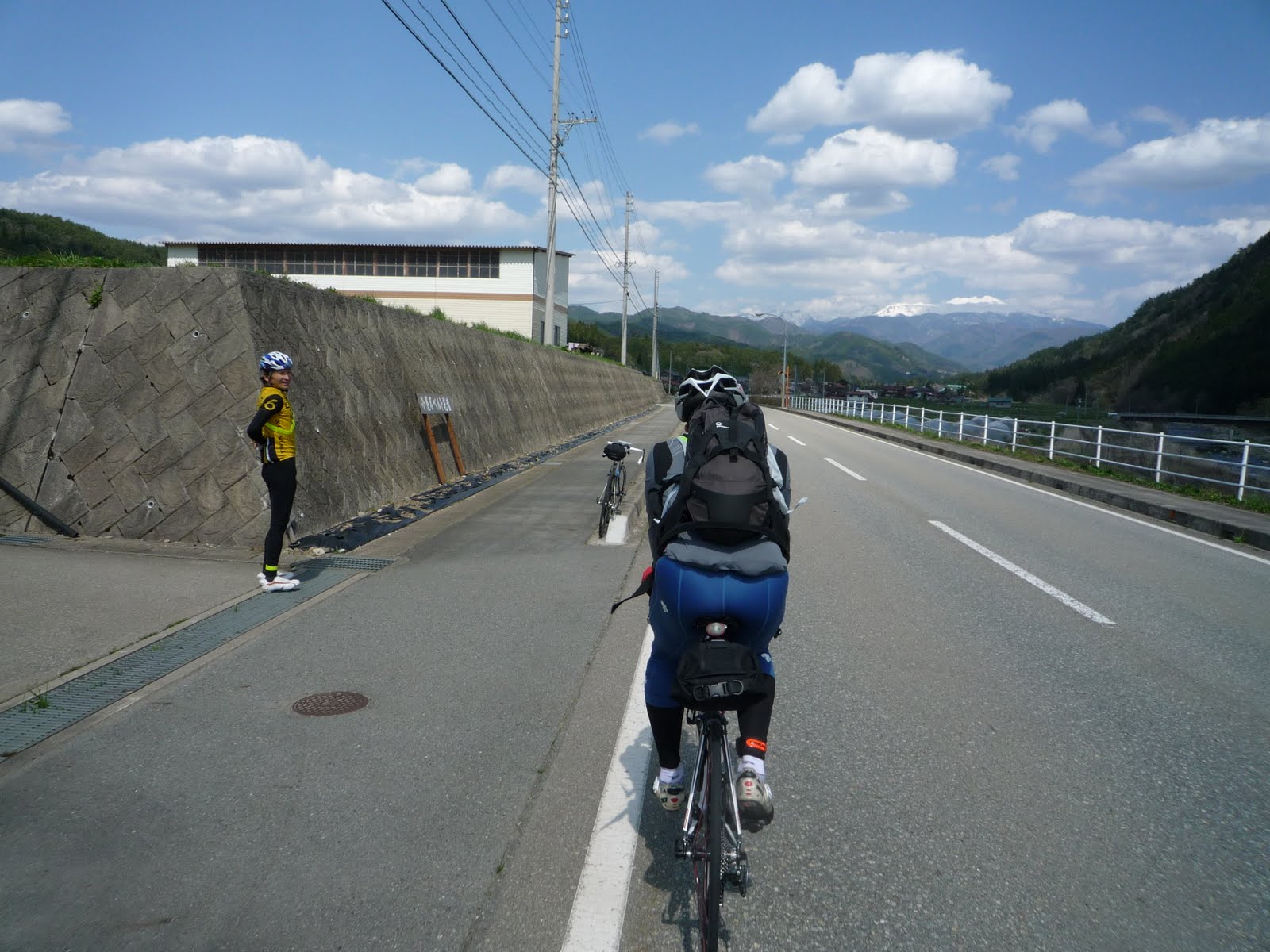
These guys looked really strong. One (in front, in blue and yellow — photo above), who had chatted with me at the start, had not an ounce of body fat, and a rucksack that looked outsized on his small climber’s body frame. Another had calf muscles (back of lower leg) that bulged. He wore „pedal fast“ shorts and a Saitama Audax 2007 PBP jersey (see photo above). I rode much of the last 2 legs with other people in these and similar 2007 PBP commemorative articles of clothing — vests and jerseys — notching up their 2010 mileage to get their 2011 spots). Mr. Pedal Fast was riding alone, while the other 3 were clearly working as a group. Another rider pulled up behind me and pointed to one of the three. „That’s Mifune-san. He was a pro for 8 years in Europe, rode with Landbouwkrediet-Colnago.“ (actually, he said „Rabobank Colnago“ … but who wouldn’t, given the extra vowels in „Landbouwkrediet“). Sure enough, Mifune-san had a bit of the look of a Euro pro … and turned around just as I was about to photograph the personal url on his jersey to preserve for a visit to his website later. His jersey’s „dragon scale“ decoration was interesting — almost as if a yakuza tattoo had instead been placed onto a cycling jersey, subtly and without color.
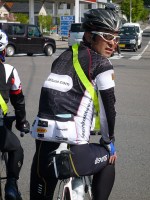
Anyway, I rode with them almost to the first checkpoint (at only 36km) … or maybe I should say that the last 10 km I rode behind them, catching up at lights and on short descents that followed a few short climbs. I was having fun — and why not, as long as I could keep the effort within limits, my heart rate not high. I lost them on one of the longer, open stretches, a few kilometers before the checkpoint, but arrived as they were still buying their food.
Now the real ride began. Many beautiful valleys, even the dams and reservoirs were nice, on a smaller scale than Okutama-ko or the massive one we sometimes pass in Gunma when heading toward Honjo Waseda.
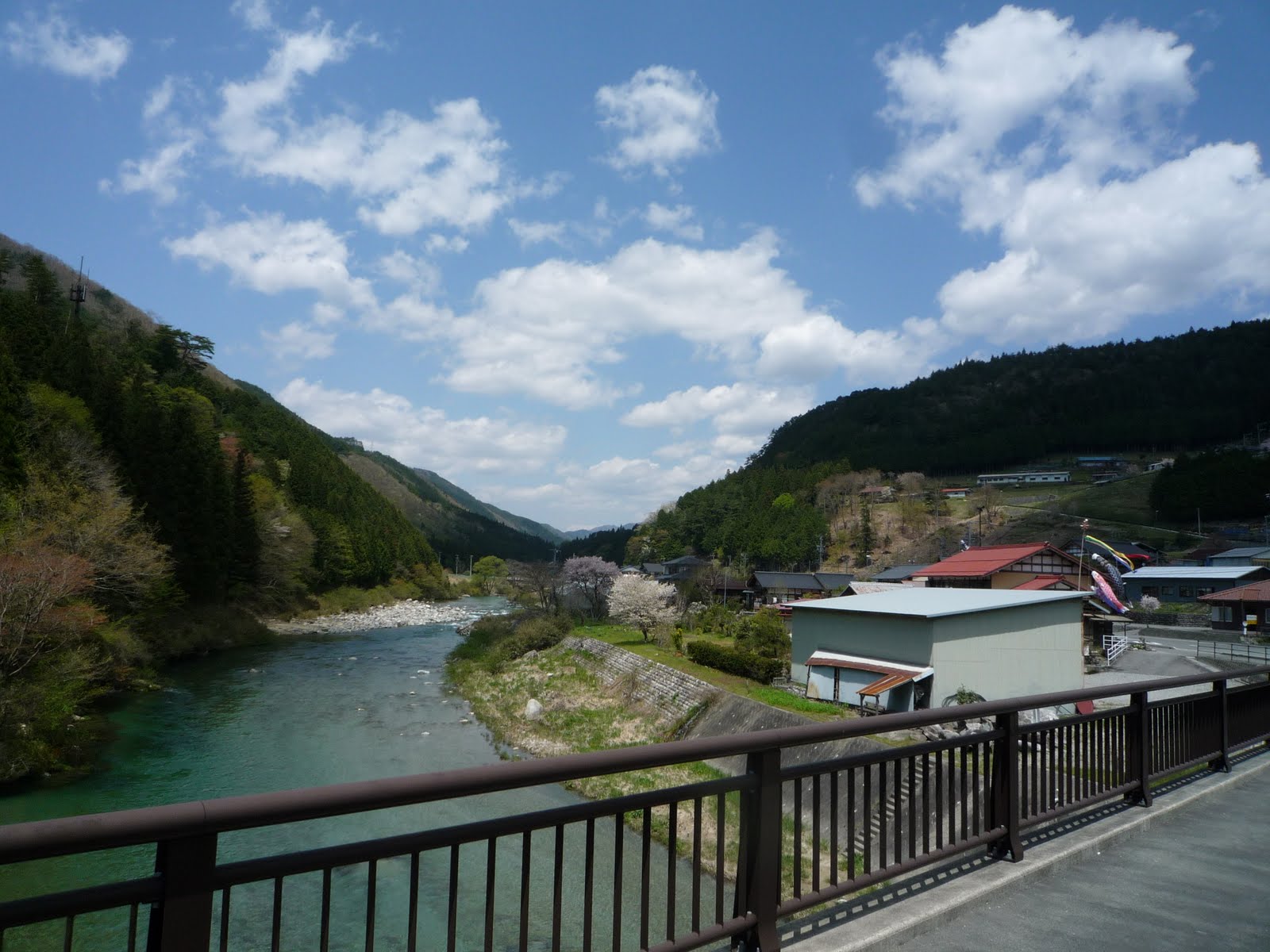
This segment involved a number of smaller climbs of 150-250 meters net elevation, the first on Rte 85 over a pass, then one up to a reservoir, then further up to another reservoir, then finally up a hillside to a tunnel entrance, and through the tunnel and down a real descent, into Gero and then Hida-Hagiwara, for a quick stop at PC2. 105 km done, 500 to go. The third segment started with another 21 km ride up crowded Rte 41 along the Hida-gawa, and just a few kilometers before Takayama turned East with Rte 361 and toward the day’s major climb. There were flowering trees and quaint villages everywhere, but my main impression of the second and third segments is of the sound running water. Almost everywhere, we are riding alongside rivers, streams, or just water burbling through the drainage systems alongside the road.
I rode with 2 other riders for awhile, one of whom had cut very short his first rest-stop visit, and had a mostly-uneaten submarine sandwich in his rear center jersey pocket. … very tempting.
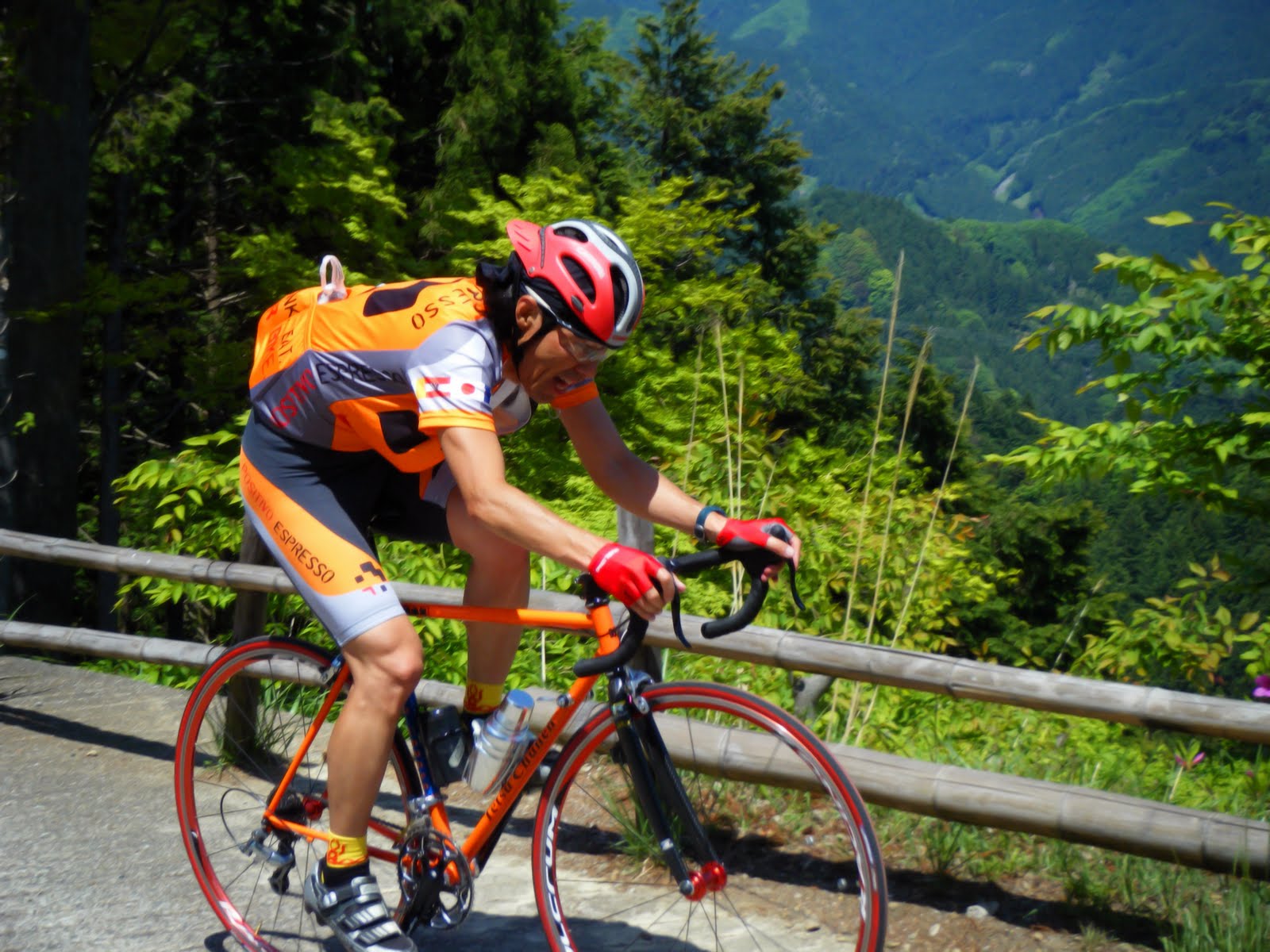
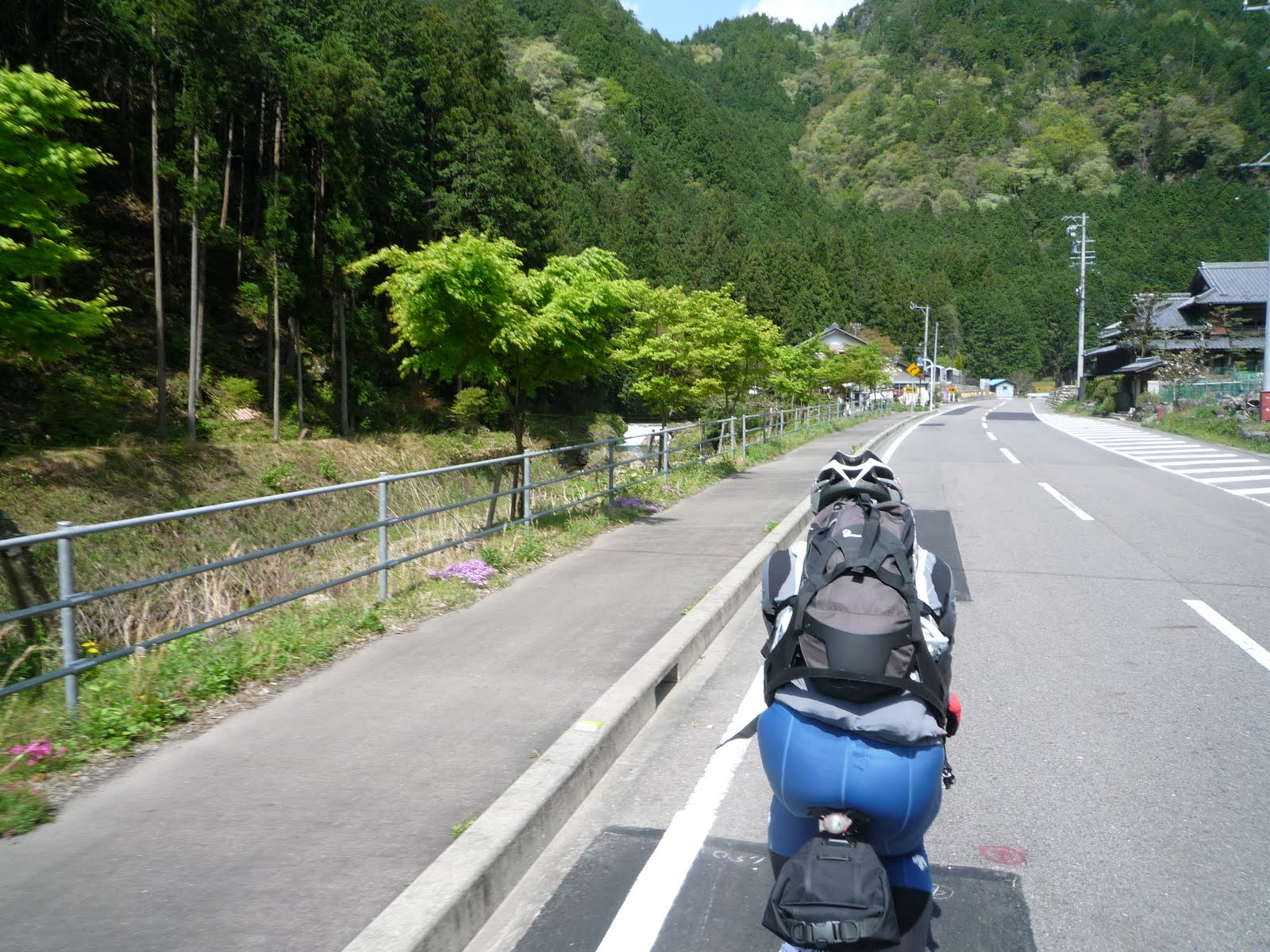
Another rider with strong legs and plenty of gear in his rucksack, was my companion for part of segments 2 and 3, before he went ahead (I saw him one last time briefly at the top of Nomugi Pass, as I rolled in and he finished his rest stop):
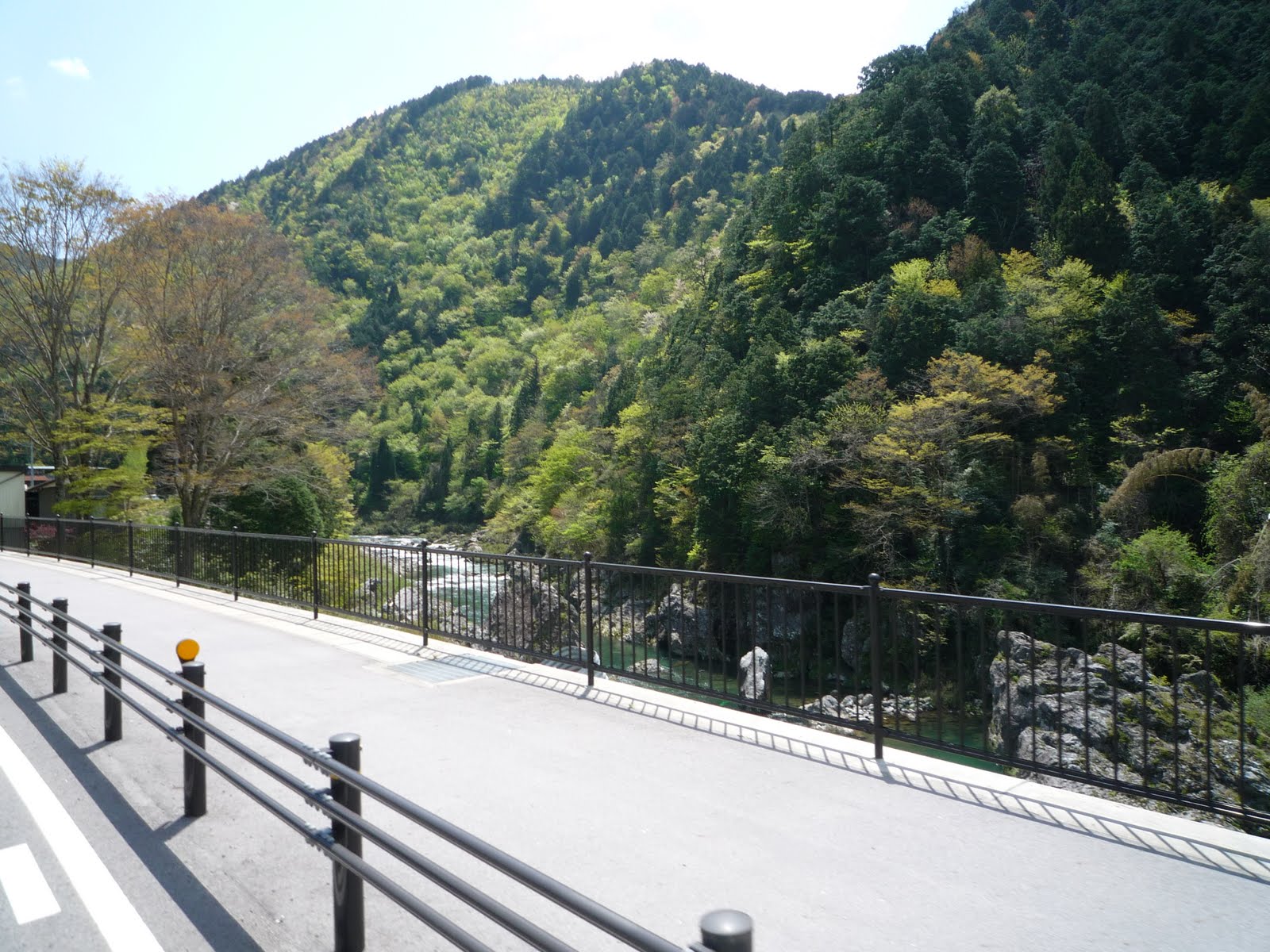
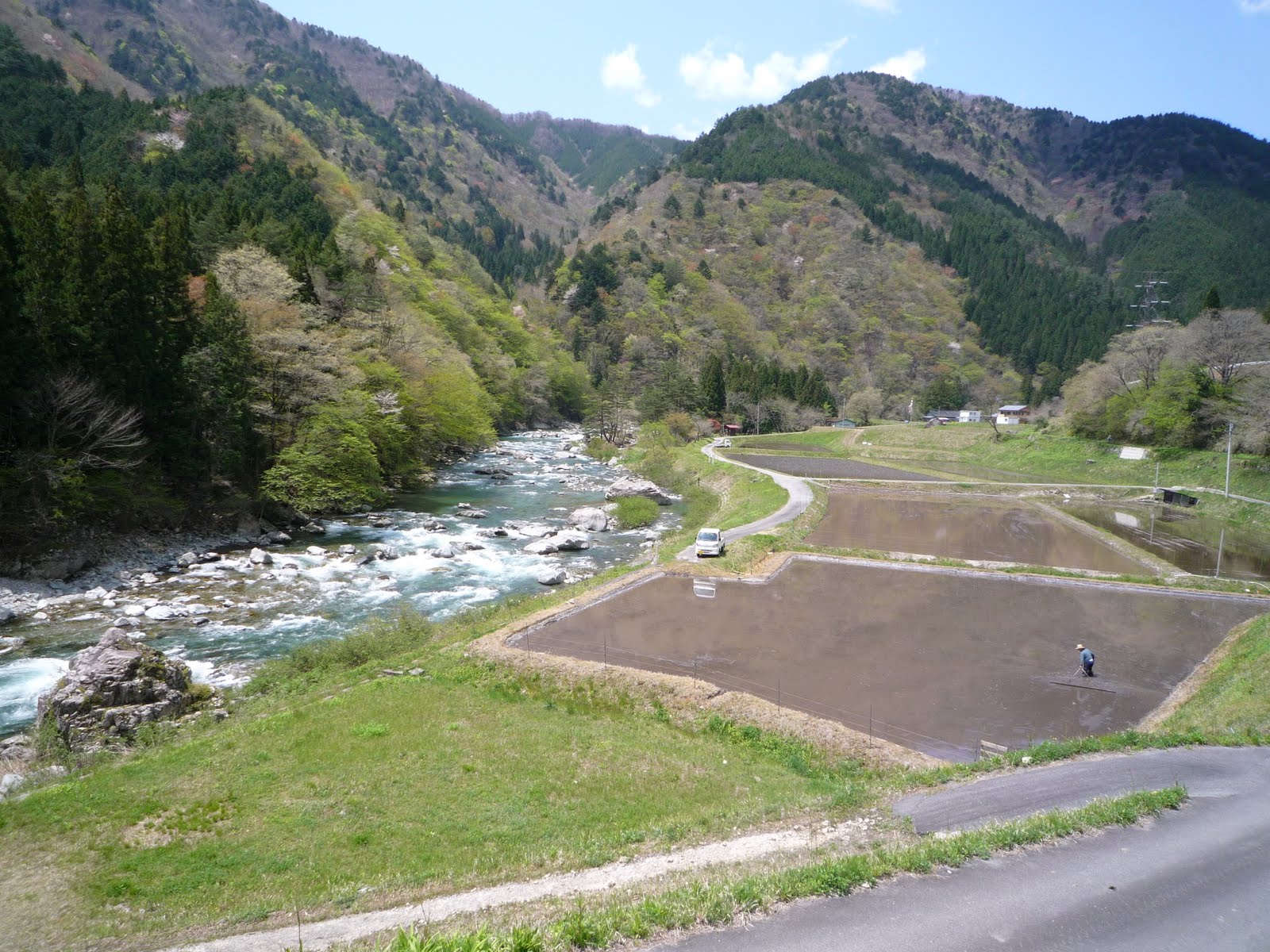
More rivers, hillsides, trees:
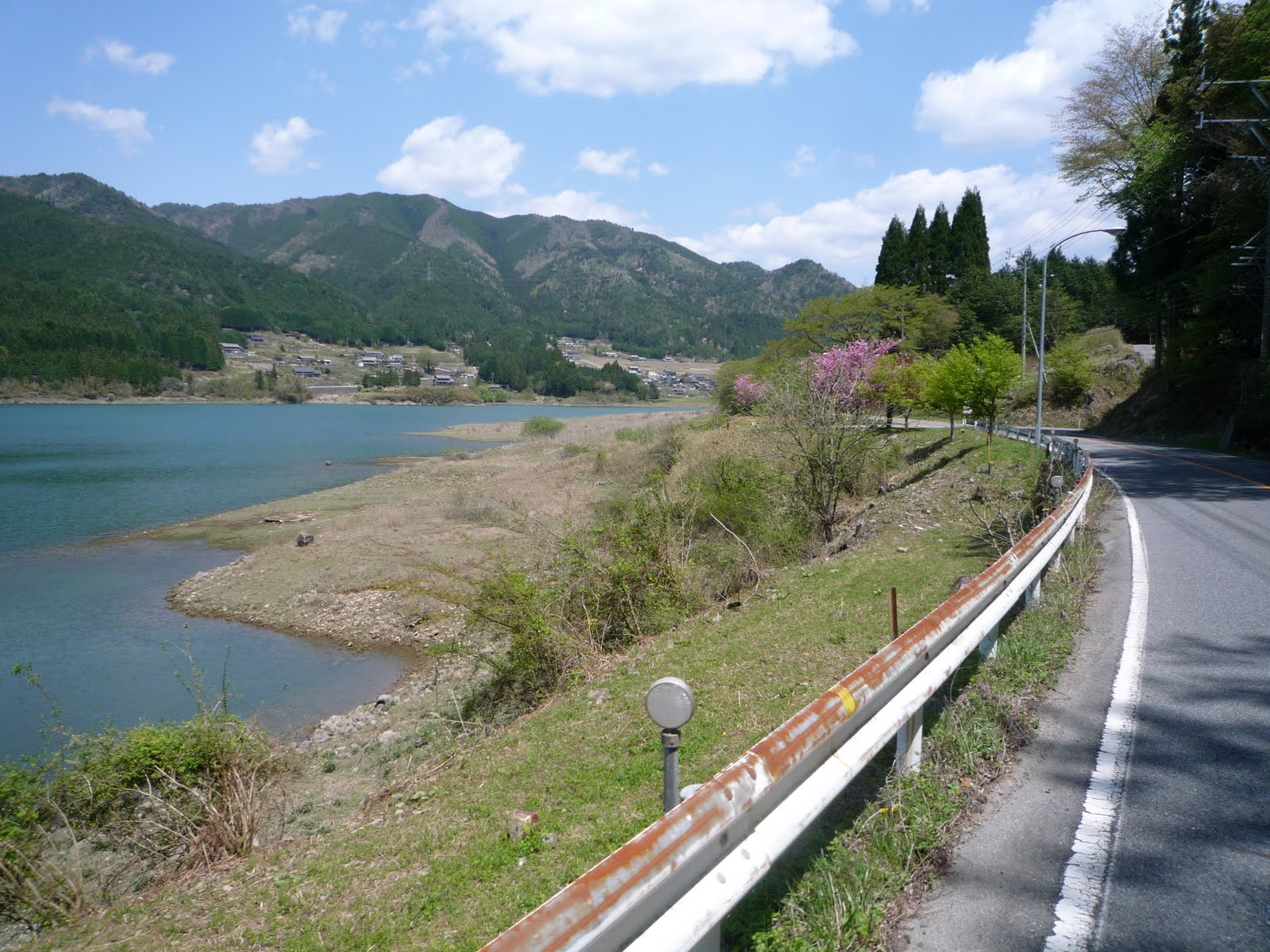
Even the reservoirs looked pretty:
Plenty of work this Golden Week for the rice farmers in Gifu:
Are those mountains in the distance?
Checkpoint 3 was at a small rest stop (Michi-no-eki) on highway 361. One of the organizers was waiting there, logging us in, and checking off our convenience store receipts from the first two unmanned checkpoints. Only about 10 riders had arrived before us.
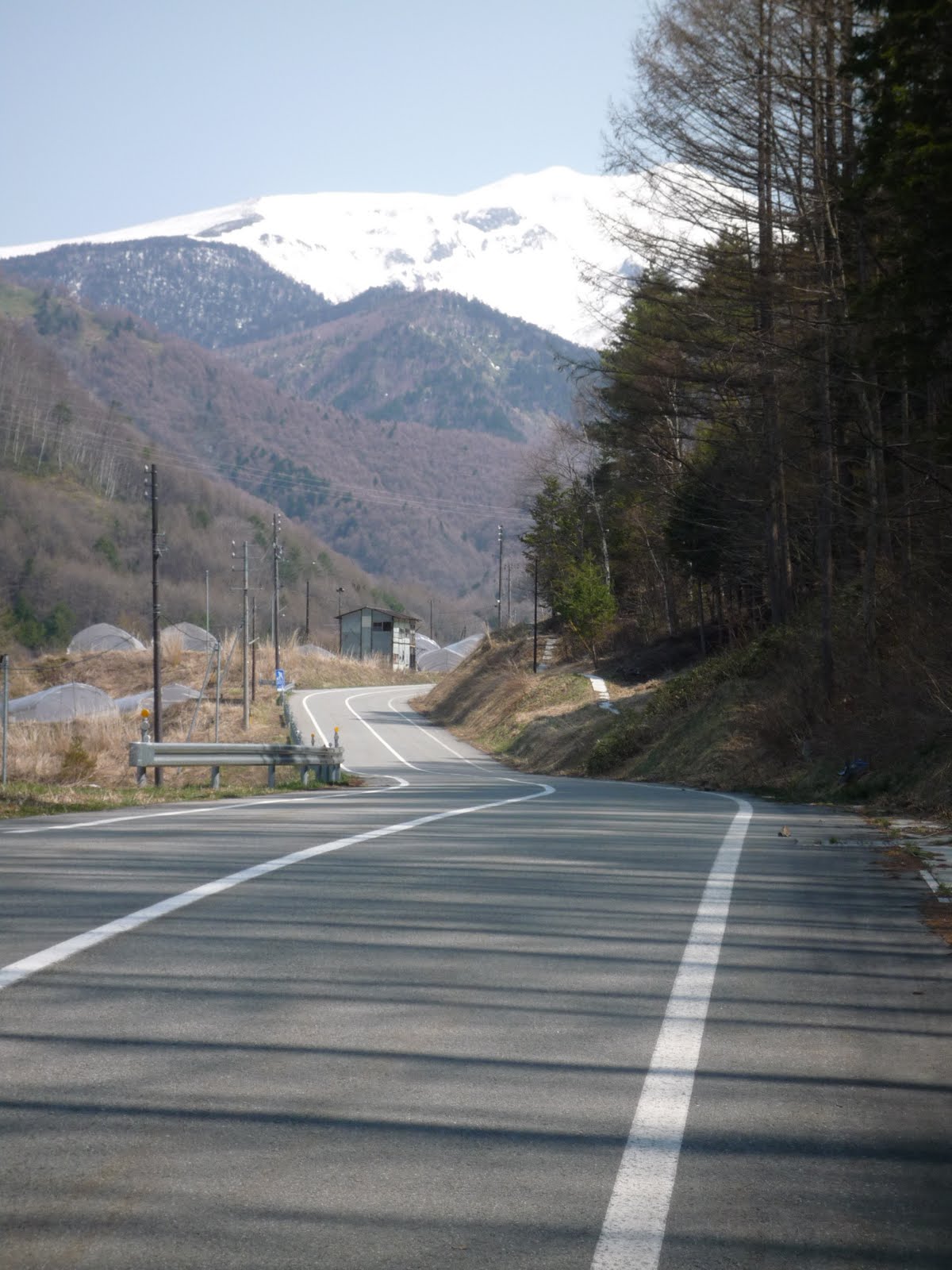
Up Rte 361, through tunnels, around reservoirs, a bit harsher, higher territory, and finally, the turnoff for Nomugi Pass — onto Rte 29 for the long climb. Again, I found myself alone — below is a photo of the lower middle of the climb and Norikura Mtn (before the first „false“ pass at 1375 meters, the descent back down to 1225, and the „real“ climb up to pass at 1670). (Today I see that this same stretch of road is photographed in Cycling Sports‘ Nomugi Pass write-up in the June 2009 special on the top 20 mountain passes of Nagano — the road pictured is probably a 9% grade, visibly turning up to 11% or so):
When I made it to the top, I saw the rider from earlier in the day leaving the visitor center to start his descent. Have you seen anyone else? „No. Nobody.“
There were probably 10-15 fast riders ahead, and the rest … are far enough back so they did not even catch ME on the long climb … maybe I started out too fast, again? It is somehow reassuring to see another rider come up to the Pass just as I am remounting.
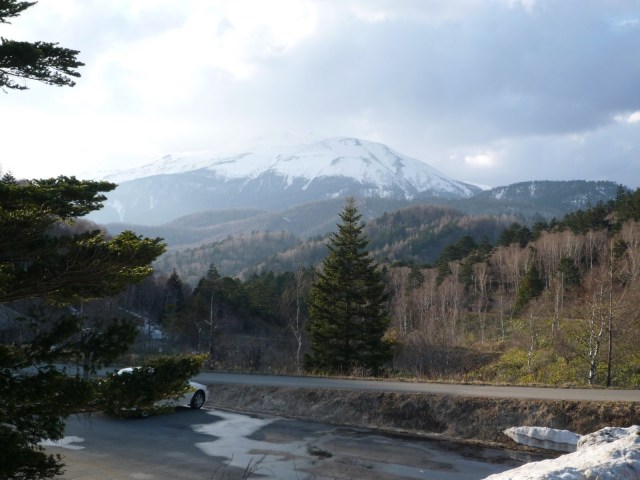
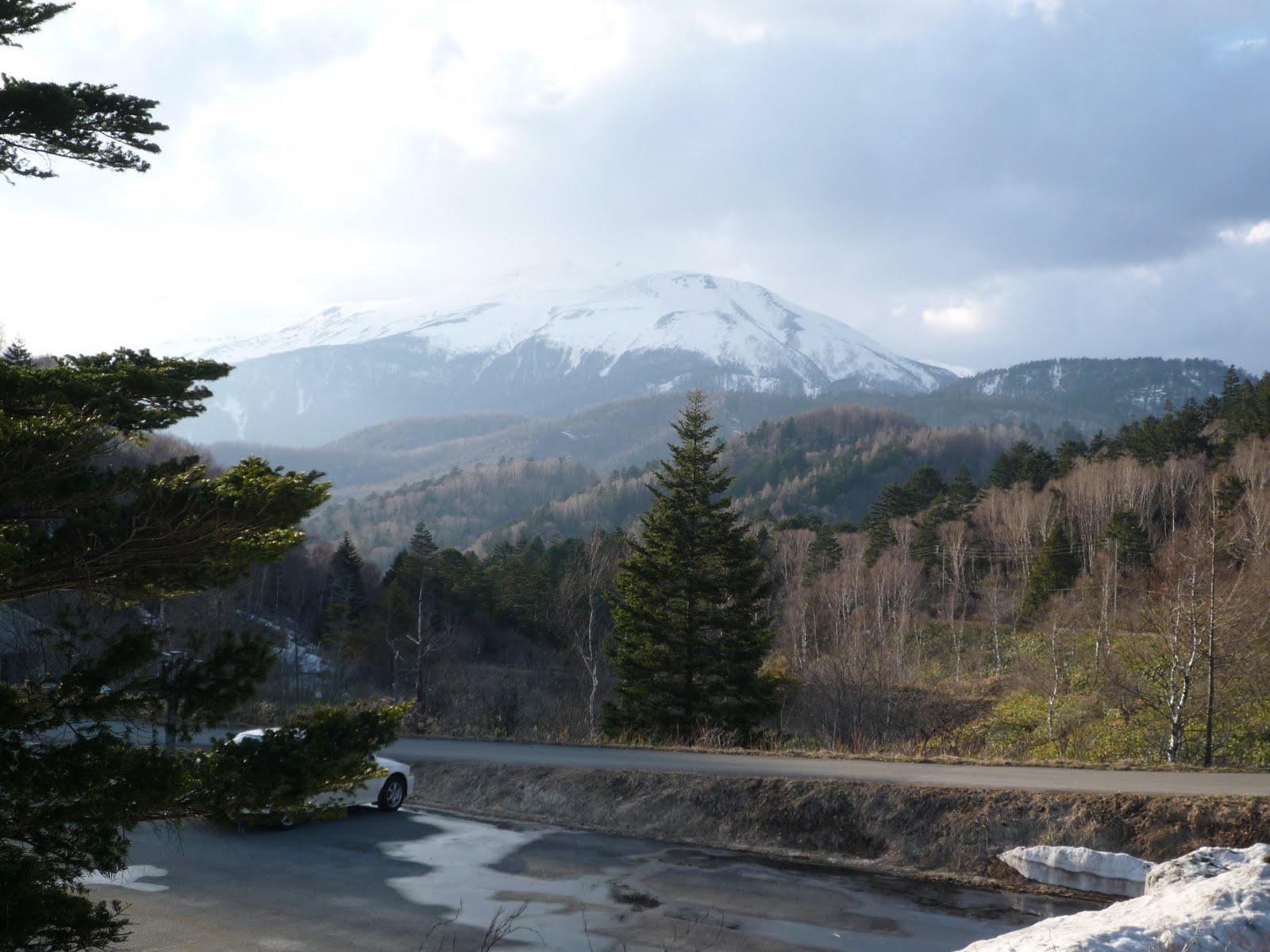
Norikura Mtn, looking back from the top of Nomugi Pass, as the sun gets lower in the sky:
Zoomed in:
I was with another rider on the dark country roads between Akashina and Tokura Onsen … I had ridden with him after PC4, as we lost the route, took an alternate, and ended up rejoining it on Rte 147 and then Rte 19 to the North. I pulled him much of the way for 10 km+ down Rte 19 — flat or a 1% downgrade, light traffic, and even a slight tail wind allowing me to make great time and put the hammer down a bit. We then headed into the cold and the hills, the first of several climbs on the next stretch. Eventually, I bid farewell and pulled off at a rare convenience store that appeared out of nowhere in the countryside, as the Nagano Expressway loomed overhead in the dark just before the turn from Rte 403 to Rte 12. Fatigue, exhaustion, a desire for sleep — nothing a Rainier Double Espresso with plenty of caffeine and sugar wouldn’t hold at bay, at least temporarily. As I continued, a few other riders passed me, including Mr. „My Pace“ from two weeks back in Nishi Izu — who was riding strong and reported that this time, he was well-rested and going all the way, as he no doubt did.
There was one more climb on Rte. 55 before the last flat section to the turn-around. On the map it was labeled „forty eight turn pass“ or 四十八曲がり峠, though I could remember that there was a tunnel before the top (looming above in the dark), saving us from the actual pass. I started the climb and could see some lights of other riders behind me in the night. Two passed me, and I passed someone who was lagging. 3 of us were relatively close when we came upon a sign that was like someone’s idea of a cruel joke — „warning 13% uphill grade ahead.“ A few meters later the road entered a shed, designed to shield it from snow in the winter — way too steep for plowing or for cars to travel if covered with snow or ice. Fortunately, after a few minutes and couple hundred meters of barely turning the crank, the road started to level a bit, the shed ended, and we could approach the tunnel. The forty eight turns seemed to be on the OTHER side of the pass, as the road down twisted and turned many times. I finally made it down Rte 55, to Togura Onsen.
One young rider struggled with me to navigate the recommended route through Togura, that would lead across the bridge, onto the next main road (Rte 18). There were plenty of people out and about strolling after enjoying the hot water. We ended up choosing alternate routes — he made the better choice, since I passed him again 10 minutes later as I hit my pace again on the flats of Rte 18. As I approached Kawanakajima and the war memorial park, I kept thinking I must have overshot, checking my map repeatedly … but then I saw some of the faster Brevet riders heading the other way on their return, so knew I was still on track.
Eventually I found the park/memorial — pitch dark, nothing visible there, not even the statute of Uesugi and Takeda. The Daily Yamazaki down the street … was dark, boarded up, with a „tenant wanted“ sign. Where was the turn-around? I pulled out the cue sheet and finally figured out my mistake. There was another Daily Yamazaki that did not show up on Google Maps, and I needed to go back to Rte 18 and head back 500 meters. I must have passed this store going in the other direction, across the wide (6 lane, with divider) highway and not noticed it. … my concentration was fading. I reached for my maps in my jersey pocket … NO MAPS. They must be on lying somewhere back on Rte 18 within the past 3-4 km. Well, even with no map, if I could just get Rte 70 out of this area, that would take me all the way to Rte 19, then I just needed to retrace my steps, with one required (and easily identified) side trip after Nomugi Pass, and I could finish even without a map, and assuming that my GPS battery would not last much longer. No map, no problem. And I was halfway done in just under 15 hours, with a 40 hour cut-off, and an informal goal of 36 hours (8PM finish giving me plenty of time to wrap up and find my way to Nagoya for the last shinkansen to Tokyo (leaving 10:10PM Sunday).
I studied a map off the magazine rack at the turnaround checkpoint’s Daily Yamazakistore, and headed out after eating, chatting with the organizers and trying to rest … somehow 50 minutes had passed but I did not even get a chance to lie down, and I certainly did not feel rested. I found the turn-off toward Rte 70, went ahead as it twisted and turned, remembering the map in my head, despite lack of any signage and another rider (who DID have a map) pulling off at several points, finally stopping at intersection to check the route … and not following, no light even visible behind me when I looked back 500 meters later. Someone else did catch me as we approached the climb, a younger rider from Mie Prefecture, and first he, then a sign ahead, confirmed that this was Rte 70. He seemed like a nice guy, and wanted to talk. He clearly had extra energy left. I told him to please go ahead. He said no, that he found riding alone at night could be boring. He would zip up a section of the climb, then slow down and wait for me to come lumbering up. He asked a lot of questions. :How long have you been in Japan? When did you start doing Brevets? Have you done one in the U.S.? I’ve heard they have some in the U.S. without hills, is that true, and where is the fun in that?“ I suggested to him again, REALLY, he should go ahead. He did not take the clue. My answers to his questions got shorter and shorter, as did my breath. On a different route at a different time, I would have been delighted to chat and returned the questions and then some, but not at 12:30AM on a climb. Finally, another rider came up and joined us, and I could see more lights down the hill one or two switchbacks behind us. I seized the opportunity, „please go ahead without me, I need a bathroom break, I lied.“ That finally did it and they left me in peace.
The next couple of hours, after midnight, were very tough. My pace slowed, there was no good place to rest, and it was way too cold (3 degrees?) for me to contemplate the idea of resting outside. A few minutes and my sweat would cool, with teeth chattering effects. I slogged ahead, saying to others that I would look for a family restaurant in/near Matsumoto, for a meal and 45 minutes of sleep. I saw a few more riders on Rte 70 — most passing me, fewer being passed — but I saw almost no one the whole time I was on Rte 19 all the way back to Akashina and then on toward Matsumoto. Only the occasional truck racing through the night. In Akashina, one more quick unofficial 7-11 stop, … where I noticed that my sunglasses were missing. They had been hanging around my neck, but must have fallen when I zipped up my jersey, or jacket.
I had one major crisis on the ride. Still on Rte 19, I started to lift out of the seat to „dance“ on the pedals and stretch my back, and just as my weight transferred toward the front wheel I heard a loud „ping“ sound coming from the vicinity of my front wheel. A spoke had broken cleanly into two even pieces — the first spoke to break on my Fulcrum wheels in 14 months since I bought them, though I’ve had plenty of other minor difficulties and a few false alarms where the spoke just came loose and I thought it must have broken. Fortunately, I had brought the Fulcrum spoke wrench, in case I needed to true the wheels. I was panicked. It was near 3AM. No one around. If I could not get the wheel into „rideable“ shape, relatively „true“, I would need to drop out. No spare wheels and no support here.
15 minutes later, I had adjusted the spokes to the point where the wheel only rubbed slightly — a slight thwamp, thwamp, thwamp, when I leaned on the handlebars. If I sat back, there was no rubbing at all. I’ve ridden home with a broken spoke before … maybe even 50 or 75 km at most. But 260 km? The odds of completion had just fallen dramatically. I gave up all hope of rest, or finding a family restaurant for a warm meal, and decided to push ahead straight to checkpoint 6. I would try to take it easy a bit while continuing to ride, no sudden shocks to the wheels on the descents. In my continued panic over the wheel crisis, I misread a sign – I want to turn right at Rte 147, taking it over to Rte 48. Instead, I turned right at a sign that leads „to“ Rte 147 and Azumino City. I must still have been 10 km North of the turn I wanted. I finally realized the error when I got to Rte 147, several kilometers away — out of the way. It was very cold. When I checked the weather Friday, Azumino was colder than Matsumoto, Nagano, Chino, Suwa, or any of the other cities in Nagano that I could find … I just did not realize it because I could not read the kanji for Azumino — 安曇野 — but at 3AM Sunday morning I figured it out [CORRECTION — actually the cold temperatures on Weather News website were for Azumi (安曇) Middle School weather station — which is on Rte 158 just past PC6. Azumino City is just in the same sloping plain as Matsumoto and is not any colder]. So I turned left onto Rte 147, heading SSE, knowing that eventually I would get to the SW turnoff I was supposed to approach from the other direction … just not sure how far, and no map to help. I tried a few false starts, but each time returned to Rte 147. (It was incidents like this that put my total mileage for the 600 km ride at 625 km. Add in 11 km from the hotel to the start. .. to get 636 km, or just shy of 400 miles — a quadruple century).
It was getting light by the time I arrive at checkpoint 6. Two riders were trying to rest outside, in front of the store, clothes pulled over their legs in an attempt to keep warm. I stayed inside, eating my instant soup and other food. They did not kick me out (the „foreigner’s privilege“?), even though the store was surprisingly crowded for 4:45AM Sunday morning. I decide to push ahead slowly — no place to sleep or rest until over the big mountain, but at least I could hope to get off Rte 158 (the most crowded, narrow shouldered stretch of road on our entire route), before the traffic, and the big buses.
Not. Only a few kilometers into the climb up Rte 158, I start being passed by massive empty tourist buses, heading up to start their days. And lots of other traffic as well — others who decided to beat the traffic. Finally I made the turn South onto Rte 26, losing 80-90% of the vehicles who continue up Rte 158. I passed some covered bus stops … little sheds with a bench inside. Each had a bicycle propped up against one side and a rider trying to stretch out and sleep inside. At least it offered a flat surface and shelter from the wind, but not the cold. I could not imagine stopping in that cold — still in the 2-3 degree celsius range. Looking at the bright side, I was climbing so slowly that the sun would be up and temperatures warmer before I reached Nomugi Pass again — the top of the climb. Until then, my activity would keep me very warm.
One of the Chubu Audax members manages a small onsen (hot spring) along the 秋神川 (Aki-Kami-gawa?) on Rte 435, a mere 7 km detour off of Rte 361 along a reservoir and then up a river valley. PC 7 was at this onsen, where we could relax in a day-house, take a quick shower and soak to freshen up, and even sleep (in my case, for 45 minutes — I arrived around 11AM, and wanted to make a 1PM departure to stay on track). This was an incredibly nice feature of this Brevet — even a chance to sit in a room with some of the other riders, eat cup noodles and mikan, and hear some stories of this and other events. Thank you, Chubu Audax!
The organizer who managed the onsen had a high end digital camera and was snapping pictures as riders headed out, one of which I’ve copied and pasted from the Chubu Audax BBS:
My front wheel held all the way to the goal. The „thwamp“ grew a little worse, so that by the time I was coming down Rte 41 along the Hida-gawa on Sunday afternoon, I heard the noise whether or not I leaned on the bars in order to brake. I stopped using the rear brake to slow the descents. I started to go full speed ahead, clearly 60 kph at times and throwing caution to the wind. I stayed generally close to the same 4-5 riders on the last 2 legs, until we got into town and were completely separated.
I had saved some battery juice in my Garmin GPS for the last part of the ride, to navigate the many twists and turns after dark (what a feeling — two sunsets on one ride). But it died just as I got into town. I outpaced on 2007 PBP jersey-wearing rider on the last descent (his front derailleur had malfunctioned, leaving him with only the smaller chainring). I stayed behind another rider who looked as if he knew exactly where he wanted to go … until he missed an obvious right turn. I yelled out at him „Right!“, „MIGI-Desu“, „MIGI-Desu“, following him through the intersection, then stopping. He looked around, but then went on … down a dark road that I was pretty sure would have him hunting for an „alternate“ route where no good one existed, and I did not see him again at the finish. I did fine until the entrance to the final park. It was pitch black, and the map would do not good. I decided to try to ride along the southern edge of the park — a road along a levy – instead of through the park, at least until I got closer to the finish. I ended up fumbling my way through dead ends and another darkened park (where I stumbled upon a large group of youth hanging out in the dark, up to who knows what … but this being Japan, they did not rob or attack me and I actually found a way out the other side, over a second levy and entered the maze-like main park. Finally, I found a mapboard, which, to my disappointment, showed only a tiny portion of the park, and did not highlight or identify the „cycling road“. A light approached and a rider passed me by, he apparently knew where he was going, and I hopped in behind to be guided the last 5 km. It was almost 8:30PM by the time we fumbled into the finish.
1. Planning/logistics. This ride offered some great challenges. In addition to the distance, the climbing, and the time limit, there was the temperature variation — a low near zero Celsius (which would have been several degrees at least colder for someone who made it back to Nomugi Pass in the dark) and a high near 20 degrees C — and the long distance between rest stops/food options over the main pass. Everyone had studied the route carefully and most seemed to have a strategy for how to get through.
The organizers offered to take a „drop bag“ to the 300 km turn around spot/PC5, and a second „drop bag“ to the hot spring/PC7. I made the mistake of putting my brightest, heaviest headlight in the PC5 drop bag … when it turned out that the darkest roads were earlier than PC5 (especially, the fast and partially blind descent from forty-eight turn pass), whereas the moon was large and high in the sky after I left PC5, and Rte 19 back to Akashina was lit much of the way. But the drop bags generally this worked great. I put a warm, long-sleeved inner layer in the PC5 drop bag, but carried enough warmer gear to get to PC5 without difficulty, and before the really cold hours. I put some of the „High5“ goods into the PC5 bag as well — refilling my saddle bag and pockets just as they hit empty. My PC7 bag … included a small towel, disposable razor and toothbrush/toothpaste — luxuries that would have been foolhardy to try and carry the first 450 km, but were nice to have. Now I just need to get the USB charger to work for my Garmin 705 …
2. Chubu Audax is a really impressive group — Otsuka-san, Ichikawa-san, Ikawa-san, and many others I met, but whose names I did not learn. They offered encouragement at stops 3, 5, 6 and 7, organized the really nice Kurumi hot spring rest stop, and pulled off a very complicated logistical effort (to get the drop bags transferred around seamlessly. It boggles the mind that the entry fee for this event was only 2500 yen, half of which went to pay for insurance (as a non-Audax member). This required an incredible volunteer effort, probably 4-5 times the effort of a 300 km ride given the logistical challenges. I got a little extra help that I suspect was offered to me as the only foreigner to attend — a 10 kilometer lift in Ikawa-san’s SUV from the finish to the Owari Ichinomiya train station that allowed me to get the last shinkansen back to Tokyo Sunday night. I am deeply grateful to the organizers. They are sponsoring a 1000 km ride in October (that also starts in the same park N. of Ichinomiya, and includes the entire route of the „Tour de Noto“ along the way). I definitely want to join it — and will try as much as I can to keep my schedule clear.
And as I have sensed before, the longer the ride, the more friendly other riders become (well, except when you are feeling cranky and someone keeps peppering you with questions at 1AM). Every rider is a potential savior if you get in trouble, and the common endeavor breaks down any barrier that might otherwise exist to communication with these folks.
3. Pain and Suffering. Even the slightest physical problem gets magnified over this kind of distance. Everything worked perfectly on my last 300 km ride, so I had confidence in my gear set-up, and was happy to get a larger „Dyna Pak“ Topeak under-saddle bag and thereby avoid a rucksack at least until PC5. On this ride, I was pain free and enjoying the ride most of the time. I had only very minor physical problems — nothing that would usually be of any note … except that I did notice, over this distance.
My left ankle somehow got a mild sprain during the ride. I barely noticed it until the finish, and could walk fine until Monday morning. It made a bit of a „tick“ sound sometimes as I used it Monday, of some concern. Tuesday AM it was still very tender — definitely a mild sprain and difficult to walk on or go up/down stairs — but after one day wearing an ankle brace it seems 90%+ healed today.
My cleat placement ended up „off“, the cleats farther forward than the balls of my feet. I only realized it from shooting pain in the bottom of my feet late in the ride that told me something was wrong. The new style of Look Keo cleats with grips on the bottom were a disaster. The grip part came loose on the right cleat, and prevented me from clipping in properly numerous times, until I finally had a „near miss“ from slipping out of the pedal while remounting and about to gain speed going down a hill after 10PM at night (maybe this caused the ankle sprain?). I managed to pull off the partially separated grip pad by hand, and I could clip-in and unclip okay the rest of the ride. I suspect that putting my feet down in the „near miss“ is when I hurt my ankle and when the cleat placement shifted.
On Monday, I was as stiff as I have ever been. The tips of my outer two fingers were a bit numb and tingly on both hands. The palms of my hands started to get tender and red 25% of the way through the ride — combination of the Shimano 7800 brake hood shape, too much pressure too long, and moisture inside my gloves. I guess this tenderness was not caused by the FSA wing carbon bars, as I had thought. (Otherwise, the new Ritchey carbon bars are great for me).
Even the Assos bib shorts were not perfect this time — my butt ached, a result of moisture and chafing I think, since it seemed to be solved by application of some Assos magic chamois cream at the hot spring rest stop. But the aching butt and need to stretch my back at times meant extra „dancing“ (stomping?) out of the saddle, which probably triggered the broken spoke. A problem with chafing shorts eventually triggers a broken spoke? A problem with cleat grips ends up causing a sprained ankle and aching feet?
I had no issues with nutrition. For me, the High 5 4:1 carbs/protein drink is good, the electrolyte tablets for water are good. I filled up 1 liter of water (w/ electrolytes) at every stop, and mixed a 667 ml bottle of the 4:1 sports drink nearly as often, and I don’t get sick of them. Spaghetti with meat sauce is still edible after 500 km., as are yogurt and yogurt drinks. Cup noodles and soups are good. I avoided anything fried or unusual, and anything sickly sweet (no Aquarius or Pocari Sweat). The 7-11 burritos (ham and cheese version) that I usually like at a first rest stop on one of our rides out of Tokyo … are much more difficult to consume 18 hours into a ride. If possible, always best to avoid any non „ride tested“ foods — once you start to have stomach issues on a long ride, it is very hard to recover.
Here is the GPS recording of the route through the first 360 kms, when I switched off the Garmin battery to try to save a little juice for emergency navigation later:
http://connect.garmin.com:80/activity/embed/32052833
| BRM501 Statistical Review … As long as the Garmin battery lasted: |
| Split |
Moving Time |
Distance |
Elev Gain |
Corrected Elev |
Avg Mvng Spd |
Avg HR |
Max HR |
Calories |
| Start to PC1 |
1:17:29 |
36.6 |
247 |
310 |
28.3 |
131 |
152 |
1,786 |
| PC1 to PC2 (valleys of Gifu) |
2:48:37 |
70.22 |
910 |
1,473 |
25 |
135 |
159 |
4,056 |
| PC2 to PC3 (Rte41) |
1:18:48 |
32.31 |
403 |
430 |
24.6 |
137 |
151 |
1,828 |
| PC3 to Nomugi Pass |
2:25:58 |
39.4 |
1,176 |
1,551 |
16.2 |
135 |
150 |
3,036 |
| Nomugi Pass to PC4 |
1:05:35 |
37.31 |
196 |
255 |
34.1 |
119 |
145 |
1,306 |
| PC4 to PC5 (turn around) |
3:33:10 |
88.2 |
719 |
733 |
24.8 |
121 |
142 |
4,008 |
| PC5 to … Garmin off |
2:02:24 |
38.88 |
567 |
485 |
19.1 |
116 |
134 |
1,894 |
| Summary Totals/Averages |
14:32:01 |
342.92 |
4,218 |
5,237 |
23.6 |
|
|
17,914 |
The „corrected“ elevation gain suggests that we went over at least one mountain that had a tunnel — and is shown merely for amusement. Actual elevation gain is around 3600 meters for the outbound trip and maybe 3200 on the return?
Another very memorable ride. I hope to see other P.E. members on these at some point … This format seems designed for Tom S., and I’m sure others would like it, though not for everyone.
 Tom Boonen’s Quick Step team switched to Eddy Merckx bikes some while ago. For the launch of the new EMX-7 model (on June 22), the PR people at Eddy Merckx Cycles created this attention-grabbing copy (re-)enacted by Tommeke Boonen…























 bikesnob28hb
 fixiefanboyhb
 sudi1662













 there is no "I" in cyclyng