Archiv der Kategorie: Ingenieur

Dem Ingenieur ist nichts zu schwör.

Lenkerband wickeln. Aber richtig.

Das, meiner Meinung nach beste Video zum Thema.

Lenkerband wickeln ist nicht einfach. Einige Bemerkungen noch dazu:

Als Werkzeug brauche ich meistens noch einen Gummihammer, eben um die Stopfen in den Lenker zu bekommen. Ich mag es halt ein wenig brachialer.

Worauf man auch achten sollte, ist wie das Band aus dem Stopfen kommt. Also, das Band läuft ja nicht exakt perpendikular zum Lenker dort sondern hat eine Wickelneigung. Also gibt es irgendwo einen imganinären Punkt wo die hintere Kante des Bandes (die vordere liegt ja auf, die hintere wird zunächst einmal reingestopft) aus dem Loch herauskommt und das Ende des Lenkers schneidet. Dies sollte möglichst ganz unten sein, denn dieser Punkt birgt das Risiko der Häßlichkeit und so kann man ihn dann nicht so gut sehen.

Clipboard01

Wie rum wickelt man eigentlich richtig? Also man sollte das Lenkerband so wickeln, dass es sich nicht loswickelt. Und der entscheidende Grund, darum dies passieren könnte ist, dass die Hand oben am Lenker greift und den Lenker imgainär drehen möchte. Und zwar nach vorne. Also muß man das Band so drehen, dass das Band nach vorne gewickelt ist (bedeutet, das Band geht vor dem Lenker von oben und unten und wird hinter dem Lenker von unten nach oben geführt). Aber wie starte man dann richtig? Eine einfache Methode ist, den Daumen der linken Hand in das Loch des Lenkers auf der linken Seite zu stecken, eine Faust zu machen und zu sehen wie die Finger „Gedreht“ sind. Dies zeigt die Wickelrichtung auf der linken Seite an. Auf der rechten Seite kann man dies genauso mit der rechten Hand machen.

In diesem Video ist es genau falsch rum. Das ändert aber nichts an der grundsätzlichen Qualität.

Und beim wickeln immer darauf achten, dass das Klebeband (meistens ein schmaller, mittig angeordenter Streifen) auch auf dem Lenker und nicht auf einem unterliegenden Stück Lenkerband klebt. Das verbessert die Lebensdauer sehr stark. Gut zum wicklen einignet sich gelochtes Lenkerband, da man dort einfacher die Überlappungen kontrollieren kann und dadurch auch genauer wickelt mit Klebeband auf dem Lenker.

Auch bei der Anwendung des Abschlußbandes bin ich etwas anderer Meinung: Die bestaussehendsten Ergebnisse bekommt man, wenn man das Band ganz genau auf die Kante des Lenkerbandes klebt und nicht über die Kante, so dass die Hälfe auf dem Lenker und die andere Hälfte auf dem Lenkerband ist. die Durchmesserdiffernz ist so groß, dass Abschlußband da immer wellt und das sieht nicht gut aus.

Wie bereits beschrieben, all dies ist nicht einfach und man braucht eine Menge Geduld wenn man ordentliche Resultate erzielen möchte. Vor allem mit Fizik Microtex, das Band das es einem noch einmal extra schwer macht.

Hinterlasse einen Kommentar

Eingeordnet unter 2013, Bits&Pieces, Ingenieur, Mob

Luft.

Hinterlasse einen Kommentar

von | 7. September 2013 · 20:26

Mit Einradanhänger durch die französischen Alpen

Kaipi hat im Rennradnewsforum einen sehr interessanten Beitrag über seine Tour mit Freundin und Einradhänger (für das Gepäck, nicht die Freundin) in den frz. Alpen geschrieben. 

Erstmal hört es sich widersprüchlich oder auch etwas verrückt an: was soll ein schwer beladener Radanhänger an einem modernen, auf Geschwindigkeit ausgelegten Rennrad? Und selbst mache ich Rennradreisen am liebsten auch mit Minimalgepäck, so wie vor zwei Jahren, zwei Wochen von Venedig durch die Alpen und zurück bis nach Bremen mit 7 kg Gepäck tutto completo.

Aber warum nicht mal die Vorstellungskraft sprengen, Unvereinbares zusammenbringen und einen neuen Plan verfolgen: Radtour mit Freundin, Zelt und allem Geraffel, durch die französischen Alpen und mit meinem Rennrad. 

Anreise von Bremen nach Genf mit der Bahn, dann durch die französischen Alpen bis ins Vercors und zurück nach Genf. Damit wir beide bei der sportlichen Herausforderung unseren Spaß haben, nehme ich den Großteil des Gepäcks. Das Rennrad muss es sein, da ich gerne die ein oder andere sportliche Solotour machen will, vielleicht Alpe d´Huez. Das geht nur mit einem Anhänger am Rennrad.

Nach ersten Recherchen ist mir klar, es muss ein Einradanhänger sein. Die Befestigung an den Ausfallenden fasziniert mich. Nur leider stellt sich heraus, dass die 3D-Ausfallenden an meinem aktuellen Alu-Rahmen nicht geeingnet sind. Im Internet finde ich nur Leute, die Anhänger am Stahlrenner fahren und das auch nur im Alltag, mit Kinderanhänger, oder zum Einkaufen. Fast schon durch Zufall stoße ich auf den Anhänger von Tout Terrain, der an der Sattelstütze befestigt wird. Nachteil ist der größere Schleppradius. Der Preis ist auch nicht ohne. Aber, wie der Schwabe sagt: i kann mir niggs billiggs leischde. Die Vorteile überzeugen mich letztlich:

  • einfache Montage an fast jedem Rad
  • bessere Krafteinleitung in den Rahmen (glaube ich zumindest)
  • durch den eingebauten Ständer lässt sich der Anhänger auch unangekoppelt beladen, leicht abkoppeln, um auch mal ohne Anhänger einen Abstecher zu fahren, und keine Probleme, das Gespann abzustellen
  •  ich brauche nicht drüber nachdenken, ob ich eine Federung haben will, denn es gibt ihn nur mit

Meine Erfahrungen:

Ich belade das Teil mit einer Ortliebtasche, 89-Liter-Modell, prall gefüllt, zusammen 25 kg. Darauf hab ich noch einen Tagesrucksack gespannt, mit Regensachen drin oder auch Einkäufen, Gewicht schwankend, dann kam noch ab und zu eine 1,5-Liter-Wasserflasche dazu. Damit hatt ich das für Straßenfahrten zulässige Ladegewicht von 30 kg eher mehr als weniger ausgeschöpft. Ein Radschloss mit gut einem Kilo hing auch noch am Anhänger. (Die große Lenkertasche erwähne ich jetzt mal nicht.) Die Stellen, an denen der Ständer auf dem Boden steht, hab ich, um den Lack zu schonen, mit Resten alter Mäntel umwickelt und mit Kabelbinder befestigt. Ein solchen Impuls hatte der Hersteller leider nicht, oder irgendwie aus dem Blick verloren. Ich hatte damit auch ein Problem produziert. Wenn die Reifenteile verrutschen, dann hakt der Ständer nicht mehr korrekt in die Aufhängung ein. Meine Bastelarbeit lässt sich aber bestimmt verbessern.
Mein Rennrad, ein Canyon Ultimate AL, Rahmenset gerade erst gekauft, habe ich mit 10 Jahre alten Dura-Ace-Komponenten ausgestattet, dazu eine Ultegra-Kompaktkurbel, Kassette 11-34, XT-Schaltwerk (schaltet nur mäßig), Schutzblechen und Sattelstütze natürlich aus Aluminium.

Mit dem insgesamt rund 40 kg schweren Anhänger ist das Gespann erst mal gewöhnungsbedürftig. Schon in langsamer Fahrt stabilisiert es sich allerdings erstaunlich gut. Den Lenker musste ich aber schon immer gut festhalten und die gesamte Karosse reagiert völlig anders als ein agiler Renner. Aber irgendwann gewöhnt man sich ja an fast alles und so ging es mir auch. Geradeaus in der Ebene fährt das Teil prima. Zum Anfahren ist je nach Beladung natürlich mehr Kraft erforderlich. Bei nicht vollbeladenem oder sogar leerem Hänger wurde die Fahrt für mich richtig zum Genuss. Das Teil schnurrt dann folgsam einfach hinterher und ist quasi nicht mehr zu spüren. Bergauf dagegen spürte ich das ganze Gewicht des beladenen Anhängers und war froh, eine 34:34-Übersetzung zu haben. Wiegetritt machte leider gar keine Spaß, denn das Rad steht wie ein Brett unter einem und wenn die seitliche Neigung zu groß wird, dann neigt es eben zum kippen. Ähnlich in Kurven, die hab ich versucht, mit gleichmäßiger Geschwindigkeit und damit seitlicher Neigung zu durchfahren. Bergab schiebt das Teil gewaltig, wie ein kleiner Motor. Bremsen ging aber gut. Ein Satz Bremsgummis hat auch locker ausgereicht, die Reservergummis, die ich vorsichtshalbe dabei hatte, brauchte ich nicht. Unebenheiten in der Straße, auch Bodenwellen und Schlaglöcher nimmt die Federung locker auf und gibt keine nennenswerte Impulse ans Rad weiter. Bergab ist bei 40 kmh Schluss. Auf sehr ebener Straße geradeaus hab ich mich schon mal bis 60 kmh getraut. Das Gefährt lag gut auf der Straße. Die Vorstellung, was passiert, wenn man stürzt und der Anhänger mit 40 kg kracht über einen drüber, ist aber nicht so schön. Bergauf gibt es neben der eigenen Leistungsfähigkeit und der Übersetzung noch ein anderes Limit. Ab rund 14 % fing das Vorderrad so langsam an, den Bodenkontakt zu verlieren. Einmal auf Schotterstrecke ist mir das passiert und ich bin stumpf umgekippt.

Probleme mit dem Hänger: hatte ich leider zwei unterwegs. Nummero 1: Nach rund 100 km stellte sich heraus, dass sämtliche Speichen am Hinterrad locker waren. Das geht gar nicht, erst recht nicht bei einem Produkt dieser Preisklasse! Nach dem Anziehen der Speichen war dann auch das schwammige Fahrgefühl weg, das ich vorher mit wilder Einstellerei am Dämpfer zu beseitigen versucht hatte. Nummero zwei: Wird der Schnellspanner an der Kupplung nach oben geschlossen, verbiegt er in engen Kurven den Splint. Der kostet gut 20 Euro extra (deswegen?) und löst sich dann nicht mehr. Ist mir leider passiert. Er ließ sich dann wieder zurückbiegen, schön ist das aber nicht. Besser wäre ein Hinweis in der Anleitung, dass der Schnellspanner nach unten zu schließen ist. Noch besser eine Konstruktion, die so eine Fehlbedienung ausschließt.

Zum Transport in der Bahn: In den Zweier- und Dreier-Abstellplätzen der deutschen und schweizerischen IC-Zügen findet der Anhänger an die hochkant aufgehängten Räder rangerückt gut Platz. Im deutschen IC hab ich die Deichsel nach hinten gedreht. So ragt der Anhänger nur geringfügig in die freizuhaltenden Gänge, so dass ich nicht den geringsten Ärger mit Bahnpersonal oder anderen Fahrgästen hatte. Um Wege auf den Bahnsteigen zurückzulegen, fand ich es am besten, den Anhänger ans Rad zu koppeln und das Gespann über die Bahnsteige und durch die Bahnhöfe zu schieben. Die meisten Fahrstühle waren groß genug für den abgekoppelten Anhänger. Zur Not lässt sich der Anhänger mit festgespannter Tasche auch von Hand, am Tragegriff der Tasche, die Treppe rauf oder runter tragen. Ist aber eine ziemliche Ochserei. Zur noch größeren Not, beispielsweise zeitlicher Art, müsste es eigentlich auch funktionieren, mit einer Hand die Tasche mit druntergespanntem Anhänger und mit der anderen Hand das leichte Rad zu tragen. Hab ich aber selbst nicht ausprobiert und kommt eher für Typen mit besserer Oberarmmuskulatur in Frage.


Vorteile des Tout-Terrain-Anhängers:

  • hoher Spaß-, Show- und Autonomiefaktor
  • grundsätzlich zuverlässiges Teil mit sehr guten Fahreigenschaften (20“-Hinterrad, Federung)
  • nur etwas größere Schleppkurve gegenüber Hinterachsbefestigung
  • genialer integrierter Ständer (Abstellen mit und ohne Rad, Be- und Entladen)
  • Sattelstützbefestigung universell, unabhängig von Ausfallenden, Hinterradfederung, Radgröße

Nachteile:

  • hoher Preis, teuer „Extras“ (Ständer, Schutzblech, Tascheneinsatz, Splint)
  • miserabel eingespeichtes Hinterrad
  • etwas fragwürdige Kupplung (fehlender Hinweis in Anleitung)
  • Lack am Ständer nicht geschützt
  • Ausrichtung von Rad und Anhänger etwas mühselig

via Rennradnews

Hinterlasse einen Kommentar

Eingeordnet unter 2013, Bremen, Ingenieur, Kaipi, Mob

Graphic Interchange Format. Auch bekannt als GIF

gifo1


sagan

Hinterlasse einen Kommentar

Eingeordnet unter 2013, Ingenieur, Mob

Ist es ein Rad? Ist es ein Helikopter?

Die Sinnhaftigkeit in einer Maschine, so groß wie ein Handballfeld zu treten wie ein Verrückter um sich ein paar Meter… hoch zu bewegen ist nicht ganz klar. Aber sehr beeindruckend.

Hinterlasse einen Kommentar

Eingeordnet unter 2013, Ingenieur, Mob

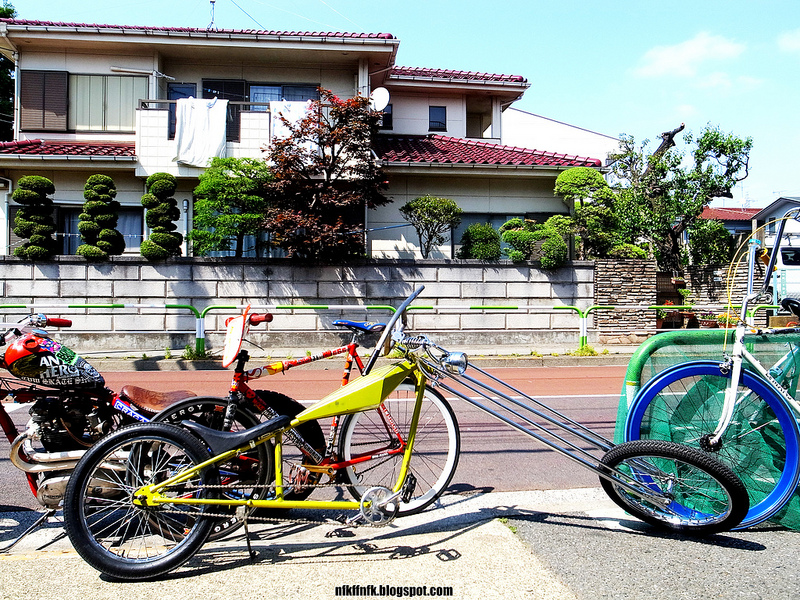
Trail, Rake and Offset

Man schaue zunächst hier:

8748988571_2e224b460f_c

8748989005_0b4063b326_cvia no future Tokyo

und lese dann dies, via Dave Moulton


If you draw an imaginary line through the center of your bicycle’s steering tube (Steering Axis.) it will reach the ground at a point in front of where the wheel actually contacts the ground.

The difference between these two points is known as the trail. Trail assists steering; as you lean the bike to the left or right, the steering axis moves in that direction, and thereby turns the wheel in that direction as it pivots on the point of contact with the road.

Trail also assists the bike in holding a straight line. It works on the same principal as a castor wheel on a grocery cart, which goes in the direction it is pushed. (Or in theory it is supposed to.) This is why it is called “trail,” because the wheel trails along behind the steering axis.

Fork rake or offset is the distance between the steering axis and the wheel center. It doesn’t matter if the fork blade is curved forward in the traditional way, or if the fork blade is straight but angled forward from the crown. If the offset is the same the bike will handle the same.

You will see from the drawing above, if the head angle is made steeper then trail decreases because the steering axis moves closer to the wheel’s point of contact. Conversely, a shallow head angle will lengthen trail.

Less fork rake, increases trail, because the wheel center is moved back away from the steering axis. More fork rake means less trail because the wheel center is moved forward.


Bicycles built in the 1930s through the 1950s typically had as much as 3 ½ inches (9cm.) of fork rake resulting in very little trial, often zero. There was a theory at that time that trail made steering heavy and sluggish.

I remember writing an article for Cycling magazine in the 1970s; someone wrote to me saying my theories on trail were wrong, and sent me an early 1950s article from Cycling to prove it.

The old theory was that if you had the front wheel’s point of contact behind the steering axis, when the steering was turned 90 degrees the point of contact was then on the steering axis line. Therefore, the front end of the bike had dropped slightly, and to straighten up again, the steering had to lift the weight of the bike and rider; thus sluggish handling.


While this statement is true, in practice when riding, the front wheel never turns 90 degrees. In fact during normal cornering the front wheel turns very little, making this whole theory about the front of the bike going up and down irrelevant.

I started racing in the early 1950s and I can say from experience the bikes of that era did not handle and corner near as well as today’s designs. These bikes handled reasonably well because frames were built with much longer wheelbases, wheels and tires were heavier, and tires were fatter.

Road conditions at that time, especially in countries like Italy and France were often appalling. The long fork rake and the long wheelbase had a dampening affect on the rough road conditions.

[Typical European road conditions in the 1940s. Louison Bobet leads Gino Bartali (striped cap) and André Brulé in the 1948 Tour de France. Picture from The Wool Jersey.]

As road conditions improved, bikes were built with shorter wheelbases and at the same time tires became much narrower. It eventually became necessary to increase trail to keep the bike going straight.
There was a somewhat chicken and egg situation with regard to shortening wheelbases and adding trail. In my case I shortened the fork rake to shorten the wheelbase and found the resulting increase in trail was an improvement.

Other older established builders, still clinging to the little or no trail theory, shortened the fork rake but at the same time made the head angle steeper to maintain the trail status quo.

This made for some very squirrelly bikes being built in the 1970s, with 75 and 76 degree head angles and front wheels almost touching the down tube. Shorter chainstays to shorten the rear end of the bike were pretty much universally accepted.

A shorter wheelbase means the bike will turn on a tighter radius. Think of a school bus and a compact car, which one will turn tighter? The front wheel turns less on a short wheelbase bike on any given corner; this translates to having to lean less to get around a bend.

I think the big advantage I had was that I was still actively racing and could try out these changes, and experience the difference first hand. Eventually everyone agreed that trail was not a bad thing and head angles became sensible again.

Frames I built had around 2 ½ inches (6.3cm.) of trail. In the early 1970s I did experiment with more trail but found that the bike felt sluggish and had a tendency to wander when climbing or sprinting out of the saddle.

As with any design aspect, more is not necessarily better; for a road bike with a 73 degree head angle the optimum trail seems to be around 2 to 2 ½ inches (5 to 6.3cm.)

Addendum. Nov 15, 2008.

There seems to be some confusion over the term “Fork rake,” which I can understand. The dictionary definition for rake is “The angle of inclination from the vertical.” However, when referring to bicycles, rake and offset are different terms for the same thing. Both are the term for the distance the wheel center is set from the steering axis, regardless of the head angle.

This probably came about because early framebuilders were artisans, not scholars. To add to the confusion, a bicycle head angle is measured from the horizontal, not the vertical. Back in the day when all bicycles had perfectly level top tubes, it was the angle measured from above the top tube to an imaginary extension of the head tube.


Hinterlasse einen Kommentar

Eingeordnet unter 2013, Ingenieur, Mob

Offen

via Adventure Cycling Association

Und ein guter Einstieg in etwas anderes, und zwar das Thema Lenkerband. Ich glaube es ist sehr schwierig ein Lenkerband vernünftig zu wickeln und auch so, dass es gut aussieht und länger hält. Ich selber kann das einigermaßen, bin aber immer noch weit davon entfernt  richtig gut zu sein. Manche Mechaniker, wie Nagai-San von Positivo Espresso können das richtig gut und ich bin sehr neidisch auf ihre Fähigkeiten.

Hier ist ein guter Artikel auf Englisch aus Cycling Tips zu diesem Thema, hier und dort von mir kommentiert.

BAR TAPE TECH

January 10, 2013

By Matt Wikstrom, CTech Editor

Photography: Mark Stinton

Handlebar tape serves as a critical contact point on the bike, and as such, deserves a little extra attention. In this post, I take a look at the range of tapes available, handlebar plugs, some options for customisation, and offer a few tips for wrapping your bars like a pro.

The handlebars of road bikes have always been wrapped with some kind of tape, however history shows that there aren’t many materials that are ideally suited for this purpose. Cotton was widely used for decades and has the strongest association with classical and/or vintage bikes. There was a short period where plastic ribbon was used to wrap handlebars (my first road bike sported this stuff) then Cinelli introduced its cork ribbon in the late 80s, defining a new era for bar tape. Cork blends and similar synthetics now dominate the market, and for good reason, because they offer enormous comfort and perform well in all conditions, albeit at the expense of durability. More recently, harder wearing synthetics have appeared, the most familiar of which may be Fizik’s Microtex tape (benutze ich sehr oft). Bar tape remains relatively inexpensive, though there is an option that is typically reserved for luxury vehicles, namely leather.

Cotton Tape

Any bike built before the late-80s is best presented with cotton bar tape. Cotton tape is very cheap but it’s not widely available anymore and your best bet may be to go shopping online for it. Newbaums appears to be the only current manufacturer of cotton tape and they offer a superb range of colours (there are 16). Cotton tape comes in a roll with an adhesive backing that is easily applied to a clean set of bars, and by using two or more rolls of different colours,  some stunning patterns can be created. The purists like to give the cotton several coats of shellac to protect the material and prevent it from unwrapping. The same purists will also insist on twine to secure the end of the tape rather than electrical tape.

Cork/Synthetic Tape

Cinelli invented cork tape in the early 80s by blending ethylene vinyl acetate (EVA) with cork to yield a foam with a great feel and then spent another couple of years working out how to colour the tape. By 1987, Cinelli had developed eight colours of “cork” tape and it quickly replaced cotton as the tape of choice (Andy Hampsten immediately fell in love with the new tape because it allowed him to race without gloves). The company now offers arguably the largest range of handlebar tape and its cork ribbon can be had in a variety of colours and patterns. There are plenty of similar products from other companies–most bike brands offer their own tape–but the feel of Cinelli’s cork blend still sets the standard.

A sample of Cinelli’s range of bar tape. The company is always looking for new ways to decorate their tape.

In recent years, some new materials have appeared and one that stands out for me is Fizik’s Microtex tape, which combines some classic styling (perforations and stitching) with a robust material that can be thick (for comfort) or thin (for more handlebar feel) with a variety of textures. Microtex is more durable than the cork blends and it seems to be easier to clean, though white tape is still hard to keep in pristine condition.

Fizik’s Microtex tape comes in a variety of textures for black and white tape (left), a range of new colours (bottom right), but my favourite is its dual tape for comfort (top right), though it appears to have been discontinued for 2013.

Cork/synthetic tape ranges in price from $10-30 and is typically supplied with a small strip of adhesive backing. The tape needs to be stretched carefully when wrapping the bars otherwise it will look untidy and be prone to unravelling. Take care with cork blends, stretch them too much and they will break. Cork tape is too thick for pattern making, however I’ve used Fizik’s thin Microtex tape for dual-colour wrapping with some success. If you’re looking to mix colours, then you might be interested in Lizard Skin’s DSP 2.5 Dual Colour Bar Tape or Fizik’s Dual  Tape, though it appears the latter has been discontinued for 2013.

Leather Tape

At the top end of the bar tape market, you will find leather. Cinelli offers a leather tape, as does Brooks (in 16 colours, no less), Melbourne-based DiPell (the logo for their Competition tape looks familiar), and HandleBra, to name a few. Expect to pay around $100 for leather tape; expect also for it to last for years, with some riders arguing that it improves with age.

Custom Bar Tape

If you’ve been paying attention to CT’s Bikes of the Bunch, then you’ve no doubt spotted the custom bar tape made by Busyman Bicycles (see here for an example, and here’s another). You may have also read CT’s interview with the Busyman himself, Mick Peel, in which case you know the man is devoted to custom leather upholstery for bikes (ie saddles and bar tape). Busyman makes bar tape out of cow and kangaroo leather, though he recommends cow because it provides more cushion and only requires a single join to make a strip long enough to wrap one side of a set of drop bars. He adds bulk and cushioning to the tape with a second strip of leather then uses perforations and stitching patterns to decorate it. Customers are free to choose the colour of the tape, a contrasting backing strip and any combination of perforations and stitching they desire. The final price of the tape reflects the amount of work required but expect to pay $120-170 for two rolls of tape. As with all custom work, there is a lead time, which is approximately 8 weeks.

An example of the custom leather tape hand-made by Busyman Bicycles: a strip of red leather is used to provide bulk and extra cushioning as well as contrast for the perforations.

Finishing the Job

Once the bars are wrapped then there a few choices for finishing off the job. Electrical tape provides the simplest and most effective means of securing the end of the tape to the bars (genau, ich habe Rollen in diversen Farben, das ist billig und funktioniert perfekt, wesentlich besser als das, was normalerweise vom Hersteller an dünnen Streifen mitgeliefert wird) , but don’t use too much or wrap too wide as it will spoil an otherwise neat finish. For those that are keen to express their individuality, HoopSkinz makes custom tape strips to use instead of electrical tape. At the other end of the bars, you can choose to fashion your own plugs from corks or you can order some custom plugs from Purely Custom, which offers 17 anodised colours and personalised engraving.

Aftermarket options: Cinelli offers plastic plus in anodised colours (top left), Brooks makes a cork plug (top right), and Purely Custom offers custom-engraving for its range of alloy plugs (bottom left and middle) and a unique funnel plug (bottom right).

Choosing Handlebar Tape

Bar tape is a consumable that is prone to wear and tear and most of it relatively inexpensive. There’s plenty of options to explore too, and new tape will always rejuvenate a tired-looking bike. It’s worth experiencing the subtle differences in comfort, feel and performance offered by different brands and materials. Colour can have a big impact too (if you’re looking for some advice on colour, then refer to Rule #8). In short, there’s no excuse for leaving tired, dirty tape on your bike. Feel free to experiment with bar tape, it’s a great way to add style, class, and individuality to your bike.

A Few Tips For Wrapping Handlebars

Wrapping bars requires two hands so a bit of preparation makes the job a whole lot easier.

  • Lay out everything you need in a work area that is close to the bike and find a handy spot to keep a pair of scissors (I tend to use my back pocket). – Oh ja.
  • I cut two strips of electrical tape and hang them from the stem before I start wrapping so I don’t have to fumble to finish off the job.- Oh ja.
  • Use more tape to secure the cables exactly where you want them to go.
  • Wrap the tape from the outside to the inside (clockwise for the left side of the bars, anti-clockwise for the right) to stop it from unravelling as your hands pull on the tape while riding. – Äh, mache ich immer genau umgekehrt aus eben genau diesem Grund!
  • Use two small strips of tape to cover the lever bands.
  • Wrap the bars in one long, even spiral, running as close to the levers as possible to prevent gaps from forming. Wrapping a figure-eight around the levers generally adds too much bulk.
  • Make sure you don’t cover up any of the ports required for fitting new inner cables or holding the lever hoods in place.
  • Keep even tension on the tape so that the bars are wrapped firmly.
  • Cut the excess off with a taper that is perpendicular to the bars so that the spiral finishes with a straight edge.

See below for some illustrations on how to get the job done (these instructions at DiPell are worth reading, andthis video by HandleBra is very good too).

Hinterlasse einen Kommentar

Eingeordnet unter 2013, Ingenieur, Mob

Die richtige Sitzhöhe

Ein interessanter Artikel aus Bike Radar über die verschiedenen Methoden die für einen passende Sitzhöhe zu bestimmen.

How to get your seat height right

By Nick Morgan | Tuesday, Dec 25, 2012 9.00am

Setting the correct seat height would seem to be such a fundamental part of cycling that you would have thought the boffins had agreed long ago on the best method. But you’d be wrong.

One thing all the experts agree on however is that if you get the height wrong, the effects can be catastrophic. A study suggests that setting the height too low can decrease time to exhaustion by as much as 12 per cent.

Consequently cyclists with limited time on their hands might actually get more out of a shorter session by lowering their seats to a sub-optimal level so as to make it harder.

It’s an interesting theory, but even knowing how to get it wrong presupposes that you know how to get it right, and many don’t.  Read on to find out exactly how to do it.

1 The Heel method

The heel method: the heel method

This is the one every bike shop owner or gym assistant will tell you whenever you clamber onto the saddle. You place the heel of your shoe on the pedal and set the saddle height so your leg is straight at the bottom of the pedal cycle with the pelvis remaining in a horizontal position.

Despite this commonly heard method, there is virtually no scientific evidence to support it and it often leads to the saddle height being adjusted too low.

Professor Will Pelever of Mississippi University for Women has written several papers comparing methods for finding the best seat height and says, “The main problem is that this method does not take into account individual variations in femur, tibia and foot length.”

2 The 109% method

A more robust method was developed by Hamley & Thomas in a 1967 paper. They experimented with different saddle heights and found that the ideal was achieved when the saddle was positioned at 109% of your inseam length when measuring from the pedal axle to the top of the seat height.

Your inseam measurement is basically the length from your crotch to the floor. To calculate this, face a wall and put a thick-ish book between your legs as if it were a saddle. Ensuring that you are standing straight with your heels on the floor, mark a line along the top of the book edge touching the wall.

The distance from the floor to the height of the mark is your inseam measurement. It’s best to measure it several times and take an average.

This has proved an extremely popular method and is recommended by many top-level coaches. Yet a recent study by Professor Pelever found that it was inferior to the Holmes method (see below) both in terms of power output and economy.

3 The LeMond method

This is a popular variation on the 109% method and pioneered by the three time Tour de France winner Greg LeMond.

Also using inseam length as a guide, this formula calculates 88.3% of your inseam length and uses it to measure the distance from the centre of the bottom bracket to the top of the seat height.

Interestingly, Pelever has shown that this often produces a different seat height from the 109% method and although it seems to work for many people, it may not be ideal for someone with particularly long femur bones.

4. The Holmes method

This was originally developed to reduce over-use injuries in cycling and takes a different approach entirely from the other three.

It uses a device called a goniometer for measuring the angle of the knee joint at the bottom of the pedal stroke. Holmes recommends an angle of between 25 and 35 degrees and closer to 25 for those with a history of patella tendonitis.

This may all sound a bit technical and if so it’s probably best to go with one of the two inseam methods, but you can pick up a goniometer for around £20 from medical suppliers.

Pelever’s research has shown that setting your seat height based on a knee angle of 25 degrees outperforms all other methods (including an angle of 35 degrees). “Using a goniometer and a 25 degree angle is definitely the method I’d recommend,” he says.
Don’t rely on simply feeling comfortable either. “If you’ve been pedalling at a much lower saddle height than is optimal, it may feel awkward in the beginning,” says Pelever.

“However, as your body adapts (usually in two to three weeks) the new position will not only feel comfortable, but will improve performance in the long run.”

Of course, if you still feel uncomfortable after a few weeks then you will need to make changes. It’s best to use the 25 degree knee angle as a starting place. Have someone watch from behind to ensure that your hips do not rock back and forth across the saddle due to over extension at the bottom of the stroke. If that is the case then the angle may need to be adjusted upwards slightly for comfort.

“When I finish fitting someone on their bike, their knee angle is usually somewhere between 25 and 30 degrees, but much closer to 25 on most all occasions,” says Pelever.


Hinterlasse einen Kommentar

Eingeordnet unter 2012, Ingenieur, Mob

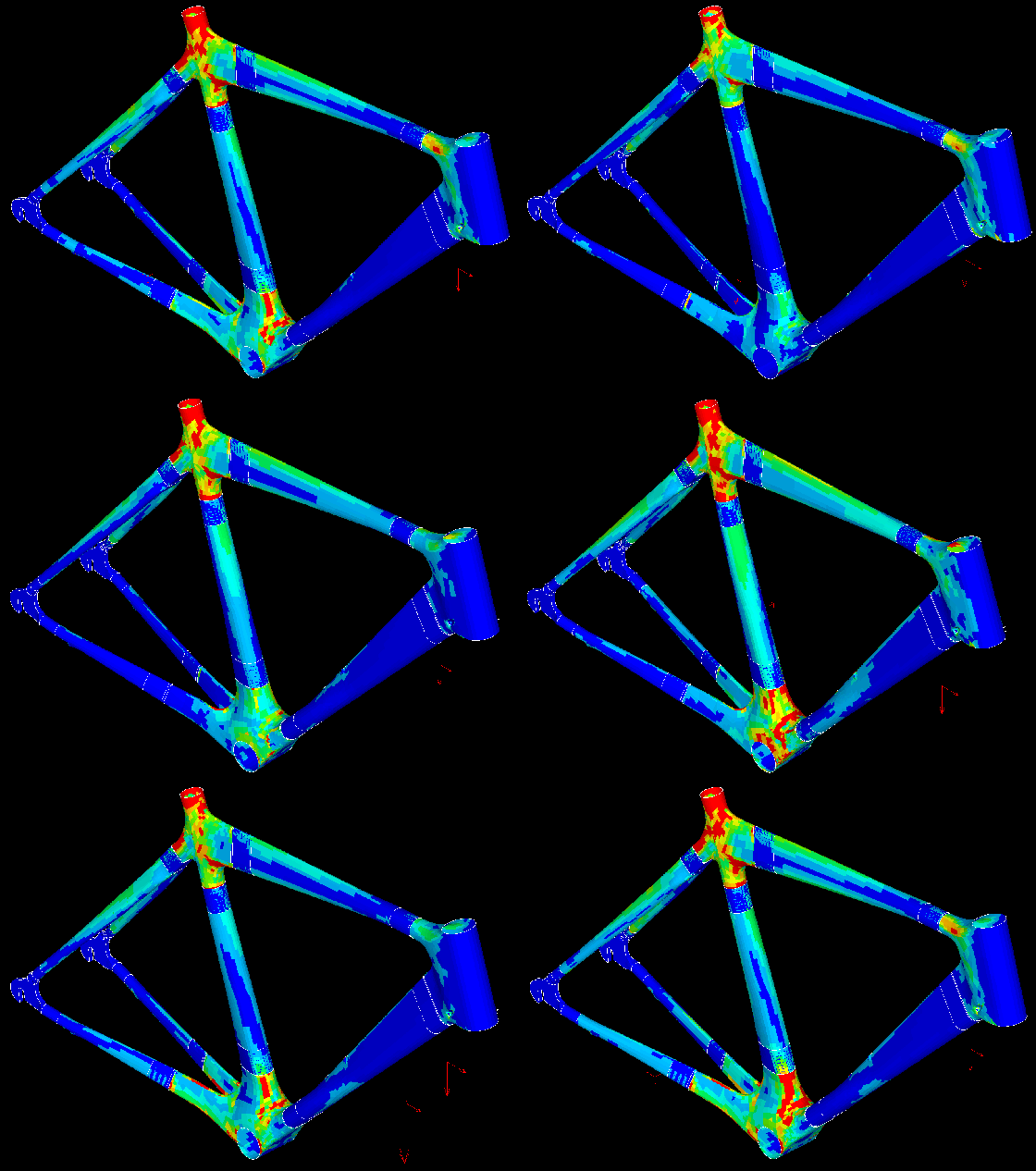
Finite Elemente Methode


GIF, bitte klicken zum ansehen. Zeigt im Prinzip einen Carbonrahmen der um da Tretlager herum gebogen wird in einer Computersimulation. Die Methode heisst „Finite Elemente Methode“. 1989 habe ich damit einmal gearbeitet, damals musste ich meine Daten Abends zum Rechenzentrum karren, dann wurde gerechnet und am nächsten Morgen konnte ich meine Ergebnisse abholen. Heute geht das locker auf PCs. Die Farben zeigen Kräfte oder Spannungen an. Da wo blau zu gelb oder gar rot wird steigen die  Spannungen im Material an, d.h. das sind die Stellen wo das Material am ehesten reissen oder brechen könnte.

Hinterlasse einen Kommentar

Eingeordnet unter 2012, Ingenieur, Mob

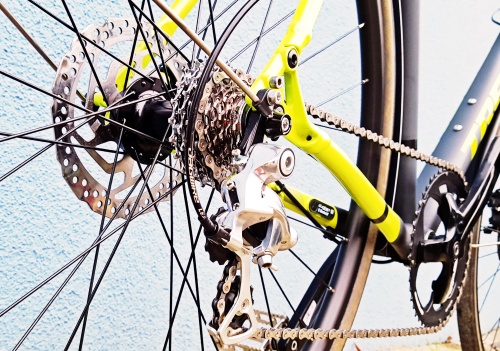
Reibungsverluste

Ein sehr interessanter Artikel von Bike Radar über mögliche Reibungsverluste an Kette und Schaltwerk. Zusammenfassung: Die Systeme sind schon sehr effizient, man kann aber noch ein paar Wättchen hier und dort rausholen. Das meiste Potential scheint es bei der Schmierung der Kette zu geben.

Friction Facts'

Artikel in Englisch auf Bike Radar

Tiso's full-ceramic pulleys are fantastically low in friction, partially owing to the omission of seals and lubricant

Halt etwas für Ingenieure und solche die es gerade werden.

Hinterlasse einen Kommentar

Eingeordnet unter 2012, Ingenieur, Mob