SUPERFAST – SLOW – FAST MEMORIES

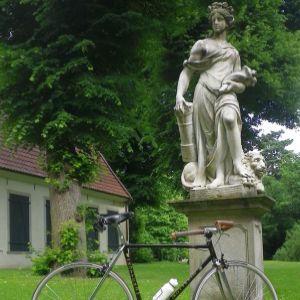
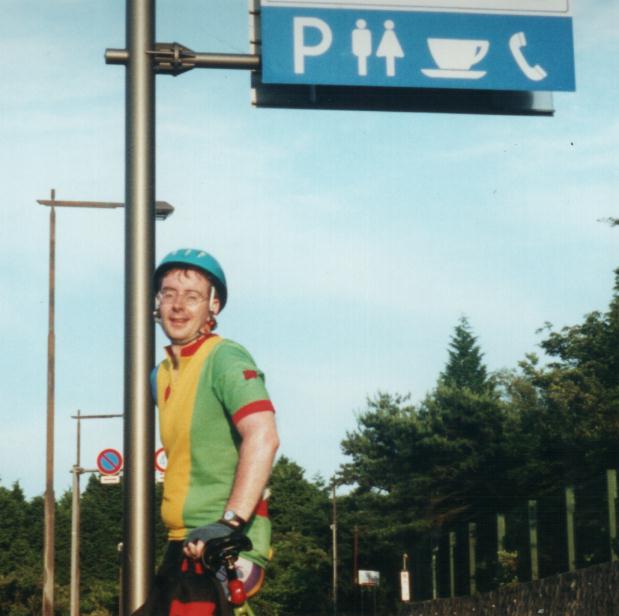
At Hakone pass in 2001 after climbing up the old Takaido. Please note the helmet which now my 8 year old daughter refuses to wear for reasons of general coolness.

[Preliminary note: This is a cycling-performance related post which emphasizes (and exaggerates) one’s own mediocre performances on a ride the day before. Don’t continue to ride if you expect something humorous].

I have to admit that I have problems to get out of the bed in the morning. It has been always like this and reached it’s highpoint during my rather long university career where I refused to go to lectures starting before 1 PM. So where can one do a meaningful ride at 11 AM?

I wanted to ride out to Hakone on Sunday but couldn’t get up in time. I also coulnd’t get up on Monday. Each time I tried to convince Dominic to join me. Then suddenly it was 11 AM on a Tuesday.

That’s when I left the house after spending the morning reading reflection papers from my students. I took the train out to Kamakura where I arrive at 12:10 and assembled my bike under the blue winter sky. I was slightly overdressed as it was a relatively warm day for the season.

SUPERFAST

But it was super day for cycling along the coast in direction Odawara, with a very strong tailwind. I guess I have written that many times already, but I would like to reiterate the point that I love riding along the roads at the sea. As a bicycle rider one tends to forget that Japan is an island. I like MOSBURGER because i am a MOS guy. And MOS is the abbreviation for MOUNTAIN OCEAN SUN. Oh, you didn’t know?

Sometimes I take other riders out to the coast at Miura or Shonan, but everyone finds the traffic three quite terrible. This is true however, the fresh, strong wind, the smell of the ocean and the sight of many familiar places compensate me for that:

I pass around my favorite German restaurant in Kamakura, the legendary SEACASTLE [Please check out the story in Japanese], then I pass my favorite Italian restaurant AMALFI just before passing Enoshima. And everytime I am passing Enoshima, I think that I should finally take a look at the naked Benzaiten, something I plan to do since I first heard about in October 1990. I never do and it is something which could be included easily on my list of new years resolutions just between „climb mount Fuji“ and „try to be nice to wife and children“.

Surfers were still in the water. Surfing is now a full year around activity and I saw many bikes which were refitted so that surfboards can be mounted for transport.

Lots of memories. Actually the first longer bike ride I ever did was in 1990 from Setagaya to Enoshima with my friend Tobias. I didn’t had a bike yet so I rented the „Samurai“ steel frame bike from my friend Juergen with toe clips. which I bought at a shop in front of Yokota USAF base.

Tobias in Enoshima, 1990. Still wondering if his hair had a perm.

We spend hours trying to get out of Tokyo on the road to the coast. We had maps which we showed to some local by passers which seemed to be rather surprised of the concept of maps at all. Somehow we made it to Enoshima where we arrived so late that we had to turn back immediately to reach home before dark.

Of course I forgot to get my foot out of the toe clip at a traffic light and toppled over towards Tobias who than fell as well. Domino-theory, I guess. Did I ever apologized? Someday I will.

Anyway, that was the start of a more or less serious cycling career and after that ride I bought a proper Panasonic steel frame bike in Meguro which I kept riding until 2000, when it was stolen.

So I was thinking about this and that when riding along the coast in the 36 – 40 km/hr bracket. The traffic was bad but there were almost no traffic lights and there was enough space on the left side to pass. Then I saw another rider going relatively fast in front of me. Good bike (TIME), old clothes, so this could be a rather competitive one, I thought. And indeed he was. When I overtook him he immediately got into my draft and continued to follow me for the next kilometers. So what to do, in the spirit of Deej’s recent TCC post?

I turned out that he couldn’t keep up with me anyway. One reason seemed to be rather large ears which were mounted perpendicular to the head and significantly increased the Cd-value (also speedplay pedals wouldn’t help here I guess). Another reason also might be that he also stopped at traffic lights quite often.

Then I passed another rider on a GIANT bike with an Oakley backbag [not competitive looking acc. to Deej’s classification] and he also stayed in my draft. And he wasn’t bad at all, overtook me from time to time and all this despite the fact that he was new to cycling evidenced by (a) listening to a music while riding on a public road and (b) giving hand-signals all the time.

Yes, hand-signals, a difficult topic. I try not to overdo it and restrict them to the most basic ones. But this guy needed at least four hands to give signals and keep one hand on the handle. He tried to signal something which, if I understood correctly meant:

„I am going to stop at the next light and make turn for the left to Odawara station, by the way, thanks for the nice ride“

Or, perhaps he wanted to signal instead:

„I have an itching eczema on my butt which I treated at the local doctor and the bill I got is that long.“

In the end I enjoyed 72 minutes of fast riding at an average of more than 32 km/hr without any stops and only a few slow downs. This was probably the longest, fastest stretch I did in a long time.

SLOW

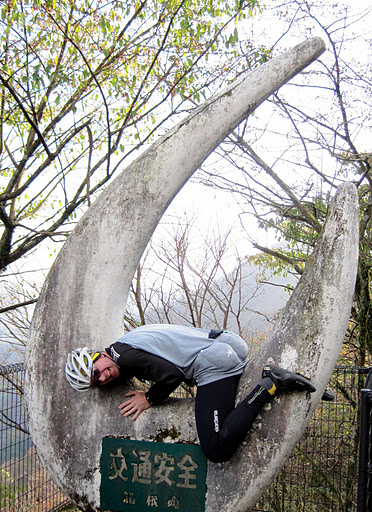
Followed by a very boring piece of road between Odawara and Hakone. The only interesting thing to note about this road is, that one can see on the right side another „Pinchers of Hell“ monument to traffic safety which I could pass unharmed.

Instead of continuing the Ekiden road 1 up to Ashinoko and Moto-Hakone, I took a left turn at Sanmaibashi (? 三枚橋) to road Ken 732 which seemed to be the old Takaido leading up to Hakone and took a rest at the (approved) 7-Eleven at Hatajuku (畑宿). I knew this road as I have tried to ride up to Hakone in 2001, one of the first rides on my new Cannondale bike. I never tried again after that.

I have a lot of respect for that climb. Hwen I was doing it in 2001 I took many breaks, walked a large stress on foot and was completely done when I reached the top.

Nevertheless I decided to define a new Toge-baka (#18) and went slowly for it. After about 100 meters of climbing up I noted the house where I had asked an old lady in 2001 if it would still be far up to Ashinoko. She said very politely that it wouldn’t be that far anymore, went into the house and gave me two bottles of green tea. I needed them because it was still 600 meters up.

This is a much nicer climb that road #1. There is much less traffic and the houses and resorts along the way are slightly more upscale. There are also some interesting shrines and temples of new religions with a battalion of guard men. The only disturbing thing is, that you sometimes get a good view on the new toll road almost running parallel at some points. Compared to road 1, the distance is shorter (10.6 to 13.2 km), covers less elevation (700m to 745m) but as in the end you arrive at the same point, some of the slopes are brutally steep.
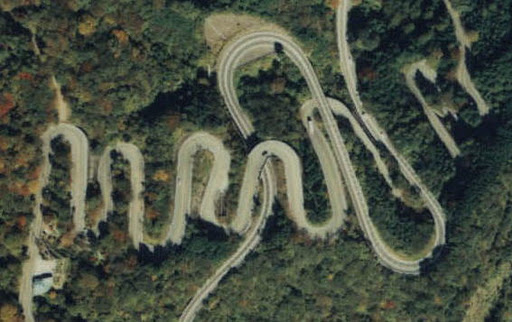
For example there is the 七曲 hair needle section which is a nice challenge.
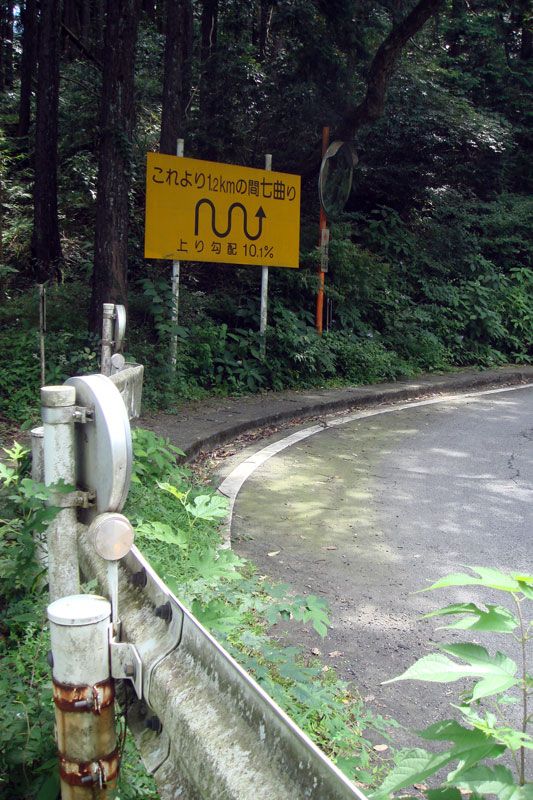
So after less than 53 minutes I arrived at the top and dutifully recorded my time on the blog. By the way, the top is even higher than the mighty Van Hai pass.

FAST

There was only a short stretch to Ashinoko where I took a rest at the (approved) 7-Eleven. It was very warm there as evidenced by the photo below.Then up to Hakone pass (which is not the highest point) and further on to my beloved route 20. The weather was beautiful and the road offers beautiful views to the pacific on the Eastern side (Odawara) as well as to mount Fuji and the pacific on the Western side as it is running on top of the ridge. And I just love the gentle incline and the many curves which leads on a fast and demanding ride to Atami Toge.

From there onwards it is brutally steep and fast down to the city of Atami. I had a shouting match with a minibus driver that overtook me in one of the curves and it got really close. The maneuver was completely senseless as he had to stop anyway in front of a right light some meters further.

The usual argumentation enfolded: I told him, that he was almost killing me and that he drives recklessly. I was told that if it was that dangerous I should stay away from the road. After all this a 車道 (car road). Well, it is not for the sole usage of cars, technically speaking: „自転車は車道が原則、歩道は例外“ (Bicycles shall ride on the road in principle and only in exceptional cases on the walkway) is stated in the pamphlets distributed by the local police station after revision of the basic traffic law in June last year.

I hate to be rude to people but I also dislike to be killed. Reckless drivers shall be shouted at in exceptional cases and only in regular cases not.

After that and within now time I was a Atami station where I took the Shinkansen back home. About 80 km, 1.100 meters of climbing and only 3:30 hrs of riding time. All together 6 hours away from home. An excellent alternative to not do a ride I guess.

Which brings me to the point that it doesn’t always have to be the long, demanding ride. I do a lot of one hour rides along the Tsurumigawa and I have found another road along the river that brings me within one hour to Onekan. This is good for a tow hour ride. I can combine this with Onekan and extend this into a three hour ride. I also commute to the university in Tokyo. In November I rode 19 out of 30 days, only four rides where longer than 100 km. Nevertheless I made more than 1.100 km during the month.

A late start is not an excuse for doing nothing.

Hinterlasse einen Kommentar

Eingeordnet unter 2009, Mob

F2P at Tokyo Cycle Show


Kenichi will be representing F2P (PE’s official outfit supplier) at Cycle Mode 2009 (Makuhari – Dec. 11~13). For those going, look for Booth 2-73.

Hinterlasse einen Kommentar

Eingeordnet unter Uncategorized

Good manners count…

The Nikkei Weekly – November 30, 2009

Speeding cyclists pose threat

Health, green issues get people on bikes; poor habits result in pedestrian collisions

An increase in accidents involving pedestrians is forcing the city to place limitations on a popular cycling course in Tokyo. Some of the plans under consideration include building a platform that separates the pedestrians from the cyclists and enforcing speed limits.

Some municipalities have changed street names to emphasize the pedestrians‘ right of way. A strong awareness of health and the environment is turning more and more people into cyclists, but these cyclists need to find a safe way to coexist with pedestrians.

„Watch out for pedestrians“ and „Reduce speed“ are among signs that dot Fuchu Tamagawa Kaze no Michi, a 9.4km road alongside the Tama River in western Tokyo.

Cars and motorcycles are not allowed, but the road has been the site of collisions involving pedestrians for about 10 years. According to Tokyo Metropolitan Police Department’s Fuchu Police Station 2007 and 2008 saw 23 accidents – two serious ones in 2008- involving pedestrians. The main cause was the excess speed of cyclists, who were unable to get out of the way in time and collided with pedestrians.

Fuchu spent about 12 million yen ($134,830) through last year building speed bumps into roads with frequent accidents. This fiscal year, the city plans to install signs along the route that appear like the road is narrowing to encourage slower speeds. A 53-year-old man who commutes by bicycle said, „The only way to tackle this is for cyclists to reduce their speeds.“

Machida city recently renamed the 14.5km stretch used by both cyclists and pedestrian known as the Sakaigawa cycling road. Complaints from pedestrians about cyclists – from rudeness to accidents – have increased in recent years. The city said the name erroneously led cyclists to believe the road was for them only. The name, Sakaigawa Yukkuri Road, reflects the fact that pedestrians have the right of way, city officials said.

Bicycle accidents involving pedestrians are on the rise even in the city. According to the National Police Agency, there were 2,942 bicycle accidents in 2008, a 4.5-fold increase from a decade earlier. Part of the increase stems from the fact that a growing number of cyclists are riding faster, sports-type models.

According to a nationwide survey of 100 bicycle shops conducted by the Tokyo-based Japan Bicycle Promotion Institute, sports-bicycle sales per store jumped 45% in fiscal 2008. In the last three years, sales of other types of bicycles have stagnated, while sports-type bicycles are rising 30-45% compared with previous years.

Many people are buying sports-type bicycles for the first time to combat the onset of metabolic syndrome and save on gas costs, observers said. Most of the sports-type bicycles are racing bikes, which can easily hit speeds of 30-40kph. If the pedestrian walking ahead makes a sudden turn, cyclists have a hard time avoiding a collision. The bikes are quiet and pedestrians may have trouble noticing them.

Arakawa emergency riverside road, also known as Arakawa cycling road, has adopted speed limits. The Ministry of Land, Infrastructure, Transport and Tourism, which manages the road, has called for a speed limit below 20kph – the speed at which a cyclist can easily stop. Signs warning speeders have been placed at 91 locations on the road.

Good manners count

Residents of local municipalities are pushing for separate roads for pedestrians and cyclists, but officials say roads do not have enough shoulder space nor can they be widened to create separate paths for both. The reality is urbanites on foot will just have to count on the good manners of cyclists for peaceful coexistence.

Masahiro Mashimo, former racer and leader of a hobby cycling team, acknowledged that it would be ideal if pedestrians could be separated from cyclists, but said in tight spaces, „speeding is a bad idea.“

5 Kommentare

Eingeordnet unter Uncategorized

Further Update – Shoulder injury — and random thoughts on cycle commuting and Japanese health care

Further Update: Checked in to Tokyo Medical Center on Tuesday afternoon.  On Wednesday, they were able to reset the shoulder with me under general anesthesia … without making an incision or cutting up my muscles/tendons.  I’m out of the hospital this morning, with my upper arm heavily taped to my side/back for the next 3+ weeks so it does not „pop out“ again.  Seems like everything went smoothly, and the usual pleasant surprise with a bill that is probably 10-20% what it would have been in the U.S. and leaves one scratching one’s head as to how they can possibly pay salaries of the docs and staff.

_________________________________

Update:  The shoulder movement was not returning as quickly as it should have — I cannot turn my arm outward or lift it up. I had my 2nd follow up visit yesterday to the doctor and still nothing showed on another x-ray — so he had me CT scanned. The CT scan shows very clearly (1) a portion or the back side of the „ball“ joint of my arm into my shoulder socket was crushed in the impact against the shoulder socket — nothing that won’t heal with time and still plenty of bone left all around it, but also (2) the arm is dislocated … not all the way out of the shoulder socket, but about 1.5-2 cm shifted back from where it should be, and the jagged edge of the damaged part of the „ball“ joint is riding/catching on the edge of the socket, which is why I have very limited movement, and also which prevented it from „relocating“ to the right place on its own.

I’m going in Tuesday afternoon, for surgery, general anesthesia, Wednesday morning. They will try to „relocate“ the shoulder and if that works, they won’t need to make an incision.
If it does not, or looks like it risks further damage … then they will do surgery to achieve the same result. Seems like the doctor wants to do this ASAP, says the longer I wait the harder the relocation will be/more damage to the non-bone parts. So I’ll just get it done … at least it is a major medical center with a good reputation from what I know (Tokyo Medical Center – Komazawa) … rather than hunting for the best shoulder doc in Japan or hopping on a plane to get someone in the U.S. to deal with it (as some of my colleagues have said I am crazy not to do, given their perception about the difference between the higher end of orthopaedic surgeons in the U.S. and Japan, as well as their desire for an English fluent doctor). We shall see.

P.S. Maybe next time (if there is a next time) this doc will believe the patient when he says it hurts so much there must be a break or dislocation — turns out there was both!

___________________________________________________________________

Original Post:

Komazawa Dori was a solid line of standing traffic on Thursday morning last week around 9AM. After passing Komazawa Park, at the Jiyuu Dori intersection, I could see not only the line of cars but also taxis blocking the shoulder that usually serves as an informal bike lane, so I went onto the sidewalk at the far side of the intersection, in front of the National Medical Center, slowing my pace.

The sidewalk is at an angle, tapering as it moves away from the corner, and a signpost of some kind blocked my view straight up the path. As I rounded the sign post, I came face to face with a college student (Y.O.) on a mamachari, going at full speed as he rounded it from the other side, starting to get a proper line to cross the intersection (late to class?). I swerved to try to avoid him, but we brushed left shoulder to left shoulder. At my very slow pace, and with my motion already to the right, that brush was enough to drive me off the bike and shoulder first into the pavement. … If I had hit Y.O. head on, I probably would have done some serious damage to him, helmetless and probably 1/2 my weight, but as it was, he stayed upright and came back to see if I was alright.

I was not — I lay on my back, a stinging pain in the shoulder immediately following impact. I could not move my arm. Anyway, Y.O. helped me over to the conveniently located National Medical Center, and spent the next 2 hours with me as I went through check-in, then by wheel chair to the orthopedics department, then down to x-ray/radiology, then back up to the orthopedics department, then to the sign out line, then the cashier. The bill was 6240 yen (US$70) without insurance. Then we walked across the street to one of several conveniently located pharmacies to get two types of pain killer and another medication to take to counteract stomach problems from one of the painkillers (another 3000 yen — under US$35).

Fortunately, the orthopedist gave priority to a large foreigner writhing in pain and I did not need to wait long. I was skeptical when told there was no sign on the x-ray of a broken bone or dislocation, even though I could see the xray myself … but was assured that, yes, it really could hurt THAT MUCH!!!!, even without either a break or dislocation. … I’ve since heard colleagues mention scary phrases like „rotator cuff“ (an injury one received upon being slammed shoulder first into the boards while playing hockey … with a four month recovery period including rehab?). Maybe I will get my first MRI after I stop back at the orthopedist on Wednesday for follow up? Doesn’t everyone get an MRI at some point in Japan (where the government-mandated cost is something like 10-15% the equivalent in the U.S.A.)?

The pain has gradually subsided over the intervening 4 days … but it is only today that I can type at all with my right hand reaching the keyboard, and only with my arm very carefully positioned and without much stamina. And I’m still on painkillers and wearing a sling for the rest of the week–I hope no longer than that.

1. I may have a warped perspective, but I think Y.O. bears at least 75% of the blame for this accident, because he was going way too fast for an obstructed view part of a sidewalk, and did not seem to take evasive action. That said, my bike was not harmed, my insurance will cover any of the (modest, in Japan) medical costs, and I really did not see the point of calling the police or filing a report for an accident that occurred on the sidewalk, as opposed to going straight into the hospital for treatment.

2. I blame myself for deciding to ride on the sidewalk. I thought this stretch of fairly broad sidewalk, with very limited access from either side and relatively low traffic after passing the hospital entrance, would be safe, but sidewalks are a much more dangerous location than streets, in my view, since you are much more likely to have a Y.O. appear immediately in front of you, or to have a high school kid with gym bag come running out of a stairwell just as you pass. The only way to ride safely is to preserve an ability to defend oneself, and that is harder on the sidewalks.

3. Even when I stay in the street, however, I often recently come face to face with cyclists riding the wrong way on the shoulder, forcing me into traffic to avoid them. I always try to scream „hantai houkou“ (wrong way) as I pass … but I’m fighting a losing battle against the umbrella-bearing, mobile-phone-screen-viewing, wrong-way traveling cyclists of this town. There are more and more cyclist commuters in Tokyo with each year, most of them quite responsible, to the point of being ridiculous — waiting at red lights at minor intersections even when there is no cross traffic nor a policeman in sight! In general more cyclists are a good thing because cars are more likely to expect and anticipate you — but it is not so great when there are no bike lanes or other real accommodations. And I see more and more cyclists zooming right in front of pedestrians who are trying to walk across the street, terrifying them like something out of a Lucas Brunelle video of messengers racing across Manhattan, flitting through lines of traffic and pedestrians like schooling fish (There were 3 of these Brunelle videos among the short films I saw at Bicycle Film Festival, even crazier, much crazier than this one on Youtube — music by ÜBERDOSE! — from a few years back). UPDATE: You can see more Lucas Brunelle videos and material at his official site, including similar Stockholm and London rides … but not yet the new NY rides I saw at Bicycle Film Festival.

4. I also am painfully reminded that the traffic, and risks, are much worse if I ride in at 9AM than if I leave home at 7:30AM. Now if I could just teach the clients to keep early hours, I would be fine.

5. The National Medical Center is impressive in at least one way. I have never seen so many elderly Japanese in a single place — the equivalent of at least 10 or 15 country villages all sitting in the waiting areas around this hospital complex. Average patient age must be creeping over 80. Is this what the restaurants and trains of Tokyo will look like in 30 years? If it is, I don’t think I want to be here to see it (at age 77).

6. What a great business the pharmacies across from the medical center have — the one I visited, Terada, had an endless stream of customers, keeping 8-10 pharmacists busy at all times filling prescriptions. The shelves and bins were overflowing with more prescriptions, just waiting to be picked up.

I’ll provide an update when I have a better idea of whether this is a 2-week, or a 4-month recovery and rehab path, and when I know what my injury is called — something more technical than „tenderized/smashed up soft bits inside shoulder area“).

13 Kommentare

Eingeordnet unter Uncategorized

ALERT — Transalp Sign up – Tuesday Dec 1, Noon CET (8PM Japan time)

Family schedule next summer does not permit me to sign up for the Transalp for 2010, but I hope to try it again in 2011. In the (unlikely?) event that anyone is going to go for it in 2010, online sign up is tomorrow, Tuesday, at 8PM Japan time (Noon CET). Here is the Transalp website in English, and in German (Ludwig? MOB? Tom?) … in case there are any takers. Of course, you need a 2-person team!

I recommend gathering all the necessary information in advance so you can sign up within a few minutes of the site opening to assure a spot — worked for Jerome and me this year). They have posted „screenshots“ of the application form on the site, so you can see what is required. … once you get a space confirmed, they give you several weeks or more to wire the payment — which, I must say, was a real bargain given the support and organization involved for a weeklong race in 3 or 4 countries.

2 Kommentare

Eingeordnet unter Uncategorized

40

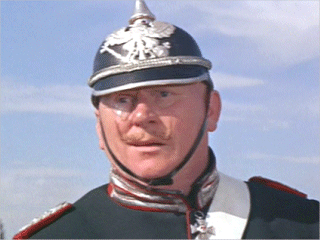
Congratulation to our (undisciplined) team member Manfred von Holstein
(below right, with his friend captain Rumpelstoss and two Narushima riders)
on the occassion of his 40. birthday today.
There is nothing a German officer cannot do.“

Hinterlasse einen Kommentar

Eingeordnet unter 2009

OFFICIAL PE-TCC HAKONE EKIDEN RIDE

We are planing to have our traditional (since 2008) first training ride of the year on January 2nd 2010 together with Tokyo Cycling Club. A gruesome ride from Tokyo (Kawasaki? Yokohama?) along the coast to Odawara and finally up the hill to Moto-Hakone. All the way followed by a bunch of incredible fast (and incredible young) university students ….. running.
Who will make it up to Ashinoko before they overtake you?

The reward for those who make it: The mother of all downhill rides: Route 20 from Hakone Pass over Jukoku pass and Atami pass down to Atami. And the mother of all quick returns.
January 2nd 2010. Mark the day.
[please also mark January 2nd 2011, 2012 and 2013 in case you bought calendars already]

Ein Kommentar

Eingeordnet unter 2010, Mob

Temples and Shrines

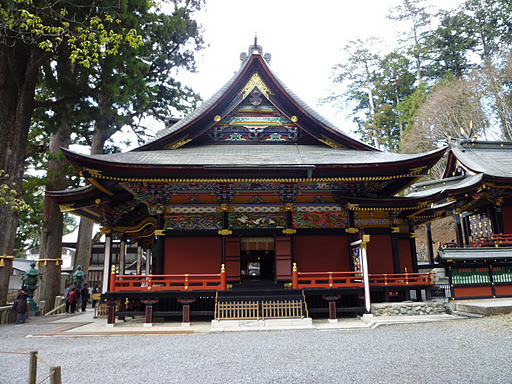
This being the last ride in my 30s, I made yesterday a pilgrimage to some (semi-)important temples and shrines around Chichibu. Chichibu is full of them, so I had to be selective.
My first stop was at Shiofunekannon-ji, just outside Ome.

At 8am it was still so early no visitors were in sight.

I then cycled into the most southerly mountains of Chichibu, up an increasingly steep road (the steepest part must be at least 20 degrees) to Nenogongentenryu-ji – a first for me, but a temple which Tom visits quite frequently.
I was greeted by two devils guarding the entrance, and there were already a few hikers who had made it up the mountain (elevation 600m).
After a rapid descent to route 299, I cycled it up to and then through the 2km long tunnel – not a lot of fun with so much traffic, and in particular with so many dump and other trucks taking this route. It always amazes me how much dump truck traffic there is on route 299 between Hanno and Chichibu-shi. But then seeing that Chichibu basically sacrificed its house mountain and turned it into a huge quarry, it is not surprising what all these trucks must be doing. This place may well have the highest density of dump truck drivers in Japan!
Down in Chichibu city it was time to visit a shrine, the Chichibu-jinja.
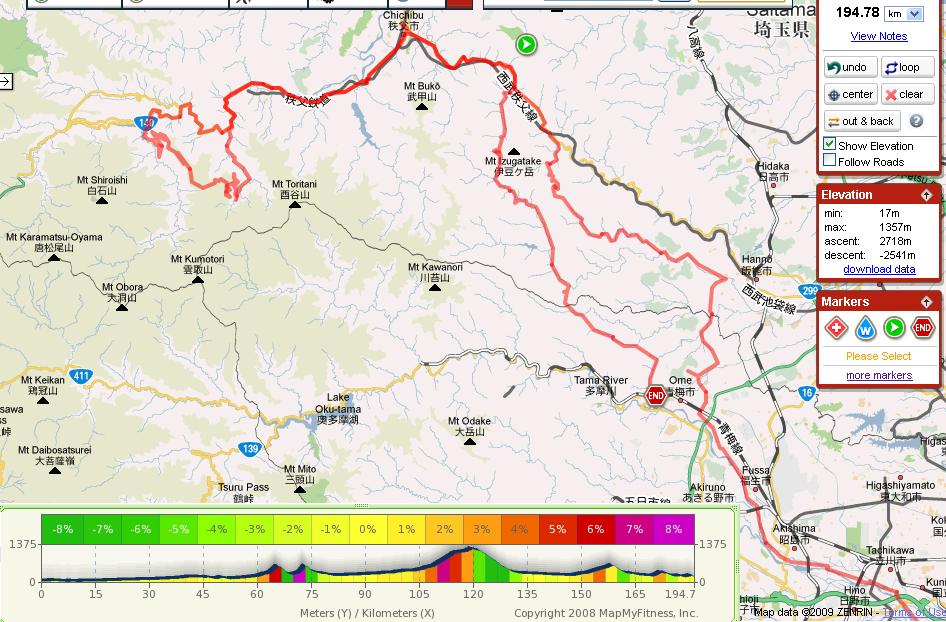
Soon I was heading towards the last and arguably most important stop of my pilgrimage: Mitsumine-jinja. Somehow I felt well in shape and it took me only 1.5 hours to ride the 40km in distance and 900m in altitude from Chichibu to Mitsumine. At 1,100m the air was crisp and the many visitors were complaining how cold it was: something like 5 degrees. The sun had disappeared behind increasingly dense and dark clouds that were accumulating in the mountains around – the Chichibu plain itself was still in bright sunshine, clearly visible from up there.
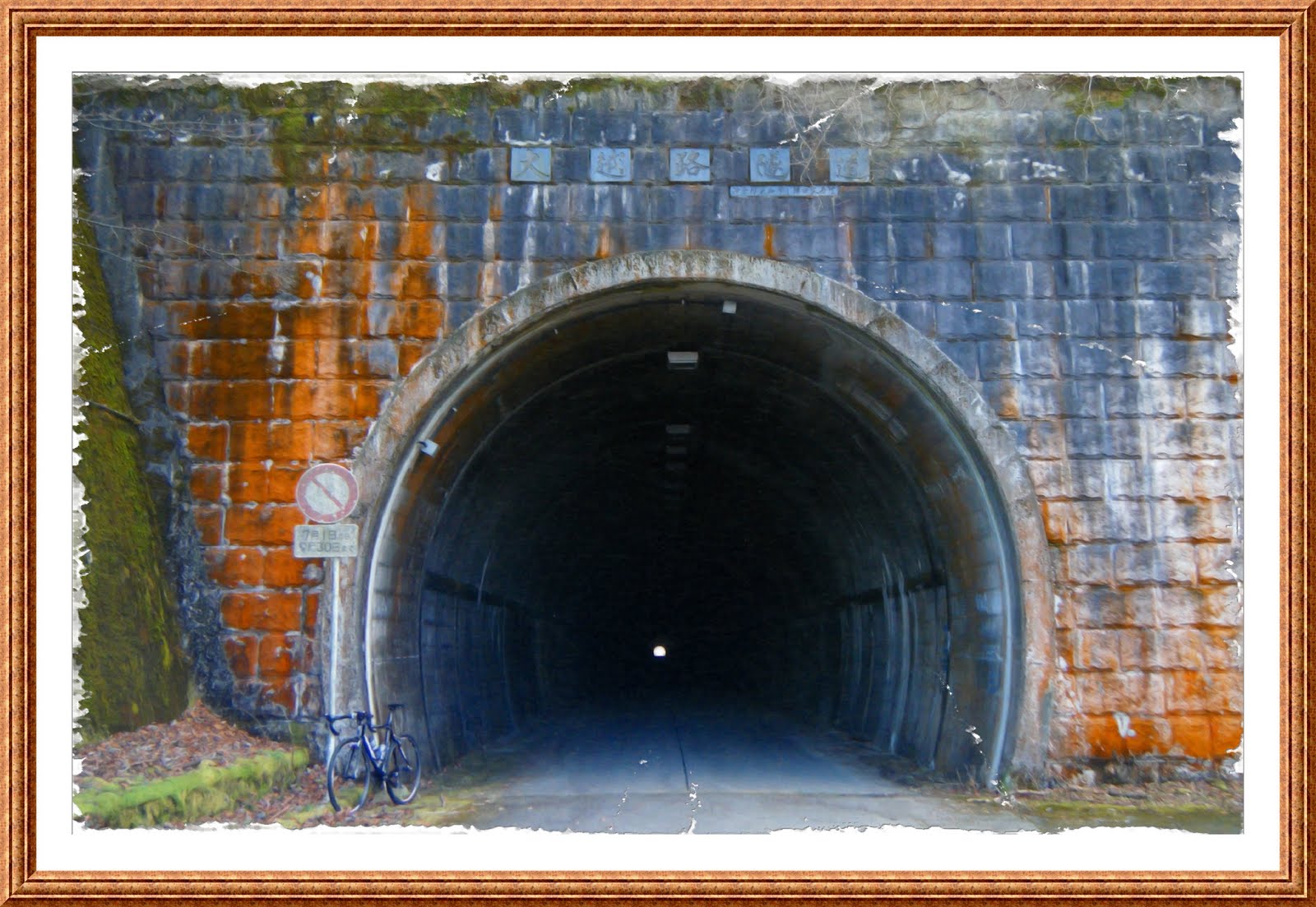
I then rode on to try out a new rindo which according to Google should take me back onto the main road towards Chichibu-shi – or so MOB and I had discovered while studying the area online the night before. Indeed, not only did the rindo exist, it was open to all traffic, had surprisingly few warning signs, and turned out to be well paved and almost completely free of debries or leaves. After climbing to 1,200m, I reached a long and dark tunnel – one of those that threaten to unleash evil spirits on my fellow riders MOB and Tom, but usually leave me alone. After a bit of down and up there was another tunnel with another ascent, and then it was a very long and very smooth sailing down to the main road. Next time, I will definitely cycle up that side and take the main road down from Mitsumine. It makes for a nice loop.
Back at the outskirts of Chichibu-shi I was tempted to return to Ome via Arima-toge, but abondoned the thought as the long crossing (including the unpredictable building site Tom, David and Nishibe-san discovered the other day) would have meant I would have reached Ome only in complete darkness. Instead I took 299 up to just before the tunnel (and while it was full of traffic, thankfully all the dumb tracks were on their way back to Chichibu rather than heading up with me) and then headed up Yamabushi Toge. On my descent I caught up with two cars and one motorcycle which were preventing me from getting one minute faster to Ome, so much to their surprise I passed the mercilessly in corners and steep long sections.
I reached Ome station at 16:35, not long before complete darkness. 210km on the road, with something like 2,200m of climbing. And most importantly plenty of omairi to get me into a new decade.

2 Kommentare

Eingeordnet unter 2009

For those of you who want to get out in the mountains tomorrow

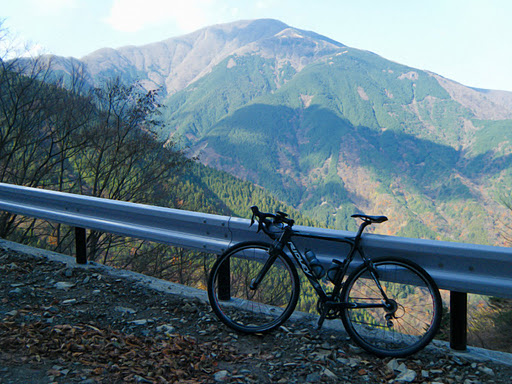
and are not afraid of a little adventure…here’s the alternative to the well-trodden routes of Okutama & Chichibu…

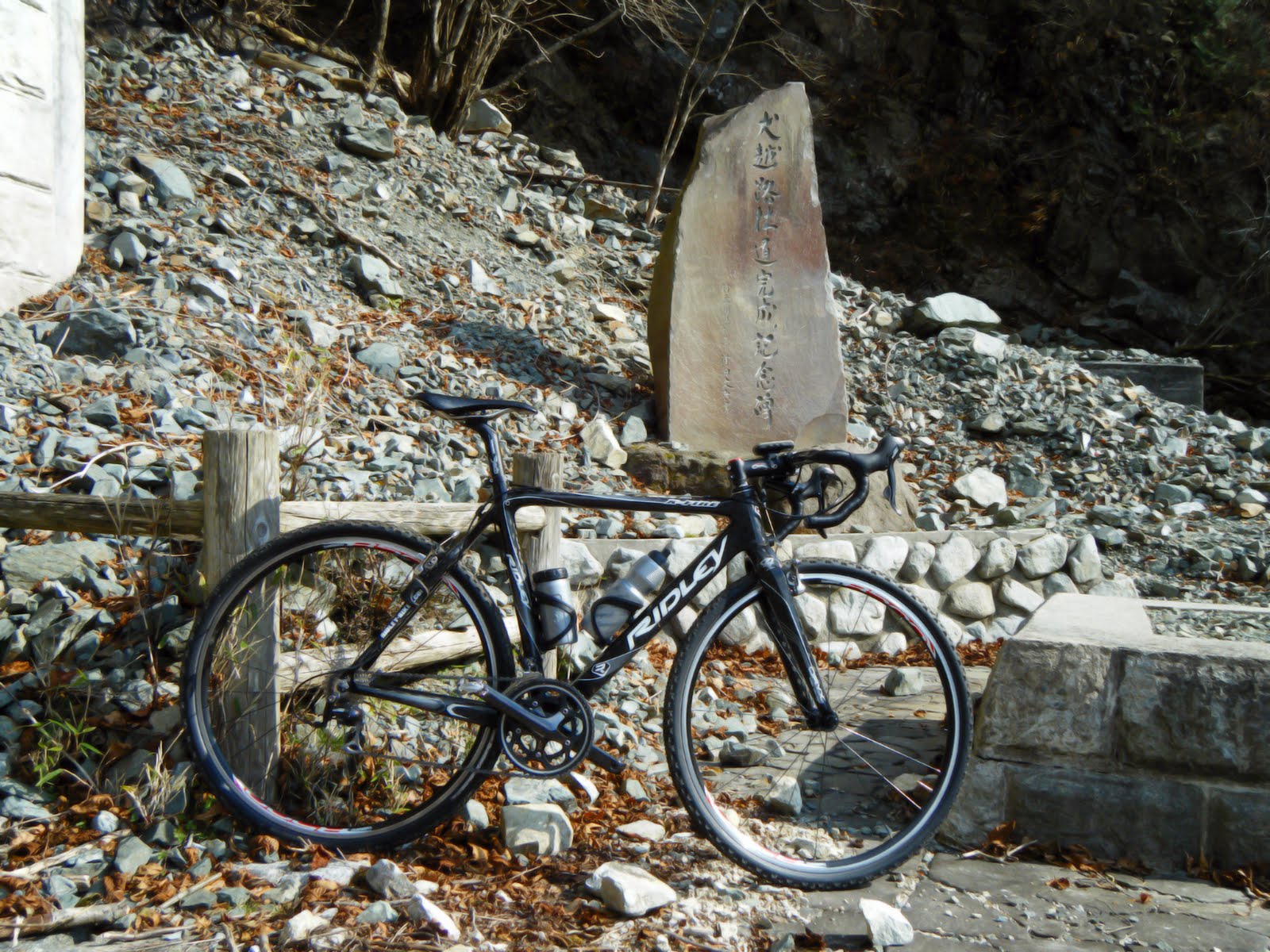
INUKOEJI PASS!

RdV: 7:00 a.m. at ONEKAN / 18 intersection

Course: Lake Tsukui → Doshimichi → Inukoeji Pass → Lake Tanzawa → not decided yet (possibly return via Odawara ~ Enoshima coastline and then upward)

Tomorrow’s ride includes „dreadful“ Road 76 with long, tire-bu(r)sting unpaved gravel stretches not suited to road bikes. The Inukoeji Tunnel on top (1,060m) is pitch dark. Climbing tempo expected to be brisk. Anyone (still) wishing to join (in spite of my attempt at threatening/discouraging), should bring lights and put on sturdy tires/wheels….

IT WAS FANTASTIC OUT THERE TODAY !!
Perhaps some other time?

Hinterlasse einen Kommentar

Eingeordnet unter Tom

Pinchers from Hell

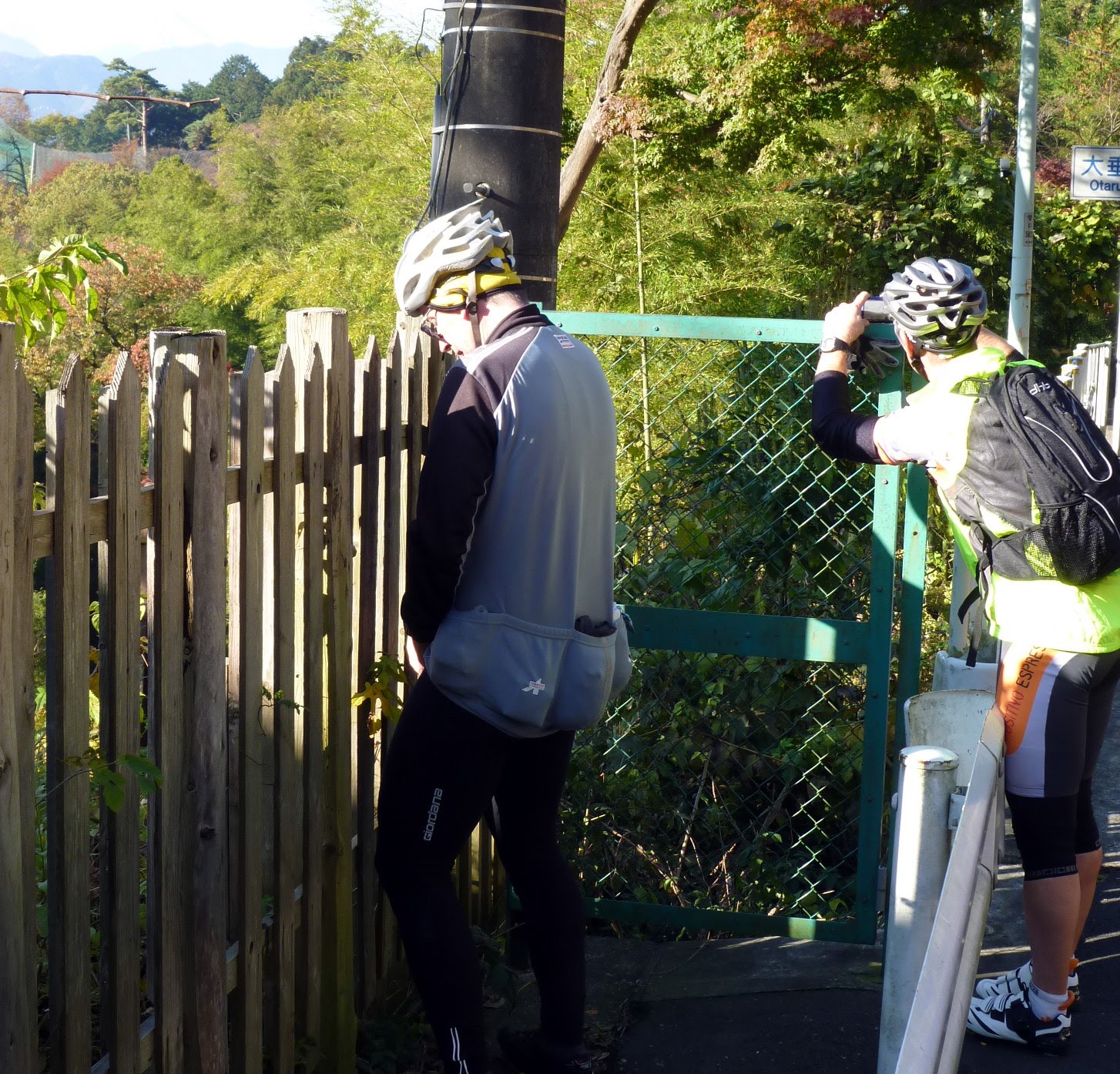
The last weekend ride has been already covered very well on the blog, however I would like to add some photos and comments in addition nevertheless.First stop on top of Otarumi Toge. Tom making photos of the landscape, Ludwig of me. Thierry probably resting on his bike in the back and David and Jerome still to come.Ludwig in shiny neon claded, still alive at the shores of Yamanaka lake with stars in his eyes and basking in the glory of double championships.
I practiced the characteristic „David Millar movements“ with my bike at Yamanaka Lake in front of mount Fuji. In case I ever want to get rid of my bike, I will make sure to do it at this spot.Ludwig pulled underground by the pinchers of hell, disguised as monument to traffic safety. Tom is trying everything in his power to hold him back, but the weight of his sins (too many red lights crossed) is too heavy. Last time we saw him. If you meet somebody resembling Ludwig now, it will probably be Manfred.Then it got me. Could barely escape at the last moment to come home and tell my children about the terrible experience we made. As in case for the invisible octopuses living in the vault of the Sasago tunnel, they remained largely unimpressed by my stories of blood and gore.Oden heaven at the PE-approved Seven Eleven in MotoHakone. Oden to the people.

PLEASE DO IT AT HOME

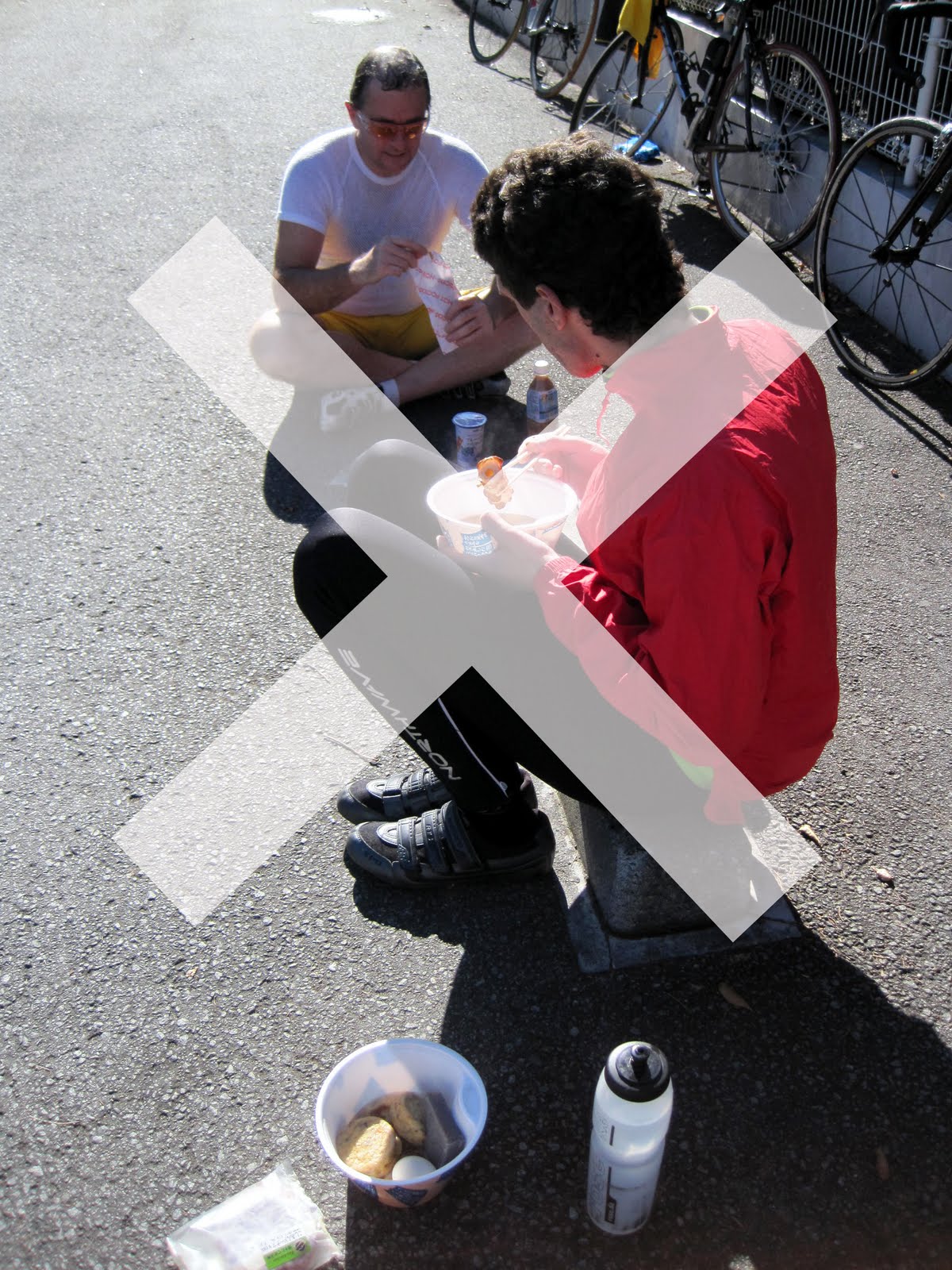
Here we can see improper eating behavior of two foreigners in front of a (PE approved) Seven Eleven in a semi-urban environment.And here we see proper behavior in comparison. Please note that Manfred is eating again a bowl of Oden which is neither proper nor improper. Both foreigners have moved away from the (PE approved) Seven Eleven in a less than semi-urban environment. The elevation of the eating place is significantly higher than the mighty Van Hai Pass (but irrelevant).

Hinterlasse einen Kommentar

Eingeordnet unter 2009, Jerome, Mob, Tom