Archiv des Autors: bikesnob28hb
Saiko
Bremen on Clenbuterol
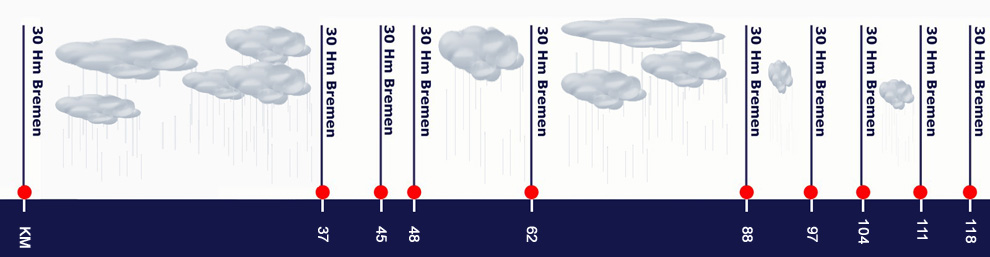
„Summer of the old hags“ or in German „Altweibersommer“, that’s how we call a period of relative good weather at the end of summer or the start of autumn. Last Sunday surprised with temperatures up to 24 degree and blue skies. So I left my family in the chaos of our apartment, created by the arrival of a forty feet container from Japan with all our goodies and left to explore one more time the Bremen countryside.
Of course the ride was worth all trouble and hardship, especially when arriving back home again after the ride without proper announcement of the intended duration it took. But I felt mightily inspired by the feats of mighty Thor and with an equally mighty tailwind I made excellent progress in Northern direction along the river Wümme, the Bremian equivalent to the Tamagawa. As I didn’t need to concentrate on pushing the pedals, I let my mind wander and an unbelievable story I have heard back in town came creeping up in my conscience.
Probably most of you have heard the story of the „Town Musicians of Bremen„, a folktale recorded by the Grimm brothers in the last century. The town musicians, a donkey, a dog, a cat and a rooster have become world famous and act as a kind of symbol of the town of Bremen. However what most people do not know, that the original group of the town musicians consisted not of four, but of five animals. The fifth and actually most important animal was an elephant that was brought over from India by the owner of a circus. The elephant was however neither in possession of a proper visa, nor of a valid working permit and in order not to entice foreign animals to immigrate to Germany, the elephant was kept quiet bout. However the good people of Bremen built a monument in honor of the elephant which can be seen to this day quite close to the central station. For some reasons it is one of my favourite places in Bremen and I keep pointing out the elephant to my bored children every time we pass by. These are the thoughts of a cyclists that rides fast an aimlessly through the beautiful landscape North of Bremen.
After about 20 km I came to the small town of Ritterhude, where Ludwig has been trained as a paramilitaric (or was it a paramedic?) some twenty years ago. I was looking for a place called Pellen’s Park where a cyclo-cross race was supposed to be conducted on Sunday and just by chance I found Ludwigs old training ground on the left side of the road to the park.
By pure coincidence this is almost the only place within a circle with 150 km diameter around Bremen that features some kind of hills. It is, so to say, Bremens landscape on Stereoids, or should I better write on Clenbuterol? It isn’t really hilly, but at least it seems that the landscape has been moved by geological forces somewhat in the last 5 million years. As opposed to the rest of the landscaped that has been cleared by a giant piece of blotting paper.
And then I saw the cyclo cross race. This was the first time I have ever been to a cylco cross race and anyway one of the first times I have been to a race that I didn’t attend myself. Not sure if I will ever join a cyclo cross race after what I have seen on Sunday. For those who don’t know I will highlight some of the important characteristics as I see them:
First, the season for cyclos cross races in Germany is not, as every normal human being would think, during the months of July and August, the only month in which one has a chance to occassionally glimse the sun and enjoy temperatures above 20 degress, but from
Second, I have never come to terms with the idea of a road race the goes in circles. One arrives at the point where one has started, so what’s the big deal? Shouldn’t one uses it’s power to ride from A to B? With the exception of the Tokyo-Ítoigawa fast run all races I have attended finished at the starting line. Bloody stupid anyway. David and Jerome perfected this nonsense when they rode 400 km on the weekend, just to arrive back in the same spot after 24 hours.
Ok, this isn’t very logic. One would assume now that cyclo cross races are following the same weird logic. But they must be more „straight“, as whereas road races have to follow curvy lines in forms of roads, the cyclo crosser just goes a straight line and crosses fields, rivers, walls, barbed wire fences etc. that he will find in his way. That’s why he has a cyclo cross bike in the first place, right?
But no, cyclo cross track layout is even more stupid. Basically it is a patch of grassland, say 200 by 200 m of dimension and then the course ziczacs in all directions over the grassland. Not only that you are going nowwhere, from every point of the race you see other iders going in completely different directions, just guided by some red and white tape. The studidity that nobody is going nowhere is even more pronounced and visibale as for a road race.
And my last point is, that the raods in cyclo cross races are very bad. Some of them are even so bad, that they could be used for the grand prix Chantal Biya. But I am pretty sure that Chantal Biya will never attend a cyclo cross race.
OK, this was even a high class race, even with the world champion (German) attending. Does somebody remember this fantastic post about cyclo cross by James (Keyword: „Heckling – it is the aspect of the sport I’ve chosen to perfect„)? Well, even in Germany we have Hecklers at cyclo cross races and it was a great joy to listen to their hecklings. If I am not mistaken, one of the hecklers was the offical and probably even paid heckler of the world champion. He even ran alongside the track to increase the time intervalls of intensive heckling absuses to which his rider was subjected.
But I didn’t want to spend my whole Sunday standing in a muddy field and watching riders going nowhere so I jumped on my bike and continued in direction Farge on the river Weser where a pretty big U-boat bunker called „Valentin“ is still standing. A nasty thing indeed and not smelling after 4711 eau de cologne. Ok, this is a very complicated joke, which needs further information for those of you that are interested: One guy on the TCC blog wrote that the German perfume 4711, used to be a long time favourite among the crews of German WW2 u-boats. This is an interesting perspective, as my personal impression of 4711 was, that it was that smelly liquid that my grandmother and other older women used to use on festive occasions and funerals. I am not 100% sure if my grandmother ever was a member of an u-boat crew during the war, but I am 99,99999% sure that she wasn’t.
So after having seen this, I turned to the East and rode along the beautiful landscape of Schwanewede, Eggestedt and, my personal highlight Osterholz-Scharmbeck, being non-charming at all, a city with a name like a female German minster of justice from the FDP party.
Now the landcape became even more interesting.
This photo is showing the landscape just after leawing the town of Osterholz-Scharmbeck.

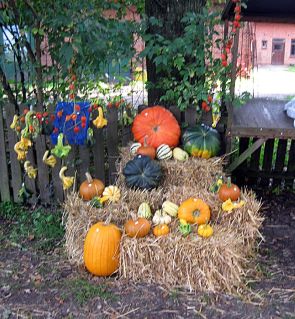
And after Quelkhorn comes Fischerhude, where a nice house is on the side of the road that I can afford to buy with my income as university professor. Autumn has surely come and the farmers have put on proud displays of their fruits of works along the road. To my surprise, I saw a lot of pumpkins, a fruit I have never thought of being home in abudant quantities in Germany, but hey, the times they are a changing. And I like pumpkins as they grow more or less inthe official team color of Positivo Espresso.
By now I have rode against a strong headwind for the last 30 km and I was relieved that I could ride the last 20 km or so without doing too much work. One nasty climb was although still waiting for me: At the fabulous „Platzhirsch“ restaurant I had to cross the federal higway. I concentrated and put all what was left of my power into the pedals and barely made it with 30 km/hr over the top.
After 121 km and 4 1/2 hour of riding I was home again. I made no breaks except the one at Pellen’s park (OK, I made 1 or 2 minute breaks inbetween, I admit) so I remained the last 100 km and 3 1/2 hour in the saddle. This is really the nice thing here in Bremen, the average speed is high, there are no nice spots neither convenience stores which would require breaks and as the road is straight, one can take photos, one can eat, drink and possibly relieve oneself as well.
As I have relieved myself from all ththoughts in my head right now.
Eingeordnet unter 2010, Bremen, Cervelo Soloist, Mob
"My first race in France"
I found this amusing write-up on Joe Papp’s very good blog-site, Papillon (http://joepapp.blogspot.com). For those who do not know this site it is well worth reading. As a former pro cyclist who was caught doping and who came clean, he has some interesting insights to what is going on in the sport nowadays.
This is not quite Tim Krabbe’s book The Rider but is a good read.
„Ok, the first rule of racing in France: Never ever, ever, ever believe a Frenchman when he says the course is „almost completely flat“. To an Englishman flat is flat, with possibly a bit of a downhill finish. To a Frenchman, flat is at best „rolling“ with a „small“ climb of maybe 8% and, I swear I am not making this up, a finishing stretch of maybe 500m into the village along cobbles at 22%!!!! It also comes of the corner at the end of the circuit’s climb, just to really spice things up.
Le Grand Prix de [small French town]. Thankfully, I rode the circuit first, and thankfully they wouldn’t let me race Elite 1,2 and 3! Because I had only just registered with their association they made me ride 4 and 5. Police outriders at a local amateur race, a beautiful course, 10 laps making just fewer than 50k. Cat 4 and 5. Sounded do-able.
How did it go?
How can I put it?
Basically, I got raped. By 40 angry Frenchman. For an hour. Over and over again, whilst a new friend (the French cyclist who invited me to the race after giving me directions to go training earlier that week) laughed at my suffering. He said he hadn’t been that entertained all year.
On the rolling section the peloton averaged 50kmph. From kilometer 0. Seriously.
Some wad attacked on the first lap, got about 20 meters on the peloton, and then we groveled for a lap, trying to rein him in. And as soon as we had, someone else goes (actually it was mostly the original wad attacking again and getting others to do the same), we rein them in, then someone else, and so-on and so-forth. By about lap 4 (I really had forgone the ability to count by now) I felt the inevitable happening. I was slipping back through the peloton. Losing wheels each time every f*cker and his dog stepped on the gas at the top of the climb. I just wanted to make sure I wasn’t the first to get dropped. Surely someone else couldn’t take this punishment for much longer too?
So as soon as I see the old boy next to me start to shake his head, I am onto him like a flash. My new best friend. Please Granddad, give it up. I’ll keep you company. It’ll be our own little grupetto. We can share our horror stories, tell each other about the injuries that have held us back today. Now I did say he was old, maybe mid 50s if I am being generous to myself, but f*ck he was stubborn. Every time I saw a gap ahead of him, I thought, „great we can relax now, and I can shake my head disapprovingly, point and blame you for being dropped“. But no, he would summon up something from his leathery, ox like thighs and back on we would get. More pain, more racing heart, more burning lungs, more f*cking lunacy. Why am I doing this? I am on holiday!
And then finally, it happens. He looks down at his gears (the eternal fail safe excuse for an impending crack), mutters something in French, shakes his head some more, and he’s gone. I am not going to come last! Well, not if I can beat him up those cobbles at the end, or knock him off at least. I then have a bit of a second wind, inspired by my „victory“ over a retired Frenchman, I manage to find a few more wheels for half a lap, a few more dropped, and then I am done. I wait for a nice stretch of road with no spectators, and I gratefully sit up and wait for the stragglers, and hope they haven’t got too much fight left in them.
But of course they do. And actually there are quite a few I hadn’t seen. About 12 of us. So I spend the rest of the race trying not to get dropped by some other losers, and suffering the indignity of the final police outrider laughing at my pain, and then finally we hear the bell. Should I go early? Hope to give myself a head start for the monster at the end? I give it a go. I fail. I give it another go. I fail again. F*ck it guys, we are racing for last! I am a tourist. Give me a break! So I sit in, try to save myself. And I needed to. Then end was brilliant. One of the funniest and craziest things I have seen in a bike race. Guys just stopping dead halfway up the finish. Guys walking. Guys running. Guys falling. Shouts of „putain“ and „merde“ filled the pretty little street on the lord’s day, accompanied by the childlike, joyful laughter of the spectators. There were still remnants of the main peloton struggling up it when i got there. I was in the 27″, took it easy and I thought to myself, If I don’t have to get off, I won’t come last.
And I didn’t.
As I coughed up what felt like the remnants of a lung, I flopped over the finish line, into the village square, received a kiss on both cheeks from a beautiful French girl as she put my finisher’s garland round my neck, and then found a nice corner to throw up in. It was f*cking brilliant. Insane but brilliant. I can never return to racing in the UK with any real enthusiasm now. I had forgotten how well the French do all this. Every weekend! I had spent too long away from it. Too long. When i got home, after a two hour „nap“, I began persuading my fiancée that we would be spending three months every year back in France so I could race „properly“ again. Thankfully she had found the whole experience so funny, she was easily persuaded.“
-contributed by a Pappillon reader
Eingeordnet unter Uncategorized
Mighty Thor
The nice thing about the living in Germany is, that one can see a lot of bicycle races on television, i.e. Eurosport. Combined with a very easy to use hard disc recorder provided courtesy of German Telekom it is easy to record all programs that include the word „cycling“ and watch them later in the evening or during the weekend. I watched a lot of stages of the Tour de France. the Vuelta and the World Championship in Melbourne.
Perhaps I even spend more time before the tube than riding my bike.
I liked the course of the world championship with two hilly sections. All the races were exciting, however the women race on Saturday had the most exciting finish.
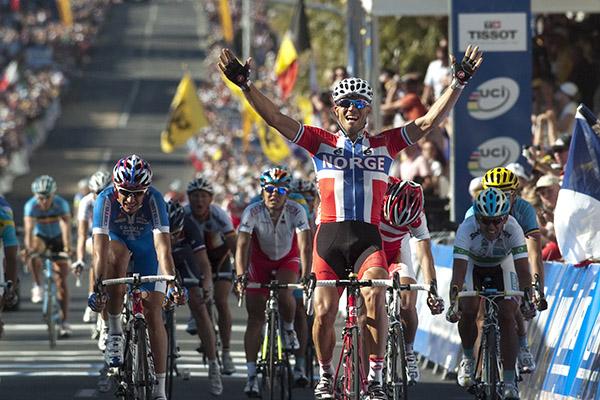
As a somewhat supporter of the Cervelo test team, I am delighted that a rider of the team managed to get a last, big victory before the team is defunct at the end of the season. This is a great guy and it is amazing that despite his stature and weight he is such a comparatively good climber and uphill sprinter. Of course the video here explains the source of his power in detail (please note the nice connection to the rainbow jersey of the world championship).
By the way, there is a dedicated page on cycling fans that shows which live resources including video live coverage is available for the bigger cycling events.
Beautiful Brevet
This Saturday Jerome and I joined the Kanagawa Oct 2 400km Brevet from Numazu to Karuizawa and back.
400+ km. 4870 meters of climbing (really). 23 hrs 57 mins. Please click through to „View Details“ via Garmin Connect:
http://connect.garmin.com:80/activity/embed/51523117
Completed in just under 24 hours, with many stops, including a steak dinner at a family restaurant in Saku, Nagano (complete with after dinner nap); too many brief rests slumped over my handlebars in the dark on the middle of the last two long climbs, completely exhausted; and 30 minutes or more passed out in a 24-hour McDonalds on the Southern edge of Kofu, Jerome and I the only customers other than a group of attractive women in the smoking area who looked as if they had just gotten off work at 2:45AM Sunday from one of the local establishments.
There were some familiar riders — a few from the Chubu 600; Tsuchida-san from the Saitama 300 km event in March, the ex-Keirin star who rode with a much younger guy (perhaps his son? protege?) as an assist; Daisuke S. from the Positivo Catteni club team; Jose, a Philippine expat who Jerome and I met just 2 weeks ago in Oume; and some of the Kanagawa organizers. We rode the last 75 km with an English speaking Brevet-crazed freelance software engineer from Kobe, Moriwaki-san. He did the Cascade Pacific 1250 km this summer, an identifying tag from the event still attached to his seatpost, as well as a series of three 1000 km Canada events (one day off between each in the series!), and said he had done a German 1000 km Brevet in a prior year, starting out of Munich. And no doubt he would have zoomed ahead of us, but for the fact that he waited with Jerome 30+ minutes for me at Lake Shoji-ko after the last long climb, and he must have been saving himself for next weekend’s Chubu 1000. All that, plus a mechanical problem (dying bottom bracket) that required him to make an unscheduled repair stop at a bicycle shop in Saku.
As with last time, Jerome had not registered and was an „unofficial“ entrant. He did commit to the organizers that, next time, he will register in time and pay the modest fee. He had a late meeting at work that went to 11PM on Friday evening, and so went straight to Shin Fuji on Saturday morning, planning to meet me 25 km into the ride or so. We missed our rendezvous, as I got through the first 25 km very quickly — a tailwind making it possible to zoom down the coast line at around 40 kph without undue effort, and Jerome stepped into a family restaurant for breakfast. In any event, I continued on, knowing he would catch me somewhere up the Fujikawa. At least he did not need to wait for me until we were well over 100 km into the ride. Then he waited at the top of (or down the other side of) each hill, each wait longer than the last.
As with other events longer than 300 km, there is way too much to put in a blog entry at 1AM. A few highlights:
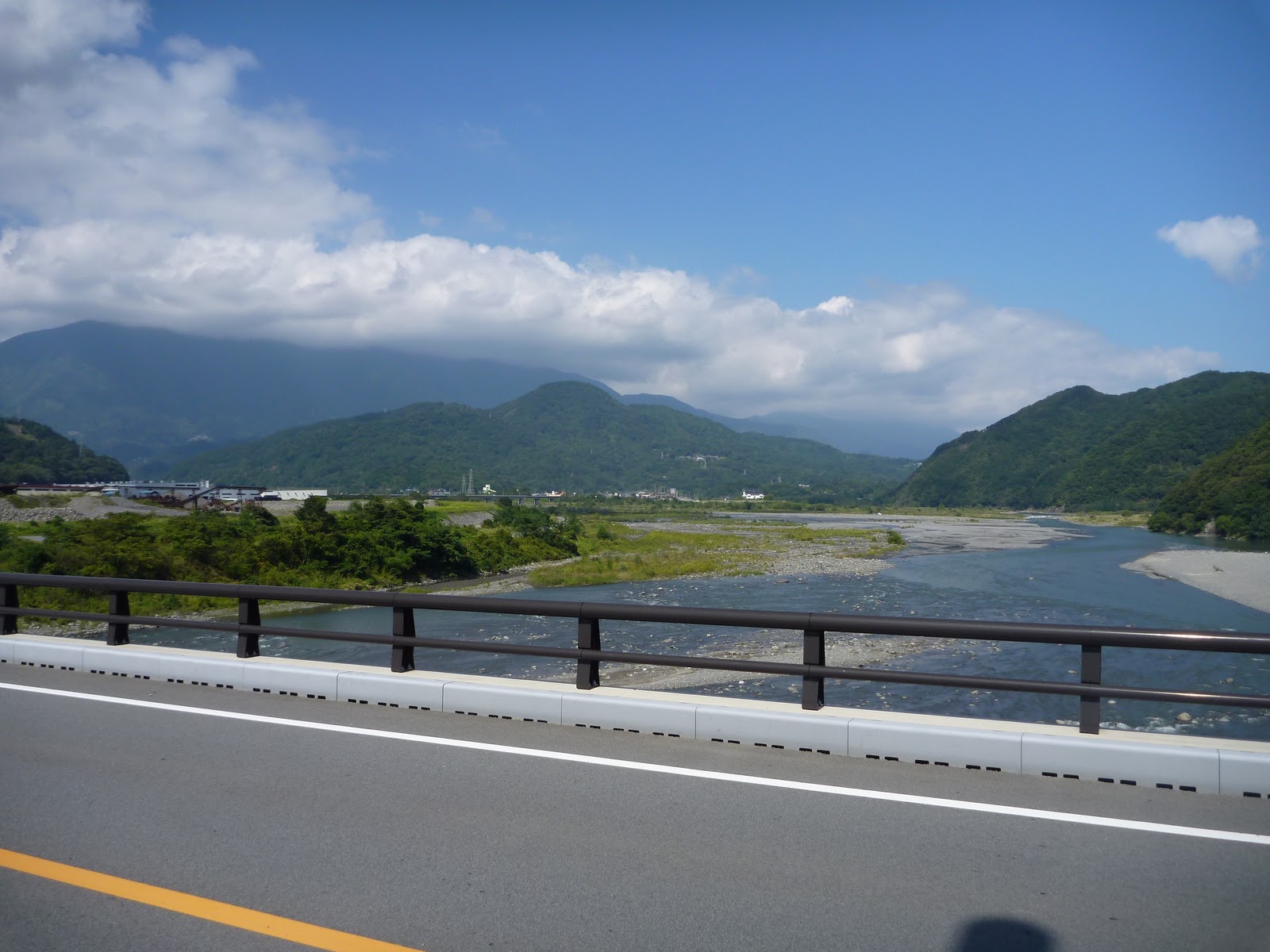
1. The climb to Shinshu Toge went through some beautiful country. Somehow I was expecting stark, harsh terrain (like the approach from 411 to Kamihikawa), but there were nice farm villages and valleys, and even some downslopes to mix with the climbing from Nirasaki (360m elev) to the pass (1460m elev). Most of the gradient was reasonable – just a few km of 10%+ climbing near the top.
2. The „surprise climb“ of the trip was from Saku (low point 670 m elevation) to Naka Karuizawa (1003m elev). I somehow was hoping that the turnaround point — 60% of the way from Saku to the center of Karuizawa (well, the Shinkansen station), would be at the same elevation as Saku. No luck … and plenty of slow, suffering riders to witness after we started back down the hill.
3. We saw the sun rise over Mt. Fuji as we passed through „Asagiri Kogen“ – Morning Mist Highlands. A beautiful site … the scene not captured on film, as I was at that point descending at a good clip and has zero energy to stop and take photos.
4. This was a really well-thought-out course, especially compared with the Brevet at end of August. The Fujikawa was very nice, the route out through Minami Alps/Nirasaki avoided much of the „sprawl“ of Kofu, and travel on „main roads“ — 141 from Saku back to Nirasaki, 20 through Kofu, and 358 up to Mt. Fuji — was mostly during the dark of late night and very early Sunday morning, when traffic was almost non-existent. … until buses, cars and trucks started roaring up Rte 358 before 5AM Sunday. Our only suggestion to the organizers was that they try Rte 2 instead of Rte 141 between Koumi and Saku on the outbound leg, as the truck traffic on 141 can be heavy. Also, the course had the benefit that all of the hard work is done before the last 50 km, which includes a 30km+ downhill stretch that starts just after passing Motosu-ko.
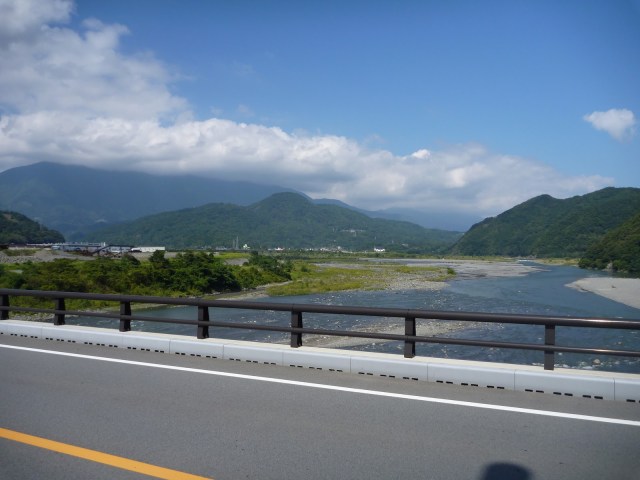
![]() |
| The view North while crossing the Fujikawa on Rte 300, 75 km into the ride |
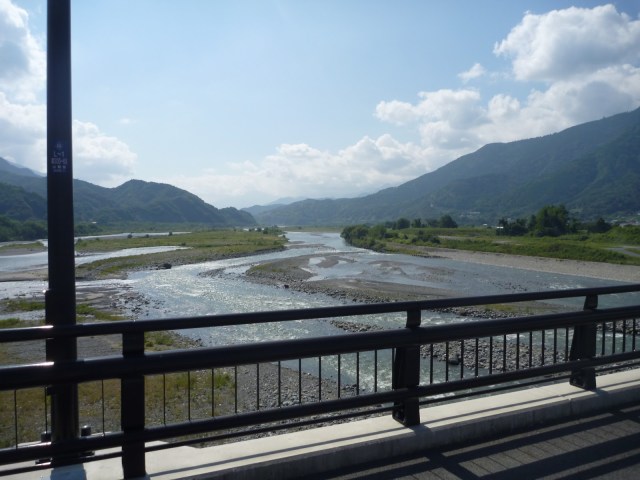
![]() |
| The view South. |
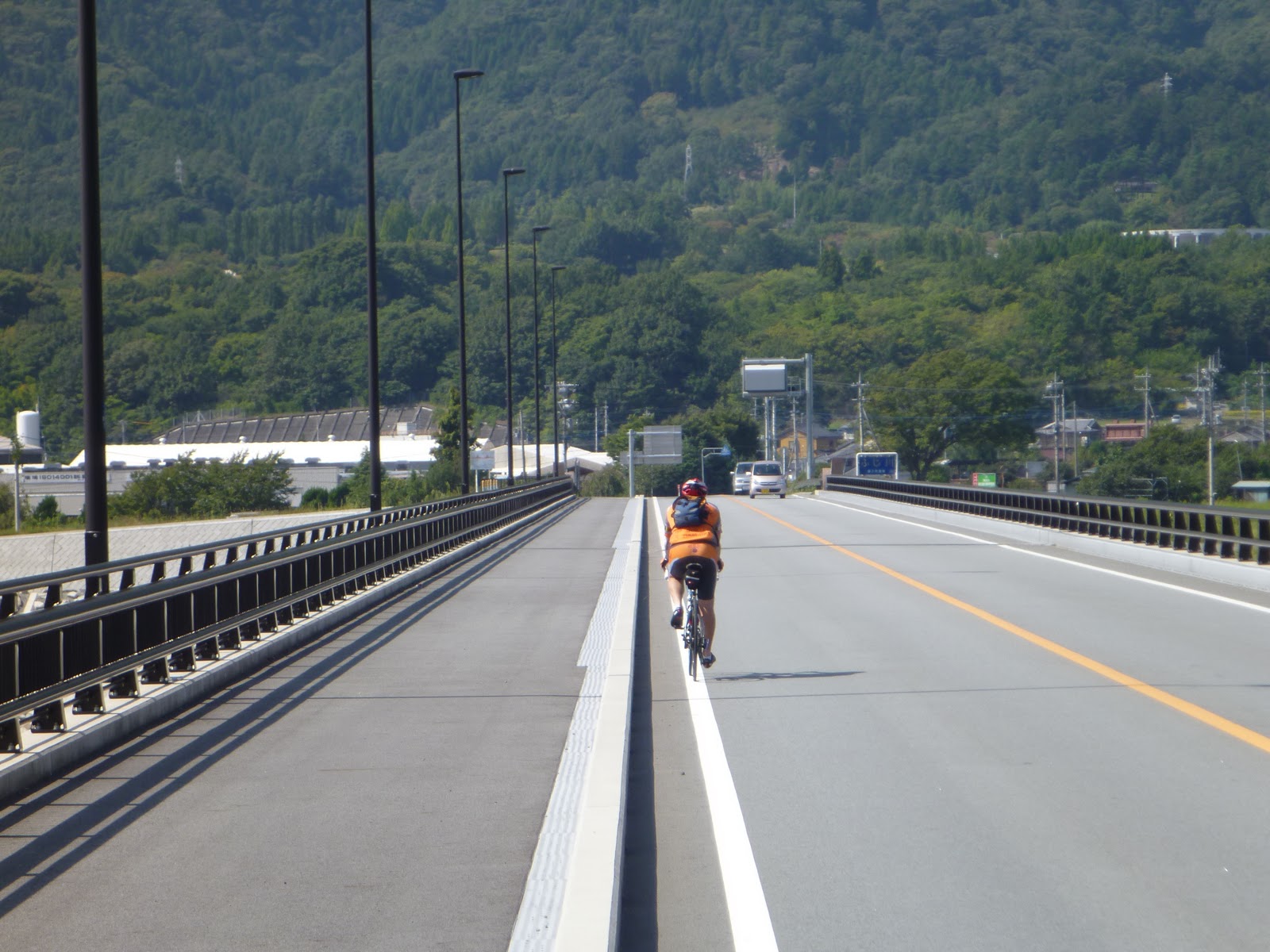
![]() |
| The view West. |
Eingeordnet unter Uncategorized
Riding With The Russian
The title for this blog came to me while cooking tonight (a delicious ragout with fusilli which was very good even though I say so myself). I was listening to the B.B. King & Eric Clapton album called ‚Riding With The King‘. Now I am not suggesting my riding partner Laurent is regal in anyway other than perhaps being The King of The (Quick) Drink After Work.
We met by the river at 7:15am and headed off while discussing the day’s route. In contrast to the official Positivo style where a route is planned and then ignored, we didn’t start with a plan. Both of us set out from our homes feeling tired and expecting a shortish ride but then The Russian mentioned a drive up to some caves he did with his son earlier in the summer and we started to think bigger. Along the way we met Pro Dave (James M) who was waiting for Mossad’s man in Hachioji, Yair. They were to do the last ride before Pro Dave headed off to ride the Tour of Cameroon with his team. We rode for a few km before our paths split and sent Po Dave off with our best wishes and the warning of non-male-borne diseases in Africa for which we do not even have names.
Nowadays we ride along the road by the river rather than on the cycling/jogging/dog-walking path and this was definitely a good thing on this day as there was the 30km and 50km marathon walk going on. There were many hundreds, if not a couple of thousands walkers on the path. The variety of dress was interesting: some in T-shirts & shorts, others in jeans and collared shirts while others were decked out in full hiking gear with boots, gaiters, two cross-country style walking sticks, ruck-sacks, compression tights and GPS watches. And don’t forget those bells to warn bears of your presence! I saw it all except for ropes and crampons. We arrived at Ome and paid our respects to the Aurora Bakery by buying a Royal Milk Bread each which we devoured sitting outside. it was on our last visit here that Laurent was cleverly unmasked as a Russian by an American agent pretending to be a stoned, mid-30s, shoplifting loser. Great disguise which had us all fooled.
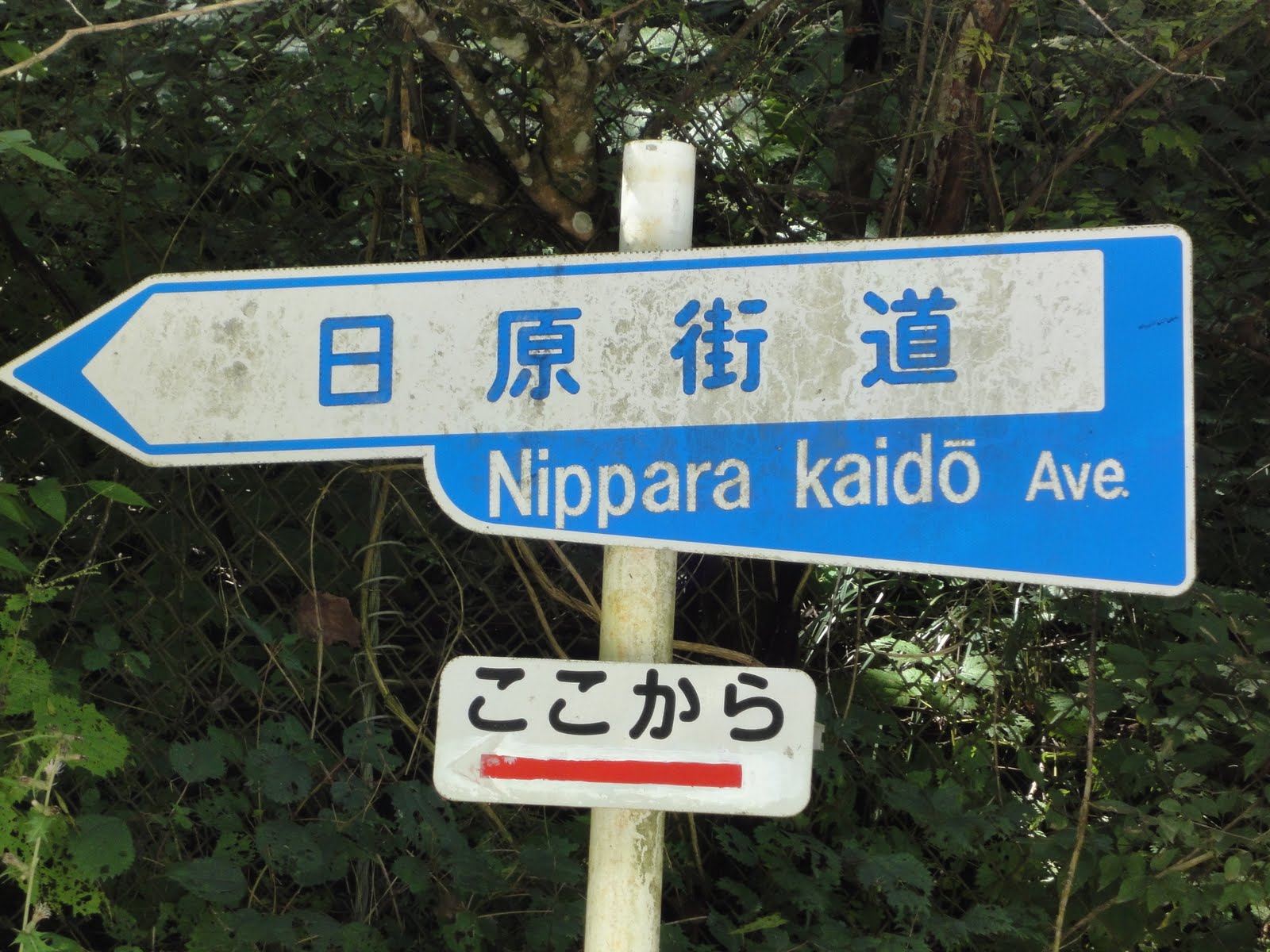
We rode on to Okutama and then turned up Nippari Kaido, a new road for me. It climbs gently up to a shrine and some of Japan’s longest caves. Much of this road is even prettier than the wonderful Yabitsu Toge. On the way up we met Steve ‚ Montezuma‘ Tallon who I had not seen since the Tokyo-Itoigawa ride. He was looking to blow off the cobwebs of jet lag with a warm-up climb up Nippari Kaido and then Nokogiri and Kazahari. On the descent we tried to explore roads leading off the main road but they went nowhere far before turning into rough tracks.
Having briefly rejoined Ome Kaido we turned off up Nokogiri, another first for me. This climbs up 650m to 1,000m at the top. Almost all the way my Garmin reported a gradient of 9-10% with stretches at 13%.
It is interesting to see how much stronger I felt now the temperature and humidity had dropped compared with August. I was surprised by how good I felt on the climbs considering not having had a good night’s sleep for a few days. We were actually chatting on the way up unlike the near death experiences The Russian and I endured only a few weeks ago going up places like Shiozawa Toge. The descent however was rough and much time was spent on the brakes. Parts are already slippery with moss and wet fallen leaves are just beginning to accumulate.
A fast run from Honjuku to Itsukaichi was interrupted by an ice cream stop at a tofu store. Tofu flavoured soft cream is definitely recommended.
Just as I was preparing myself for the uninspiring ride from Itsukaichi back towards Tokyo The Russian, no doubt utilising his orientation skills learned in an elite but secretive academy back in Moscow, led me on a great road through villages, paddy fields in which old men were hanging out the rice hay to dry, shrines and under highway underpasses until we popped out at Fussa. From here we made our way back to the Tamagawa road and raced with a powerfully built man in an ugly jersey who was up on the cycling path. After we pulled ahead of him I felt we had made our point and so did not bother when we got held up at a traffic light, but The Russian kicked hard to pass me saying that we cannot let this guy go. Therefore, after riding 160km already we found ourselves riding into a slight headwind at 40km just to overtake someone we did not know to prove a point – what point though I am not sure.
At the outset of the ride I think we were both a little tired and perhaps were hoping the other would suggest an easy ride but in the end we had a great ride in wonderful weather and had a lot of laughs. 190km, 8 hours and 1,900m of climbing.
Eingeordnet unter Uncategorized
Joint PE Father-son / Father-daughter event ?
The thought just occured to me after another beautiful ride with my daughter this morning…how about organizing an all-PE father-kid and/or an all-PE family (with spouse) ride sometime this autumn? David? Laurent? Jerome? anybody else?
Break your Cycling Bad Habbits
We’re all creatures of habit, especially when it comes to our cycling. But some habits are bad. Break them, says Matt Barbour, and you’ll become a better rider.
Bad habit 1: Going too fast, too soon
Leading the pack from the off has an obvious draw, but if you want to cross the finish line in pole position you might need to rethink your strategy.
“If your heart rate is too high in the starting 30 minutes, your metabolic rate goes up and your body goes into sugar-burning mode,” says Andy Wadsworth, director of My Life Personal Training and an elite cycling trainer.
“You need to train your body to use the longer-lasting fat reserves rather than sugars, which will literally burn out in half the time.” Start slow and you’ll set a precedent for the whole ride, he says. if you don’t want to blow up, only up the intensity after 30 minutes of riding at a conversational pace.
So for the first 30 minutes, work at a perceived exertion rate (RPE) of no more than five out of 10 and then move up to eight or nine out of 10 for six two- to four-minute intervals, with six-minute rest intervals between each, again working at five out of 10.
At the end of that batch, do another 30 minutes of steady-state training and repeat. “If you haven’t been able to recover adequately to tackle the next interval, increase your rest phase, or decrease the length of your high-intensity interval,” says Wadsworth.
Bad habit 2: Climbing in wrong gears
Whatever gradient you’re on, you need a consistent cadence of 90-100rpm. “Ninety to 100 rpm is simply the most efficient ratio,” says John Herety, team manager of Rapha Condor Sharp.
„Any lower and you’re in too high a gear, putting too much strain on your joints; any higher and you’re in too low a gear, wasting valuable energy spinning your legs around at speed.” And while that latest NASA-worthy electronics system that you’ve got on board might help you count, go back to basics, he says.
“You need to develop a feel for how fast your legs are going round, so practise counting for 15 or 30 seconds on every single ride until you know without looking what it feels like to be in the right zone. The best Formula 1 drivers listen to their engines and know how it’s responding, which is exactly what you should be doing.”
Bad habit 3: Too much time at the front/back of groups
Learn how to draft to conserve energy – but don’t become a wheel sucker and ‘forget’ to take your turn. “Cycling off the front of an eight-man pack can reduce oxygen consumption by almost 40 percent,” says Herety.
“But spend too long at the back and you’ll earn the nickname ‘wheel sucker’ and lose friends. Spend too long at the front, though, and you’ll be exhausted.”
The key, he says, is communication and trust. “You need to agree a specific time period – say 60 seconds – for each rider to lead, or if you’re tackling a particularly tough hill you need to be able to communicate that you need to drop back sooner.”
Do this by signalling clearly with a flick of your elbow that you’re pulling out, accelerate forward briefly, so you don’t clip wheels with anyone directly behind you, then go out and allow the next rider to accelerate smoothly past you, tucking in behind.
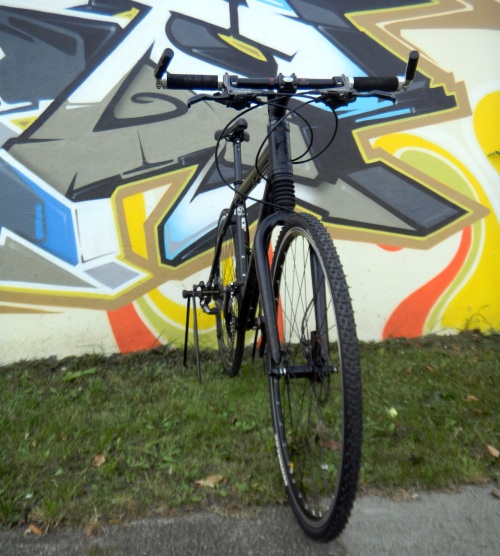
“For real efficiency, you need to stay as close to the person in front as possible, focusing on the brake callipers rather than the wheel so there’s just inches between you,” says Herety. Which means keeping it smooth.
“One of my pet hates is people suddenly standing up on hills, slowing down, which causes countless accidents. Nobody will ever think the worse of you for asking if it’s your turn to step up or back, but they will if you make any sudden movements and cause the mother of all pile-ups.
„It’s best to avoid hitting the brakes and slightly pull out to the side of the pack to use wind resistance to slow yourself down more gradually.“
Bad habit 4: Never resting
Overtraining can cause persistent soreness, suppressed immunity, injuries, moodiness and loss of motivation. “Rest isn’t the absence of training, it’s an important component of it,” says Wadsworth.
“During recovery periods, your cardiovascular and muscular systems are restored and rebuilt to a higher level – that’s where all performance gains are made.” Every training programme should have a rest day in addition to two or three easy days (shorter, less intense rides following harder efforts) each week, he says.
“If you haven’t had a strenuous week, it’s all right to cross-train – swim, take a yoga class, or treat your dog to a long walk. But if you’re coming off a high-mileage week, reward yourself with a day of total rest. Schedule a massage or breakfast with a friend so you’ll feel like the time off was well spent.”
Bad habit 5: Cycling, cycling and more cycling
Clocking up the miles will do your cycling no end of good, but ignore your overall fitness and you could ultimately suffer. „Cycling isn’t an all-round form of activity,” says Matt Rabin, nutritional advisor with Team Garmin-Transitions. “It uses predominantly the lower body muscles and in a very specific, limited way.”
The upshot is that your cycling muscles will become short and tight, and non-cycling muscles will become weak, creating imbalances – little wonder that in one Californian study of over 500 randomly selected recreational cyclists, over 85 percent reported overuse injuries.
Supplement your riding with conditioning specific work. “Focusing on core stability keeps the pelvic girdle and spine in the perfect position to stop the pelvis tipping forward and prevents backache and poor form,” says Rabin.
Try toe touchdowns – lie on your back with knees bent and hands under your back. Contract your abs and press your back against your hands, then slowly lift one foot a few inches off the floor, pause and lower.
Swap feet and continue until you lose the pressure against your hands. Avoid overly-tight hamstrings by doing 12 toe curls off the edge of a step, then turn around and do 12 heel drops.
And avoid knee maltracking and strengthen your glutes with wall ball squats: place a fitness ball between your back and a wall and slowly squat down until your thighs are parallel to the ground.
Bad habit 6: Pre-ride faffing
Nothing is more infuriating than having to wait while other riders endlessly adjust and check their kit – and if that laggard is you, as well as losing friends you’ll lose time in the saddle. “You have to know the moment you get on your bike it’s ready to ride, so always prep it for the next ride the moment you finish your last one,” says Wadsworth.
“Any niggles will be ultra-fresh in your mind, so you’ll know exactly what needs looking at. Clean it, oil it, check the wheels are in properly, and check you’ve got your pump, spare tubes and tyre levers, so it’s literally ready to ride the moment you pick it up.
„If you had a flat on your car you wouldn’t leave it on the road unfixed until the next time you needed to go somewhere – you’d sort it straight away, which is what you should do with your bike.”
And for those riders who suffer some form of obsessive compulsive disorder and can’t stop re-checking their kit, keep a simple checklist with your spare tubes and tick off each item – including sports drinks, energy bars and wet weather clothing – after each ride.
“Actually seeing it in black and white will mean your mind can move on to other things so you can actually get out there, riding, in half the time,” he says.
Bad habit 7: Avoiding hills
Riding at full-throttle is exhilarating, but any rider knows that if they want to truly improve, they have to head for the hills. “Anyone who says they’re ‘not good’ at hills is wrong – they’re just avoiding them because they think they’re not good at them,” says Wadsworth. But he isn’t an advocate of finding the biggest hill you can and grimacing to the top.
“Incorporating smaller, relatively shallow four to eight percent gradient hills that last from 20 seconds to two minutes, keeping the power output up throughout, will have much bigger benefi ts – as you become used to increasing power for short bursts so your body and energy systems adapt.”
He reckons that if you add just two or three 30-minute hilly rides a week you’ll actually start enjoying them and start seeking them out rather than avoiding them. You’ll start focusing on power output – attacking each hill in progressively harder gears at the same cadence, rather than spinning your way up in easy gears – rather than speed, which is where improvement lies.
And just because you’ve conquered a climb, don’t take your foot off the gas. “Actually accelerating once you reach the top will set you apart from the competition when it comes to racing,” says Wadsworth.
“I see so many riders drop down the gears at the top and coast, when that’s the last thing you should be doing. Again, don’t just focus on huge climbs for this – it can be done every time you’re facing a small slope, even if you’re just commuting in town, and will make you psychologically much stronger.”
Bad habit 8: Being your own quack
Cyclists – like any half-serious athletes – are often hyperaware of their bodies, and when something’s ‘off’ they can be all too quick to self-diagnose. “We’ll ice a tight hamstring, pop ibuprofen, and grind through lingering pain,” says Joy Potts, a former international cyclist who became an osteopath and opened a clinic specialising in sports injuries.
“Minor injuries wrongly diagnosed could turn into serious issues such as muscle tears or long-term back pain.” So, when you have a nagging ache or pain, the sooner you see a doctor – preferably a sports-medicine specialist – the faster you’ll be back on track. If you’ve been sluggish on rides, schedule a check-up.
Asthma, a heart murmur, high blood pressure or anaemia can sap energy levels. Ask your doc to test your blood’s iron stores. “Serum ferritin, a protein responsible for iron storage, can become depleted,” says Potts, “and is associated with slower recovery and declining performances.”
Bad habit 9: Not fuelling properly
Don’t give your body any nasty surprises – make sure you’re used to what you’re filling up on. “Too often riders enter a sportive or race with a major nutrition sponsor and, because it’s free, try products that are unfamiliar to them,” says Rabin.
“This often leads to ‘GI irritation’, cramps and stomach upsets, which has the double whammy of making you feel pretty rotten and also stop taking in enough fluids and fuel.” He advises never trying anything in a sportive you haven’t trained on extensively. Likewise, during training you need to practise your nutritional strategy, so eat and drink on the bike, finding out what works for you.
Also, pre-ride, prepare your food for your return. There’s a 45-minute optimal window to replenish glycogen stores after a long ride, after which time your muscles won’t be able to re-stock their energy shelves, leaving you struggling over the next few days, affecting performance and energy levels.
Bad habit 10: Lack of sleep
Cyclists who short-change sleep compromise recovery, immunity and mental sharpness. “Sleep enhances the restoration of cells that are damaged from exercise,” says Professor Jim Horne from the Sleep Research Centre at Loughborough University.
Getting enough shut-eye can also ward off ‘effort headaches’. A 1999 study found distance cyclists experienced twice the number of headaches as non-cyclists. Horne says this is most likely due to the dilation of blood vessels and sinuses that occurs during exercise.The good news: headaches occurred less frequently when the cyclists got more sleep. Some people are fine with five hours’ sleep, others require 10. “Athletes who put greater demands on their bodies tend to benefit from the higher end of that range,” says Horne.
Note how many hours you get each night in your training log. Review it and look for patterns. Once you figure out your target number, try to hit it each night, particularly in the week leading up to a ride. “Consistency and knowing what works for you is the key,” says Horne.
via Bike Radar.
One of the netter articles in form of a list of what to doa and what not. Personally, I plead guilty in seven out of ten counts. Avoiding hills is unfortunately not an option in Bremen.