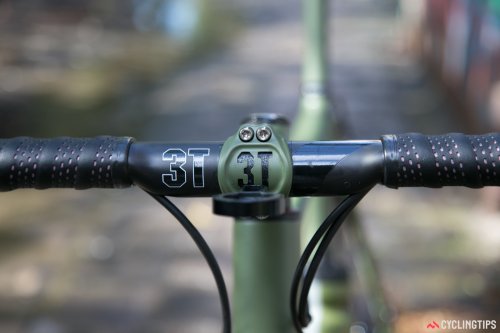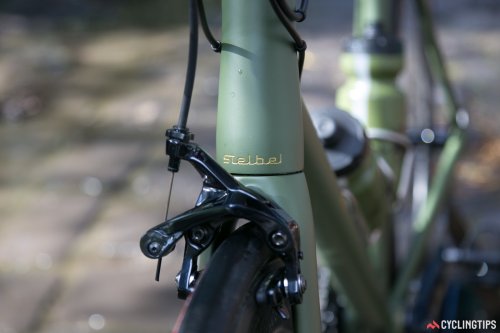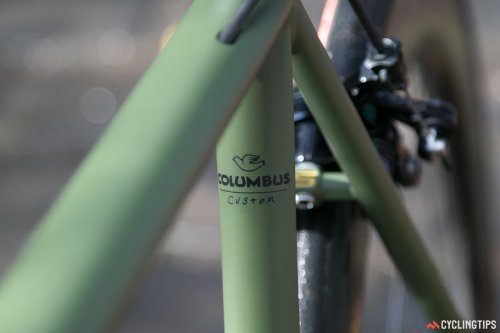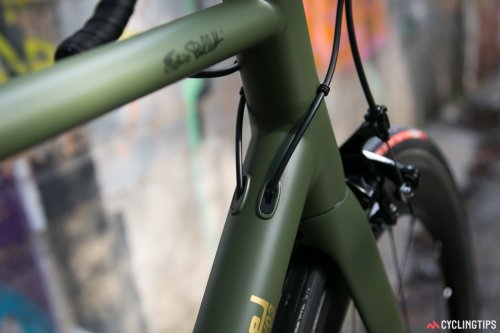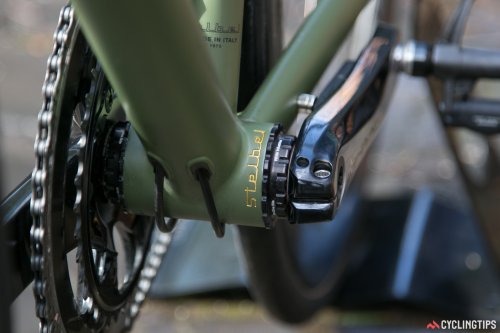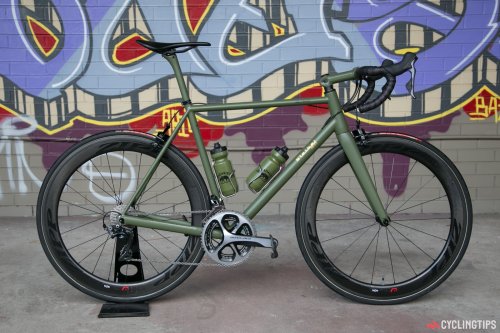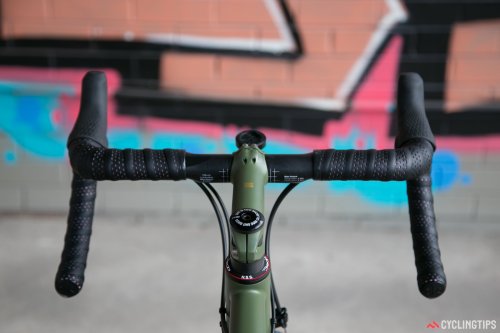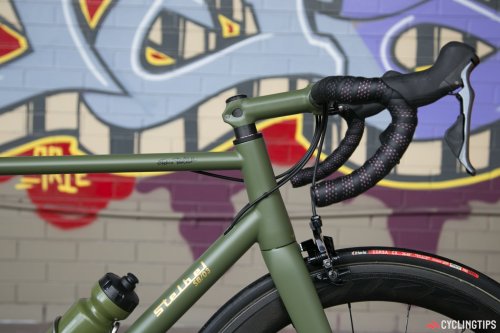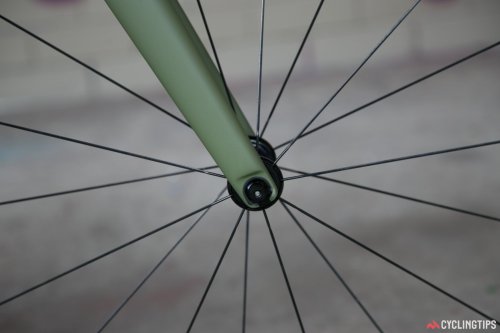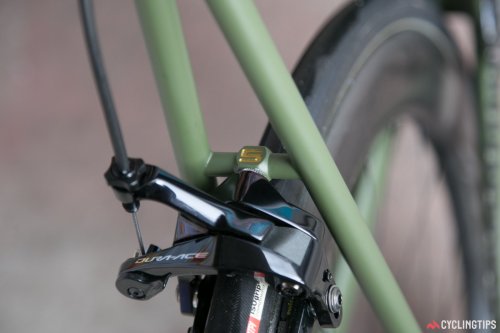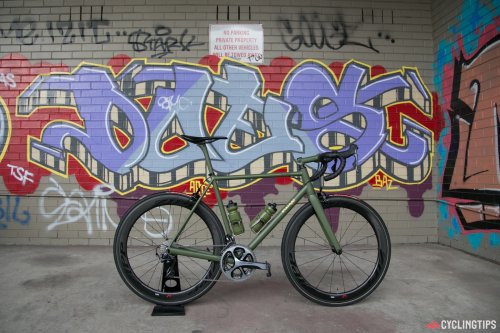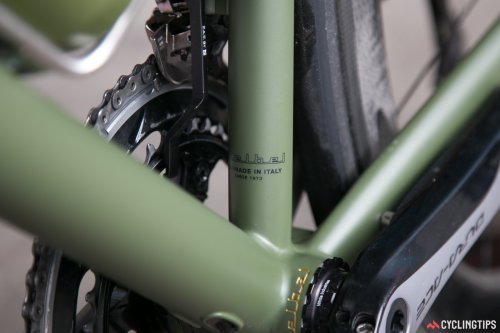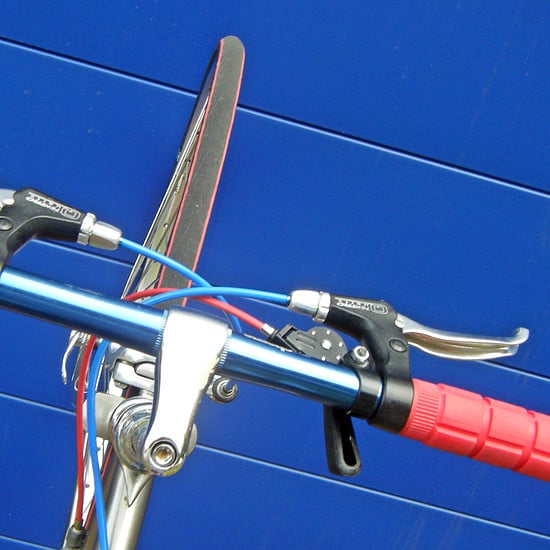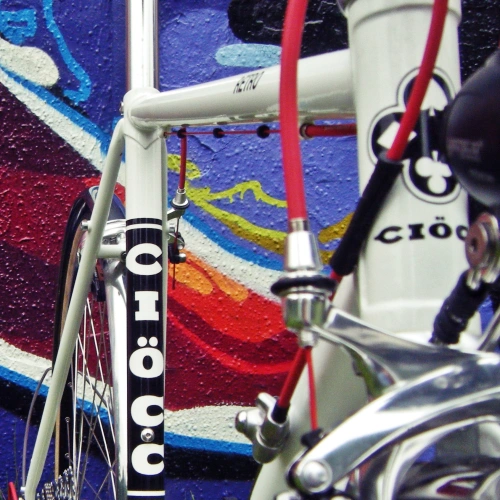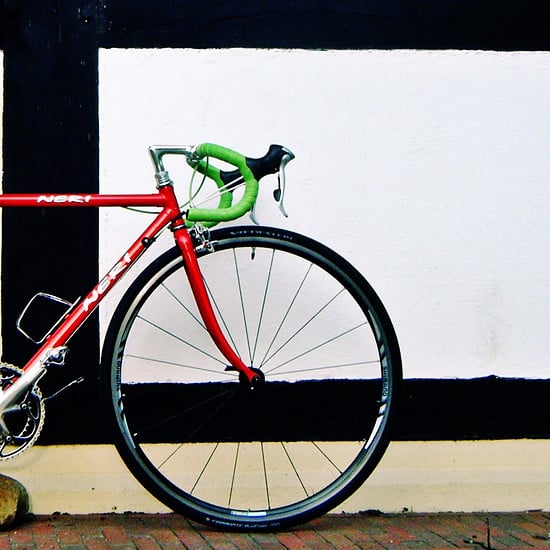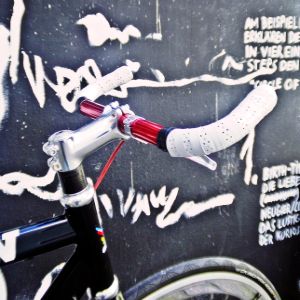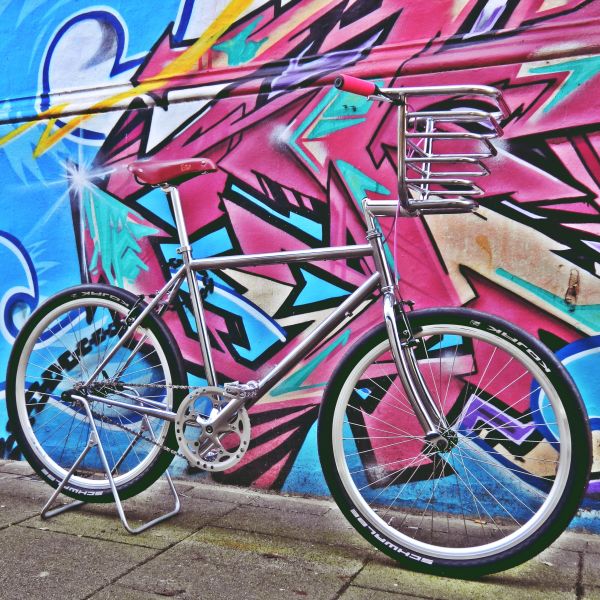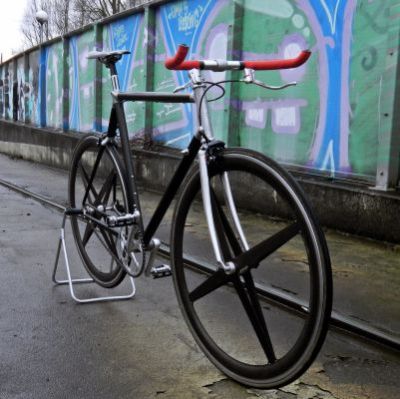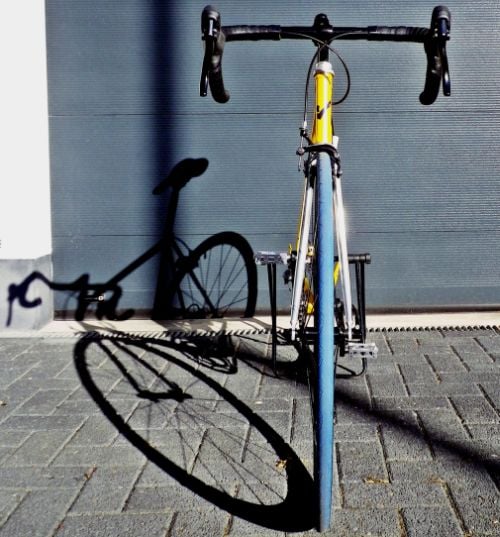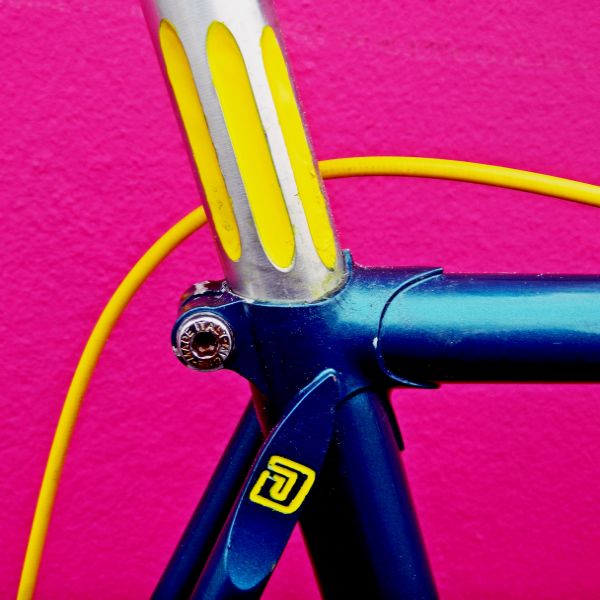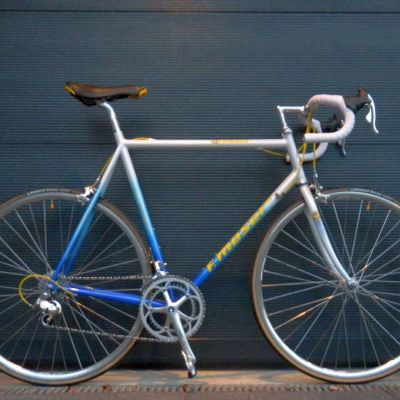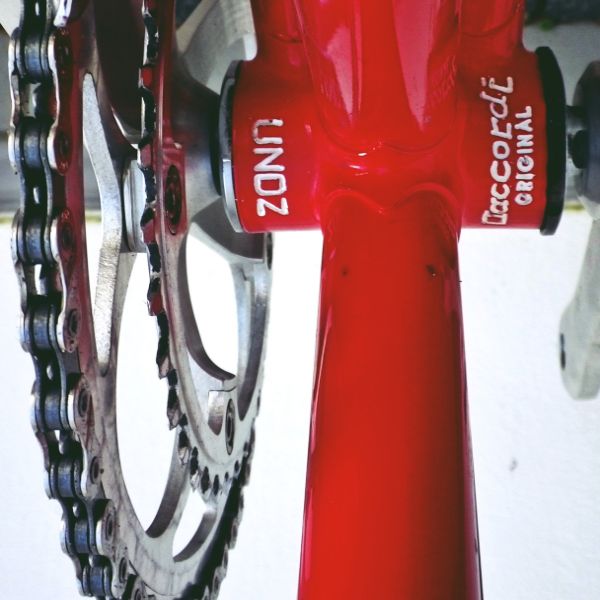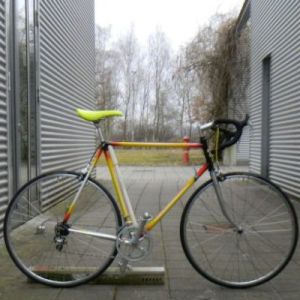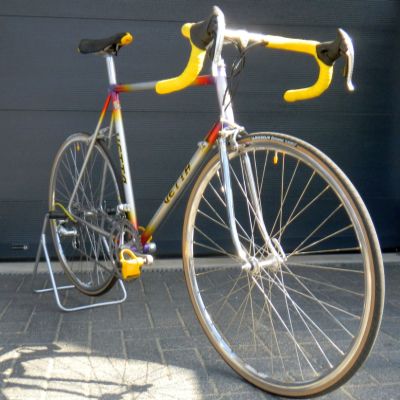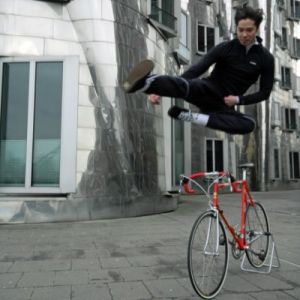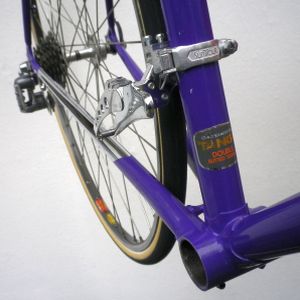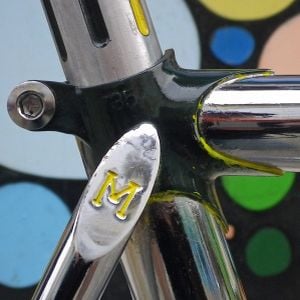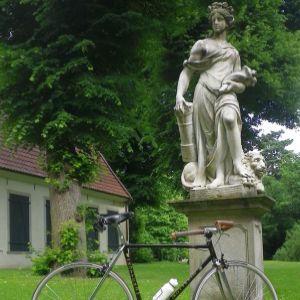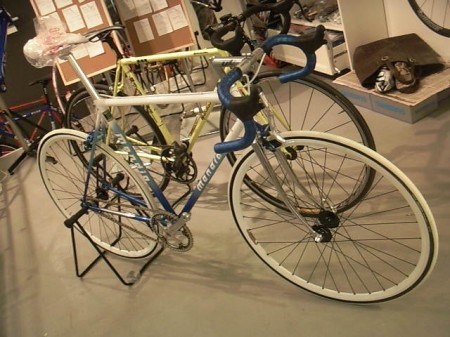
Gierige Räder: Stelbel SB/03. Stahl.

Ich kann es nicht erklären; ich habe einfach eine Vorliebe für italienische Räder im Vergleich zu deutschen, französischen, holländischen oder gar belgischen Möhren. 

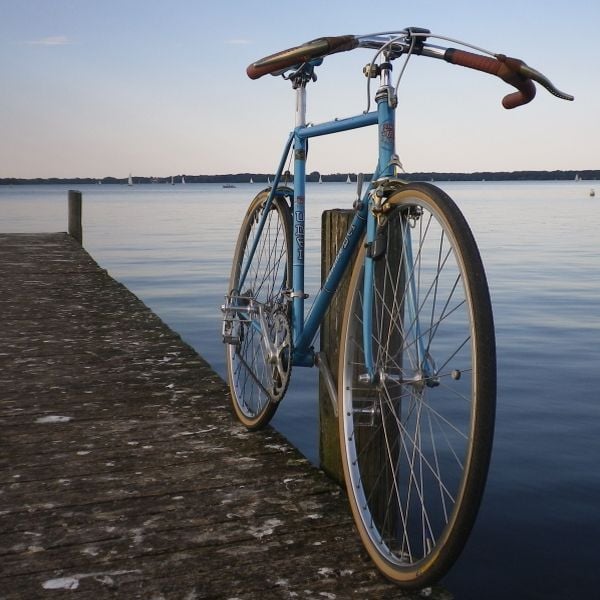
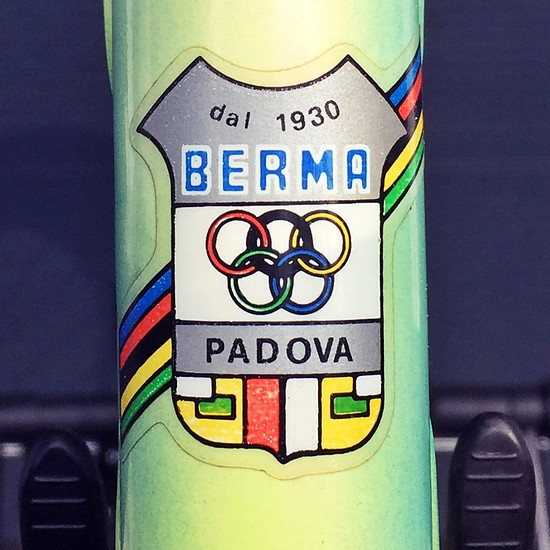
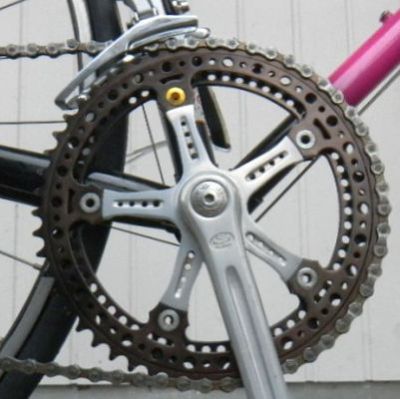
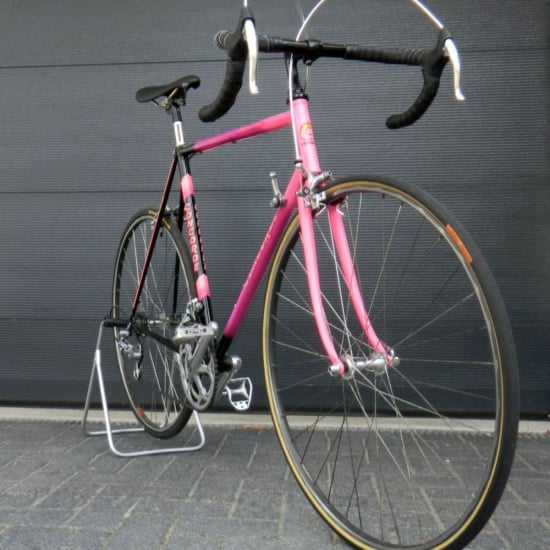
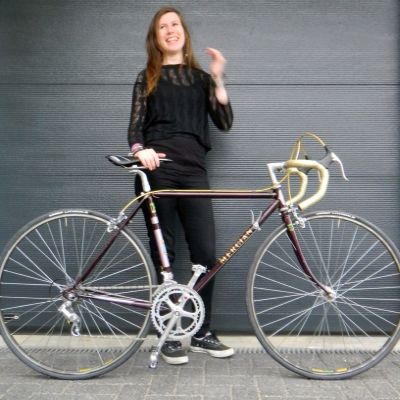
Und auch innerhalb der vielen italienischen Marken finde ich durchaus nicht alle toll und gut, sondern einige besser als andere. Im Laufe der Jahre konnte ich ein paar Rennräder selber ausprobieren: Basso, Moser, Daccordi, De Rosa, Olmo, Romani, Viner, Colnago, Pinarello, Berma, Chesini, Neri, Fagin, Dancelli, Vetta, Simonato, Milanetti, Bottecchia, Gimondi. Und einige noch nicht. Ganz oben auf meiner Wunschliste steht definitiv Stelbel.

IMG_6857IMG_6879IMG_6884IMG_6887IMG_6900IMG_6909IMG_6934IMG_6938IMG_6958IMG_6959IMG_6975IMG_6976IMG_7028

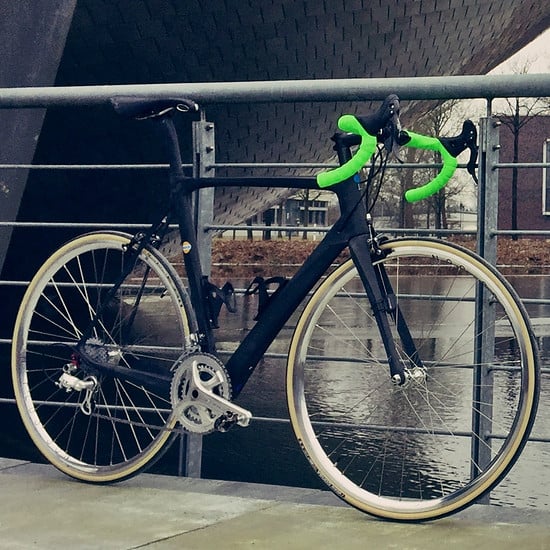
Dinge militärisch-grün oder in Camouflage zu lackieren entspricht derzeit dem Zeitgeist.

via Cyclingtips.

2 Kommentare

Eingeordnet unter 2017, Gierige Räder, Mob

XShifter.

XShifter finde ich, trotz vieler Unzulänglichkeiten, ein gutes Konzept, dass mit der Zeit noch besser werden könnte. Zwei XShifter vor vorne und hinten? Niemals. Aber ein Shifter hinten, der unabhängig von der Anzahl der Ritzel, den Ritzelabständen und dem verwendeten Schaltwerktyp alle möglichen Kombinationen schalten könnte? Das wäre sehr, sehr cool. Bitte noch dazu eine in einen Rennradbremshebel integrierte Version. Ein Preis von ca. 150 bis 200€ fände ich da akzeptabel.

2 Kommentare

Eingeordnet unter 2017, Bits&Pieces, Mob

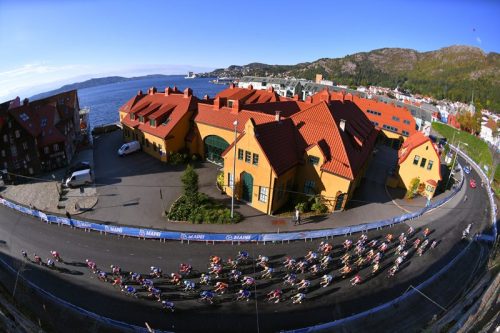
Bergen.

Das Frauenrennen

SPTDW80016-1-800x533

SPTDW5026-800x533SPTDW5055-800x533SPTDW5066-800x533SPTDW80035-800x533SPTDW80050-800x533SPTDW80058-800x533

Männerrennen aus dem Helikopter

Hinterlasse einen Kommentar

Eingeordnet unter 2017, Mob, Racing

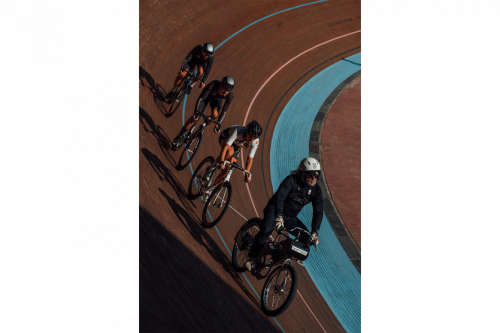
Vigorelli.

via The Radavist.

vernor_RHCvigorelli2017-2167-1335x890

vernor_RHCvigorelli2017-2483-1335x890

vernor_RHCvigorelli2017-2191-1335x890vernor_RHCvigorelli2017-2324-1335x890

vernor_RHCvigorelli2017-2439-1335x890

Hinterlasse einen Kommentar

Eingeordnet unter 2017, Mob

Riding Mountains, Riding Cities.


„Aber ich glaube, ich wäre kein guter Mensch, wenn ich nicht Fahrrad fahren würde.“

Hinterlasse einen Kommentar

Eingeordnet unter 2017, Mob, Sex. Lies & Vids

Daily Eddy. Daily Stelvio.

stelvio

EddyMerckxPissed

Hinterlasse einen Kommentar

Eingeordnet unter 2017, Mob

Drillium.

by Dave Moulton

Most vintage bike enthusiasts know about cutouts in frame bottom brackets, but some, especially newbies don’t know the reason. Someone recently asked me why I didn’t put drain holes in my bottom brackets? I was baffled and asked, “Who does that?” He listed frames that had “Drain holes,” and I realized he was talking about bottom bracket cutouts.

It was a fashion gimmick of its time, that’s all. There was no logical reason. Think about it, it is a poor drainage system. The bottom bracket is in direct line of fire from water spraying up from the front wheel. These large holes let in more water than they let out again.

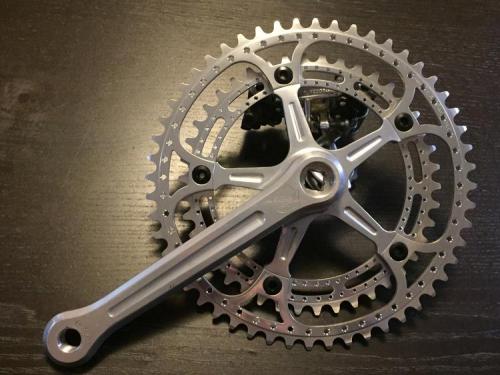
For those who don’t know, here is a history lesson. In the 1970s a craze started amongst cyclists all over Europe, later referred to as “Drillium.” (Picture left.)

Drilling holes in component parts to reduce weight. The fad was huge in the UK, especially amongst time-trialists, who were forever looking for ways to save weight. And of course removing metal reduces weight.

The amount of weight saved by drilling holes in aluminum components was miniscule, but it didn’t matter.

It was a way to customize a bike and a few more holes than your competitor was a psychological boost if nothing else.

If your bike had so many holes, it had no shadow, you were a winner, in style anyway.

Component manufactures were quick to follow this trend, and for example, a seat post that was previously round and smooth, now had flutes machined in them. Frame builders too got on the band wagon. A large hole cut out of a bottom bracket shell, was a considerable chunk of steel that was no longer there.

Of course all these holes and flutes created more aerodynamic drag, but no one thought of that at the time. Aero bikes would be a future craze.

Frame builders used a special die and a press to stamp out these cutouts in seconds. Holes were similarly stamped in lugs before the frame was assembled. It also gave framebuilders an opportunity to individualize frames with cutouts in the form of their logo. It was done for brand recognition.

My newbie inquisitor was still not satisfied. “If these are not drain holes in the BB, then why weren’t they engraved?” I’ll tell you why. Holes can be stamped out in seconds, but engraving takes time, and is super expensive. Especially engraving on a curved surface.

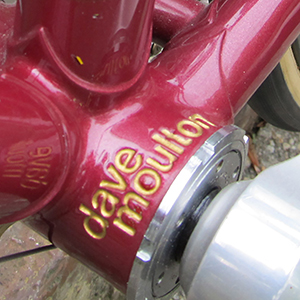
I know this because I had my name engraved in the top of the BB shell.

It had to be done with a special fixture that rotated the shell as the engraving progressed, so the router bit that does the cutting is always at right angles to the curved surface of the BB shell. (Picture right.)

It is a highly skilled operation and is one of the reasons my custom frames cost so much. If you see what appears to be engraving on the bottom bracket of a production bike. Things like lettering, a logo or grooves. It was most likely cast that way. The design was in the mold.

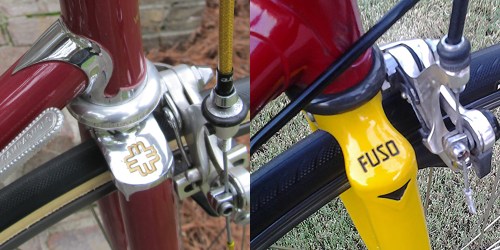
Just as my custom frames had my logo engraved in the crown, whereas my production Fuso frame had the name cast in it. (See above.)  I had to buy 1,000 crowns to get that feature. So why did my Fuso not have a cutout BB? By 1984 when production on the Fuso started, the fashion had run its course.

Some Italian framebuilders continued doing cutouts, but remember they had dies to stamp the holes. I was not about to invest that kind of money for the tooling and a press, for fad that had run its course, and was dying out anyway.


Hinterlasse einen Kommentar

Eingeordnet unter 2017, Ingenieur, Mob

Erst Pinarello. Jetzt Rapha.

Man kann über den Wert und die Schönheit eines Pinarello Rennrades verschiedener Meinung sein. Aber kann man verschiedener Meinung darüber sein, dass Pinarello nun zu Louis Vuiton, und Rapha den Eigentümern von Walmart gehört? Der große Ausverkauf.

Bildergebnis für pinarello

Pinarello, 1952 gegründet und 65 Jahr lang ein unabhängiger, großer, bekannter und innovativer Rennradhersteller in Familienbesitz wurde dieses Jahr an Louis Vuiton verkauft. Das ist bereits eine Weile her und keine Neuigkeit.

Rapha hingegen ist eher ein Unternehmen, dass man als Start-Up bezeichnen könnte; 2004 in London gegründet machte Rapha 2016  £63 Millionen Umsatz, im wesentlichen mit Bekleidung.

Beide Unternehmen erwirtschaften einen erheblichen Teil ihres Umsatz in England, wo sie als Sponsoren des Team Sky einen großen Bekanntheitsgrad haben. Es ist etwas schwierig vorzustellen, Pinarello Räder im gleichen Laden zu kaufen, wie Moet Champagner oder Louis Vuiton Taschen. Oder Rapha Klamotten in der Grabbelkiste im Walmart – was ist die Intentionen von Investoren? Eine reine Finanzanlage?

Zwei Artikel in Englisch dazu von RKP und Bicyling.com:

Rapha Sells

If you follow the merger and acquisition side of the bike biz then you’ve probably been aware that the leviathan of cycling apparel, Rapha, has been courting buyers. It was previously reported that LVMH, the group that owns Louis Vuitton (and scores of other luxury brands like Moët and Chandon) and ultimately bought Pinarello, was interested in Rapha, but they passed.

So who bought Rapha? Hold on to your seats.

RZC Investments. Likely, you are scratching your heads right now. It’s not a name you or anyone else in the bike industry has heard. There’s not much of a paper trail on them; one can find lots on other similarly named entities in Google.

But here’s what we can tell you: RZC is an investment group headed up by Steuart and Tom Walton. Of those Waltons. Not the John Boy and Mary Ellen variety, but the family out of Bentonville, Arkansas, who own Walmart. Steuart and Tom are grandsons and Tom is known to have kickstarted the trail building in Bentonville that has made it the hot spot for mountain biking for nearly 1000 miles in every direction.

While LVMH decided to against buying Rapha, RZC Investments had to fend off other suitors including Invus Group and Industrialinvest, which is a shareholder in Aston Martin. RZC is reported to have paid $200 million to CEO Simon Mottram and his investors. Shareholders in Rapha include Active, which has stakes in Honest Burger, Soho House and Leon.

So what did RZC get for its $200M? Well Rapha’s revenue for 2016 was £63m, which was up 30 percent over 2015. They are reportedly up 40 percent over this point last year. Considering the crazy multipliers over EBITDA that are seen in the tech sector, this was a terrific buy for RZC.

We at RKP have several unnamed sources that have told us there is an effort by Mssrs. Walton to bring more bike brands to Arkansas, to do for Arkansas what Boulder did for Colorado. There is no word on whether the apparel maker will move stateside, but if this is the kind of capital they are willing to pour into the bike sector, expect to see some other jaw-dropping purchases.


Rapha Bought  by Walmart Heirs; Here’s How the Brand Might Change

Founder Simon Mottram says he’s found the partners he wants for the long ride

AUGUST 10, 2017

Shiny Black Rapha Logo on a Matte Black Background


The terms “enthusiast cycling” and Walmart don’t overlap much; the massive volumes of bikes the big-box retailer sells every year aren’t exactly aimed at dedicated cyclists. But on Monday, the two came together for the first time with the news that boutique clothing brand Rapha sold a majority stake in the company to RZC Investments, a closely held investment vehicle run by Steuart and Tom Walton. The two are the grandsons of Sam Walton, who opened Walton’s Five and Dime in downtown Bentonville, Arkansas, and grew it into one of the largest companies in the world.

In some senses, Rapha’s sale wasn’t big news: Simon Mottram, who cofounded the company in 2004, has been a minority shareholder “since before launch,” he told Bicycling in an interview on Tuesday. He retains a small ownership stake and will continue as CEO. According to Mottram, RZC Investments’ acquisition of a majority stake in Rapha was mostly a liquidation of existing ownership interests from other investors, like Active Partners Private Equity. It’s not so much Mottram selling as swapping out investors.


So why do it?

“We are an international business and did some £85 million turnover, so there’s an opportunity for a more strategic investor who can take us to the next phase,” Mottram said.

RZC is not a classic private equity firm like Active Partners; it has no website or other public face, and that’s an important detail. RZC is “a shareholder with deeper pockets, there for a longer term,” said Mottram. “They offered something different in that, because they’re not a private-equity house, they’re not looking to flip the investment in a few years.”

When Mottram and cofounder Luke Scheybeler started Rapha in 2004, Mottram said he did not have a specific monetary goal for the company. “The business had financial roadmaps, but they were written to support what I wanted to do,” he said. Mottram is a self-described “brand guy” whose pre-Rapha career included advising luxury brands like Burberry. “Rapha is the first and only thing I’ve done on my own,” he said. “My ambition was to create a brand that encapsulated what cycling was to me and build an enduring company. That was what was most important, not to be a £10 or £100 million business.”


But Rapha did grow very quickly—in large part because it was successful at creating something different. Mottram wanted to create a clothing aesthetic that was different from what he saw in cycling at the time, but he wasn’t creating a cycling company. “I didn’t want to talk about being part of the cycling market,” he said. “We’re consumer-direct and don’t use the normal sales channels, and we don’t buy traditional media.”

In some ways, Rapha’s rise confounded traditional clothing companies. As Rapha expanded rapidly and entered the US market in the late 2000s, I spoke with representatives from several established clothing companies who were confused by Rapha’s reputation. When they compared features, fit, and fabric, Rapha wasn’t clearly better. So why the devotion? I responded that the clothing was secondary; Rapha created an image of cycling that cyclists responded to.

In the years since, it’s also produced its share of parody and backlash against the Rapha aesthetic of high-grain, black-and-white photos of serious roadies staring into the middle distance while suffering up rainy climbs or sipping perfect espresso pulls. But a key to understanding Rapha is that they create content as much as they create clothing, and it’s all part of producing emotions as a means of brand-building.

“Consumers don’t buy the way the bike industry thinks they do,” said Mottram, adding that that was especially true with the growth of online commerce. “The way you get under someone’s skin and inspire them to have a relationship with your brand isn’t by listing out features.” In a sense, think of Rapha as a creative agency that just happens to make money by selling clothing.

That made finding the right buyer essential. Mottram said that when the company hired an investment bank to help oversee the sale, “interest was quite overwhelming, actually.” Private equity investors and fashion brands were said to be interested. In the case of L Catterton, which bought a controlling stake last spring in Pinarello and was said to be close to acquiring Rapha earlier this year, the two entities were one and the same.

Ultimately, RZC paid £200 million, or $260 million US, according to reports in Sky and The Financial Times. Mottram declined to confirm or deny the sale price, or to specify whether that was the size of RZC’s investment, or the total value of the company. Mottram says Rapha has grown 25 percent or more every year of the business, and 10x revenue growth would be £210 million.

But of all the suitors, RZC won, and perhaps one reason why is that Tom and Steuart Walton are both committed cyclists. According to Bicycle Retailer and Industry News, RZC also own an investment in Little Rock-based Allied Cycle Works, a bikemaker that was created from the bankruptcy of Montreal-based Guru Cycles. But the Waltons have also contributed tens of millions of dollars to trail construction in the Bentonville area through the Walton Family Foundation. And they are significant donors to the International Mountain Bicycling Association (Tom Walton was a keynote speaker last year at the IMBA World Summit, held in Bentonville).

“I suppose at the end of the day, if people make the right decisions, it doesn’t matter if the investors, or the accountants or the guys in IT, are active cyclists,” said Mottram. “But it does matter, because of the sense of mission that Rapha has always had. Small things that might get in the way become non-issues because people will pull together more if they know where we’re trying to get to.”

So where is Rapha trying to get to?

Mottram says there’s a firm five-year plan, focused on more international growth. The US is its biggest single market, at roughly a quarter of sales. “But we’re 75 percent outside the UK now, and we see significant growth not just in the US but in Asia and Europe, and markets we’re not in yet: China, the Middle East, whole areas of the world that are right for us to develop into.”

Rapha wants to accelerate openings of its clubhouses—retail outlets that also serve as gathering spaces for events and the Rapha Cycling Club. That’s currently a 9,000-strong group of members who pay $200 a year for access to club chapter events, high-end bike rentals at clubhouses around the world, and first dibs on exclusive and limited-edition gear. “I haven’t even mentioned products yet, the core of what we do,” said Mottram, who promised that current R&D has some exciting products in the works.

Given that the Waltons are best known as mountain bikers while Rapha identifies most as a road brand, what might we see there, I asked?

“Cycling is such a sport of tribes, isn’t it,” said Mottram with a laugh. (For a more humorous take on this, check out our Field Guide to North American Cyclists.) “I’ve spoken to Tom and Steuart about this briefly, but we already sell a lot of product to mountain bikers already. And there’s a blurring of the lines now between the tribes, where your adventure bike with the relaxed geometry and clearance for 40c tires can do all these things, and I think clothing is headed that way too, with a slightly looser aesthetic. We’ll be serving more and more cyclists.”

Partly, but not solely, because they ride, the Waltons “get what we’re trying to do, and are invested for the long term. It’s not a short journey here; we’ve barely started.” Whatever direction Rapha goes, Mottram is confident he has the partners he needs for the long ride.


Ein Kommentar

Eingeordnet unter 2017, Bike Buisness, Mob

Campagnolo’s Zukunft.

Bildergebnis für campagnolo logo

Hier ein längerer und sehr guter Bericht von Cycling Tips über die Zukunft von Campagnolo auf Englisch. Ich würde den wie folgt zusammenfassen.

Erste Behauptung: Campagnolo geht es nicht gut, weil vor 20 bis 25 Jahren Rennräder individuell zusammengebaut wurden und der Kunde die einzelnen Komponenten dazu aussuchte. Heute kauft der Kunde ein komplettes Rad.

Kann ich aus eigener Erfahrung nicht so bestätigen. Ich habe immer komplette Räder im Laden gekauft, bis ich anfing mich für das basteln zu interessieren. Ich denke, dass muss noch länger her sein und galt vermutlich auch eher für den Mid/High End Bereich der Rennräder. Und auch nur in Italien. Egal, jedenfalls ist da alles viel zu lange her, als dass Campa da nicht schon lange daran hätte arbeiten können.

Zweite Behauptung: Die meisten Räder kommen heute aus Asien, wo sie auch montiert werden. Shimano und SRAM produzieren in Asien (China, Taiwan, Japan und Malaysia) und können so einfacher und schneller die Produktionen versorgen; im Gegensatz zu Campa, die nur in Italien und Rumänien produzieren.

Ja, mag sein. Obwohl z.B. die amerikanischen Hersteller (Trek, Cannondale, Specialized) und auch Canyon in Holland bzw. Deutschland montieren lassen für den europäischen Markt. In der Konsequenz ist es jedenfalls so, dass eine Nicht-Präsenz in der Erstausrüstung von Rennrädern dazu führt, dass es schwieriger wird Kunden zu finden, die ihre Räder mit Campa nachrüsten wollen. Da hat Campa gepennt.

Bildergebnis für campagnolo potenza

Dritte Behauptung: Aber das wird jetzt alles besser, weil Campa mit der Potenza einen Kokurrenten gegen Ultegra und mit der Centaur einen Konkurrenten gegen die 105er ins Feld schickt. Bianchi zum Beispiel verwendet diese Gruppen bereits an den 2018er Modellen.

Ich lach‘ mich tot. Bianchi, deren Marktanteil in Deutschland, vielleicht 1% ist, wenn überhaupt. Die großen Rennradmarken in Deutschland sind Canyon, Rose, Cube, Stevens, Focus, Merida, Scott, Giant, Trek, Cannondale, Specialized, Felt und die Eigenmarken der großen Ketten Stadler und BOC. Welche von diesen Marken hat denn heute Rennräder mit einer Campagnolo Erstausstattung im Programm? Ich würde einmal vorsichtig schätzen, dass außer Canyon (im High End mit der Super Record) kein einziger genannter Hersteller Campa verbaut. Und selbst Bianchi ist als italienischer Hersteller nach Pinarello und Wilier ebenfalls nur die Nummer drei.

Und warum sollte dies denn auch ein Hersteller tun – was hat denn eine Potenza oder eine Centaur Gruppe zu bieten, was eine Ultegra oder 105 nicht genauso gut kann? Abgesehen vom Aussehen, wo die Geschmäcker halt verschieden sind.

Ich sehe da schwarz für Campa. Mag ja auch sein, dass das Unternehmen die falsche Verkaufsstrategie hatte, aber ein Punkt der hier noch nicht genannt wurde ist, dass Campa eben heute keine richtig guten Produkte mehr hat, die sich von Shimano unterscheiden. Bzw. in einigen Bereichen, wie z.B. hydraulischen Scheibenbremsen, deutlich langsamer agiert als Shimano oder SRAM. Die wiederrum übrigens beide von der höheren Innovationsrate im MTB Segment profitieren – wo Campa nicht präsent ist.

Das passiert alles gerade zu einem Zeitpunkt, wo das Produkt mt dem bei Campa alles angefangen hat, der Schnellspanner, zunehmend durch Steckachsen ersetzt wird. Nachdem Campa bereits vor einigen Jahren das Bekleidungsgeschäft aufgegeben hat (sie wollten die Marke nicht an einen anderen Hersteller lizensieren), könnte ich mir gut vorstellen, dass sie in einigen Jahren nur noch Laufräder herstellen werden und keine Gruppen mehr. Andere italienische Marken wie z.B. Gipiemme. Ambrosio, Miche oder ITM zeigen ja, dass man als Komponentenhersteller auf Sparflamme weiter existieren kann.

Was natürlich schade ist, da dies im Endeffekt bedeutet, dass an allen Rennrädern dieser Welt in Zukunft nur noch Shimano oder SRAM verbaut wird. Es sei denn ein neuer Hersteller schafft es sich dort zu etablieren. Auf dem Horizont ist da derzeit nicht viel zu sehen: FSA, Microshift und Rotor erscheinen mir nicht schlagkräftg und innovativ genug um den Platz einzunehmen, den Campa offen lassen wird.


Bildergebnis für campagnolo tattoo

How Campagnolo plans to stay relevant in a changing market

by James Huang, July 28, 2017 Cycling Tips

Photography by James Huang

Few companies in the cycling industry have as storied a history as Campagnolo. Tullio Campagnolo invented the quick-release skewer in 1927 and introduced his famed Cambio Corsa derailleur system in 1940. Following closely on Shimano’s heels with integrated brake-shift controls, the original Ergopower was launched in 1992 — 14 years before SRAM debuted its first road groupset.

SRAM components have been used to two Tour de France overall victories — an impressive feat given how long its road range has been around — and Shimano can claim seven. But both of those number pale in comparison to Campagnolo’s 41 maillots jaunes. And while no official statistics exist on the matter, it’s a fair assumption that no other bicycle industry logo has been tattooed on more bodies.

Most of Campagnolo’s modern product offerings have been on-point, being highly competitive in terms of function and admirably lightweight — and there’s always been the uniquely Italian aesthetic that has long marked anything with that fabled winged emblem.

Campagnolo tattoo

There was once a time when Campagnolo parts could regularly be found on complete, off-the-shelf bikes as a more premium option for well-heeled buyers who were willing to pay a little extra for a bit of exclusivity and the mystique of Italian heritage. But that percentage has dropped precipitously, with only a handful of brands, usually Italian, currently offering Campagnolo on some higher-end builds. Not a single Specialized, Giant, nor Cannondale road bike today is available with Campagnolo components; Trek doesn’t even offer it as an option for its Project One custom program.h

Many have attributed Campagnolo’s decreasing mainstream visibility to the fact that it’s more expensive than what Shimano and SRAM offer, but as is often the case, the full story is a bit more complicated.

ITALY VS. THE REST OF THE WORLD

According to Campagnolo global press manager Joshua Riddle, it’s not the component companies, or even the components themselves, that have changed much over the years. Instead, he thinks it has more to do with the global business of how bikes are now manufactured and distributed.

“What’s happened during the last 20-25 years is a seismic shift in the way the market functions and the way people purchase bikes,” he said. “You used to pick out, and custom tailor, the bike how you wanted it: the hubs, the spokes, the nipples, the rims, the pedals, the crankset. The components become a centerpiece of that build. If you’re handpicking everything, then you’re going to do a lot of due diligence in terms of research, or at least pick the ones that emotionally create a visceral connection with what you see your ideal being.

“Nowadays in most countries you go into a bike shop and say, ‘I want a Specialized Venge’ or, ‘I want a Dogma’, and then whoever is working in the shop is going to say, ‘yeah, ok, I’ve got that in your size and in these flavors, built this way.’ You’re picking out a bike that a product manager has decided how to build, which is not necessarily a negative thing; it makes sense and it’s easier for the bigger companies to move products around the world.”

Trek Madone

There are plenty of reasons why this shift toward pre-configured bikes has happened. On the one hand, as Riddle pointed out, such a business model is easier for bigger companies to manage: fewer combinations and less flexibility make for more predictable supply chain logistics, as well as fewer SKUs for retail dealers to inventory. From a consumer point of view, it also makes for easier buying decisions: instead of agonizing over every individual part, now you just choose from Column A or Column B.

Either way, that shift has occurred, and whether by intent or willful ignorance, Campagnolo didn’t change how it did business to suit.

“In Italy, that seismic shift happened last, and Campagnolo was perhaps guilty of looking at Italy first and then applying what worked there to the rest of the world,” Riddle admitted. “In fact, Italy is one of the few markets where some of the bigger brands will still sell framesets today. Italy was the blueprint by which we tried to paint the entire world. We didn’t take the growing pains and make the moves necessary to be involved in the OEM game. So we lost a little bit of ground with regards to our competitors.”

MOVING PIECES

Coinciding with that shift in how mid-to-high-end road bikes were sold was an industry-wide move to Asian manufacturing. Shimano was already producing its components in Asia, of course, and although SRAM is an American company, its manufacturing has always been based there, too. Add in the fact that most frames were also being built in China or Taiwan, and it was a natural progression to centralize all operations for complete, pre-built bikes in that area.

Campagnolo, however, has long prided itself on its Italian roots. It’s an essential part of the brand’s identity, and to change that would tarnish one of the brightest aspects of the Campagnolo mystique. True to form, the company is still headquartered in Vicenza, and save for some electronic components for its EPS drivetrains, everything is manufactured either in Italy or Romania to this day.

“We’ve always stayed true to building things in the European Union and 100 percent in-house,” Riddle said. “Nothing’s offshore and nothing is outsourced. Everything apart from circuit boards and batteries for EPS is done in-house.”

Made in Italy

That steadfast commitment to remaining in Europe likely has just a minimal effect on aftermarket component sales. After all, since most aftermarket parts, regardless of brand, are manufactured in one place and then shipped somewhere else, the specific origin doesn’t matter much. Also, the recent and rapid rise in Asian wages has made eastern Europe more competitive in terms of labor costs than in years past.

James Winchester has served as a product manager for a wealth of well-known bicycle brands over the years. Currently at Masi Bicycles (and sister MTB brand, Haro), he also spent time at Fuji, Specialized, Schwinn, Felt, and Colnago — and as a self-admitted supporter of Campagnolo, he’s had a front-row seat to how the Italian company has approached the OEM side of the business.

“As bikes made their way to Asia and assembly moved to Taiwan, it became harder to get that stuff from Europe on there — and it was a lot more expensive,” he said. “Shimano is all made over there, SRAM is made there as well, so it’s really easy for an assembly factory to get the parts they need on a pretty good timeline. The Italian stuff coming from Italy or Romania is a lot harder to get a hold of — and usually more expensive because of the exchange rate.”

SHIFTING FOCUS

Campagnolo has historically devoted the bulk of its attention at the upper end of the market. Often considered more of an aspirational brand than Shimano and SRAM, Campagnolo has long operated on the premise that if it continued to concentrate on high-end, lust-worthy components, the market would figure out a way to put them on their bikes. Campagnolo didn’t need to cater to the masses, or so the thinking went; they would come to Campagnolo, and the finances would just naturally iron out from there.

That approach may have worked before the “seismic shift” that Riddle references, but the fact of the matter is that high-end product alone doesn’t pay the bills. The Ford GT is a bona fide supercar, for example, but it’s the Focus and Fiesta that keep the lights on and supply the funds to develop the higher-visibility halo products. Likewise, mid-range bikes don’t generate the same sort of visceral desire as the expensive stuff, but as much as desire plays well in magazine ads and Instagram feeds, volume is what matters when it comes to the bottom line.

“It’s almost like Campagnolo was a victim of its own success,” said Winchester. “If you ask me, I would suspect that most of Campy’s sales are Super Record, Record, and Chorus in the aftermarket. It’s harder for them to sell the lower-cost stuff because of exchange rates and stuff like that. They just never wanted to play down that low [in the pricing spectrum], I think.

“But the vast majority of bikes are not at that spec,” he continued. “Yeah, it’s great to spec a high-end Dura-Ace or eTap or Record bike, but the number that you sell is minuscule compared to the 105, Tiagra, and Sora bikes, which are the real bulk of the market. Campagnolo is something you ride if you’re ‘in the know’ — the secret handshake, the secret knowing smile. Everyone knows Shimano, but [Campagnolo] isn’t as well known, especially among non-cyclists.”

Shimano Sora groupset

That now seems to be changing — or at least, Campagnolo has finally put in place some measures to help swing the needle the other way.

Campagnolo introduced the new Potenza groupset last year as a direct competitor to Shimano Ultegra, and recently followed up with Centaur, which is intended to go head-to-head with Shimano 105. Both options rival their Shimano counterparts in terms of price and weight on paper, and their overall performance seems on-par as well — and the long overdue introduction of its H11 road disc brake components won’t exactly hurt, either.

“Potenza was a step in the direction of getting more OEM business,” Riddle said. “We’re taking on the heavy-hitter Ultegra — the OEM par excellence groupset — so that has been an uphill battle. It’s difficult for a product manager to justify something that’s not Ultegra in that middle section. We think we have a good offering, but [Ultegra] is a safe spot for a product manager.

Campagnolo Centaur crankset

Bike brands are understandably reluctant to show their cards in terms of MY2018 spec, but according to Riddle, Campagnolo’s recent moves are starting to bear some fruit — and in turn, the company is starting to make its way back to more widespread relevance in the mass market.

“Bianchi, for example, is really keen on partnering with Campagnolo,” Riddle said. “We’ve been partners for quite some time. They took a leap of faith with Campagnolo and built up quite a few units with Potenza, and then we, on the other hand, helped push those in stores with Campagnolo signs and what have you. It’s been more of a collaboration, if you will — not only as a consumer and client, but as team, helping to drive home the fact that there’s a little more value added behind that than what was considered to be the norm. If you can take on that risk in tandem, there are some dividends to be made there.”

Bianchi Oltre Potenza

Winchester agrees that Campagnolo is finally moving in a positive direction, specifically praising the U.S. office — based in Carlsbad, California — for its efforts to increase the brand’s visibility.

“The more demand you can get on the sales floor, the easier it is for me to put a part on there,” he said. ” So they’re doing the right thing: driving demo cars around the country, doing shop visits, explaining their stuff. That’s how you get stuff on bikes. It’s not about forcing product managers to spec; it’s getting demand for it in the market.”

Nevertheless, that “safe” aspect is something Winchester knows all too well, and it’s clear that Campagnolo still faces a long and steeply uphill battle — and not every product manager is willing to gamble.

“For sure, we have [looked at Potenza and Centaur],” he said. “For 2018, [Masi] will have three Campy bikes in the line, which is a lot for a small brand like ours. It’s all focused on the steel side of the things, though. Potenza looks pretty great, but looking at it from an international standpoint, it’s hard to go wrong with Ultegra or 105, especially with the new Ultegra R8000 this year, which is 90% of the look and feel of Dura-Ace R9100. From a pure engineering standpoint, it’s hard to compete with Shimano, especially at those price points.

Shimano Ultegra R8000 groupset

“It’s hard,” he admitted. “If you spec a bike and go out on a limb, and the bike doesn’t get any traction in the marketplace, it comes back to you. We’ve had that same issue with SRAM stuff [in Europe]. In the past, the SRAM road stuff has really been a non-starter for us. So we’re a little gun-shy on stepping outside of the norms. As a product manager, you really have to make sure you’re not trying to step outside what the market is looking for.”

Bear in mind that Campagnolo isn’t entirely abandoning its previous practices, and Riddle stresses that the company is very much looking at the long game. The past few years may have been rough, but Potenza and Centaur should certainly help the company regain some spec and mainstream visibility. The resurgence of the hand-built market is also playing in the company’s favor, and Riddle suggests that the rise of online shopping is bringing back the practice of handpicking individual components. There are plans to better serve the growing gravel and adventure markets, too.

“Maintaining true to your roots is never a negative,” Riddle insists. “Sometimes it doesn’t pay the dividends that you think, but in the long term, it’s like investing in the [stock] market: if you can keep your blood cold, as they say in Italy, and be able to ride the highs and lows, that trend is always going to be moving up. Obviously there are some growing pains associated with that, and we’ve taken our licks. But I think the longer we move forward, people will be willing to invest in those ideals that Campagnolo represents because it will become increasingly rare.”

It should perhaps also be mentioned that when it comes to the currency of cool-factor, the company still has some money in the bank. How much that plays into the buying decisions of both end-users and product managers remains to be seen in the coming seasons, but business hiccups and all, there’s still a strong sense of desire when it comes to Campagnolo road components.

“We all love Campagnolo,” said Winchester. “I have Super Record EPS on my own bike, and I love it, but it’s the kind of thing that people seek out more than anything else. If there’s a product manager that doesn’t have a Campagnolo bike in their garage, they’re lying to you.”

ba5df24f8eb41ba710f7d4ea3c77397e--bike-tattoos-campagnolo

Hinterlasse einen Kommentar

Eingeordnet unter 2017, Bike Buisness, Mob

Mallorca. 726 km und 10.472 Höhenmeter später.

1710 Malle Lars schwimmt 3

Mallorca. Wenn man noch nie da war, dann stellt man sich die Insel entweder so vor wie auf dem Foto oben (man steht drauf), oder eben wie auf dem Foto unten (man schaut drauf). Abgesehen von Meer und Sangria hat Mallorca auch Radfahrern etwas zu bieten: Straßen.

Bildergebnis für ballermann

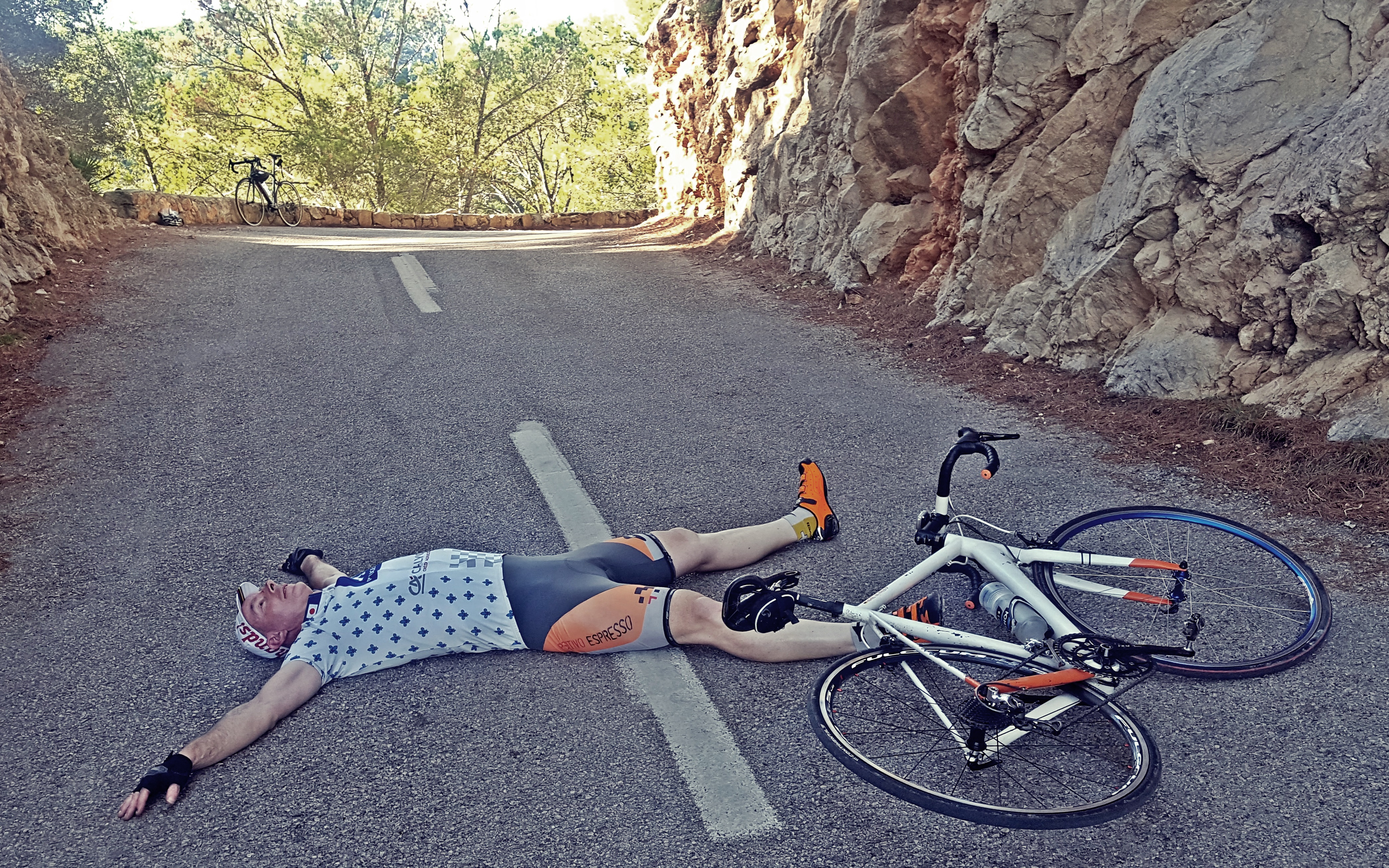
Lars und ich hatten uns entschieden unser herbstliches Trainingscamp auf Mallorca mit Basis in Alcudia zu halten. Nachdem die Saison 2017 nun zu Ende ist und wir wirklich gut in Schuss sind, wollten wir noch einmal richtig hart trainieren, um danach … ja, was eigentlich? Ja genau, um im Winter die ganze gute Form verkümmern zu lassen und im Frühjahr wieder mühsam von vorne anzufangen. Deshalb haben wir uns auch richtig reingekniet mit dem Ergebnis, dass ich diverse hunderte Kilometer und mehr als 10.000 Höhenmeter später so aussah:

1710 Malle Fab 6

Lars war da schon zuhause, vermutlich in ärztlicher Behandlung, da er auch nicht viel weniger gefahren, oder weniger fertig war.

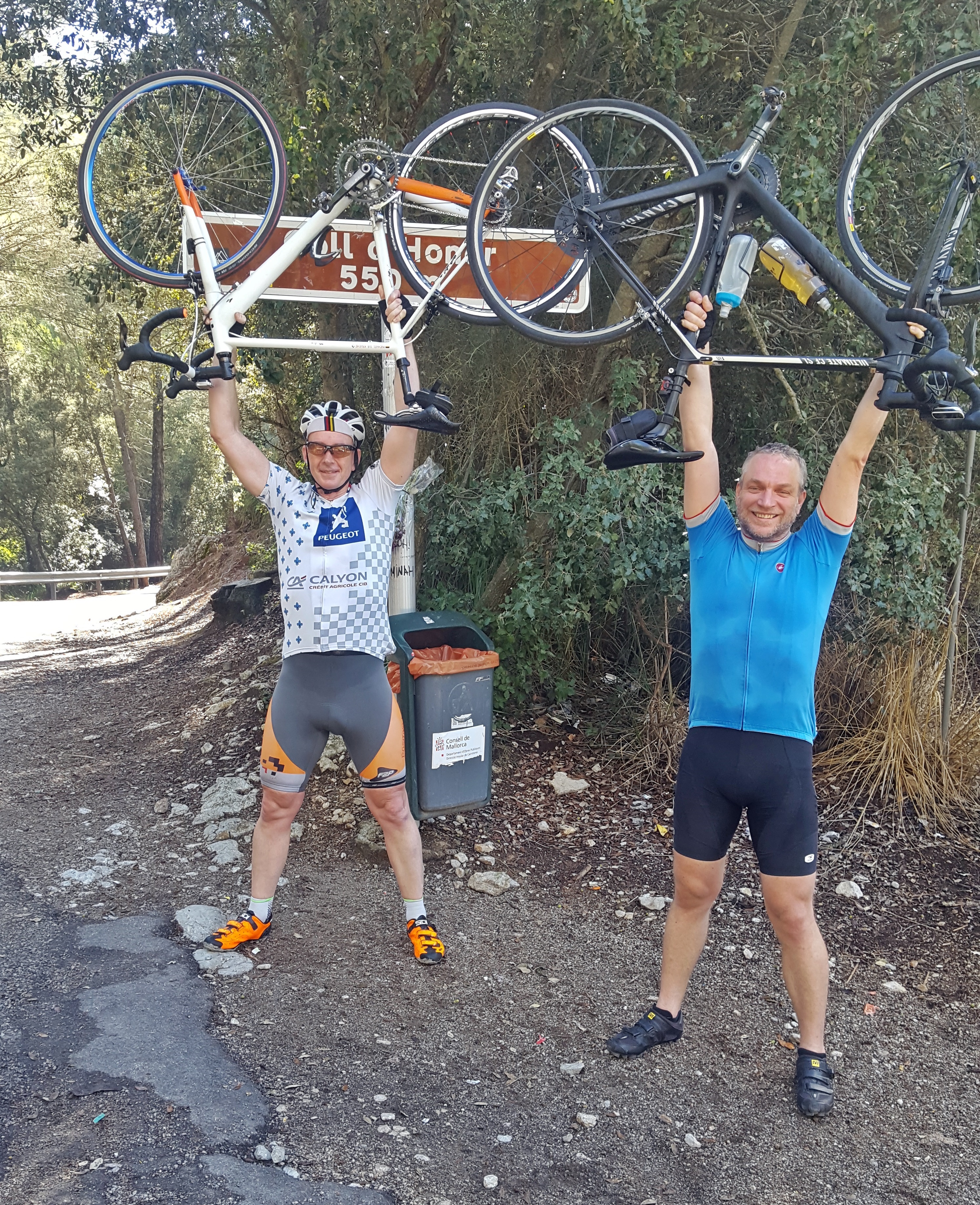
Während der 10 Tage dort sind wir fast jeden wichtigen und schönen Anstieg auf der Insel gefahren: Formentor, Sa Calobra, Col Soller, Gallilea, Orient, Randa, Col Es Grau, Col Honeur….einzig und allein den Puig Major haben wir uns für das nächste Mal aufgespart. Obwohl ich nun bereits recht oft auf der Insel war, habe ich es noch nie geschafft, den einmal von Soller aus hochzufahren.

1710 Malle Mob Lars07

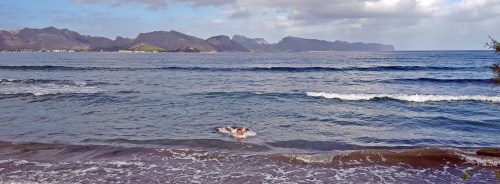
Egal. Natürlich kann man auf Mallorca auch noch andere Dinge machen außer Radfahren: Essen, trinken und schlafen zum Beispiel sollen dort auch ganz prima sein. Und wir hatten auch großartige Pläne, was wir diesmal sonst noch unternehmen würden: Wandern, schwimmen, shoppen, vielleicht auch Paintball, Fallschirmspringen, Stockfechten oder einen Kochkurs besuchen. Und natürlich haben wir absolut nichts davon gemacht, wie jedes Mal. Na ja, so ganz richtig ist das nicht, denn Lars ist dann doch drei Stunden bevor sein Flug nach Hause ging noch einmal für 17,3 Minuten ins Meer gesprungen.

1710 Malle Lars schwimmt 1

Lars. Oder die rote Boje mit Bart.

Und mehr oder minder zufällig waren wir beim „Festival der Quallen“ in Muro.


Und ich war später noch zusammen mit Kathrin, Fabian, David, Juliane und den „Kindern“ auf einem Partyevent auf einer größeren und alten Finca.

1710 Malle Jul 8

Einer der Höhepunkte war der Abstecher auf das Velodrom in Sineu, eine 300 m lange Radrennbahn aus Beton auf der wir uns ausgetobt haben.

1710 Malle mit Lars151710 Malle mit Lars231710 Malle mit Lars28

Die beiden letzten Tage hatten es doch noch einmal richtig in sich. Da bin ich mal wieder Rad gefahren. Am Dienstag zunächst mit Fabian von Es Capdella hoch nach Galilea und weiter an die Nordküste und die Corniche lang.

1710 Malle Fab 1

1710 Malle Fab 2

Lambretta Club

1710 Malle Fab 81710 Malle Fab a

1710 Malle Fab b

Jeder der in Japan war wird dies hier sofort verstehen.

Es lief super. Ich fühlte mich gut und schnell und sprintete die Berge hoch. Am nächsten Tag sind wir zusammen mit David und seinem 82-jährigen Vater Alan von Bunyol aus nach Orient hochgefahren. Alan war lange Jahre als Amateurfahrer im England der Fünfzigern und Sechzigern erfolgreich.

Zu einer Zeit also, als viele von uns sportlich noch im  Kinderjudo, Krabbelgruppe oder Babyschwimmen unterwegs waren, oder sowieso nur Proteine in der einen oder anderen Form. Beim Anstieg nach Orient fiel ich langsam hinter David und Alan zurück, obwohl ich wirklich alles gab und auch in guter Form war. Wow, so ein 82jähriger kann richtig schnell sein, vor allem wenn er auf einem e-bike sitzt. Alter, Leistungsfähigkeit und letztendlich auch die Verbreitung dieser Maschinen ändern so langsam aber sicher meine Meinung („unfaires Zeuch!“) darüber.

Das war auch erst einmal die letzte Ausfahrt mit meinem Canyon Positivo; das Rad habe ich auf Mallorca gelassen für weitere Abstecher. Im nachhinein muss ich sagen, dass dieses Canyon bisher das beste Rad war, was ich hatte. Ich hatte es 2011 für die Transalp gekauft, denn die wollte ich auf keinen Fall mit meinem bockharten Cervelo Soloist fahren. Also kaufte ich mir einen Cayon Ultimate CF SL Rahmen und ließ ihn irgendwo in der ehemaligen DDR lackieren, weil ich nicht wollte, dass auf dem Rahmen irgendwo Canyon draufsteht. Und dann schraubte ich die ganze Komponenten vom Cervelo ab und baute die auf dem Canyon an. Ein schnelles, bequemes Rad mit guter Kurvenlage, dass ich immer gerne gefahren bin. Es gab natürlich in der ganzen Zeit auch ein paar Probleme, aber nie mit dem Rahmen, sondern nur mit den Komponenten und den Laufrädern. Auf Mallorca nun z.B. versagte der Schwalbe Reifen hinten:

1710 Malle Mob Lars04

Ich schätze, das Canyon hat nun so etwa 40 – 50.000 km Gesamtlaufleistung und jede Menge Macken. Für Mallorca ist das OK, aber ich brauche unbedingt etwas neues. Ist ja auch schon unterwegs, mehr oder minder.

Danke an Lars, Kathrin, Fabian, „die Kinder“, David und Juliane für die gute Zeit auf Mallorca und die vielen Eindrücke. Hier noch ein paar:

1710 Malle Fab 31710 Malle Jul 11710 Malle Jul 21710 Malle Jul 41710 Malle Jul 51710 Malle Mob Lars011710 Malle Mob Lars051710 Malle Mob Lars061710 Malle Randa


Ein Kommentar

Eingeordnet unter 2017, David, Fabian, Juliane, Mob, Touren