Archiv der Kategorie: Autoren

Gute Menschen, die auf diesem Blog schreiben.

Alles, wirklich alles über Campagnolo Monoplaner Bremsen

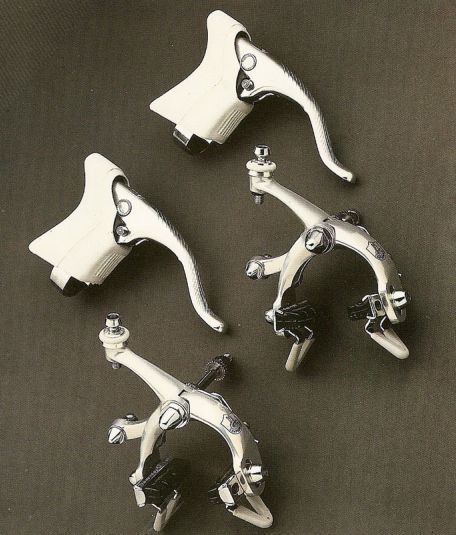
 Campagnolo Chorus D500 Monoplaner 1987

Abbildung 1: Campagnolo Chorus Monoplaner 1987
Quelle: Campagnolo Chorus Katalog 1987


1. Historische Einordnung

Mitte der Achtziger Jahre hatte Campagnolo drei Komponentengruppen in seinem Produktportfolio: Die Record als qualitativ hochwertigste, und darunter die Victory und Triomphe Gruppen (Campagnolo Catalogue 18 bis, 1985). In der Record Gruppe wurden 1986 zum ersten Mal andere, als einachsige Bremsen (single Pivot) eingesetzt, die legendären und umstrittenen Delta Bremsen (Cyclyng 2012). Die Victory und Triomphe Bremsen hingegen waren noch konventionelle einachsige Bremsen, deren grundlegendes Design aus den Siebzigern stammte.

Die japanische Konkurrenz hatte technisch in den Jahren zuvor aufgeholt: Bei Shimano gab es mit der 600EX 6207 (Velobase 2007a) und 6208 (Velobase 2008) funktionell gute einachsige Felgenbremsen und die Dura Ace 7300 AX (Velobase 2007b) war das aerodynamische Gegenstück zur Campagnolo Deltabremse. Suntour hatte mit der Superbe Pro (Velobase 2007c) und der Cyclone (Velobase 2009) ebenfalls technisch gute Bremsen mit einem guten Preis-Leistungsverhältnis auf dem Markt.

Campagnolo füllte 1987 die Lücke zwischen der Record und der (ab 1987: Nuovo Triomphe bzw. Victory) Triomphe Gruppe durch die Chorus Gruppe, mit der das Unternehmen Monoplaner Bremsen auf den Markt eingeführte (Campagnolo Chorus Catalogue 1987).

2. Funktionsprinzip

Monoplaner Bremsen sind einachsige Bremsen und  haben zwei Bremszangen die an der Achse miteinander verschränkt sind. Der rechte Bremsarm ist in der Mitte geteilt und aus dieser Teilung ragt der Arm an dem der Zug fixiert wird. Abbildung 2 zeigt das Prinzip.

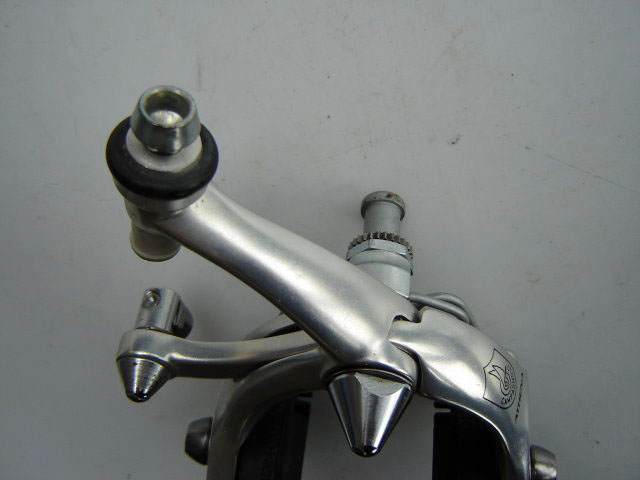
Campa Monoplaner Bild 1 Linker Bremsarm

Campa Monoplaner Bild 2 Veschränkung

Campa Monoplaner Bild 3 Rechter Bremsarm

Abbildung 2: Prinzip der Monoplaner am Beispiel der Campagnolo Athena Monoplaner
Quelle: Fotos des Autors

Nach Aussage von Campagnolo hat die Konstruktion den Vorteil, besonders stabil and stromlinienförmig zu sein. Zusammen mit dem aus hochfestem Stahl gefertigten Achsbolzen und der geringen Fertigungstoleranz sollten Vibrationen beim Bremsen, insbesondere bei der Vorderradbremse vermieden werden. Der Bremskörper hat keinen Schnellverschluss, dieser ist nun in den Bremshebel integriert (Campagnolo Chorus Katalog 1987). Dieses Prinzip wird bis heute bei Campagnolo Bremsen verwendet und soll die Sicherheit erhöhen indem auch bei geöffnetem Bremsverschluss noch gebremst werden, bzw. dass auch beim Fahren der Schnellverschluss am Lenker wieder geschlossen werden kann.

Man kann Monoplaner Bremsen schnell identifizieren, indem man auf die rechte Seite (also die Seite auf der der Zug fixiert ist) betrachtet und prüft, ob der Arm mit der  Zugfixierung hinter dem rechten Bremsarm liegt. Oftmals und irrtümlich werden Campagnolo Bremsen aus dieser Epoche als „Monoplaner“ bezeichnet, wenn Sie aus der gleichen Zeit, aber aus Gruppen stammen, bei denen das Monoplaner Konstruktionsprinzip noch nicht angewendet war.  So waren z.B. die Bremsen der Athena Gruppe von 1988 bis 1993 konventionelle Einachsbremsen, auch wenn die Chorus Gruppe im gleichen Zeitraum nach dem Monoplaner Prinzip konstruiert war (Campagnolo Athena Catalogue 1988).

3. Übersicht der Monoplaner Versionen und Varianten

Monoplaner Bremsen waren zehn Jahre, von 1987 bis 1997 im Angebot von Campagnolo; neben der Chorus Gruppe, wurden sie auch in den Gruppen Athena, Veloce und Mirage verwendet. In diesen letzten drei Gruppen wurden jeweils Einachsbremsen (Single Pivot) durch die Monoplaner Bremsen ersetzt; die Monoplaner Bremsen wurden dann wiederum beim nächsten Produkte Update durch Zweiachsbremsen (Dual Pivot) ersetzt. Einen Vorläufer in der Chorus Gruppe gibt es nicht, da die Chorus Gruppe 1987 neu eingeführt wurde. 1994 wurden auch die Chorus Monoplaner durch modernere Zweiachsbremsen ersetzt.

Im Folgenden werden Monoplaner Bremsen in verschiedenen Gruppen als Versionen, und verschiedene Bremsentypen innerhalb einer Gruppe als Varianten bezeichnet.

Innerhalb jeder Gruppe, mit Ausnahme der Mirage, gab es mehrere Varianten der Monoplaner Bremsen. Campagnolo führte in den Neunzigern regelmäßige Updates der Gruppen durch, diese wurden durch jährlich neu aufgelegte Kataloge dokumentiert.

Campa Monoplaner Bild 4 Gruppen Entwicklung

Abbildung 3: Versionen und Varianten der Campagnolo Monoplaner Bremsen
Quelle: Grafik des Autors nach Campagnolo Katalogen 1987-1997

Campagnolo folgte dem Prinzip, die Technik qualitativ höherer Gruppen über die Jahre in die qualitativ darunter liegenden Gruppen zu übertragen, wie in Abbildung 3 gut zu erkennen ist.  Nachdem 1994 die Chorus Gruppe, wie die höherwertige Record Gruppe mit Zweiachsbremsen ausgestattet wurde, kamen Monoplaner Bremsen als Ersatz für Einachsbremsen in der nächstniedrigen Athena Gruppe zum Einsatz. Dieses Prinzip setzte sich auch in den Gruppen Veloce und Mirage weiter fort, bis 1998 die Bremsen aller Gruppen als Zweiachsbremsen ausgeführt wurden.

Während die Unterschiede in den Varianten innerhalb einer Gruppe gut zu erkennen sind, sind die Unterschiede nachdem eine Version in eine niedrigere Gruppe „transferiert“ wurde teilweise minimal. So sind z.B. die Veloce BR-12VL von 1995 und die Mirage BR-12MI von 1996/97 quasi identisch, bis auf den Gruppenschriftzug „Veloce“, bzw. „Mirage“ auf dem linken Bremsarm. Durch die Ersatzteilkataloge von Campagnolo in diesen Jahren ist dokumentiert, dass ein Großteil der Einzelteile der Bremsen unabhängig von den Gruppen identisch ist.

Mit einer Produktionszeit von sieben Jahren wurden die Chorus Monoplaner Bremsen am längsten hergestellt und werden daher vielmals auch als die klassischen Monoplaner Bremsen bezeichnet. Die Monoplaner Bremsen der anderen drei Gruppen waren jeweils nur zwei bis drei Jahre im Angebot und sich deswegen generell seltener.

Als besondere Variante gab es die Chorus Monoplaner Bremsen BR-02CH mit „Graphite Finish“. Diese besondere Art der Oberflächenveredlung in dunklem grau-schwarz wurde bei den Komponenten der Chorus und Athena Gruppen kurzzeitig ab 1990 angeboten. Dieses Finish ist anders als das „Century Finish“, dass ausschließlich der Record Gruppe vorbehalten war (Tears for Gears, 2009).

4. Merkmale der Chorus CH-051/CH-052 Monoplaner Bremsen 1987-89
Campagnolo Monoplaner Chorus Alte Version 01

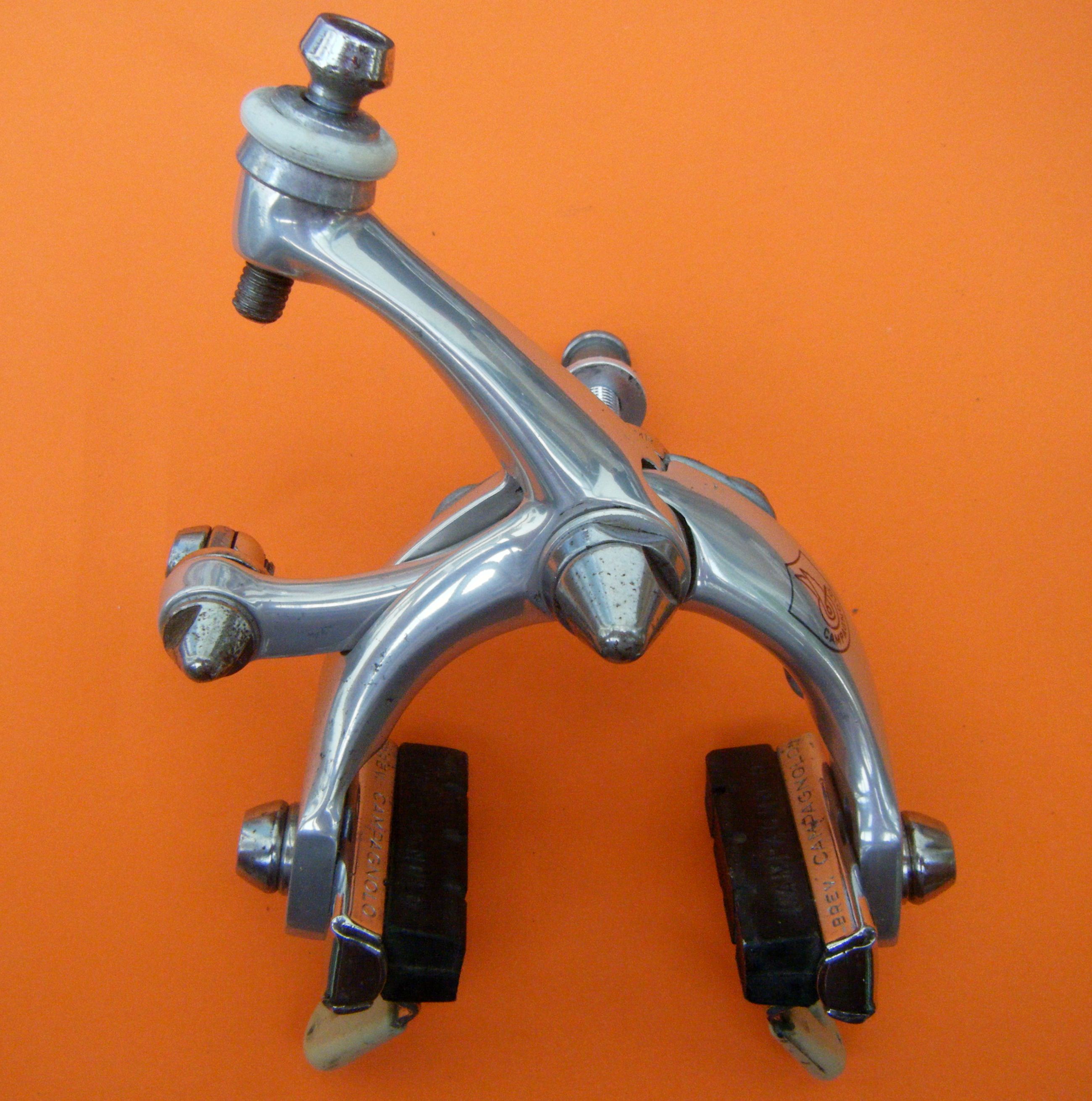
Abbildung 4: Campagnolo Chorus Monoplaner Bremse CH-051 (1987-1989)
Quelle: Fotos des Autors

Diese Monoplaner Bremsen waren die ersten auf dem Markt und wurden von 1987 bis 1989 verkauft; technisch sind sie die aufwändigsten Monoplaner Bremsen von Campagnolo und bestehen aus jeweils 29 Einzelteilen (Campagnolo Dealer Parts Catalogue 1988) Vermutlich gibt es innerhalb dieses Zeitraums keine weiteren Varianten der Bremsen; heute verkaufte Bremsen mit anderen Bremszugseinstellern, schwarzen Gummiringen der Bremszugseinsteller oder Bremsschuhen bzw. Bremsbelägen sind vermutlich zu einem späteren Zeitpunkt umgerüstet worden.

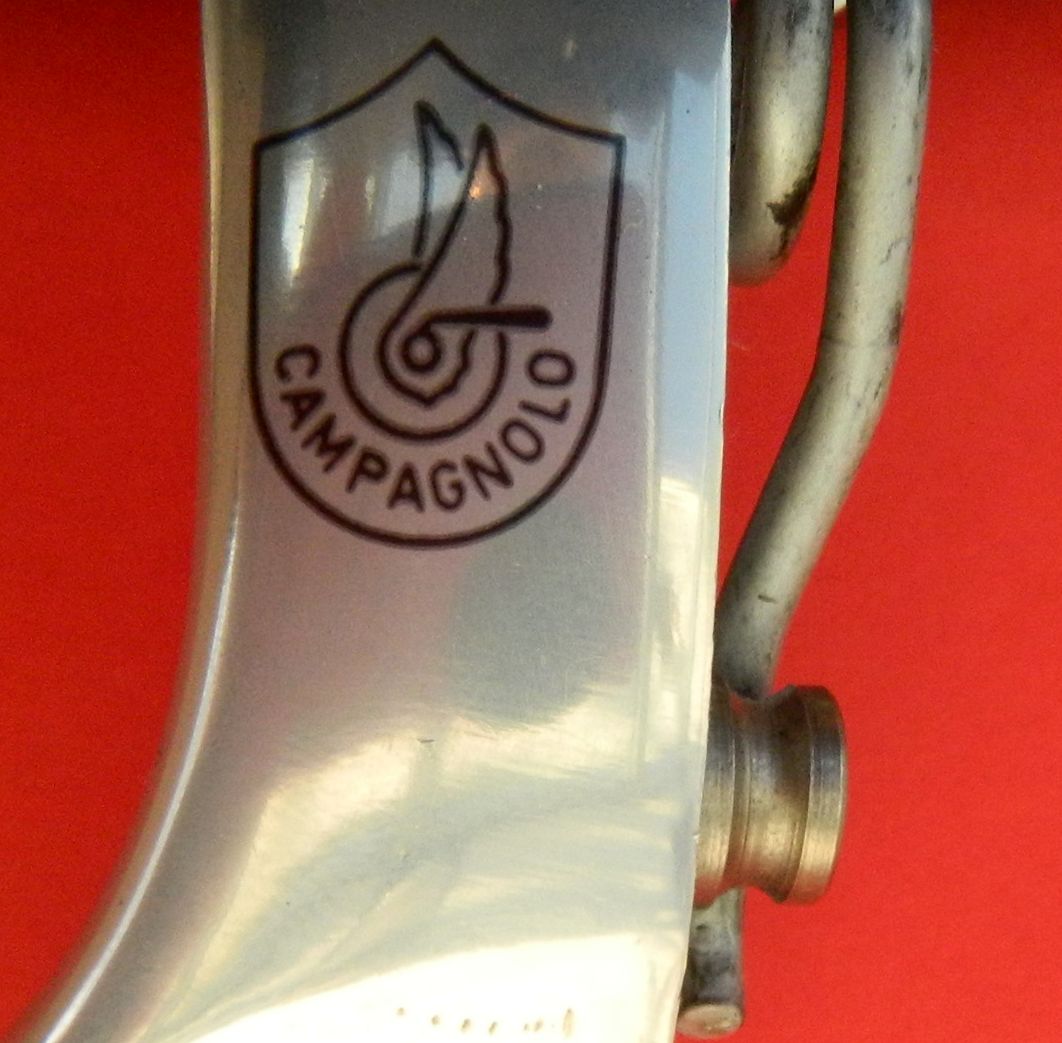
Im Gegensatz zu den anderen Campagnolo Gruppen dieser Epoche, verzichtet Campagnolo auf die Gruppenbezeichnung „Chorus“ unter dem Campagnolo Schild auf dem linken Bremsarm. Sollte nicht der Gruppennamen nachträglich entfernt worden sein, sind Campagnolo Bremsen dieser Epoche ohne Gruppenbezeichnung immer aus der Chorus Gruppe.
LOG 1 Chorus at

LOG 3 Athena

Abbildung 5: Gruppennamenmarkierung auf dem linken Bremsarm. Oben Chorus, unten Athena
Quelle: Fotos des Autors

Da Campagnolo zu diesem Zeitpunkt noch Siebenstellige Teilenummer verwendet, ist es nicht möglich präzise zu sagen, welche der Einbauteile bei der nächsten Variation verwendet wurden. Gut unterscheidbar sind Chorus Monoplaner Bremsen dieser Variation von denen anderen Gruppen und der neueren Chorusvariante BR-02CH an den folgenden Merkmalen:

Auf der Rückseite der Bremse sind die Federn mit rundem Querschnitt am Ende nach außen gebogen and liegen auf den gelagerten Widerlagern der Bremsarme auf. Diese aufwändige Konstruktion wurde nur in den Chorus Varianten CH051/052 und BR-02CH angewendet.

ch1b

Abbildung 6: Federkonstruktion mit Lagern, Campagnolo Chorus CH-051/052
Quelle: Fotos des Autors

Im Gegensatz zu allen anderen Versionen der Monoplaner Bremsen, kann die spitze Mutter am vorderen Ende des Achsbolzens abgeschraubt werden. Dies macht eine zusätzliche Unterlegscheibe vor den Bremsarmen erforderlich. Dagegen ist die Halterung der Federn am Achsbolzen fest and kann nicht demontiert werden. Bei allen Monoplaner Bremsen der anderen Gruppen ist es genau umgekehrt, die spitze Mutter vorne ist fixiert und der Federhalter kann abgeschraubt werden.

ch2b

Abbildung 7: Aufbau des Achsbolzens, Campagnolo Chorus CH-051/052
Quelle: Fotos des Autors 

Die Bremszugsfixierung rechts ist ebenso wie der Achsbolzen aufgebaut, d.h. die spitze Mutter vor der Bremse kann entfernt werden. Damit lässt sich auch dieser Teil der  Bremse komplett in seine Einzelteile zerlegen. Alle anderen Versionen der Monoplaner Bremsen haben eine wesentlich simplere, einteilige Konstruktion, die mit einem Sprengring gesichert ist. Die Bremszugfixierung wird mit einen Sechskant 4 mm gelöst, spätere Versionen sind, wie die Schrauben der Bremsschuhbefestigung mit 5 mm Innensechskant ausgestattet.

ch3b

Abbildung 8: Aufbau der Bremszugfixierung, Campagnolo Chorus CH-051/052
Quelle: Fotos des Autors

An der Vorderradbremse ist am Bremsarm rechts hinter der Aufnahme des Bremszugeinstellers ein Gummistopper angebracht, damit bei extremem Lenkereinschlag der Rahmen nicht beschädigt wird. Dies ist weder bei der Hinterradbremse, noch bei anderen Versionen der Fall.

ch6b

Abbildung 9: Gummistopper an der Vorderradbremse, Campagnolo Chorus CH-051/052
Quelle: Fotos des Autors

Die Bremszugeinsteller haben weiße O-Ringe und die Gravur „Campagnolo Brev. Inter.“ Dieses Merkmal ist einzigartig für die Monoplaner Bremsen der ersten Chorus Variante.
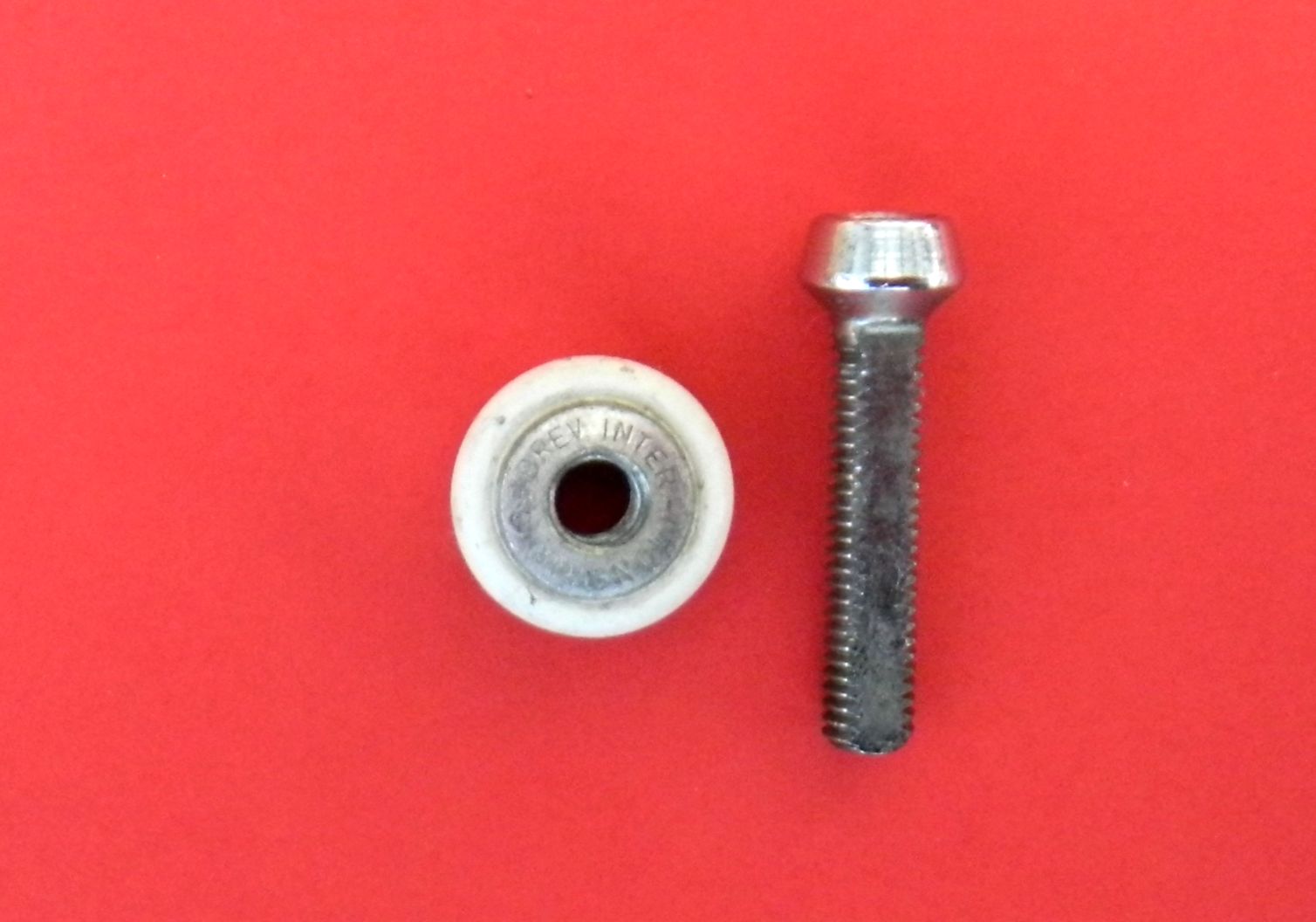
BZE 1 Chorus

Abbildung 10: Bremszugseinsteller , Campagnolo Chorus CH-051/052
Quelle: Fotos des Autors 

Als Bremsbelägen wurden eckige, schwarze Gummis verwendet, die in Bremsschuhen aus Aluminium mit weißen Plastiküberzügen über den Einfädelhilfen stecken. Die Bremsbeläge haben die Gravur: „Brev. Campagnolo“. Die Bremsschuhe können konventionell, d.h. in schmalen, geschlitzten Bremsarmen mit M6 Schrauben mit Innensechskant 5 mm fixiert werden.

SCU 1 Chorus alt

Abbildung 11: Bremsschuh, Campagnolo Chorus CH-051/052
Quelle: Fotos des Autors

Ein Paar Bremsen der Chorus Monoplaner Bremsen CH051/052 wiegt 260 Gramm, ohne Bremsschuhe und Befestigungsmaterial. Für das Jahr 1990 wurden die Bremsen dann nach drei Jahren auf dem Markt leicht überarbeitet.

Mehr Informationen im Campagnolo Chorus Katalog von 1987 und im 1988 Campagnolo Dealer Parts Katalog.

5. Merkmale der Chorus BR-02CH Monoplaner Bremsen 1990-93

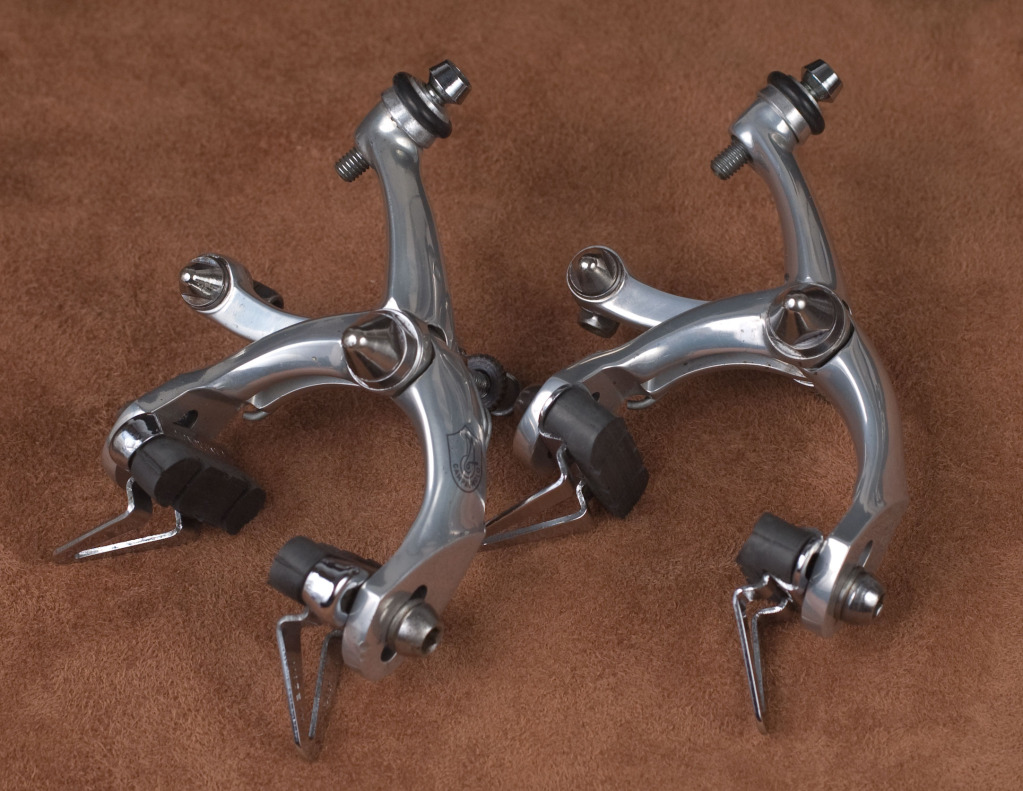
Die Chorus Monoplaner Bremsen der zweiten Generation, Code BR-02CH, wurden von 1990 bis 1993 produziert und lösten die erste Generation der Chorus Monoplaner Bremsen CH051/052 ab.
Campagnolo Monoplaner Chorus BR-02CH

Abbildung 12:  Campagnolo Monoplaner Chorus BR-02CH 1990-1993
Quelle: Ebay USA

Die Chorus BR-02CH Bremsen wurden mit einer Variante von 1990 bis 1993 hergestellt. Diese Variante ist die „Graphite“ Oberflächenveredlung, die optional im Campagnolo Katalog von 1990 angeboten wurde (Campagnolo Kataloge 1991, 1992 und 1993).

Monoplaner Graphite Finish 2

Abbildung 13:  Campagnolo Monoplaner Chorus BR-02CH in Graphite Finish 1990
Quelle: Ebay USA

Die wesentliche konstruktive Änderung im Vergleich zu der Chorus Vorgängervariante sind die neugestalteten Bremsarme. Die unteren Enden der Bremsarme, also dort wo die Bremsschuhe befestigt werden, sind wesentlich wuchtiger und „fleischiger“ ausgeführt. Diese Form der Bremsarme wird im Allgemeinen als das „klassische Monoplanerdesign“ empfunden und wurde anschließend bei den Monoplaner Bremsen der Athena Gruppe übernommen.

cj3b

Abbildung 14:  Vergleich der Bremsschuhaufnahme BR-02CH links und C051/052 rechts
Quelle: Foto des Autors

Darüber hinaus führte Campagnolo weitere kleinere Updates durch; die Bremszugeinsteller sind nun mit schwarzen, statt mit weißen O-Ringen ausgestattet.

Die Bremsschuhe sind nun die gleichen wie bei der Record Gruppe, d.h. die Bremsschuhe sind an den Enden gerundet und ohne Plastiküberzüge an den Einfädelhilfen (HP Blocks).

Die Schraube zur Bremszugfixierung kann nun mit einen 5 mm Sechskant- (vorher 4 mm) und einen 9 mm Schraubenschlüssel geöffnet werden.

SCU 5 Chorus neu

Abbildung 15:  Chorus Monoplaner BR-02CH mit Bremsschuhen HP Blocks
Quelle: Campagnolo Katalog 1991

Durch diese Änderungen stieg das Gewicht eines Bremsenpaares leicht von 260 auf 273 Gramm an.

6. Merkmale der Athena BR-12AT und BR-22AT Monoplaner Bremsen 1994-95

1994 wurden die Monoplaner Bremsen der Chorus Gruppe durch Zweiachsbremsen ersetzt;  dies war  bereits vorher  in der Record Gruppe geschehen. In diesem Zuge wurden die Einachsbremsen der darunter liegenden Athena Gruppe durch Monoplaner aufgewertet.

In der Athena Gruppe wurde die Variante BR-12AT nach nur einem Jahr 1995 durch die Variante BR-22AT, und gleichzeitig die Einachsbremsen der Veloce Gruppe durch die Monoplaner Bremsen BR-12VL abgelöst. Zu diesem Zeitpunkt waren damit erstmalig Monoplaner Bremsen in zwei Gruppen auf dem Markt erhältlich (Campagnolo Catalogue 1994, 1995)

Campagnolo Monoplaner Athena 01

Abbildung 16:  Athena Monoplaner BR-22AT
Quelle: Foto des Autors

Die Athena Monoplaner Bremsen sind konstruktiv simpler als die Chorus Monoplaner Bremsen. Neben der Funktionalität scheint besondere die Vereinfachung der Produktion aus Kostengründen eine Rolle gespielt zu haben. Alle späteren Bremsen basieren auf dem Konstruktionsprinzip dieser 1994 eingeführten Athena Monoplaner Bremse BR-12AT.

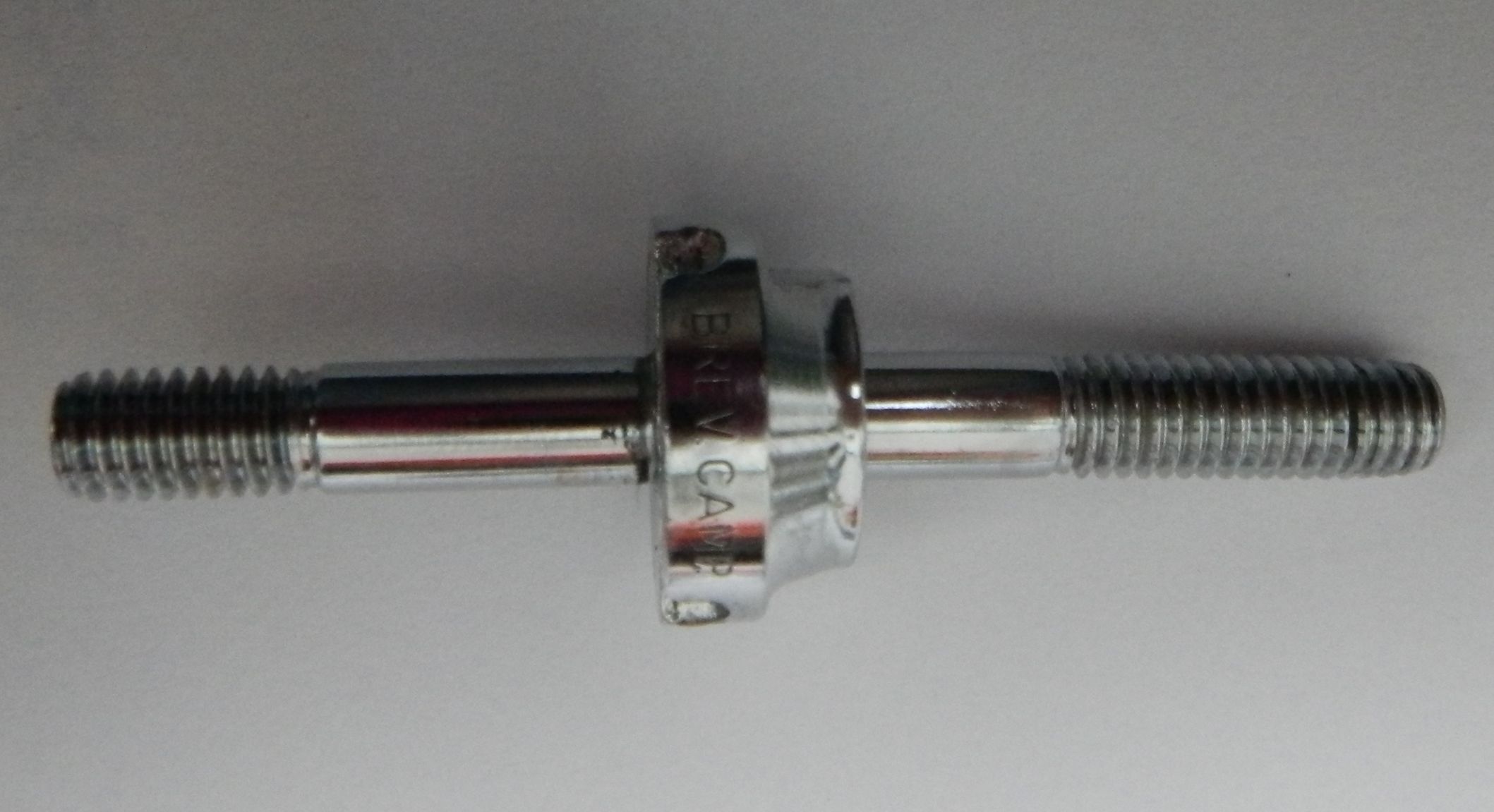
Eine der wesentlichen konstruktiven Veränderungen gegenüber der Chorus Version ist, dass der Achsbolzen nun fest mit der spitzen Mutter am vorderen Ende verbunden ist und der Federhalter abgeschraubt werden kann.
cj1b

cj2b

Abbildung 17:  Achsbolzen Chorus BR-02CH  unten und Athena BR-12AT oben im Vergleich
Quelle: Fotos des Autors 

Ebenso wie der Achsbolzen, ist der Bolzen der Bremszugaufnahme aus einem Stück gefertigt und mit einem Sprengring gesichert. Die Fixierschraube ist zum Öffnen mit einem 5 mm Innensechskant einer Außensechskantmutter für einen 9 mm Schraubenschlüssel ausgeführt.

In der Abbildung 18 ist eine weitere konstruktive Änderung gut erkennbar: Statt Lagern mit gebogenen Federenden, werden nun integrierte Aufnahmepunkte am Bremsarm mit geraden Federenden benutzt. Um die Leichtgängigkeit der Bremsen zu erhalten, sind die Federn mit Plastikenden umhüllt. Diese Form der Lagerung und des Federtyps wurde dann bei allen weiteren Versionen und Varianten der Monoplaner Bremsen beibehalten.


FED 1 Chorus

FED 2 Athena

Abbildung 18:  Federn und Auflager; Chorus C051/052 oben und Athena BR-22AT unten
Quelle: Foto des Autors

Es gibt drei weitere, kleinere Merkmale, an denen die Athena Version erkennbar ist: Zum einen ist unter dem Campagnolo Schild auf dem linken Bremsarm ist bei der Athena Monoplaner Bremse der Gruppenname „Athena“ aufgedruckt. Zum anderen wurden andere Bremsschuhe bzw. Bremsbeläge eingesetzt. Statt Bremsbelägen aus Gummiplastik die in Bremsschuhen aus Metall gehalten werden, sind nun Bremsschuh und Bremsbelag eine Einheit aus Gummiplastik (Typ SK3); die Befestigungsschraube wird in einen Metalleinsatz im Bremsbelag befestigt.

Die Bremsbeläge haben, im Gegensatz zu späteren Ersatzbelägen, Rillen die in unterschiedlichen Richtungen schräg zur Fahrtrichtung verlaufen und ein Muster von Dreiecken ergeben.

SCU 3 Athena

Abbildung 19:  Neue Bremsschuhe SK3 an der Athena Monoplaner BR-22AT
Quelle: Foto des Autors

Außerdem hat der Bremszugeinsteller keine Gravur „Campagnolo“.

Schwieriger ist es Unterschiede zwischen den Bremsenvarianten BR-12AT und BR-22AT festzustellen. Vergleicht man die Campagnolo Ersatzteilkataloge 1994 und 1995 so erscheint es, als ab bei der Variante BR-12AT Federn ähnlich der ersten Chorus Version CH051/52, also ohne Plastikenden und nach außen gebogen, verwendet wurden. Bei der Variante BR-22AT wurden dann wiederum Federn wie bei der Chorus BR-02CH mit Plastikhülsen an den Federenden eingebaut.

Das Gewicht der Athena Monoplaner Bremsen entspricht mit 275 Gramm fast genau dem Gewicht der Chorus BR-02CH Version.
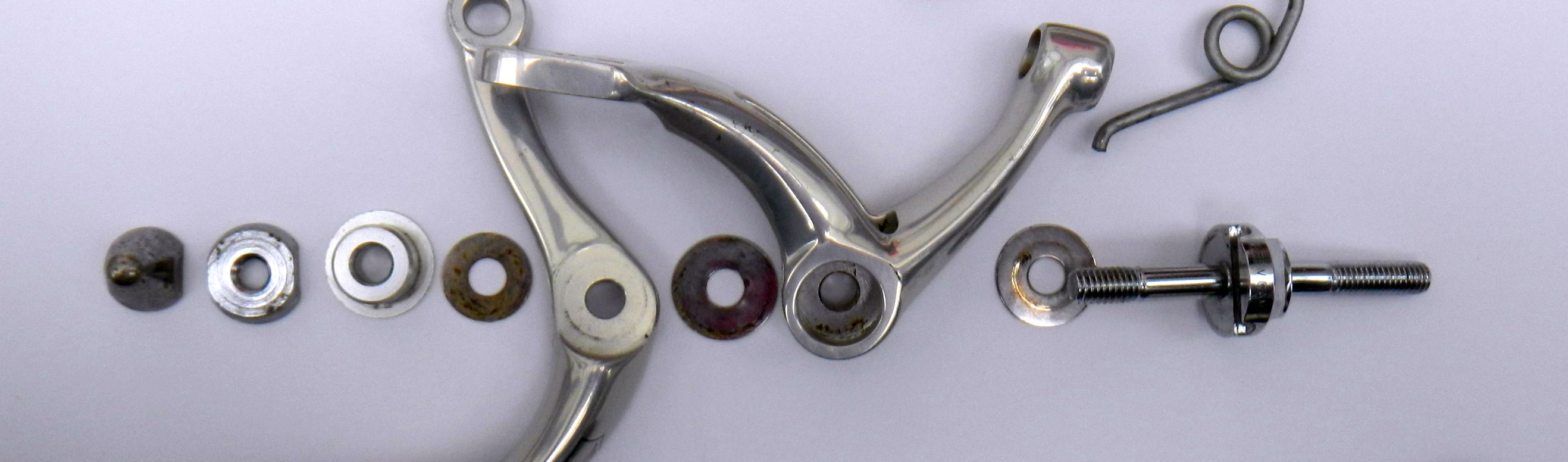
ch2b

Abbildung 20:  Aufbau der Athena  Monoplaner BR-22AT
Quelle: Foto des Autors

6. Merkmale der Veloce BR-12VL und BR-22VL Monoplaner Bremsen 1995/97

Von den Veloce Monoplaner Bremsen gibt es zwei Varianten; die BR-12VL, die 1995 auf den Markt kam und die BR-22VL, die diese bereits 1996 ablöste und bis zum Ende der Monoplaner Ära 1997 hergestellt wurde. Nachdem 1996 die Athena Monoplaner Bremsen ebenso wie vorher die Chorus Monoplaner Bremsen durch Zweiachsbremsen ersetzt wurden, war nun die Veloce Gruppe die Gruppe mit der höchsten Qualität, bei der noch Monoplaner Bremsen eingesetzt wurden. Record, Chorus und Athena Gruppen benutzen bis heute Zweiachsbremsen; dies setze ein deutliches Signal in der Käuferschaft für die Überlegenheit der Zweiachsbremsen gegenüber dem Monoplaner Konzept (Campagnolo Katalog 1995, 1996 und 1997).

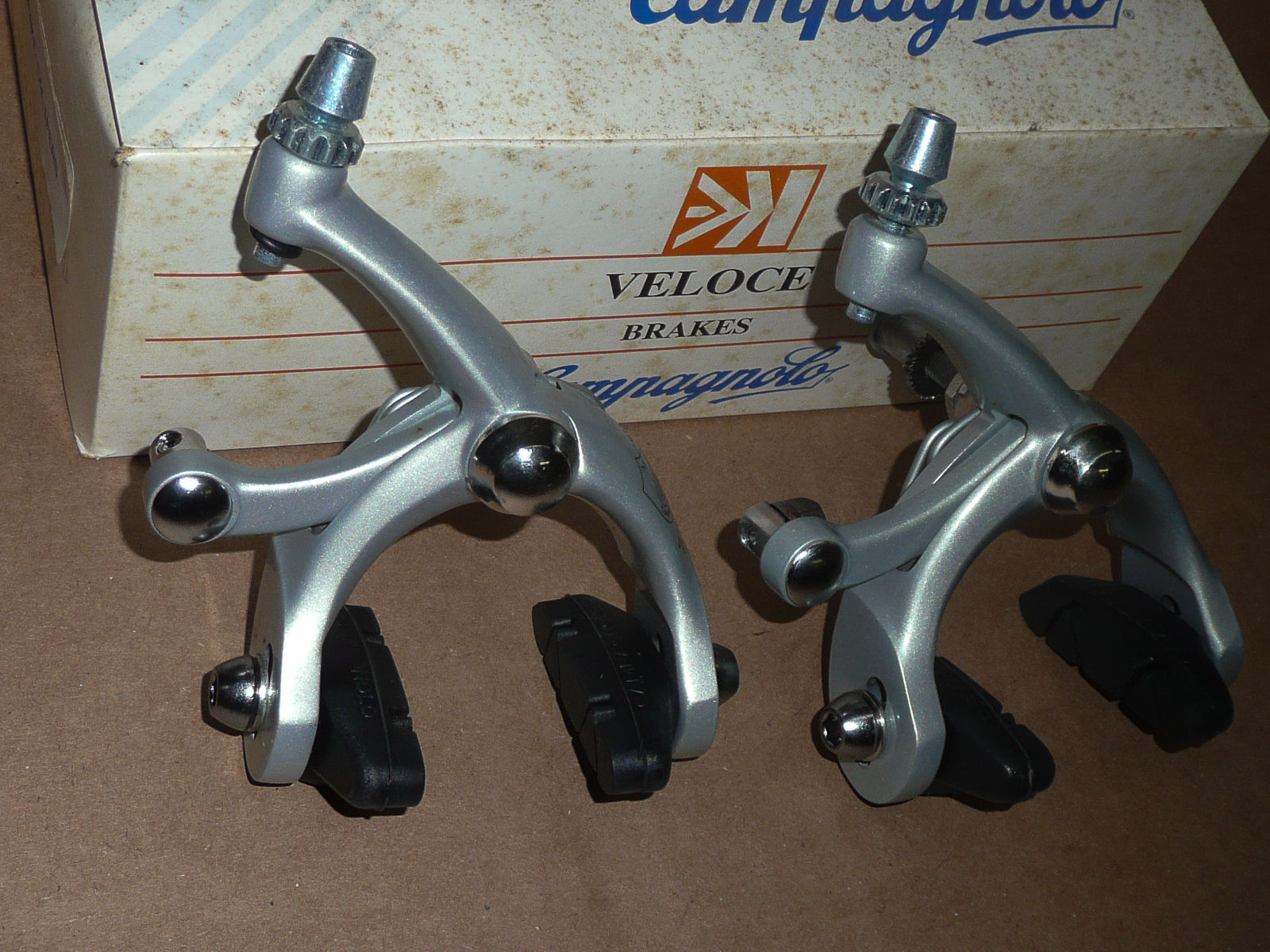
cl1b

Veloce Monoplaner BR-12VL

Abbildung 21:  Veloce Monoplaner Bremsen BR-12VL (unten) und BR-22VL (oben)
Quelle: unbekannt

Die beiden Varianten der Veloce Monoplaner Bremsen unterscheiden sich erheblich voneinander. Die erste Version basiert auf der Konstruktion der Athena Bremsarme und wurde im Vergleich zu dieser mit einer neuen Achsbolzenmutter vorne, einer neuen Bremzugsaufnahmenschraube und neuen Bremszugeinstellern ausgerüstet.

Die spitzen Muttern an Achsbolzen und Bremszugaufnahme kamen nicht mehr zum Einsatz, so dass ein Element des typischen Monoplaner Designs verloren ging. Anstelle der spitzen Achsmutter wurde eine kugelförmige Plastikabdeckung verwendet die weniger wertig aussieht.

Die Bremszugeinsteller mit schwarzen O-Ringen wurden durch ein geriffeltes Rad aus Aluminium ersetzt. Diese waren nun durch einen zusätzlichen kleinen schwarzen O-Ring, der unterhalb des Bremsarms platziert wurde gegen Herausfallen gesichert.

cl2b

Abbildung 22: Sicherung der Bremszugeinsteller durch schwarzen O-Ring an der Unterseite, Version BR-22VL
Quelle: Foto des Autors

Auf diese Art und Weise wurde ein Unterschied zu den höherwertigen Athena Bremsen des gleichen Jahrgangs „konstruiert“.

Ein Jahr später, 1996, wurden das Monoplaner Prinzip auch in der untersten Gruppe, der Mirage, eingeführt. In diesem Zuge kam es zu einer Neukonstruktion der Bremsarme, die dann von den beiden verbliebenen Monoplaner Gruppen, der Veloce und der Mirage übernommen wurde.

Die Bremsarme waren im Vergleich zu der Athena Version filigraner, mit weniger „Fleisch“ an den Aufnahmen der Bremsschuhe, dünner im Querschnitt und mit breiteren Langlöchern für die Aufnahme neuer Bremsschuhtypen versehen. Dies machte sich auch im Gewicht bemerkbar: Die Athena Bremsarme wiegen zusammen etwa 85 Gramm, die Veloce Arme der Variante BR-22VL hingegen nur noch 68 Gramm.

Die Bremsarme konnten die neuen Bremsschuhe der Record Gruppe aufnehmen, bei denen die Schraube im Bremsschuh integriert war und mit einer Innensechskantmutter 5 mm  an den Bremsarmen befestigt wurde. Dies erforderte die Verbreiterung der Langlöcher in den Bremsarmen.
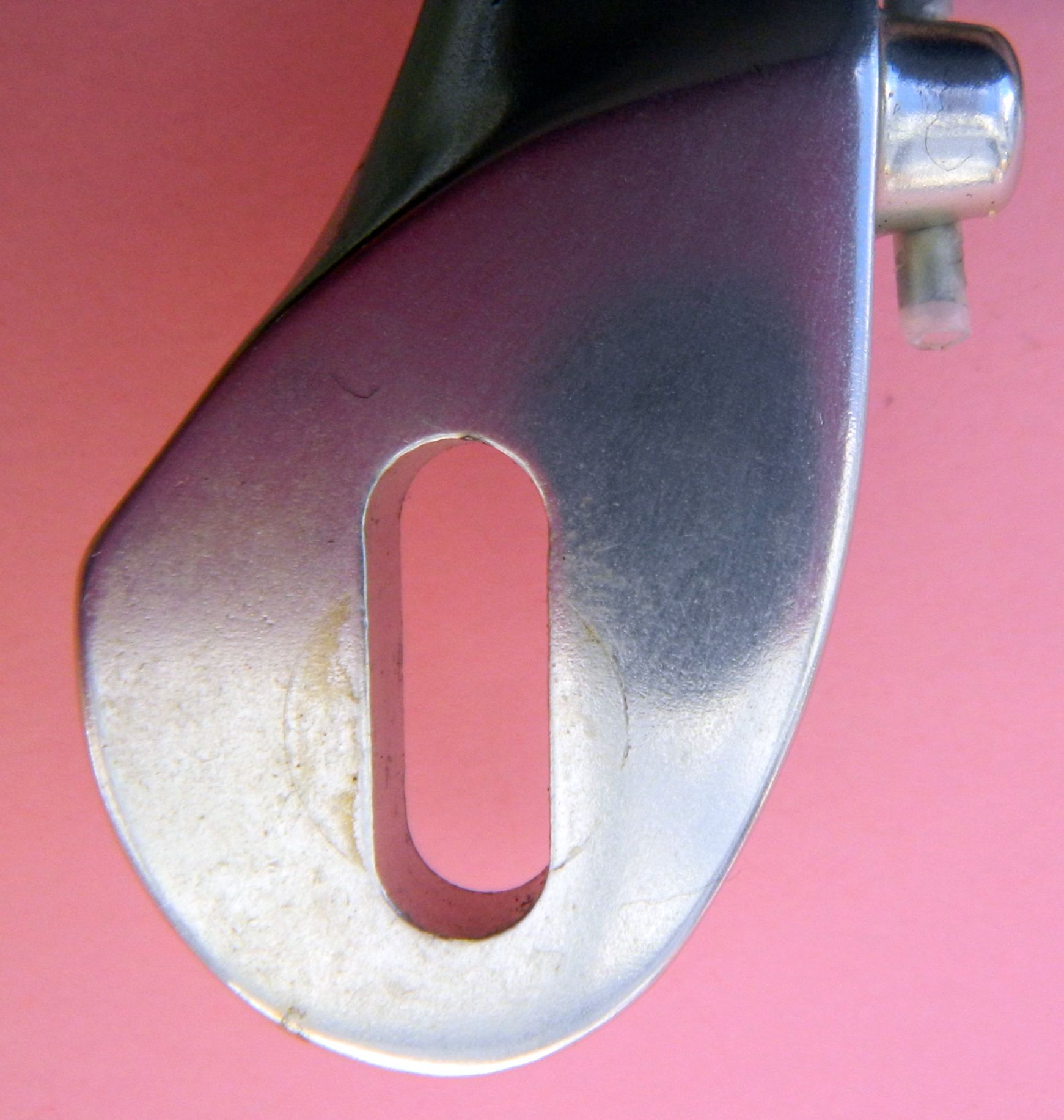
BAR 3 Athena

BAR 4 Veloce

Abbildung 23:  Vergleich Bremsarme Athena BR-22AT (oben) und Veloce BR-22VL (unten)
Quelle: Foto des Autors

Damit verloren die Veloce Bremsen BR-22VL das klassische Aussehen der Monoplaner Bremsen. Um einen Unterschied zu den Mirage Bremsen zu schaffen, wurden nun wieder die spitzen Muttern der Athena bzw. Chorus Gruppe  und deren Bremszugeinsteller mit schwarzen O-Ringen verwendet. Die Bremszugeinsteller haben einen länger gezogenen Hals, um der Aufnahme der Bremskabelhülle mehr Platz zu bieten.

Darüber hinaus kamen bei der Veloce BR-22VL neue Bremsschuhe zum Einsatz. Die Vollgummiplastik HP Beläge der Veloce BR-12VL wurden durch neue Aluminimumschuhe mit integrierter, kurzer Einfädelhilfe und abgerundeten Kanten, sowie vorne und hinten gerundeten Bremsbelägen aus der Record Gruppe ersetzt. Der Gesamteindruck ist insgesamt höherwertiger und näher an einer Athena Monoplaner Bremse mit Ausnahme der sehr filigran geratenen Aufnahme der Bremsschuhe.

Insgesamt wurden die Bremsen leichter, ein Paar der Veloce BR-22VL Variante wiegt nur noch 248 Gramm im Vergleich zu den 275 Gramm der Athena bzw. Chorus Version.

7. Merkmale der Mirage BR-12MI Monoplaner Bremsen 1996/97

Campagnolo Monoplaner Mirage 01 Abbildung 24:  Campagnolo Monoplaner Bremse Mirage BR-12MI
Quelle: Foto des Autors

Die Mirage BR-12MI Version der Monoplaner Bremsen von Campagnolo ist die letzte Version die auf den Markt gebracht wurde. Sie wurde zeitgleich mit der Veloce BR-22VL in den Jahren 1996 und 1997 angeboten (Campagnolo Catalogue 1996, 1997).

Im Prinzip handelt es sich hier um eine Kombination aus der Veloce BR-12VL mit der typischen kugelförmigen Plastikabdeckung vorne auf dem Achsbolzen, den Bremszugeinsteller mit geriffelter Scheibe, und den filigranen Bremsarmen der BR-22VL zur Aufnahme der Innensechkantmuttern der Bremsschuhbefestigung. Die Bremsarme der Veloce BR-22VL und der Mirage BR-12MI sind konstruktiv identisch und haben unterscheiden sich nur durch den jeweiligen Gruppenname Veloce bzw. Mirage auf dem linken Bremsarm  unter dem Campagnolo Schild (Campagnolo Spare Parts Catalogue 1996, 1997).

Im Gegensatz zu den Bremsen der Veloce BR-22VL wurden bei den Mirage Bremsen keine Bremsschuhe der Record Gruppe, sondern wieder Vollgummiplastik Beläge mit Metalleinsätzen, ähnlich wie bei den Athena Monoplaner Bremsen und der Veloce BR-12VL verwendet. Diese tragen die Markierung HPB Comp. in weißer Schrift auf der Außenseite und haben die charakteristischen Dreiecksmuster der Beläge.

cm1b

Abbildung 25:  Einzelteile der Monoplaner Bremse Mirage BR-12MI
Quelle: Foto des Autors

Mit 229 Gramm sind die Mirage Monoplaner Bremsen die leichtesten gebauten Monoplaner Bremsen.

7. Schnelle Identifikation der Monoplaner Versionen und Varianten

Anhand von zehn Merkmalen lassen sich mit einiger Sicherheit schnell die Versionen einer Monoplaner Bremse identifizieren. Dazu gehören Bremszugeinsteller und Bremsschuhe bzw. Bremsbeläge die einfach und häufig wegen Verschleiß ausgetauscht wurden. Aus diesem Grunde wird davon abgeraten diese Merkmale zur Bestimmung von Version und Typ zu benutzen. Ebenso einfach ist es den Gruppenname „Athena“ mit einem Felgenradierer zu entfernen und so eine „Chorus“ Monoplaner Bremse zu „erzeugen“. Sicherere Merkmales zur Identifizierung sind die folgenden:

+ Rollenlager zur Federaufnahme und filigrane Bremsarme: Chorus CH051/052

+ Rollenlager zur Federaufnahme und wuchtige Bremsarme: Chorus BR-02CH

+ Aufnahmepunkte für Feder und nach außen gebogene Federn, wuchtige Bremsarme:
Athena BR-12AT

+ Aufnahmepunkte für Feder, Federn mit Plastikhülsen, wuchtige Bremsarme:
Athena BR-22AT

+ Aufnahmepunkte für Feder, filigrane Bremsarme, Plastikabdeckung vorne
Veloce BR-12VL oder Mirage BR-12MI, nur am Gruppenname erkennbar

+ Aufnahmepunkte für Feder, filigrane Bremsarme, Spitze Mutter am Achsbolzen
Veloce BR-22VL

Eine noch sichere Bestimmung anhand aller Merkmale kann anhand Abbildung 26 erfolgen.

Campagnolo Monoplaner Project

Abbildung 26:  Einzelteile der Monoplaner Bremse Mirage BR-12MI
Quelle: Eigene Darstellung

8. Seltenheit und aktuelle Preise

Im Folgenden sind typische Preise für ein Paar Monoplaner Bremsen ohne Bremshebel angegeben (Stand Januar 2014). Die Preise orientieren sich im Wesentlichen an Angeboten auf Ebay.

Version

Chorus

Athena

Veloce

Mirage

Variante

CH051/052

BR-02CH

BR-12AT

BR-22AT

BR-12VL

BR-22VL

BR-12MI

NOS

120 € plus

100 € plus

80 € plus

80 € plus

Gebraucht, alle Teile Original

60 – 90 €

60 – 90 €

40 – 70 €

40 – 70 €

Gebraucht, teilweise Neuteile

50 – 70 €

50 – 70 €

40 – 60 €

40 – 60 €

9. Quellen

Campagnolo Catalogue 18 bis (1985): http://goo.gl/WXejiq

Campagnolo Chorus Catalogue (1987): http://goo.gl/EHMwuQ

Campagnolo Athena Catalogue (1988): http://goo.gl/ciD6i7

Campagnolo Dealer’s Part Catalogue (1988): http://goo.gl/oUOPki

Campagnolo Catalogue (1991): http://goo.gl/uL0FZx

Campagnolo Catalogue (1992): http://goo.gl/7oqInQ

Campagnolo Catalogue (1993): http://goo.gl/W7SpX3

Campagnolo Catalogue (1994): http://goo.gl/H8Lr2J

Campagnolo Spare Parts Catalogue (1994): http://goo.gl/crLvon

Campagnolo Catalogue (1995): http://goo.gl/RCsGiK

Campagnolo Spare Parts Catalogue (1995): http://goo.gl/Lf2Pag

Campagnolo Catalogue (1996): http://goo.gl/jdev8e

Campagnolo Spare Parts Catalogue (1996): http://goo.gl/0TD7U2

Campagnolo Catalogue (1997): http://goo.gl/KDBQ64

Campagnolo Spare Parts Catalogue (1997): http://goo.gl/wd6tng

Campybike Classic Era (2013): http://goo.gl/LLVhqd

Campyonly Catalogue Archive (2013): http://goo.gl/y4IvL4

Tears for Gears: Campagnolo’s Century Finish (2009): http://goo.gl/0F5Ypn

There is no I in cyclyng: Campagnolo Delta Bremsen (2012) http://goo.gl/S2C02q

Velobase Shimano BR-6207, 600EX (2007a): http://goo.gl/973OBI

Velobase Shimano BR-7300, Dura-Ace AX (2007b): http://goo.gl/AIyJIT

Velobase SunTour CB-3600, Superbe Pro Short Reach (2007c): http://goo.gl/2wtKIa

Velobase Shimano BR-6208, 600EX (2008): http://goo.gl/hk8wc9

Velobase SunTour CB-8100, Cyclone (2009): http://goo.gl/OBJII2

12 Kommentare

Eingeordnet unter 2014, Bits&Pieces, Mob, Moderne Klassik

Rigida Nova Aufkleber

Rigida Nova Aufkleber

Sind übrig und liegen seit langer Zeit in der ganz, ganz tiefen Kiste. Wer seine Felgen damit aufwerten möchte, bitte gerne ich schicke die kostenlos zu.


Hinterlasse einen Kommentar

Eingeordnet unter 2014, Bits&Pieces, Mob, Sales

Blogging 2014

tumblr_mubetqnkG51ryedguo1_1280


Lustigerweise bekomme ich heute über 1.000 Hits auf diesem Blog, weil ich vor Monaten einmal über Martin  Kuhn, einen verrückten Deutschen, der mit einem alten japanischen Rad völlig naiv quer durch Japan gefahren ist gepostet habe. Um das gleich richtig zu stellen: Ich beneide Martin Kung für seine Naivität und die Möglichkeit Japan das erste Mal zu entdecken. In der Zwischenzeit ist Martin Kuhn so etwas wie eine Mini-Medienstar in Japan geworden und heute hat jemand drüben irrtümlich gepostet, dass dieses Blog das Blog von Martin Kuhn ist. Danke, aber falsch.

Das hat mich allerdings dazu gebracht einmal über das bloggen an sich nachzudenken. Ich habe „There is no I in cyclyng“ im Februar 2013 abgefangen, auf die Idee brachte mich eine Unterhaltung auf facebook:

„There is no I in happyness!“

„Well, there would be, if you spell it right.“

In den letzten zwei Jahren habe ich fast täglich meinen Reader (zunächst Google, heute feedly) auf bloggenswerte Beiträge im Netz gecheckt, das hat Spaß gemacht und ich habe viel gesehen und gelernt, insbesondere im Aufbau klassischer Räder. Aber es hat auch sehr viel Zeit gekostet. Und heute hat sich da eine gewisse lieblose Routine eingestellt, es gibt immer weniger was ich bloggenswert finde , nach über 2.300 Posts ist das auch nicht verwunderlich.

Zeit also 2014 etwas daran zu ändern. Ich werde weniger bloggen, nicht mehr jeden Tag etwas posten und mich darauf konzentrieren eigene Beiträge zu posten und nicht vom Netz zu re-bloggen.

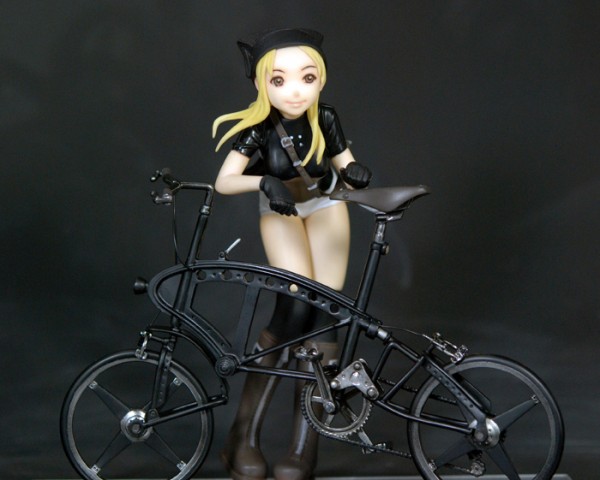
Zum Abschluss hier eine Sammlung wunderschöner Anime Figuren zum Thema Rad aus Japan.

1347434102_11030_Steins1

FIGURE-000105_01

lrg168053_0_1228511

Hinterlasse einen Kommentar

Eingeordnet unter 2014, Mob, Sex. Lies & Vids

Schnellster Blogpost jemals: Fixed Beards Bremen Neujahr 2014 Absacker Tour

So, und schon fertig. War ’ne Supertour, danke an Silke, Sebastian, Olli und Jörg. Konnte kaum das Hinterrrad halten.

1401 Fixed Beards Bremen Absacker RideÄh was, ihr fahrt noch?

Jahresrückblick

Hinterlasse einen Kommentar

Eingeordnet unter 2014, Bremen, Joerg, Mob, Olli, Silke, Touren

#Festive500: Day 7: The End of Bremen

4_4b38608cc6

Somehow, I couldn’t resist the urge. Blue skies outside, on the bike and go. Another 50km. And that’s it definitely.

So I could bring up the total to 614.61 km, which looking at Strava right now (12/31 17:21h) would place me in 49th place in Germany (out of 693 participants) and in 738th place globally (out of 26,208 participants). Not too shabby, provided that nothing unreasonable will take place during the next 72 hours until all results are uploaded. Well, it „would“ place me there, but as all my distances are manually uploaded and not supported by any hard GPS evidence the excercise is fruitless in this respect.  So I will rely fully on Phlipp, who finished well above the 500km mark as well.

1312 Festive500 Day07 02

I didn’t want to go for a long ride, however I wanted to explore some new roads. So I started at the Weser barrage and went downstream on the embankment on the left side. Not too many people were ot today, but I met one guy on a CX bike with a very nice beard and quite impressive 3/4 length bib shorts.

1312 Festive500 Day07 03

After passing Dreyhe I was basically lost as I had neither maps nor  a GPS with me. I tried to find mey way through some of the smaller roads along the embankment. After almost 30km I was desperately looking out for a bridge to pass the river Weser. Finally, just right after Thedinghausen I could finally cross the river in direction Achim.

1312 Festive500 Day07 04

Rivercrossing at the road between Thedinghausen and Achim, looking downstream….

1312 Festive500 Day07 05

…and looking upstream.


I made much more km than I intended to do, I now tried to ride back to Bremen as quickly as possible. I had a nice tailwind that allowed me to stay in the 30 – 35 km/hr bracket all the time, if not for the urban sprawl of Achim, Bremen und everything inbetween. But finally I almost made it home when I met Silke.

1312 Festive500 Day07 06

Silke, except for the „Victory sign“

Silke was on her way back from BOC where she bought some new cycling stuff. I hope I will see her and many others again tomorrow at 11:15h at the Weserbank when we will have our Hangover 2014 Tour.

Home. Over. Legs alone won’t do it in 2014. I decided I need some more propulsion

1312 Rocket man


I wish you and your families the best of Health, Happiness and Prosperity in 2014. Have a peaceful and enjoyable year of the Horse. 

Hinterlasse einen Kommentar

Eingeordnet unter 2013, Bremen, Mob, Touren

#Festive500: Day 6: Southeast of Bremen

festive-500-banner-01

„One more and last time“, I thought when I jumped out of the bed. But there is always a next time, or „After the game is before the game.“

Most wonderful day today in Bremen. Almost like Japanese winter. Cold, blue skies BUT very strong wind from the Southwest as usual these days.  I went to the Post office first to pick up a saddle for my new Moser Leader AX bike. Almost ready, except for the saddle and the handlebar tape. The guys from Ireland send the wrong saddle. Too many Murphy’s before Christmas I guess.

Long lines at the post office prevented my to arrive in time at 11 AM at the Haus am Walde, but I guess nobody wanted to come anyway, so I started on my own.

1213 Festive500 Day06 01

I made my way into Blockland, then further on towards Borgfeld. I then decided to ride in direction of Oyten against heavy crosswinds and over some dirt roads along a railroad track. After a while I was back in common waters and arrived at Fischerhude. enough experiences for the day, I thought and rode to Wistedt, always a nice bet for some fast roads and a good tailwind. And more or less precisely after 499 km I arrived at a gas station of mild fame in Wistedt. This is where I will stop, I thought, because I decided to refuse to ride 500 km in protest of the regulations of the Festive500 that do not allow manual Strava uploads.

1213 Festive500 Day06 02

1213 Festive500 Day06 03

I got off my bike, called my wife and asked her to pick me up as under no circumstances I would add further mileage on the bike. She said „Sure, wait and see“ and so I waited. After a while I became a little bit nervous and called her again to ask her where she is. She told me then „Oh, did you really thought that I will pick you up?“

So despite my refusal I was forced by fate to continue to ride. I made some mor eloops in the area in direction Worpswede and then returned on the left side of the river Wümme to Bremen. I arrived after many kilometers at one of my favourite places in Bremen, the kiosk „Yellow peril“. Here I had a big party with one Snickers to celebrate my achivement.

1213 Festive500 Day06 05

Surely it would have been nicerif anybody else would have been there, bit so what. Perhaps I can do another loop toomorrow? So far 563.8 km.

DSCN4315

Hinterlasse einen Kommentar

Eingeordnet unter 2013, Bremen, Mob, Touren

#Festive500: Day 5: West of Bremen

festive-500-banner-01

Yesterday was a rest day. I rode only 4 km to the closest Irish pub, had a drink with cycling friends and returned home …somehow… luckily I didn’t had a GPS device with me, that would have shown some circles on a map. 

We had some Guiness and a sort of semi-serious drinking. So naturally I woke-up late, needed to do some errants for the fanily and could only start a quarter to one, which is basically in the dusk during winter in Bremen. Being certain that I would not arrive back home during daylight hours, I fixed some lights on the bike and started in direction of the Weser barrage. The cloud-making facilities were pumping out clouds like it would be the last day on earth.

1312 Festive500 Day05 02And the result was a weird mix of thick rainclouds, blue skies and some beams of sunlights making it through.

1312 Festive500 Day05 01 We all know that culture influences languages, Germans have words that hardly translate into other languages like „Weltschmerz“ or „Verschlimmbessern“; so do the Japanese with „binmyo“ or „mabui“ and also the English and Americans or the French. Now I have run out of languages I have any idea off. Douglas Adams wrote somewhere, that

Eskimos had over two hundred different words for snow, without which their conversation would probably have got very monotonous. So they would distinguish between thin snow and thick snow, light snow and heavy snow, sludgy snow, brittle snow, snow that came in flurries, snow that came in drifts, snow that came in on the bottom of your neighbor’s boots all over your nice clean igloo floor, the snows of winter, the snows of spring, the snows you remember from your childhood that were so much better than any of your modern snow, fine snow, feathery snow, hill snow, valley snow, snow that falls in the morning, snow that falls at night, snow that falls all of a sudden just when you were going out fishing, and snow that despite all your efforts to train them, the huskies have pissed on.“

I wonder why in Bremen we do not have about 200 different words for „rain“ or „clouds“. It would make our conversations so much more interesting.

I continued along the Weser until I reach Riede and then I took a turn west in direction Okel. Although the weather is mostly dry this winter, the wind is very strong and almost always blowing from the West or the Southwest. I like riding out against the wind, for me it feels like winding up an old-fashioned toy. It is slow and takes some efforts on the one hand, but on the other hand it feels also like storing energy, like a wind-up toy car that is ready to release its power at any given time on the way back home. I was now on the same roads as with Jörg and Olli some days ago. I hesitated for a moment to go all the way South towards Bruchhausen-Vilsen and get some strawberry cake at the bakery with the tatooed lady; but as darkness approached fast I decided to ride towards Syke, then crossed the B6 and continued to Nordwohlde. There were almost no cars on the roads and no people to be seen today. Beautiful, a rarely experienced tranquility was in the air today. Many cars were parked in front of the local restaurant or pub in the small villages, so I guess that  families and couples decided to go out for lunch after all the preps with Christmas.

My original objective for the day was Harpstedt but I didn’t felt like riding down to Bassum on the rather ugly B51 (one worse than B52) and so I just headed straight on. I came now on a „rindo-like“ road (rindo: jap. forrest road, off limit for public traffic) that led me somewhere, I assuming it would be Harpstedt.

1312 Festive500 Day05 03

Hm, or perhaps not. The road continued forever and was going rather in the general direction of Bremen. I was suddenly then on the Bremen-Osnabrück cycling road. I heard about that one, basically to the effect that it is hardly approriate for roads bikes; but the stretch I was on was OK and continued to an old sand excavation site and then further on to Heiligenrode.

1312 Festive500 Day05 04Look mum, no hands!

With a strong tailwind I flew home now but decided to make a small detour to Delmenhorst. There was only an ugly, big road and after the experience silence before it was rather nasty. There is nothing charming in Delmenhorst except Karin and Torsten. Oh, and perhaps the blond girl that Torsten saw one day was from Delmenhorst as well. Luckily there were some gas stations open so I could refuel and take a look at my now rather really, really dirty bike.

1312 Festive500 Day05 05

1312 Festive500 Day05 06

So far, so good. Everything is working fine. I am really glad that I tuned the gears before starting the Festive500, shifting is now smooth again. I am afraid although that my white Tacx derailleur sprockets are not that white any more. I need to check, but it is hard to see with all the dirt. From Delmenhorst I took the old road through Kattenturm and the GVZ and then I was back at the main station. Soon the Bremen Sixdays will start again.

1312 Festive500 Day05 07

The sport program looks all right, but the music program includes everything which makes one running away as quick as possible. Here are some examples to let you experience the full impact of German „Schlager music“ presented at the Six Days.

This seems to be harder to take than riding for example 500 km between Christmas and New Year’s eve. Last year was equally worse. I saw my old teenage idol Suzi Quatro on stage.

Actually, she has changed a bit, just like me, compared to her heydays during the Seventies.

But this is still not the worse. Does anybody remember Beatrice Dalle, of „Betty Blue: 37.2 degrees in the shade“ fame?

That was one of the most romantic and sad movies I have ever seen. I will probably think different about this movie today, so I refuse to see it again or read the book. I would like my memories to be untouched by reality. So please don’t click here to take a look at Beatrice Dalle today.

Glad you could resist. This brings me to another story, which will be the last one for today. You all probably heard of the famous tale of the brother Grimm about the Town musicians of Bremen. They are on display close to the market place and we can see four animals standing on each other, with the donkey at the bottom, followed by the dog, the cat and the rooster. Right, isn’t that strange? I mean, these four animals are not well known for exceling in any kind of music. A donkey musician? You must be kidding? It is a not well known fact, that in the beginning the town musicians had five members, including an elephant. Actually the elephant was the most sophisticated musician in the band and he was as skilfull as Miles Davis playing the trumpet when blowing his beak. That was precisely the reason why the donkey and the other untalented animals hated him and threw him out of the band. Luckily the good people of Bremen haven’t forgotten about the elephant and errected a nice monument close to the station.

1312 Festive500 Day05 08

This is one of my favourite places in Bremen. Actually the monument is much bigger than the one of the town musicians which should bring things into perspective.

In the end I extended my loop into the Blockland and was home after some 90 km. More than 451 km done, 49 more to go.

1312 Festive500 Day05 09

Hinterlasse einen Kommentar

Eingeordnet unter 2013, Bremen, Mob, Touren

#Festive500: Day 4: Wind and Thorben

Today was very windy. And there was Thorben.

Who dragged as all the way. We made a shorter Loop through the Blockland then to Ritterhude, taking in all the mountains that Bremen has to offer.

1312 Festive500 Day4 01

Phlipp is doing a fixed festive 500 with 48/12 gearing and massive sails aka as high carbon rims.
1312 Festive500 Day4 03

Col de Sandberg at Worpswede.

1312 Festive500 Day4 04

1312 Festive500 Day4 05

Hinterlasse einen Kommentar

Eingeordnet unter 2013, Blitzrad, Mob, Touren

#Festive500: Day3: Il trio infernale

4_4b38608cc6

Day 3 of the Festive 500, this time as trio infernale.

Today, as usual, unfriendly skies but at least the weather forecast promised that it will stay try until lunch at least.

1312 Festive500 Day3 08Well, at least finally, I was able to find the place in Bremen where all the clouds come from. There seems to be a very big „cloud making factory“ located next to the river Weser operated by SWB. It was fenced off heavily from its surroundings and guarded by grim looking security men. I guess that inside the factory many workers are toiling day and night to produce these fine looking, grey clouds, soaked with condensed water that the inhabitants of Bremen have becoming so fond of. Good works guys, please keep it up.

1312 Festive500 Day3 06I was off to a comparable early start to meet Olli and Jörg and the famous Weserbank. The Weserband is one of the few banks in Germany that came through unharned by the world financial crisis of 2008/09. It is a very old bank and during this time of the year also very cold. I refrained from entering the bank and aimlessly rode around until the others arrived as I was afraid that I will freeze into a solid statue of ice and will then not be recognized by the others. Temperatures were hovering between 2 and 4 degrees. But here they were and we proceeded South towards Bruchhausen-Vilsen. It was nice not to be alone on the road for a change and we shared many stories about family adventures with the family. If I remember correctly the main tone of the conversation was, that all of them are an unthankful bunch that does not appreciate our beautiful presents. I mean, it is not that we presented them with wrenches, screwdrivers or Campagnolo cassette removal tools; although Olli came closest with a bike lock. Generally I had the feeling that all of us were happy to be united on the road again, chatting with people who really understand each others topics of conversation. I confessed that due to the clever marketing of Strava I am inclined to buy a GPS device and was told that my best choices would be some rubbish device from Conrad electronic store for 30€ or a Garmin 800 for about 10 times the amount. I am still considering. And while we were talking we didn’t realized how time flew by and in no time we were in Paris as evidenced by this photo.

1312 Festive500 Day3 02 and then, as we were in good mood we continued, just like Tom Hanks continued to run in „Forrest Gump“ and in no time we were in Berlin, as we can see in the next photo.

1312 Festive500 Day3 05In the forefront we can see some remains of the Berlin Wall that haven’t been removed yet. So now it was time to say goodbye and we continued on different ways home to our loved ones. I felt good on the bike for the first time during the Festive500, my legs were a little bit more lowerful than the first two days. And so I thought that I can do some extra miles. So when I reached my home I just continued to the HaW and then to the Blockland in direction Dammsiel. Yes, this road is very boring but at least I know where it takes me and what do expect. There were quite some cyclist making out there and I saw at least three guys on racing bikes with huge beards that would qualify them handily for a place in the Fixed Beards Bremen team. Then I rode back on the other side of the river to Lilienthal and there, much to my surprise I met Philipp. He was just on the way back from a party close to Lueneburg on his Fixie: 48/12 gearing, skyhigh carbon rims, quite impressive I must say. We continued for about 3 km and then we agreed that we will meet again tomorrow to put in some additional kms. Philipp is also attending Festive500 and, much to my delight, told me that he is not interested in the T-shirt, so I might have find a way to get around all the fuss and lay me hands on this thing.

Today I rode about 105 km, bring the total to 266, so only 234 more to go at least. But I must say, I quite got used to that rhythm of riding by now, so I might continue also for the next days with shorter stretches, weather permitting. And apart from the agreed ride tomorrow, we will have a pub meeting on Saturday and perhaps an new year inaugural ride on January 1st. So there are really some things looking forward to.

1312 Festive500 Day3 10My bike, dirty as usual.

1312 Festive500 Day3 09More clouds in the making.

1312 Festive500 Day3 07


Ein Kommentar

Eingeordnet unter 2013, Blitzrad, Joerg, Mob, Olli, Touren

#festive500: Day 1: Prologio

4_4b38608cc6

Today was day 1 of the Rapha Festive 500 to which I have submitted myself at free will. As this blog entries are intended for the greater Rapha Festive500 community I dare to write them in English an not in my German mother tongue. 

The night before I tried to think of an appropriate slogan for the first day and came up with the wonderful idea of naming it „Prologio“, which is Italian for „Prolog“. I found this nice enough as I didn’t want to overdo it on day one, just like the pros at the Tour de France have a rather easy day before they start for some grueling three weeks in earnest. Also, I wanted to add some nice Italian touch to emphasize the fact that about 50% of my DNA comes from this great cycling nation in the South. The fact that this particular part of Italy was only annexed in the course of WW1 and that my mother doesn’t speak any Italian at all can be safely neglected here.

The skies over Bremen had the typical look of skies over Bremen between October and April: Grey, full of condensed water, to be released any given minute and threatening as usual.

1312 Festive500 Day1 06

Neverthless I mounted my bike and started in direction East, Fischerhude to be precise. I made good progress at the start which I unfortunately related to my superbe form which is steady, even I just recovered from a nasty flu and hadn’t done any three digit km tripe for quite a while. Of course I wasn’t in good shape, there was just a strong wind with occassional gusts that propelled me forward in no time. From Fischerhude I moved onwards to Wistedt and passed the fateful gas station where last summer our Bremen cycling group divided into two fractions after a bitter ideological debate about the Vietnam war. Nevermind, I thought, what else happened cycling-wise in 2013? Well, the year started very well with a nice cycling holiday with david and Juliane on Mallorca in March. After that I felt ready for bigger adventures (RTF Sulingen) and the „Eagle round“ in the mountains of the Harz where I adopted a new training technique called „short seatposted“. I didn’t do any races this year with the exception of the 20km time trial at the City Traithlon in Bremen, but I spend a wonderful holiday with my family in Oberstdorf where I climbed up the Riedberg three times getting better and fast every time. Then I was ready for the event of the year, the Positivo Espresso high altitude training camp in the Sierra Nevada. The highlight was the climb up to 3.000m plus of the Pico Velato with David, david and Juliane. After that I basically stopped cycling for the rest of the year with the exception of some nice trips around Osnabrück. But now I was fully motivated again to put in the missing mileage until the end of the year.

It was still dry so I decided to extend the loop a little bit in direction Adolphshausen (before WW2: Adolfshausen).

1312 Festive500 Day1 02

From there I moved on to Worpswede. It had started to drizzle by now but I decided nevertheless to go ahead. Worse than the drizzle was the very powerful wind which slowed me down sometimes to speeds of less than 20 km/hr. I also felt that I hadn’t overcome the flu yet, it was hard to get the heart beat even up to 150 BPM. But when I came to the next junction to shorten the trip I decided again to take the longer way home and continued in direction of Ritterhude. Much to my surprise the bridge over the river Kwai, or whatever the name is, is now almost completed after endless years of construction and the old bridge is in process of getting demolished. Although unknown, this bridge is in terms of construction delays far more significant that the new airport in berlin or the train station S21 in Stuttgart.

1312 Festive500 Day1 05I was so happy to see this happening after passing the construction site on foot for what.. three years in a row now? This gave me back faith in German engineering power.  I turned back in direction Bremen on the left side of the river Kwai. Now the wind was really nasty and in addition it became wet. My feet were now soaked in water and slowly I felt that I will become very, very wet if I don’t speed up. The road was by now thick with water and many puddles. As the last part of the road is anyweay a slimy mix of bricks I didn’t felt too much secure on the bike.

1312 Festive500 Day1 03

And then I was home after about 80 km and more than 3 hours of riding. The average speed is of course miserable but I was very happy that I started on the first day of the callenge nevertheless and that I did already 16% of the total. So 420 km more to go until Dec 31st.


1312 Festive500 Day1 09

My bike was rather dirty after the ride. I shall refrain from cleaning it at all, it will be nice to make a picture of it every day at the end of each ride to note the subtle change in color.

1312 Festive500 Day1 08


5 Kommentare

Eingeordnet unter 2013, Bremen, Mob, Touren